
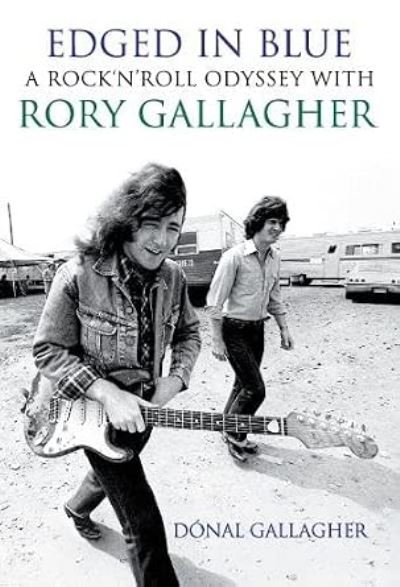
* WARNING – THIS REVIEW CONTAINS SPOILERS*
Of all the questions Dónal Gallagher has been asked over the years, surely the most frequent is, “When are you going to write your own book?” Rory fans have long hoped to hear the story of his life told from the perspective of his beloved brother and manager. So, it was music to my – and I’m sure everyone else’s – ears when, at a Q&A in Ballyshannon a few years ago, Daniel Gallagher confirmed that his father was finally pooling together his many notes and memories to produce the long-awaited (auto)biography.
Almost four years on, I’m delighted that Edged in Blue: A Rock ‘n’ Roll Odyssey with Rory Gallagher is out today. I was lucky enough to have had early access to the manuscript well over a year ago and was given the exciting task of copyediting the final version, which felt like an enormous privilege. Having read it thoroughly at least five times(!), I can assure you that it delivers on everything we hoped for from Dónal’s book – and more.
First and foremost, one thing to make clear is that Rory’s story is just as much Dónal’s. He was by his brother’s side throughout his entire life, sharing the highs, lows and everything in between. Early in the book, Dónal writes, “I was just content to be along for the ride.” He says this in reference to moving from Derry to Cork, but it could just as easily serve as a mantra for his pre-destined role. Much like Vincent Van Gogh and his brother Theo – the confidant, the patient companion, the tireless supporter – Dónal’s presence was not secondary but essential to the unfolding of Rory’s life and career. The book reinforced for me just what an absolute godsend Dónal was to Rory, and how much we owe him for looking after his brother, both professionally and personally.
It couldn’t always have been easy. Dónal admits that it still stings that some band members claim the brothers were always squabbling – and it’s clear that Rory could be stubborn, demanding and set in his ways. Yet Dónal always tried to act in his best interests and carried the weight of responsibility for everything. While Rory could lie in after a late-night show, he was up early, making preparations for the next gig and ensuring everything ran smoothly. So smoothly, in fact, that many people, including Rory himself, probably didn’t even realise the full extent of what he did behind the scenes.
Dónal was also expected to respond at a moment’s notice when Rory suddenly sprung things on him, like arranging last-minute visas or neglecting to mention the filming plans for Irish Tour ’74. And, of course, Dónal was the one left to clear up any mess. For instance, when guests at the Irish Tour ‘74 after-party got into trouble with the Gardaí, he spent the night shuttling between the police station and the local infirmary trying to sort it out.
I totally respect Rory for being his own man and sticking to his guns, but your heart does go out to Dónal at times when he tries to guide him as a manager but ultimately, as the younger brother, has to defer. Whether it’s Rory refusing to cut short a US tour to accept his Melody Maker “Best Guitarist” award, telling Dónal not to accompany him to Rotterdam to jam with the Rolling Stones or that infamous moment when he threw away his new record just as Dónal was about to deliver it to Chrysalis. But one story in particular really emphasised how Dónal bore everything with patience and grace: returning from a US tour in 1991, they were stuck at customs with guitars Rory had picked up on the road. Worried about his brother’s health and his need for rest, Dónal sent Rory on home and resigned himself to waiting there for hours to complete the paperwork. “There goes my planned Easter Monday with the family,” he thought.
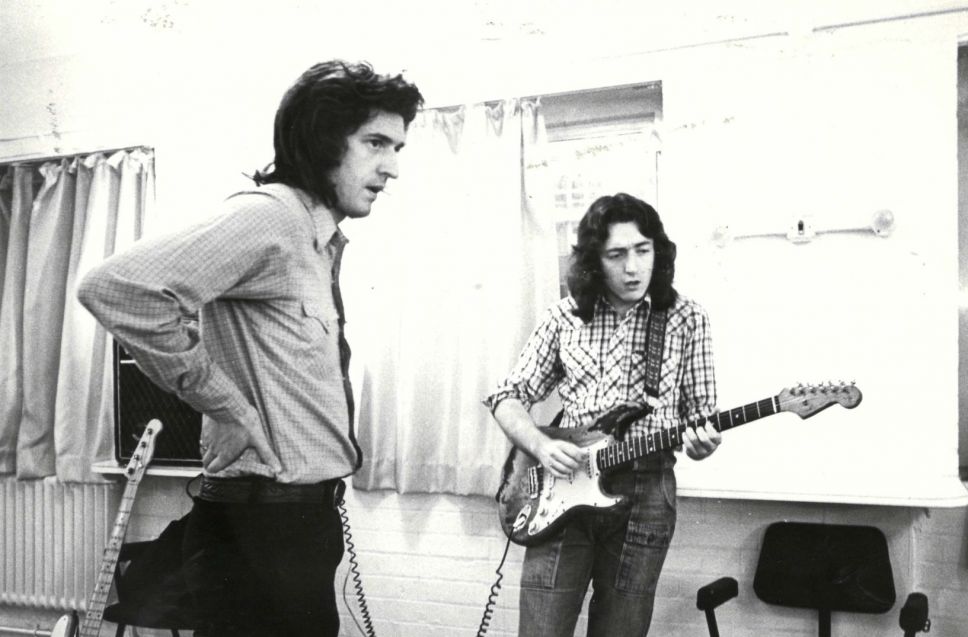
My absolute favourite part of the book is the opening chapters covering the boys’ early years. For the first time, we get a proper insight into family life and the challenges surrounding their parents’ relationship and, ultimately, separation. There was so much toing and froing between Cork, Derry and even across to England, creating real upheaval for the boys. I felt for poor Rory, often left behind with his grandmother. There’s an adorable story of him waiting at the port with her for his mother’s arrival. When his grandmother spots her, she utters, “Look, there’s Mona!” to which Rory replied, “That’s not Mona Lisa – that’s my mammy!” We also get many sweet childhood stories, such as the brothers’ antics with their pals Barry and Jerry when preparing for JFK’s visit to Cork or a prank they pulled during the Cork International Film Festival.
Other familiar tales – such as the original Gallagher Brothers’ onstage squabble, the ‘Living Doll’ incident and Rory purchasing the Strat – are told with fresh relish, thanks in part to the support of co-author Jamie Dickson, editor of Guitarist magazine. I smiled at the story of Mona wanting to take a photo of the boys with Rory’s new purchase, only for Rory to get stroppy, insisting that the Strat was his and Dónal couldn’t touch it! Eventually, he allowed Dónal to hold his acoustic, which appears in a beautiful photo, taken on the roof of their grandmother’s bar on MacCurtain Street.
What also really comes across is what an incredibly brave, strong and wonderful woman Mona was to leave her husband in 1950s Ireland, then put all her faith in Rory’s talent and support him, even when money was short. But we also see a different side to Danny that challenges a lot of the speculation and misinformation written about him over the years. The shadow of Rory’s father, in fact, lingers throughout the book, no more so than in a moving yet haunting anecdote from Rory’s later years. While playing with accordion ace Geraint Watkins, Rory pulled out a photo of Geraint and one of his father, placed them side by side and said, “Now who would that remind you of?” He believed there was an uncanny resemblance between the two men. As Dónal notes, “I think it kind of spooked him: it was like having the ghost of his father playing beside him on stage.”
I also loved hearing about Dónal’s own pathway into music, as we rarely get to hear that side of the story. We learn about all he did while Rory was in the showband and then off to Belfast, with Dónal simultaneously making a name for himself in Cork as a DJ, organising local events alongside studies at Crawford Technical College. His own youthful capers with his friend Tadg Kidney are hilarious, from running the Crypt Club with an actual coffin that guests were put inside (which got them shut down by the police) to trying to quell a riot that broke out at a club in Youghal. Dónal would go on to hitchhike all the way to Belfast to be with his brother, after which he never really left his side again. From this period, we get a wealth of tales about Taste: the kindness of John Peel, the disaster of the 1968 Kempton Park Racecourse festival, clashes with Eddie Kennedy, witnessing the last-ever Cream group hug and the disastrous Blind Faith tour.
The chapters on the 1970s, which make up a large bulk of the book, show the savage pace at which Rory was working – a pace that everyone else was expected to match. There were no holidays, with up to 300 gigs a year and the time in between often spent in the studio. It’s no wonder that relationships took a backseat while living on this relentless treadmill. As Dónal makes clear:
[Rory’s] whole life was shaped by the desire to have no distractions from music – absolutely none whatsoever. Right from the start of his career in Cork, the girls adored him and he could have taken his pick, but his intense devotion to music had, dare I say it, a priest-like quality. He might as well have taken the same vow as the clergy did. In that sense, music literally was his vocation.
Dónal takes us through so many incredible anecdotes, my favourites being those on the road in the US, such as the pranks of Rod Stewart and the Faces, Canned Heat and Rory playing Howlin’ Wolf together all night after hearing of the bluesman’s death, and the absolutely wild Bull Island Rock Festival in 1972. There are also great memories of Rory’s unforgettable annual concerts at the Ulster Hall, as well as a real sense of the dangers he was willing to face to play in Belfast – like finding razor blades in his pockets or one particularly hairy journey back to Cork when they were stopped at a fake checkpoint. The 1975 Polish tour, Rockpalast and the Macroom ‘Mountain Dew’ festival are also covered in detail, including the unfortunate fallout of Johnny Rotten being kicked out off the festival. The headlines the next day unfairly labelled Rory as “an enemy to punk,” which deeply upset him and led him to never play the festival again.
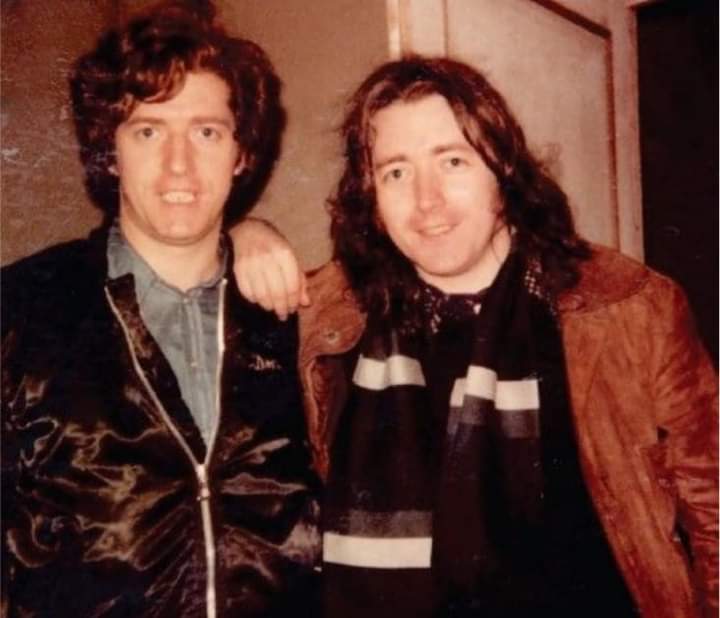
We also get the inside scoop on Wilgar leaving, as well as Rory’s clashes with Rod behind the scenes and why Rory ultimately chose to part with him and Lou. We can thank Dónal once again for persuading his brother to keep Gerry on, fearing that parting with the whole band would trigger a huge depression in Rory – similar to what happened following Taste’s break-up. We also see how the arrival of Ted injected fresh energy and fun into the group, bringing out Rory’s cheeky, schoolboy sense of humour.
As we get to the 1980s, the narrative is admittedly treated more concisely, although there is still some great coverage of events like the 1981 Athens gig where you once again feel for Dónal, who risked his life to go back out on stage and retrieve Rory’s Strat. As he lay crawling on the floor with his coat over his head, seeing flames rise, he notes the horrible reality: “If I stand up, I’m going to get shot, but if I stay here I’m going to burn.” “I’ve seen some wild things over the years, but that was the scariest night of my life,” he concludes.
Dónal also emphasises the point that Rory was not “on hiatus” between 1982 and 1986, pointing out some of the projects he was involved in like the scrapped Torch album or an (abandoned) collaboration with Van the Man. We also get an overview of the formation of Capo Records, the Jinx, Defender and Fresh Evidence albums, Self Aid, the Nelson Mandela birthday concert and the 1991 tour of Japan, Australia and North America.
In an age where mental health is now looked upon with much more compassion and understanding, I really appreciate how candid Dónal is about Rory’s struggles with depression, and I hope his honesty helps others facing similar challenges. He notes how, as Rory’s depression worsened, he spent increasingly extended periods holed up in hotel rooms. After a gig in Hamburg, for example, Rory refused to leave his room for several days, forcing Dónal to send the band on and rebook flights for them both. Later on the plane, Rory noticed the date and suddenly realised it was Dónal’s birthday: “My God, I’m sorry. It’s your birthday today,” he said, practically in tears. The strain of caring for his ailing brother is clearly evident in Dónal’s account. He writes how incredibly hard it is to be around someone struggling with depression and his own fear that it was somehow “contagious,” given how completely intertwined their lives were and how they saw each other as “twins.” “You felt keenly what the other one was going through, even if they didn’t share everything with you,” he reflects.
The way Rory’s self-confidence was so incredibly shattered in his final decade is also hard to read, and we get so many bittersweet stories on this. After performing what many would later call the gig of his life at Temple Bar Blues Festival in 1992, for example, Rory returned to his mother’s house in Cork and locked himself away in his room. “It must have been a disaster of a show,” poor Mona said to Dónal. Dónal assured her that it was one of Rory’s best and put on the video he had recorded. She agreed and managed to coax Rory down to watch it. When he did, he was genuinely surprised – bless him – at how good he had been, and a smile returned to his face. He confessed to Mona and Dónal that he really hadn’t thought he had performed well.
On another occasion, Dónal took Rory out for dinner and they bumped into The Edge and Adam Clayton in the restaurant. Adam innocently remarked, “I’m delighted you’re on our label” (Capo was distributed by Record Services in Ireland, a company in which U2 had a stake). Rory misinterpreted the comment, became upset and said to Dónal, “You get me a new deal, then. I want off that label,” before storming off with his coat. Dónal clarifies that it wasn’t anger or resentment on Rory’s part; he was just upset that a young Irish band had “bought a slice” of his musical independence.
Then there’s Rory’s almost stoic acceptance of disappointment. For example, he was interviewed for the Curves, Contours and Body Horns documentary to mark the 40th anniversary of Fender Stratocaster, but the filmmakers ended up cutting him from the final draft because Frank Zappa had recently died and they wanted to feature his son instead. Dónal was rightly furious, yet Rory simply replied calmly, “Don’t worry, that’s what they do to me” – a response that completely broke my heart.
We all know how Rory’s story sadly ends and part of me somehow didn’t want to get there. Dónal recounts his brother’s increasing problems with prescription medication and the upsetting incident at the ill-fated Town & Country gig in London, when angry members of the crowd began booing and throwing things at Rory. Little Eoin and Daniel were in the audience and asked their mother, Cecilia, “What’s happened to Uncle Rory? Why did those people throw things at our uncle?” Dónal goes into more detail than ever before about Rory’s decline in health, including considering sectioning him and the harrowing time he spent in hospital, with several emergency operations and comas, before finally passing away.
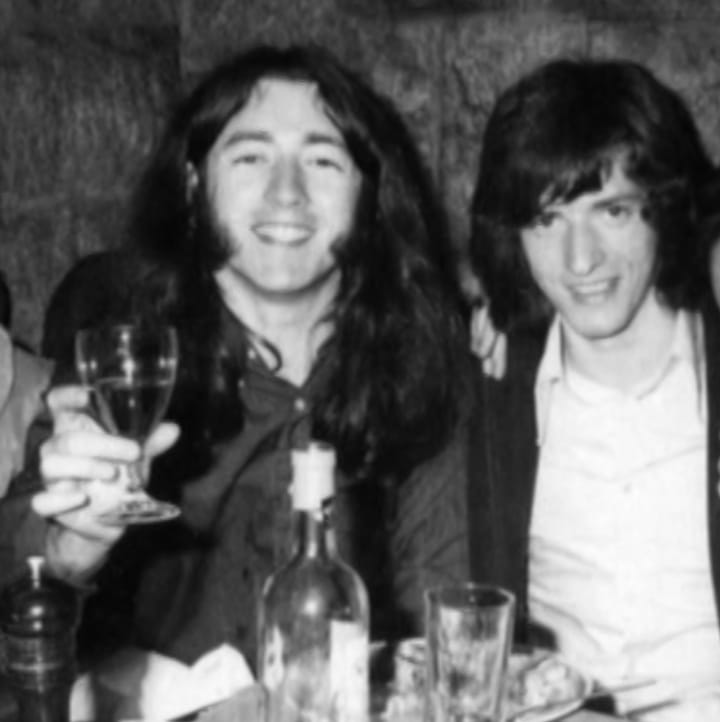
The final chapter concludes with multiple poignant stories, such as the “ladder to space” visible in the sky the days after Rory’s death and Van Morrison telling Dónal after Rory’s memorial service in Brompton Oratory that, while ‘Carolan’s Farewell to Music’ played, he clearly saw Rory come down from the altar. In the afterword, Dónal also shares the vivid dream he had the night before Rory’s funeral, making it clear that his brother’s spirit still lives on.
And of course, I have to give a brief mention to the photos too. A fantastic selection of snaps have been chosen for the book, including some that have never been shared publicly before. Seeing the two brothers side by side, from their early years right through their lives and beyond, adds a lovely visual companion to the story, capturing the special bond between them.
Naturally, there were still a few extras I was hoping for, such as the time that Rory and Dónal spent in Ghent and the friendships they forged there. I would also have loved to hear more about Dónal’s own achievements beyond his work preserving Rory’s legacy – though, of course, he is far too humble to dwell on them. Dónal also seems mindful of keeping on good terms with everyone in Rory’s story; he remains tactful in his descriptions of clashes with figures like Roger Glover and Eddie Kennedy, and even shows respect by not naming the abusive priest from Rory’s past. But really, these are just small quibbles in a profoundly heartfelt and insightful book.
Ultimately, Edged in Blue is an intimate and illuminating look at Rory’s life through the person who knew him best, even if he admits Rory remains something of an enigma. It’s full of vivid stories, laughter and heartbreak, showing both Rory’s brilliance and struggles, but just as much Dónal’s tireless care, patience and devotion. Reading it feels like sitting with someone who loved Rory deeply and wants the world to understand him as they did.
I’d go anywhere, if I thought you’d be there,
‘Cos I’ve made up my mind that’s where I belong.


Leave a Reply