
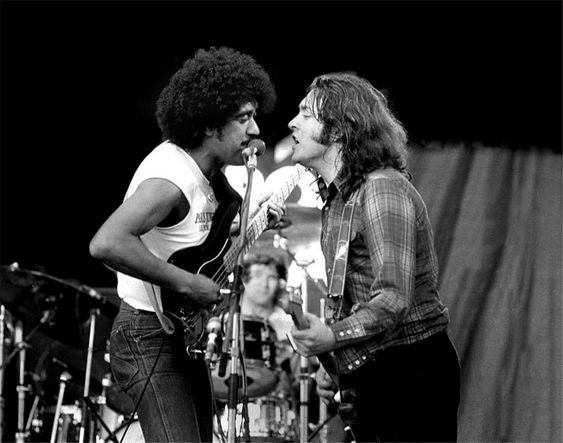
If I had a time machine, I know exactly where I’d go: Punchestown Racecourse on 18 July 1982. The night my two heroes – Rory Gallagher and Phil Lynott shared the stage and created a little piece of rock history.
As I’ve mentioned before on this blog, my introduction to Rory came through Thin Lizzy. Lizzy had been my favourite band since I was a little girl and, one afternoon, listening to their Live in Cork ’80 bootleg, I was jolted upright by Philo’s cry during ‘Sugar Blues’:
I’ve got me them Rory Gallagher blues!
‘Who is this guy?’ I wondered. I didn’t know anything about him yet, but I knew one thing immediately: if he was good enough for Philo, he was almost certainly going to be good enough for me.
This was the early 2000s – pre-YouTube, pre-streaming. Finding music wasn’t as simple as typing a name into a search bar. Record shops were no help either; Rory’s albums were long out of print. His name lingered in my mind, quietly waiting…
When the long-overdue greatest hits album Big Guns was released in 2005, I promised myself I would buy it and finally get my answer. But being a perpetually cash-strapped teenager, that plan never materialised. By the time I actually had some money in my pocket, the album had gone rare, with secondhand copies hovering around £30. My quest would have to continue.
It would take until 2016 for me to finally discover who this ‘Rory’ was, when I got hold of his 1971 solo debut, Rory Gallagher, from a market stall. From the first listen, I was hooked and my life truly was never quite the same again.
Rory has a way of getting deep into your soul. He isn’t someone you can admire casually; with him, it becomes all-consuming. While I often wish I’d discovered him sooner, I don’t think I would have had the life experience or perspective at the time to fully appreciate him. Somehow, he came into my life at exactly the right moment.
By now, YouTube existed, opening up a world of performances I’d previously only been able to imagine. One day, while listening to a playlist of rare Lizzy tracks, a grainy live recording came on. I wasn’t paying too much attention at first – it was just background noise while I was doing chores – but something about the guitar tone made me look up. This wasn’t Robbo or Scott or Gary; it was rawer, earthier, a different kind of fire.
The video title read: ‘Rory Gallagher & Phil Lynott – This is the Woman’. And there they were. A photo slideshow of the two towering figures of Irish rock, face to face at the microphone, guitars in hand. I felt an enormous smile spread across my face.
I quickly found more tracks from the same show, learning that Rory had been the headliner at the fifth anniversary celebration of Irish music magazine Hot Press. Philo had stepped up to guest on a few numbers, along with Northern Irish singer-songwriter Paul Brady.
As Rory gradually became my favourite, somehow nudging Philo from the pedestal he had firmly occupied for well over fifteen years of my life, I began to understand just how momentous that Punchestown performance was. Oh, what I would have given to be there! And how lucky those who were.
A Meeting of Minds
Of course, Punchestown 1982 wasn’t the first time that Rory and Phil had met, even though it may be the most iconic moment. Speaking to Dave Fanning in a 1986 interview backstage at Self Aid, Rory reflected that he and Phil had crossed paths many times over the years, although they never really knew each other well.
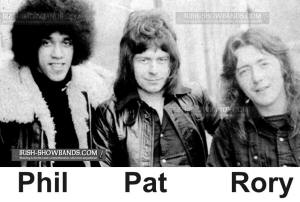
In the early days, when Lizzy were still a three-piece with Eric Bell, they supported Rory at the National Stadium in Dublin in May 1972. That same year, the two acts also played on consecutive nights at Stephanie’s Disco in Tramore. A charming photo from that era shows a fresh-faced Rory and Phil in Dublin with music promoter Pat Egan, hinting at the mutual recognition that would develop over the years. Eric, who left Lizzy in 1973, would remain a lifelong friend of Rory’s.
Even after both bands had evolved, their paths continued to cross. On 14 May 1979, when Thin Lizzy – now a four-piece with Gary Moore – played at Sartory-Saal in Cologne, Rory got up on stage and jammed with them. Rory and Phil would also occasionally bump into each other in recording studios. Artist Jim Fitzpatrick, one of Phil’s closest friends, recalls a particularly memorable encounter:
I met [Rory] first with Philip Lynott at a recording studio in London. The two of them were just jamming together while they were waiting for Thin Lizzy to assemble for rehearsal. The three of us were talking away. I’d be well used to meeting people of immense stature in the music business, but I remember thinking: this is like sitting between Brendan Behan and Paddy Kavanagh.
Jim notes how Rory was a “god-like figure” to him and Phil, yet so shy, humble and assuming. “He was very troubled. It felt like he had the weight of the world on his shoulders,” he later reflected. “You’d nearly want to wrap your arm around him and say, ‘Rory, you’re a genius!’”
Indeed, Lizzy’s own ‘Jailbreak’ was inspired by Rory’s ‘In Your Town’. Phil loved its driving rhythm and vivid lyrics about a man who has busted out of jail and is ready to settle some scores, and wanted to capture that same sense of tension in his own song. Rory, in turn, would pay tribute to Phil after his death in 1986 with the instrumental ‘One for Phil’, recorded with Davy Spillane for his Out of the Air album.
The piece emerged spontaneously during a break in rehearsals at Windmill Lane Studios in Dublin, when Rory and Davy reflected on the sadness of Phil’s recent passing. It’s a short, funky number that begins with Rory’s guitar riff, echoing – perhaps intentionally – the opening of ‘In Your Town’, before being joined by Spillane’s uilleann pipes and Rory’s gentle humming. The result is a layered, heartfelt homage to a fellow artist who did so much to put Ireland’s music on the international stage.
Rory also spoke of Phil’s passing in a Hot Press interview at the time, admitting that he had been “shocked” by the drawn-out hospital reports and the fragility he saw in Phil’s eyes during a TV performance months earlier:
I saw him on TV with Gary Moore and I got a shock when I saw him. Not the appearance but something in his eyes, God rest and save him. You’d assume because of the reputation, inverted commas, you’d take it as just another one – but it shocked me more than I thought it shocked a lot of people.
Following Rory’s death in 1995, Philomena Lynott poignantly expressed the extent of her son’s respect for Rory:
My Philip worshipped Rory. He worshipped him! I know it’s a terrible thing to say, but when Rory passed on, I thought of the sadness for his family but the joy for Philip in heaven. He would have been at the pearly gates waiting for Rory. I’m sure they would be having great jamming sessions up there now.
I find it hard to read that quote without feeling a lump in my throat every time. The thought of the two of them jamming together in heaven is somewhat comforting. But for those lucky enough to witness it on Earth, that dream came true on 18 July 1982 at Punchestown Racecourse.
Punchestown 1982
Punchestown Racecourse, in the heart of County Kildare near the town of Naas, opened in 1789 and has been home to Irish National Hunt racing for over 150 years. Over the decades, it has also hosted numerous concerts, most notably on 18 July 1982 for Hot Press magazine’s fifth anniversary.
Hot Press had been launched in June 1977 with financial backing from Rory and his brother Dónal. Rory would feature on the cover of the magazine’s debut issue, with a report inside on his headlining performance at the Macroom Mountain Dew Festival. Despite the magazine’s popularity, by 1982, its future was uncertain.
Editor Niall Stokes proposed an ambitious rescue plan: a benefit concert titled ‘A Day at the Races’. The first call he made was to Dónal and, within 24 hours, Rory had pledged his commitment to play. Despite Rory’s immediate agreement, organising the event proved far from straightforward:
Within a week we had put an extraordinarily strong bill together that in all the right circumstances might have brought 50,000 people to Punchestown, where the gig was to be held, and assured the future of the paper indefinitely. It wasn’t too long before elements of the bill began to unravel. Those whose managers agreed were pulled by their agents. Those who had agreed themselves were pulled by their managers. Some people just didn’t turn up on the day. I felt betrayed on half-a-dozen counts because these things are like a house of cards: if one piece goes, the rest tend to follow. Through it all, Rory never wavered and for anyone who was there the gig turned out to be one of the most memorable in Irish rock history…
The final bill featured Rory, Paul Brady, U2 (billed on some posters as “Bono, The Edge and Friends”) and De Dannan, with proceedings compered by Dave Fanning and BP Fallon.
The day before the concert, Rory flew into Dublin and headed straight to the RTÉ studios for a radio interview. There, he announced that Paul Brady would be guesting with him on a few numbers. Writing in his 2022 autobiography Crazy Dreams, Paul noted that Rory had sent a postcard to his booking agent in early 1982 to say how much he enjoyed Hard Station. He was “blown away” by the message, calling it “a lovely surprise that “gave [him] a big shot in the arm at the time.” They kept in touch and, once the Punchestown concert was arranged, Rory asked him if he would like to play together. Paul immediately agreed and sent Rory various tapes of his music, from which Rory selected songs that would “just about bridge the gap” between them.
They planned to rehearse together for the first – and only – time the evening before Punchestown, leaving much of their performance to instinct. Fan Daragh Connolly was lucky enough to witness part of these rehearsals. His brother Phil did mobile discos locally and happened to be in Punchestown that evening, allowing Daragh to tag along. Daragh heard a soundcheck happening outside the venue and wandered out to investigate. To his happy surprise, it was Paul rehearsing with Gerry McAvoy and Brendan O’Neill! Rory arrived a little while later, making the memory all the more special.
Speaking to RTÉ about his expectations for the day, a thoughtful Rory remarked, “I hope the event is good serious music but still nice and lighthearted […] because if you get a certain vibe at these open-air things, it can actually go beyond just being a performance. It can eclipse all that […] We’ll keep our fingers crossed.”
As always, Rory had no need to keep his fingers crossed. He delivered his usual powerhouse set, kicking off with the explosive ‘Big Guns’, before taking the audience through such tracks as ‘Bad Penny’, ‘Nadine’, ‘Jinxed’ and ‘Bourbon’. A Hot Press review noted that he deliberately eschewed obvious fan favourites, choosing instead to showcase newer material. Special praise was given to his acoustic set, including ‘Ride on Red Ride On’ and ‘Out on the Western Plain’.
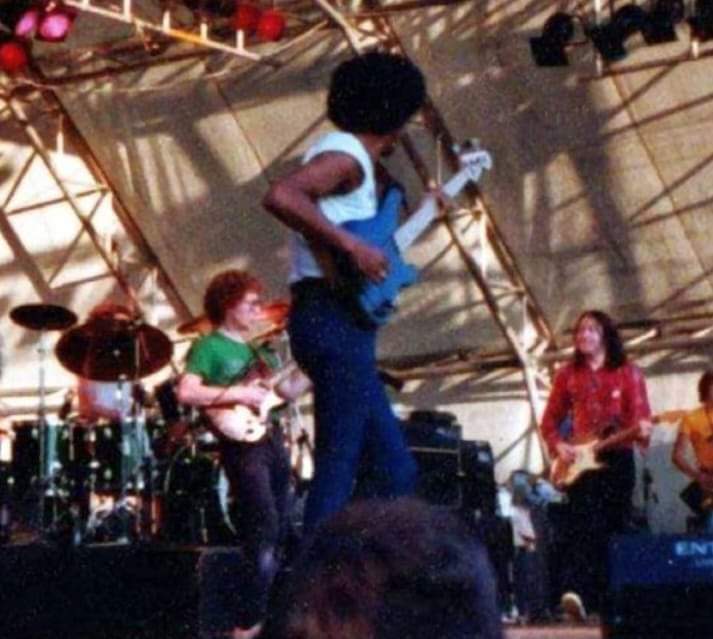
Then halfway through the show, out came Paul Brady, and together they tore into ‘Mercury Blues’ (a David Lindley classic), complete with a killer slide solo from Rory. This was followed by two of Paul’s own songs: ‘Night Hunting Time’ and ‘Busted Loose’. Paul remembers his adrenaline being “sky high,” causing him to start ‘Mercury Blues’ far too fast before settling into a proper groove. By the time they reached ‘Busted Loose’, he felt they were “cruising.” Although Rory had expressed concern in his interview the day before about the weather, it turned out to be an exceptionally hot day. So hot, in fact, that Paul’s glasses slipped off his face at one point and landed among the monitor speakers at his feet.
After a blistering return to his own catalogue with ‘Tattoo’d Lady’ and ‘Philby’, Rory casually unveiled the real surprise of the afternoon: “Mr Phil Lynott over here is gonna join us for a tune.” Phil’s appearance was entirely spontaneous – he happened to be backstage and couldn’t resist joining in when the chance presented itself.
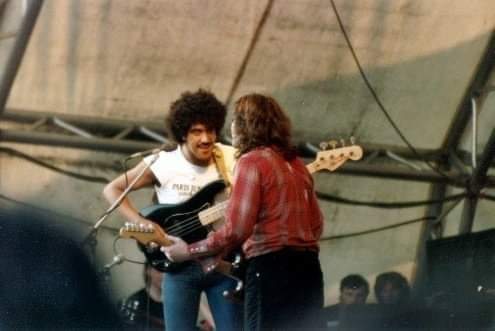
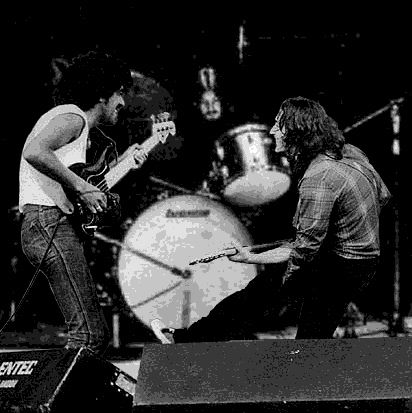
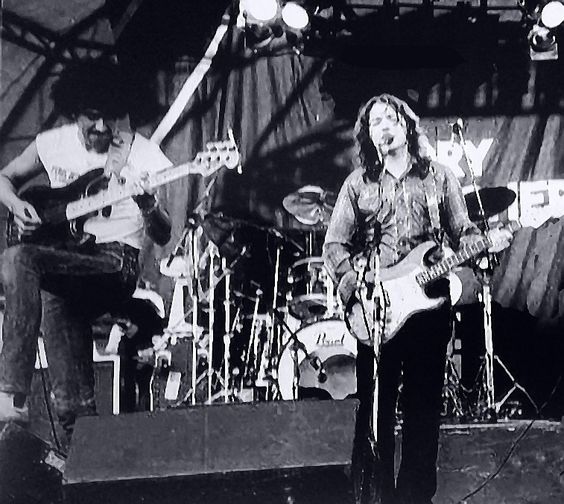
The ‘Ace with the Bass’ stepped out onto the stage to thunderous applause and launched into ‘This is the Woman’. I may be biased, but Rory and Phil sound absolutely incredible together. There’s a particularly breathtaking section in the middle where they riff back and forth – Phil’s bass taking the lead while Rory intersects with sharp, perfectly judged phrases. It calls to mind that moment when he traded lines with Jack Bruce at Rocklife 1990: two master musicians listening as much as playing, each pushing the other higher without ever overstepping.
Next up was ‘What I’m Gonna Do’, featuring more beautiful slide work from Rory, and then a closing medley of ‘Mean Woman Blues’ (Phil on lead vocals), ‘Reelin’ and Rockin’ (Paul on lead vocals) and ‘Dizzy Miss Lizzy’ (Rory on lead vocals). It was, as Hot Press put it at the time, “the perfect climax to a day of music which had been high on quality and good vibrations.”
Sadly, the performance was never filmed, but a surviving bootleg ensures that it wasn’t lost entirely. Even with its grainy quality, I’m so glad that it was recorded in full.
Photographer Colm Henry also captured the now-iconic images from the day. My personal favourite is not the best-known shot of Rory and Phil standing side by side, but the one with Paul at the microphone while the two of them stand just behind him, locked in eye contact. Rory has one leg raised, a huge smile across his face; Phil is grinning back, bass lifted high, giving as good as he gets. It’s magnificent.
And as a small personal footnote, I have to say how thrilled I was when that very same Colm Henry agreed to supply the photograph of Rory for the front cover of Rory Gallagher: The Later Years, taken during the Fresh Evidence shoot. A real honour.
Fan Memories
Although 16,000 people had been expected at Punchestown, only 3-4,000 attended. The low turnout was surprising, given the venue’s proximity to Dublin and the sunny weather. The press suggested that some people were put off by the £10 ticket price, while others were saving their money for the Rolling Stones at Slane Castle a few days later. Others still may also have been deterred by the fact that the racecourse bars were closed, meaning attendees had to bring their own drinks. In reality, it was a modest sum for what would become a historic gathering of Irish musical talent.
Speaking to some people who were at Punchestown, it’s clear that time has only deepened their appreciation of just how momentous the day was. Listening to their stories, I can’t help but feel a mixture of joy and envy, living vicariously through their stories while wishing I could have been there myself!
One person who has particularly incredible memories of the day is Irish blues musician Eamonn McCormack, who still describes Punchestown as “one of the greatest days” of his life. Eamonn was just in his late teens at the time and already playing in local garage bands. He was obsessed with music, and Rory and Phil were high at the top of his list of influences. On 18 July, he headed to Punchestown with a friend who had a car and took a tent with them. He was really excited about seeing Rory for the first time in the flesh, playing live.
He remembers that, after a while, a guy he had met a few hours earlier walked up to him and said, “You’re the guitarist who is a huge Rory fan?” When he said yes, the man explained that his wife had taken ill and they were waiting for an ambulance to arrive. Then, he pulled out an Access All Areas pass from his inside jacket pocket, handed it to Eamonn and walked off into the horizon. Eamonn could not believe his luck! He immediately made a beeline to the left of the stage, where a huge bouncer stood, but as soon as he flashed the backstage pass, he was ushered in. As he recalls:
And there I was, standing backstage on a grassy area with small caravans as backstage rooms, all the artist names printed in block letters. There were very few people there, except the odd roadie pushing equipment up and down the stage ramp. I happened upon the caravan that had my hero’s name in big black print, “Rory Gallagher,” but not a dickie bird. No sign of life in the caravan.
Desperate for a pee and with no Portaloo in sight, Eamonn walked between two caravans. Another guy ran down the stage ramp to join him and said, “Good day, isn’t it?” Eamonn then recognised him as Bono, who was then just starting out in U2. He returned to the grassy area and watched as someone opened the gates to let a Mercedes drive through. The next moment was like a dream for Eamonn:
I slowly walked to the other side and stood still as the door of the car right beside me opened, and out walked Rory himself. I froze in a kind of shock you only experience when you meet your hero. I put my hand out and he grabbed it, and we shook hands. I think I uttered the words, “How are you doing, Rory?” He replied, “Great!” Then someone out of nowhere whisked him away to his caravan. Not wanting to be a pest, I walked away past Rory’s caravan, up the ramp and sat on a flight case, watching the band that was playing, but I couldn’t concentrate because I was still buzzing on the biggest high I can remember, having just met and talked to Rory. Sometime later I walked back down the ramp, and standing outside his caravan was Rory on his own, so I went over to him, told him how much of a fan I was and we talked guitar. He even gave me the name of a guy in London who had an old Strat to sell, which I later bought. I gave him a lovely silver metal keyring bottle opener in the shape of an acoustic guitar. I treasured it and they were rare back in those days, but if I was to give it away to anyone in the world, then Rory fit the bill. He thanked me and put it in the top pocket of his jeans jacket.
Just as Eamonn was saying goodbye and wishing him a great concert, another young boy appeared with his father, who asked Rory if his son could have a photo with him. Rory obliged, and Eamonn then asked the boy’s father to take a photo of him and Rory together, which he later posted to him (sadly, the photo was lost in California some years later).
He then recalls Rory hitting the stage and rocking the festival. Eamonn walked out to watch him from the audience area. He later decided to head backstage again, but just before he could walk up the ramp, he heard the gates open once more and another Mercedes drive in and stop in the same place as before. Curious, he waited to see what would happen. Then:
The back door opens and out walks Philip Lynott to which I extended my hands out again and welcomed him. At this stage, I was relaxing and I felt like a President welcoming dignitaries to his small country and I felt I could get used to this! I chatted briefly to Phil and told him I had met him earlier in the year in Morocco, North Africa.
Eamonn then went off to sit back on the flight case and watched from the “best seat in town” as Phil walked out and jammed with Rory and Paul Brady. What an unbelievable day!
Another fan with fond memories of the day is Pat Comer. He recalls the weather as spectacular (“hot, sunny with blue skies”), making it the perfect day for the concert. He felt it was only fitting that Rory headlined the day, having always been a big supporter of Hot Press magazine. Pat admits that he was there for Rory and didn’t pay much attention to the other acts, although he does remember Bono climbing a stack of speakers and confesses to half-hoping that he might slip!
When Rory hit the stage, the crowd “surged forward in a wave of energy and excitement.” Rory did his trademark sprint across the boards before tearing into ‘Big Guns’. Pat recalls him being “in top form, delivering a set that was pure, high-energy, high-voltage Rory.” The highlight for him was undoubtedly when Paul Brady and Phil Lynott joined him on stage. He remembers them all peering at the floor at one point, realising years later that they were looking for Paul’s glasses, which were never seen again.
Pat particularly enjoyed ‘This Is the Woman’; with Phil on vocals, Rory was “free to weave together some incredible rhythm and lead work.” He can still picture Bono standing in the background, watching Rory and Phil in “genuine awe.” Rory closed the set with a blistering ‘Shadow Play’, and Pat and his friends took the 110-mile drive back to Galway in silence, all replaying the magic, excitement and brilliance of the day in their heads.
Eamon Maguire was also at Punchestown and travelled there from Kells in County Meath. It was his first time at the venue. He hadn’t seen Rory play since the four-in-a-row gigs at the National Stadium in 1979 and was excited to see him again. He remembers that a number of bands pulled out close to the date and wondered at the time if the acts had agreed to play for free (he later found out they did).
He recalls that the concert wasn’t packed or sold out, probably because the Irish economy was doing so poorly at the time. Eamonn bought two posters, which he later framed, and had a hard job keeping them intact throughout the show. He also remembers that the MC for the event was BP Fallon, who “advised” the crowd that two plainclothes drugs officers were frisking people, which was met with boos and hissing. Although he thoroughly enjoyed the gig, his memory of the setlist is poor. But of course, he clearly remembers the phenomenal ending, with Phil and Paul joining Rory on stage. “It was an incredible sight to see three icons of Irish music on the same stage,” he said, and he prayed that somebody would photograph it for posterity, as cameras were not allowed. As we know, thankfully Colm Henry did. Eamonn has two of these limited-edition prints.
Paul Deegan was also there. You can read his full memories of the occasion in a Meeting with the G-Fans post from earlier this year. He has since additionally recalled an evocative image of Rory chasing after a butterfly with his Strat across the stage.
The memories of Punchestown might be softened by the haze of passing decades, but for Robbie Poole, certain moments still cut through the static with crystal clarity. The day kicked off with The Alsatians, a band that hit the stage with a burst of high-octane energy. Riding high on their hit single, ‘Five Honours and a 175’, they delivered a set of “energetic pub rock” – a sound Robbie describes as Dr. Feelgood bolstered by a powerhouse brass section. While Belfast new-wavers Big Self passed by in a blur, the atmosphere shifted when De Dannan took the stage. As Robbie put it, “You can’t beat a bit of trad to get the juices flowing.” Simple Minds were supposed to play next, but they never showed up. U2 took the stage instead. While they played well, Robbie was not a fan of their music, so opted for a stroll instead, saving his energy for the main event.
Then, the moment the crowd had been waiting for finally arrived. Rory stepped out on stage and the entire festival grounds “came alive.” As a drummer himself, Robbie’s eyes went straight to the rhythm section, noting the arrival of Brendan O’Neill behind the kit. The addition of a saxophone duo added a new, rich dimension to Rory’s gritty blues-rock, creating a wall of sound that felt massive.
Robbie recalls the place erupting when Paul Brady and Phil Lynott later came out to join Rory (“it was joyous”). Rory finished the set with ‘Shadow Play’, bringing the day to a wonderful close. Robbie went home “very satisfied and buzzing with excitement.”
For Peter Kelly, a connection to the show’s organiser, the late Derek Nally, secured an Access All Areas pass – a dream come true for a seventeen-year-old rubbing shoulders with rock royalty. Meanwhile, John Mulligan enjoyed an even more intimate glimpse into the life of a star; attending with a journalist friend, he was invited to join Rory for dinner and drinks at the after-party. John’s lasting impression of the night wasn’t just the music, but the man behind the guitar, recalling Rory as a genuine, down-to-earth “genius” and a “lovely guy,” cementing it as an occasion he would never forget.
Echoes of a Legendary Day
Looking back on Punchestown ‘82, it is clear that few truly grasped the historical weight of that day as it happened. It’s only now, with the benefit of hindsight and the quiet ache of Rory and Phil no longer being with us, that the event’s true significance has come into focus. What might have felt like a simple performance at the time has transformed into something mythical – a rare moment of magic that feels more precious with every passing year.
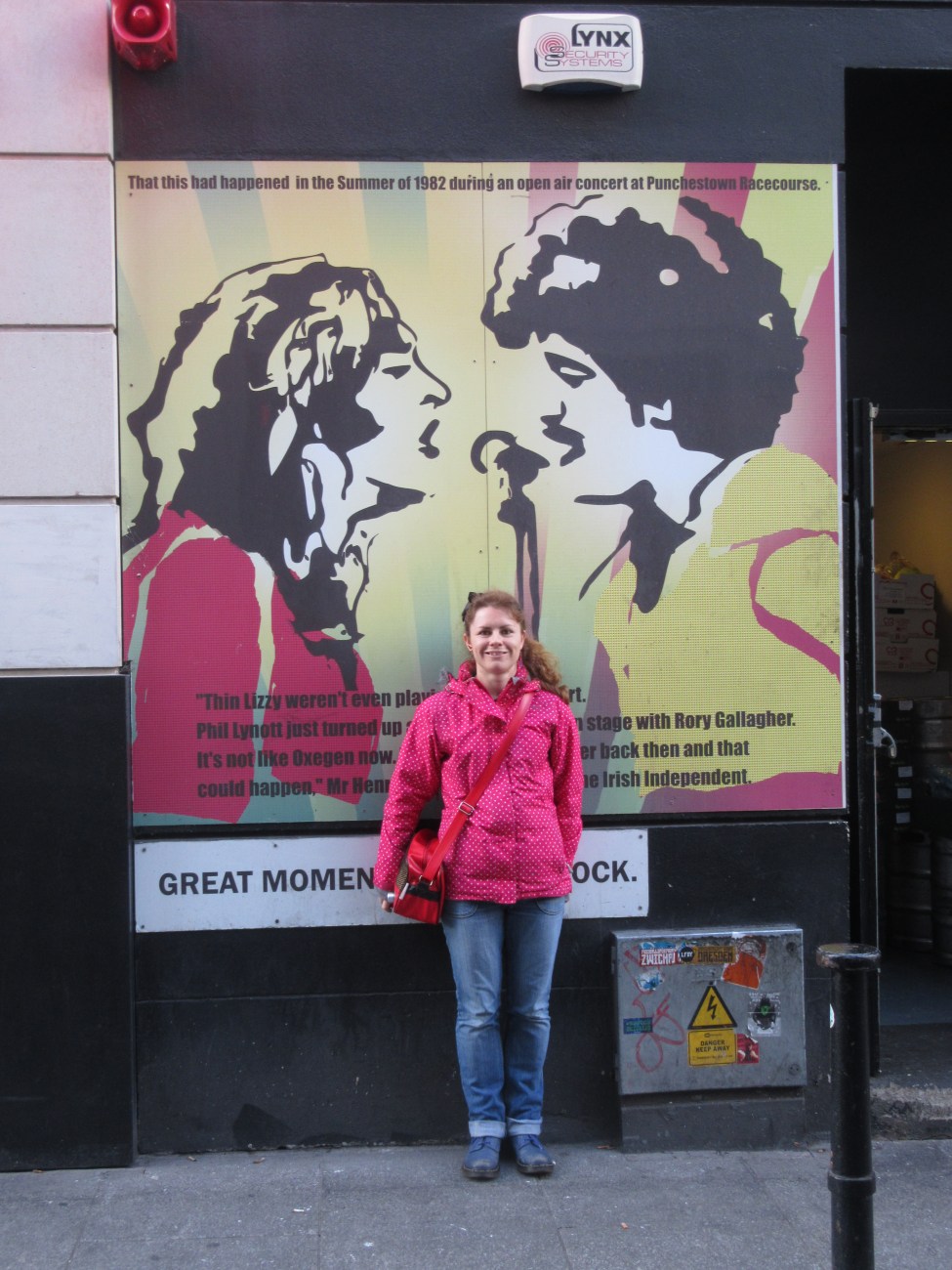
Walking around Dublin city centre on a crisp autumn morning in 2018, I was delighted to stumble across the Great Moments of Irish Rock mural – a vibrant tribute to that unforgettable moment when Phil and Rory took the stage together at Punchestown. I paused for a while, taking in the detail and energy of the artwork, before asking a passer-by to snap a photo of me in front of it. It felt like a small, personal way to connect with a once-in-a-lifetime event I’ll always treasure and, admittedly, to imagine what it must have been like to be there in person, witnessing that magic unfold.


Leave a Reply