
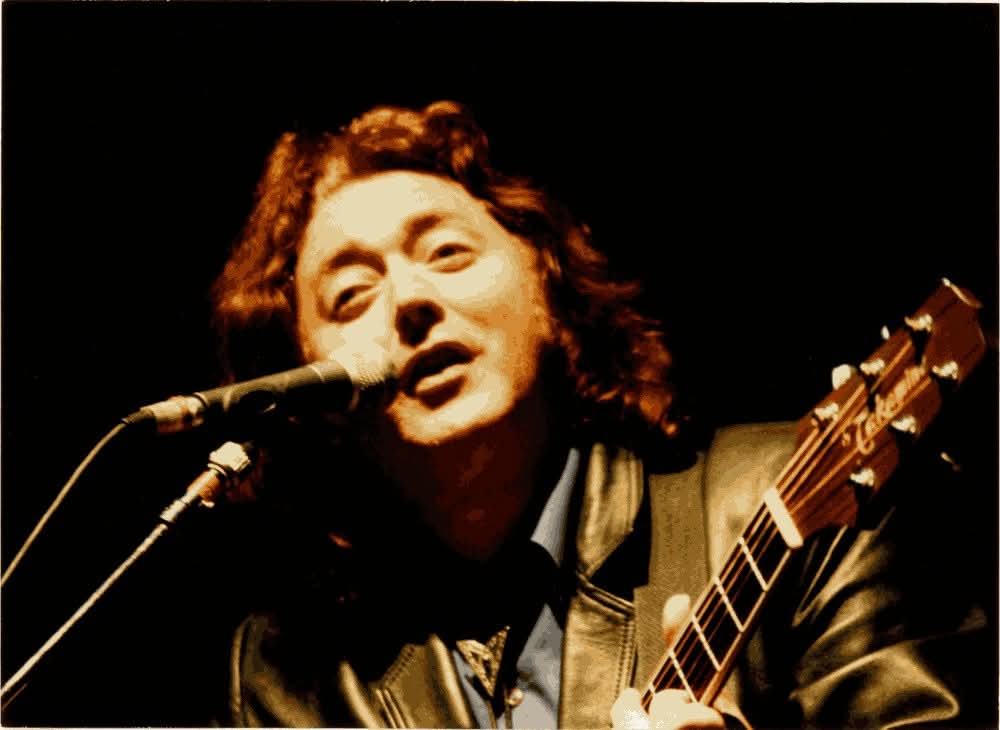
“That song ‘I Could’ve Had Religion’ that I do,
it’s not my song. I rewrote it. It’s an old song”
Rory Gallagher, 1992
One of the many, many things I admire about Rory is how he consistently acknowledged the blues artists who came before him. At a time when many rock musicians casually passed off traditional material as their own, Rory always made a point of naming his sources. Even when he adapted or rewrote a song, such as ‘I Could’ve Had Religion’, he always clarified, “This is a song by…” honouring the lineage of the music with deep respect and accuracy. And for fans like me (and, I’m sure, many others), that openness introduced a whole world of blues greats I might never have otherwise discovered. My musical tastes are so much broader and richer for it.
As with many blues numbers, ‘I Could’ve Had Religion’ has deep and tangled roots, being a traditional song that has evolved over time through countless interpretations. Traces of its melody and structure can be heard in Muddy Waters’ ‘She’s Alright’ (1953), later rerecorded for Electric Mud (1969), which also weaves in a riff from The Temptations’ ‘My Girl’. But one of the most widely known renditions is Junior Wells’ version on Southside Blues Jam (1970), recorded “live in the studio” over two days in Chicago during late December 1969 and early January 1970. Featuring Buddy Guy, Louis Myers, Fred Below and Otis Spann, the session aimed to capture the raw energy of Monday nights at Chicago’s legendary Theresa’s Lounge. Wells’ take on ‘I Could’ve Had Religion’ puts his voice at the heart of the song, backed by sparse instrumentation and no guitar solo. The result is a gritty vocal performance, with phrasing that lays bare the turmoil of a man whose path to redemption is blocked by his woman’s dirty ways.
Building on the foundation laid by Junior Wells and others, Rory’s own version of ‘I Could’ve Had Religion’ became immortalised on his 1972 Live! in Europe album. The song has invited multiple interpretations from fans. On the surface, it draws on the classic blues narrative of temptation and salvation, being pulled away from religion by a woman’s influence. Yet many listeners also read it in more autobiographical terms. It’s well known that Rory was a deeply religious man, so some see the song as his musical calling steering him away from an alternative spiritual path, his guitar being the “little girl” in the story. That layered reading becomes even more poignant in Rory’s later performances as his failing health lent the song the weight of a spiritual reckoning, with the blues as his final refuge.
Unlike previous songs I’ve explored in this series, ‘I Could’ve Had Religion’ formed part of Rory’s live repertoire primarily during two distinct periods: the early solo years with Wilgar Campbell and Gerry McAvoy, and then again in the early ‘90s with David Levy and Richard Newman. While he did occasionally perform it between 1973 and 1991, those instances were relatively rare.
As many will recall, in 1992, Bob Dylan contacted Rory’s office requesting a copy of Live! in Europe because he admired Rory’s version of ‘I Could’ve Had Religion’ and was considering recording it for his acoustic album Good As I’ve Been to You. I’m sure this gave Rory a morale boost at a vulnerable time in his life, and I’ve often wondered if it influenced his decision to bring the song back into his set after so many years.
Ultimately, Dylan didn’t record the song. When he shared the bill with Rory at the Montreux Jazz Festival in 1994, Dónal asked him why. Dylan explained that his album consisted entirely of traditional songs. Upon hearing Rory’s version of ‘I Could’ve Had Religion’, he wondered where the additional verses came from and soon realised Rory had written them himself. “It would have been very unfair of me to take that song of his and call it a Bob Dylan traditional,” he explained, “I couldn’t live with that.” Rory told Dylan that he would have been honoured if he had recorded it, and Dylan replied that maybe they could record it together someday. Sadly, that never came to pass.
Live! in Europe 1972
So, let’s get stuck in right away with the most famous Rory version of the song from Live! in Europe. Although Rory performed the song often in 1971 (for particularly nice versions, check out Enschede and London), this recording perhaps captures the raw energy and mastery like no other. “Let’s take it back a little bit and do a song called ‘I Could’ve Had Religion’. Thank you,” he introduces the song. He lightly tunes up, then slips effortlessly into a gorgeous harmonica line while strumming along on his guitar. Then comes that unmistakable opening slide lick that hooks you instantly.
The entire arrangement of the song is a masterclass in blues, especially impressive given that Rory was just 24 years old at the time. Rory’s guitar converses with his vocals, weaving in and out, answering each phrase, painting the tension of a spirit torn apart by love and temptation. When the band kicks in on the second verse, the groove tightens, the tone rich and soulful. Rory’s voice commands attention as he draws out each word with conviction:
I’ve been a bad man
As bad as I can be
I pray to the Lord above
Send his mercy on me
I want some mercy
Gotta set my soul free
Set my soul free please
For me, slow blues like this showcases Rory at his very best. He takes the song’s traditional boundaries and stretches them wide open, making it completely his own. Then, bam! The harmonica solo arrives, backed by driving rhythm guitar that feels like a one-man show of pure blues magic. As he moves into slide guitar, the tone becomes hauntingly evocative, painting sorrow and struggle with every bend and wail. And then he returns to that hypnotic motif, repeating the same five notes over and over to mesmerising effect. It’s a brilliant example of “less is more”, where repetition becomes a tool to draw you deeper into the emotional heart of the song.
As the final verse unfolds, Rory improvises searing lyrics about the devil being set loose upon him, pleading for mercy and begging for salvation. The song’s last minute in particular is pure brilliance: he repeats the line “she set the devil on me,” weaving a tight guitar lick between each phrase that the harmonica then replicates in perfect response, before both instruments converge to play the same powerful phrase together. Rory then unleashes the final cry—“I could’ve had religion!”—before closing with a plaintive piece of slide. As Melody Maker concluded in its review of the song, “That’s the blues, rolling and turning, hung back so you can beat yer heels hard.”
If you check out Rory’s incredible performance of the song at London’s Marquee Club the same year – thankfully captured on film – it’s very close to the Live! in Europe version, but gives us the chance to see him in action, not just hear him. I particularly love the way he sings along with his Tele here during the slide solo, as if his voice and guitar are intertwined in dialogue. Another particular high point is when he drops the guitar volume almost to silence for about 20 seconds, leaving just the gentle rhythm of the audience’s applause. Rory himself looks almost trance-like in that moment, before launching into a fierce piece of slide to close out the performance. This clip is an absolute must-watch for anyone exploring Rory’s entire live repertoire. There are so many other great versions of the song from the same period too, like Beat Club, the BBC Sounds of the Seventies and Cleveland WNCR radio station.
Kortrijk 1974
This stellar 10-minute version of ‘I Could’ve Had Religion’ was recorded live at De Hallen in Kortrijk, Belgium in 1974. Here, Rory sets aside the harmonica, putting the spotlight entirely on his slide work and vocals. From the very beginning, the audience is fully engaged, clapping along and feeding the energy back to the stage.
After the opening verse, the band kicks in, but rather than moving directly into the second verse as usual, Rory instead launches into a sharp-edged slide solo. His tone carries intense bite and aggression, yet he exercises remarkable control as he pulls the pace back down, creating a dynamic ebb and flow. Throughout this performance, Rory frequently sings alongside his slide lines, which sends goosebumps down my spine.
This version also features a Lou Martin piano solo, replacing the harmonica solo from earlier versions, while Rory holds down rhythm guitar. Lou’s rapid-fire piano playing contrasts with the song’s slow blues mood. Midway through, the tempo surges dramatically as Rory delivers a solo that leans more towards hard rock and Rod pounds the drums with thunderous vigour. For me, I confess that this section feels a bit at odds with the song’s bluesy soul, losing some of its subtlety and emotional depth. Still, it highlights how the song’s character shifts with different line-ups. For the last two minutes, Rory brings the energy back down, returning to the original slow blues groove that really suits the tune. The stripped-back ending, especially the line “That little girl I got sure put my Bible away,” delivers a strong, memorable finish to the song.
Marseille 1975
As someone who’s always gravitated particularly towards Rory’s acoustic side, I remember absolutely jumping for joy the first time I heard this version of ‘I Could’ve Had Religion’, recorded at the Salle Vallier in Marseille in 1975. I’m so glad somebody captured it on tape! This performance is a true testimony to Rory’s artistry: his ability to completely rework the song and turn it into a tender, intimate acoustic piece.
The opening riff is played so delicately and fluidly, like it’s come straight from the Delta. With just Rory and his acoustic, the set-up really brings his expressive vocals to the forefront. In tone and feel, this is perhaps the closest he comes to the Junior Wells version, even retaining many of the same verses.
There’s a wonderfully informal vibe to the whole performance. It as if Rory is just backstage or in his living room, experimenting and playing for the sheer joy of it. The solo is beautifully minimalist with expert fingerpicking that shifts the mood entirely. While the electric versions are raw and biting, this one feels far more introspective and intimate. Here, Rory’s voice mirrors the guitar’s melody with a natural ease, adding to the song’s reflective atmosphere. The gentle, unhurried ending invites the listener to linger in its quiet emotion.
Cleveland 1978
By the time Ted McKenna joined the band, ‘I Could’ve Had Religion’ had mostly vanished from Rory’s live sets. Yet, one night at Cleveland Agora in November 1978, he slipped it back in – a breath of bluesy calm amid a set dominated by fast-paced, hard-rock intensity. But even as a slow blues piece, true to that era’s vibe, this version comes through more aggressive than earlier takes, with the extended intro a prime example of Rory’s powerful style.
By the late 1970s, Rory’s live performances had soared to an entirely new level. His voice had deepened and matured, carrying a weight of wisdom that perfectly suited the song’s gritty edge. He commands every nuance of pace and volume throughout, using them to build tension and release with expert precision. Ted and Gerry’s tight, dynamic backing complements Rory’s playing perfectly, adding depth and drive without overpowering. In this version, I particularly like the improvised twist in the third verse:
I could have been a good man
But something happened to me the other day
I saw this good-looking woman
Threw my prayer book away
Threw my prayer book away
But the standout moment for me is the final slide solo, which really brings the performance home with a spinetingling surge of fire that cuts straight to the heart.
Chicago 1982
During the Brendan years, it was incredibly rare to hear ‘I Could’ve Had Religion’ live, so it’s a real treasure that at least one performance was captured on tape. This comes from Park West in Chicago during Rory’s 1982 US tour supporting Rush, though this was a solo gig he did in between their joint dates.
The song takes yet another fascinating turn here. Perhaps spurred on by being in the heartland of the blues – and in keeping with the rawer sound of Jinx – this version feels more deeply rooted in the genre, with a clean tone and a stop-start intro from Rory that immediately ignites the crowd. There’s a real foot-stomping, barroom energy throughout, with Rory howling and growling the lyrics like his life depends on it. His slide work weaves through the song fiercely like a river carving its way through rock.
The real magic starts, however, halfway through when Rory locks into a hypnotic little lick, repeating it until the band picks up his lead. Brendan launches into a driving drum roll, and they all slip into a ZZ Top-style boogie jam, which lasts for the final four minutes of the song. Rory starts singing the first verse again, but now at a much faster tempo and over that infectious blues shuffle, completely transforming the song. His repeated cries of “oh yeah!” show just how instinctively he’s riding the moment, lost in pure musical joy. John Cooke then comes in on piano, which adds another layer. This dynamic shift and use of keys feels much more natural and satisfying to me than in the 1974 version I shared earlier. It’s a brilliant showcase of Rory’s ability to reinvent a song live, turning every performance into something unique and unforgettable.
The only other version I’ve come across with Brendan is from Halle aux Grains in Toulouse in 1986 – and for me, it’s perhaps even more stunning than the 1982 performance as we now have the addition of Mark Feltham whose harmonica playing introduces a haunting, atmospheric shade that deepens the bluesy mood. Rory’s improvisation, both in guitar and vocals, is absolutely supreme, with lines like “I left home this morning, took my pistol out of my pocket and threw it away” adding a new twist to the song’s narrative. It’s a fine example of the musical direction Rory was leaning towards in his final decade – the sound of a musician who had nothing left to prove, only more to explore in the endless landscape of the blues.
Festival Interceltique de Lorient 1994
There’s quite a jump forward now to this next version of ‘I Could’ve Had Religion’ from the Festival Interceltique de Lorient in 1994. I’m always slightly wary of declaring any one version of a Rory song as my favourite because inevitably another one will come along and knock it off that top spot, but I can say with firm conviction that this performance absolutely does it for me. It’s like all the stars align here perfectly.
We all know that the final decade of Rory’s life was incredibly difficult as he struggled with worsening physical and mental health. Yet paradoxically and cruelly, some of his very best music was borne from this great pain in my view – and this performance is a prime example.
It always bothered me that in the Ghost Blues documentary, this was the only live clip from Rory’s later years and that director Ian Thuillier chose to overlay it with a narrative focused on Rory’s declining health, which did a total disservice to the performance itself. Here, Rory is literally laying his soul bare on stage in the most hauntingly cathartic way. There is such darkness in his vocal delivery and such fierce slide guitar, but I’m so grateful he had that release for his sadness. When I interviewed David Levy, he said this was his favourite song to play with Rory and that the piercing sound of that Tele still rings in his ears all these years later.
If you want to show somebody Rory’s craftmanship as a mature, experienced musician and master storyteller of the blues, then this is the song to share. The way he directs the band, knowing exactly when to bring the pace up or down, when to shift from rhythm to lead, when to let Mark or John in is a lesson in intuitive performance. His improvisation here is so impressive, weaving in lines from Sonny Boy Williamson’s ‘Eyesight to the Blind’ (“Her daddy must have been a millionaire. You can tell by the way she walks”) and embellishing them (“Smooth in the corner. Hot on the snare. She’ll take you to the divorce courts. And you’ll wonder why you’re there”). But the best bit comes when, on the spot, Rory crafts an entire narrative of a runaway preacher:
I was running down main street
The cop pulled me in
He said, ‘Hey, preacher.
Why are you running in your skin?’
I’m gonna give you 99 days detention
Rule out bail
Don’t mess with that girl again
You’re gonna end up in the cell
The song’s intense final line, “I could have had me good god damn religion” always strikes me here. In a 1992 interview with Michael Ross, Rory reflected on how his belief in God had always offered comfort during tough times, but that recently it hadn’t been enough. What helped him through his personal “crisis” was a renewed commitment to the blues and a deep drive to progress his music. That mix of determination and inner struggle feels vividly present here.
It’s also worth exploring other hauntingly beautiful versions from 1994 like Montreux, Bordeaux and Thun, where a similar tension between crisis of faith and comfort and hope that religion can offer comes through strongly. Interestingly, in all three performances, Rory includes the original Junior Wells’ third verse, which references the health struggles of blues legends: Howlin’ Wolf’s heart attack, Magic Sam’s death and Muddy Waters’ car accident. I get really emotional when, in the Bordeaux version, he adds, “Ain’t nobody left behind, that’s why sometimes I feel like laying right down and crying, but you cannot do that thing!” followed by a quasi-chant of “I got religion! I got religion!” It chills me that he chose to sing these lines when he was so ill himself.
Likewise, in Thun, he repeatedly adds, “It humbles me. It humbles me” after recounting the bluesmen’s illnesses. He also sings about going to the doctor, reading his report and returning alone to his hotel room to “break down and cry”. This version also references Sinéad O’Connor and her decision to shave off her hair, reflecting wider tensions around faith and protest at the time. And in Montreux, Rory’s addition of biblical references and vivid imagery (“Matthew. Mark. Luke. John. Old Testament. New Testament […] I was sick but I got cured. Got me a freight train running right down onto Lourdes, Texas, that is”) underscores the intense spiritual struggle and longing for healing that permeates the performance. His desperate plea, “Hey nurse, come over here. Take away my pain. I can’t take it anymore. This man’s gonna have to pray,” lays bare his raw vulnerability – especially striking given how private a man he was offstage.
Enschede 1995
I’ve been trying to keep these posts to just six songs which is quite the challenge, but I had to make this seven to end with this version of ‘I Could’ve Had Religion’ from Enschede on what would be Rory’s final tour in Holland, January 1995. It’s crazy to think how ill he is here because he sounds absolutely on fire vocally and guitar-wise.
The opening is very different to any other version of the song that I’ve heard. “Gotta get me religion, gonna join the Memphis church,” Rory declares assertively, “Got me religion. I’ll join the Memphis church. One thing’s for certain. Man, I sure won’t have to work.” It’s like he’s fully surrendered his soul to the blues, seeking comfort in its embrace.
He then cheekily slips in the Rolling Stones’ ‘Start Me Up’ riff, before launching into the song’s familiar intro. Unlike the autobiographical edge of the 1994 versions, here, Rory fully inhabits the song’s character, a man feeling hard done by. The lines, “Oh lord, have mercy on poor me. I’m gonna kill that woman in the first degree. She deserves it. I’ll make no bargain or plea,” are delivered with intensity, complemented by an almost vengeful slide guitar and blistering harp playing from Mark. One YouTube comment described Rory on this version as a “sack of hell” and I couldn’t agree more. The version two nights later from Leeuwarden is also particularly haunting (sadly, no longer on YouTube) – a powerful farewell from Rory’s last ever recorded gig.


Leave a comment