
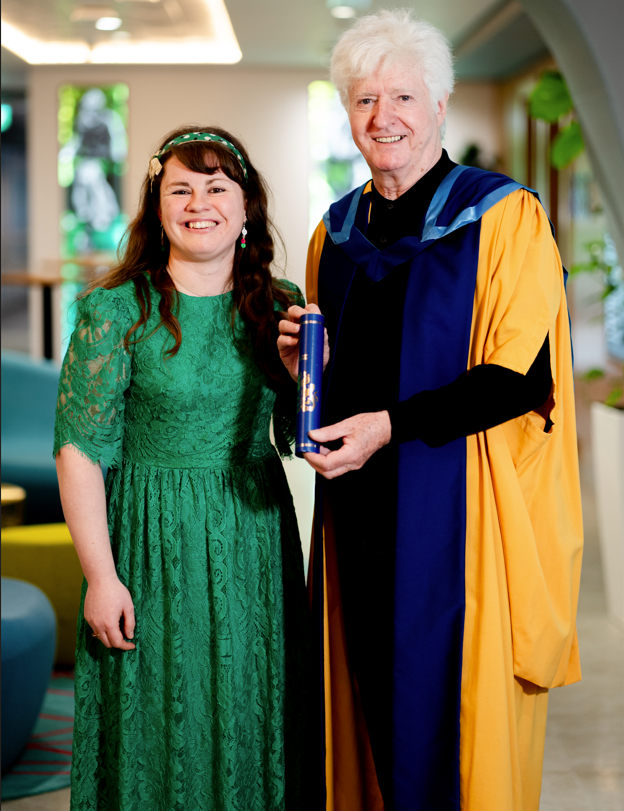
Some years ago, I heard an interview with Dónal Gallagher where he joked that he was usually introduced either as “Rory’s brother” or “Cecilia’s husband.” It was obviously said in jest, but the comment stuck with me. I remember thinking that it really was about time he received some kind of formal recognition for everything he has done – and continues to do – often behind the scenes, without ever blowing his own trumpet. So, I was absolutely delighted to see him finally honoured at a special ceremony at Croke Park on 12 March 2026, where he was awarded an honorary doctorate from The Open University.
The honorary doctorate was a long time in the making. Around three years ago, I first got in touch with Eoin and Daniel Gallagher about the idea. Both were enthusiastic and discussed it with their mother, Cecilia, who also approved. By the time our conversations began to develop further (all while trying to keep Dónal completely in the dark!), I had joined the Open University as Research Fellow and learnt about its honorary degree programme.
For those outside the UK and Ireland who might be unfamiliar with the OU, it’s a public university specialising in distance learning and flexible education. Founded in 1969, it now has more than 150,000 students and is one of the largest universities in Europe. Its fundamental mission has always been to make education accessible to everyone, regardless of social background.
Any member of OU staff can nominate someone for an honorary degree. Since 1973, the university has awarded over 1,100 of them to individuals whose work or achievements reflect the OU’s values of openness – to people, places, methods and ideas – or who promote educational opportunity and social justice.
There are two categories of nomination: Doctor of the University (DUniv), awarded to individuals whose achievements have had national or international impact and who are widely recognised by peers in their field; and Master of the University (MUniv), for those whose work has been influential at a regional or national level.
For me, it felt obvious to aim for the big one – Doctor – as Dónal’s contributions have undoubtedly been felt on all those levels. And so, I got to work on the nomination.
The application required a lot of work. While I knew quite a bit about Dónal’s background, it quickly became clear there was also a great deal I didn’t know. Like Rory, he’s an incredibly private person and certainly not someone to boast about his achievements. I began liaising with Eoin to fill in the gaps, and gradually the nomination took shape as a summary biography of Dónal’s life, interwoven with clear reasons why he deserved the honour and how his work aligned with the OU’s criteria.
I can’t share the application here for confidentiality reasons, but I can say the nomination was submitted under the “Services to the Arts and Sciences” category. In short, my argument was that Dónal deserved recognition for his exceptional contributions to the international music industry, his commitment to breaking down societal barriers through music and his enduring dedication to preserving his brother Rory’s legacy while actively supporting and enriching the Irish community in London and beyond.
The application went in during July 2024, and then… silence. For over sixteen months, I heard nothing, and the wait was agonising. I tried to put it out of my mind, but every so often I found myself checking and hoping for an update. Finally, in October 2025, the news arrived, and it was everything I had hoped for: the panel had accepted the nomination and recommended awarding Dónal the honorary doctorate.
In January 2026, I received further confirmation that Dónal had accepted and would receive the award at a graduation ceremony in Croke Park. As both a staff member and the nominator, I would be invited as a special guest. I was absolutely thrilled. But then reality hit: my usual uniform of t-shirt, jeans and trainers would not do for such a prestigious occasion. An emergency dress-shopping trip was immediately required!
“The Years, the Tears, the Memories and You… in Dublin”
Fast forward to March. The day before the ceremony, I flew over from Wales to Dublin, braving a rather hairy descent into the city amid 50mph winds. I was very glad to be back on terra firma!
The weather was no kinder the following morning. Although I wasn’t staying far from the venue, I decided a taxi was the wiser option. It didn’t seem like a good idea to arrive at such an event looking like a drowned rat!
It was my first time inside the hallowed walls of Croke Park and I have to say it was hugely impressive. After checking in at reception, I was led behind the scenes to the Hogan Suite, where I met John D’Arcy, Director of the Open University in Ireland, and Tara Craig, Deputy Director of Marketing Communications. I’d been in touch with both via email, but this was the first time meeting in person.
John is a lovely guy and, as it turns out, one of the founding members of the Oh Yeah! Music Centre in Belfast. This ceremony was one of his final official engagements, and as a long-time Rory fan, he told me he was thrilled the nomination had gone through and that he would have the honour of inducting Dónal himself.
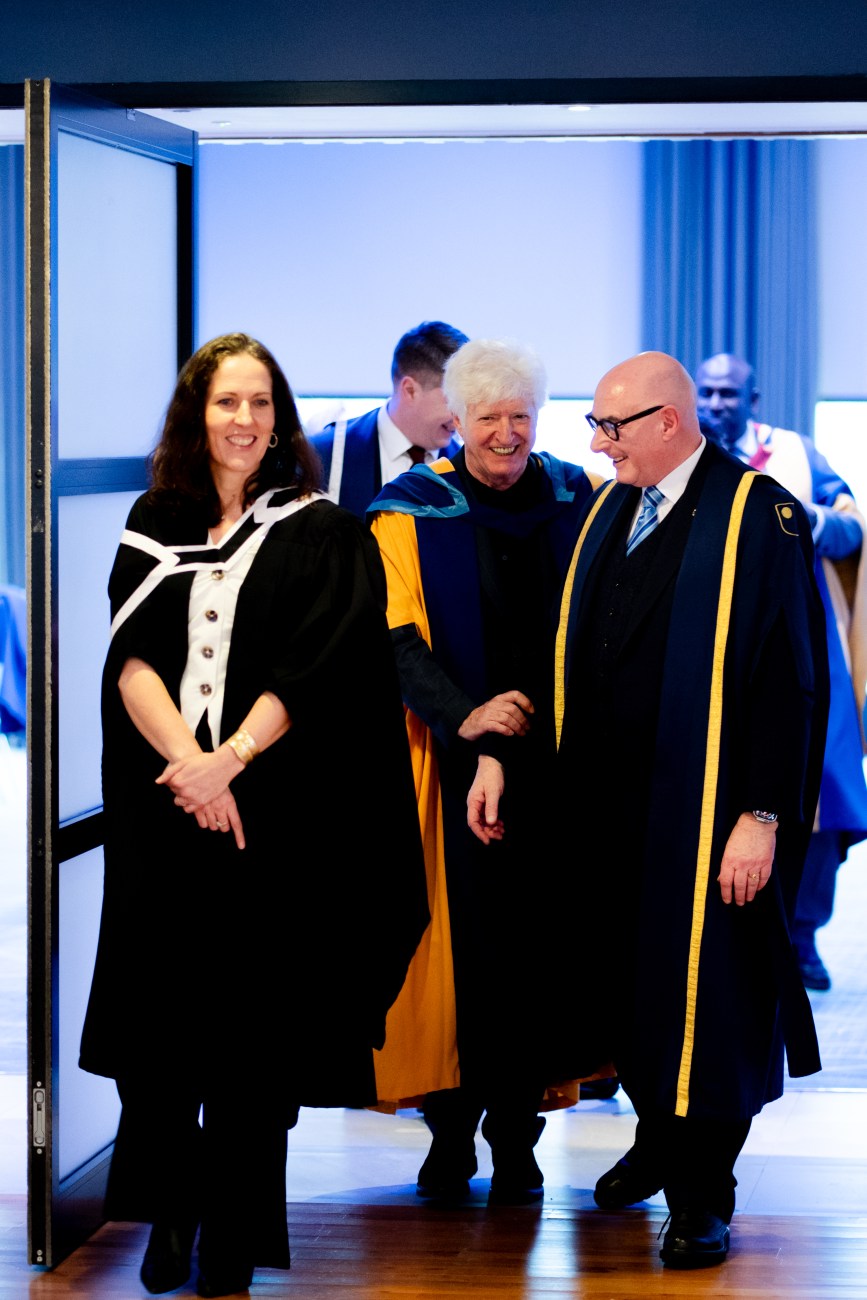
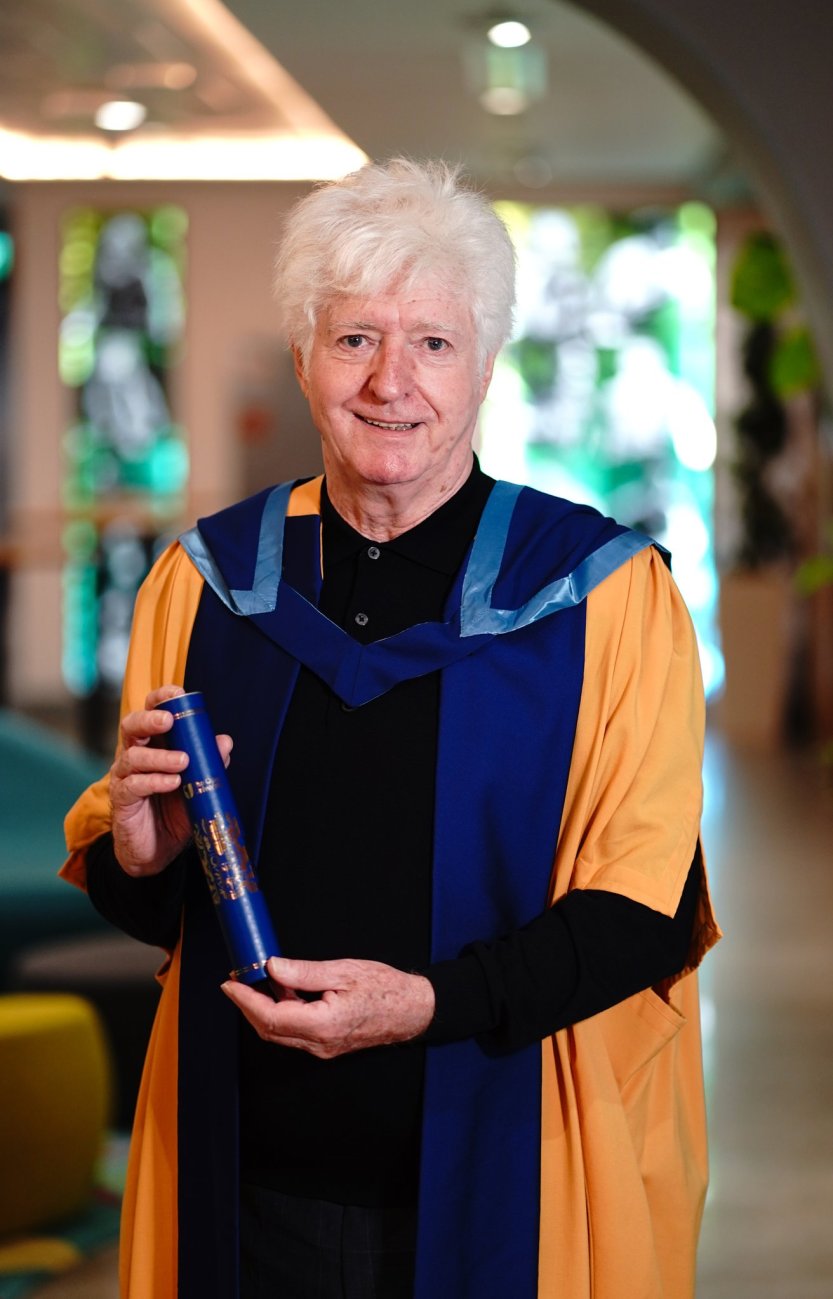
About ten minutes later, Dónal arrived, fresh off a flight from South Africa that had very nearly been cancelled due to disruption in the Middle East. Despite landing at 5am and running on practically no sleep, he looked impeccably sharp in his dark blue suit. He was immediately whisked away to be fitted with his honorary robes in a striking bright yellow and blue.
An official photoshoot followed with John, Tara and me, as well as press interviews. When asked about the honorary doctorate, John had this to say:
Dónal Gallagher’s lifelong dedication to music and cultural exchange has had a profound impact far beyond the stage. His commitment to preserving and promoting Rory Gallagher’s legacy, and his belief in music as a force for connection during some of the most challenging periods in our history, reflect values that resonate strongly with The Open University’s mission. It is a privilege to award him this Honorary Doctorate.
At The Open University, we celebrate the arts not only for their intrinsic value but also for their wider social impact. Dónal Gallagher’s work in nurturing one of Ireland’s most important musical legacies, and in using music as a bridge across communities, embodies that spirit.
Dónal, in turn, said:
This recognition from The Open University is a great honour. Education, culture and the arts should be open to everyone, regardless of background. I admire the OU’s commitment to widening access and promoting lifelong learning, showing that it’s never too late to take a new direction. To be recognised in this way, particularly in Dublin among this year’s graduates means a great deal to me and the wider Gallagher family.
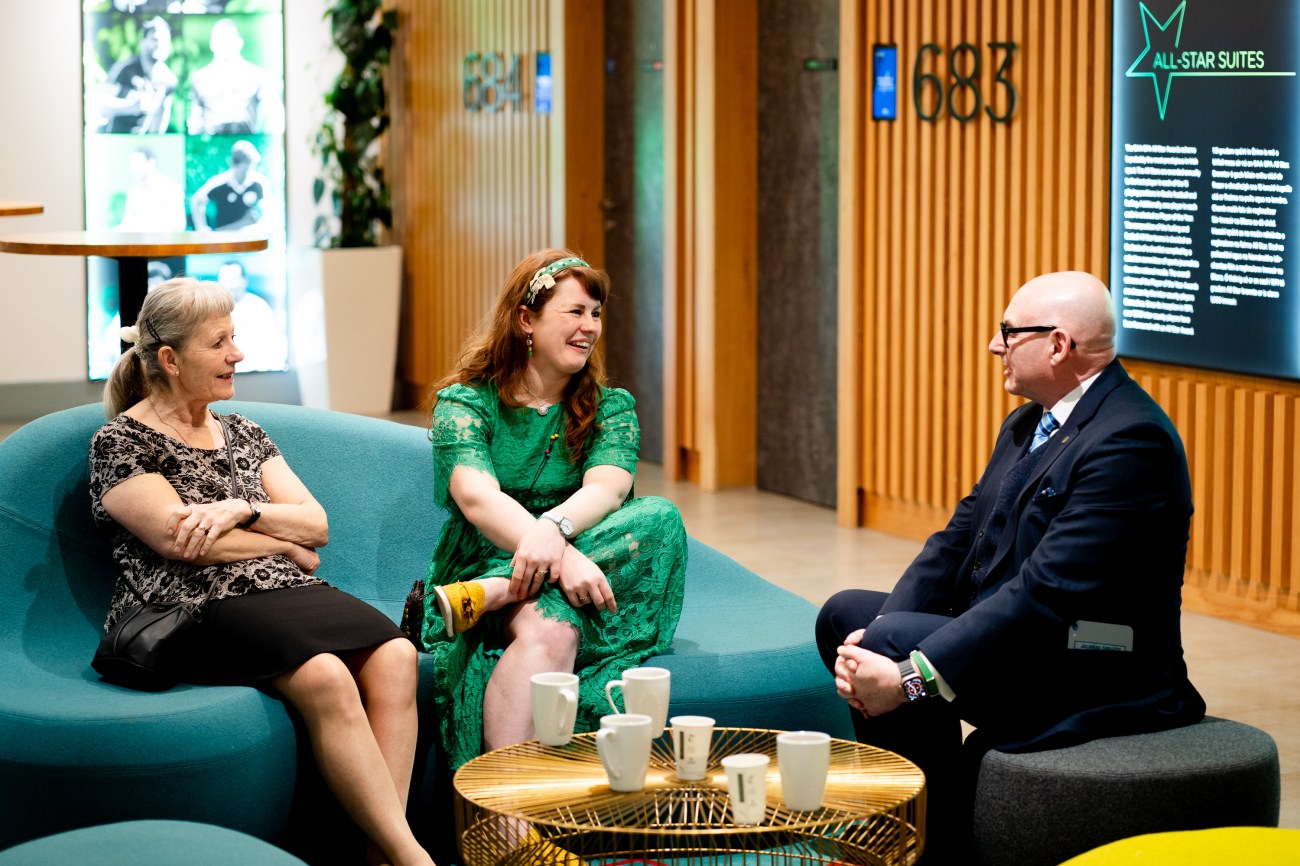
We then moved back into the Hogan Suite for tea/coffee and pastries. The suite’s large glass windows overlooked the pitch, and it felt surreal to have the entire 82,300-seat stadium all to ourselves, empty except for a lone groundskeeper tending the turf below.
Dónal stepped aside to run through his speech with me. He had discussed various ideas with his family, but ultimately decided to focus on their beloved Uncle Jimmy – a principal at RTC in Cork who had been a pioneer in using computers in education and placed enormous value on learning. Thanks to Uncle Jimmy’s vision and the early training of his students in computer skills, Apple chose Cork for its Irish headquarters. “It’s the perfect choice,” I told him.
Dónal was then taken to the ceremony hall with John for rehearsals while more guests began arriving in the VIP suite, including Cecilia and Eoin, Niall Stokes from Hot Press and several members of the Open University leadership team who had travelled over from Milton Keynes for the occasion.
At 12:30, the VIP dinner began. We were treated to a wonderful three-course meal: butternut squash and coconut soup, sirloin steak with Bombay-style rosti and mushrooms, and an assiette of espresso choux, strawberry meringue and lime-and-mango cheesecake, followed by tea/coffee. By the end, I could barely move!
“I hereby declare this ceremony open!”
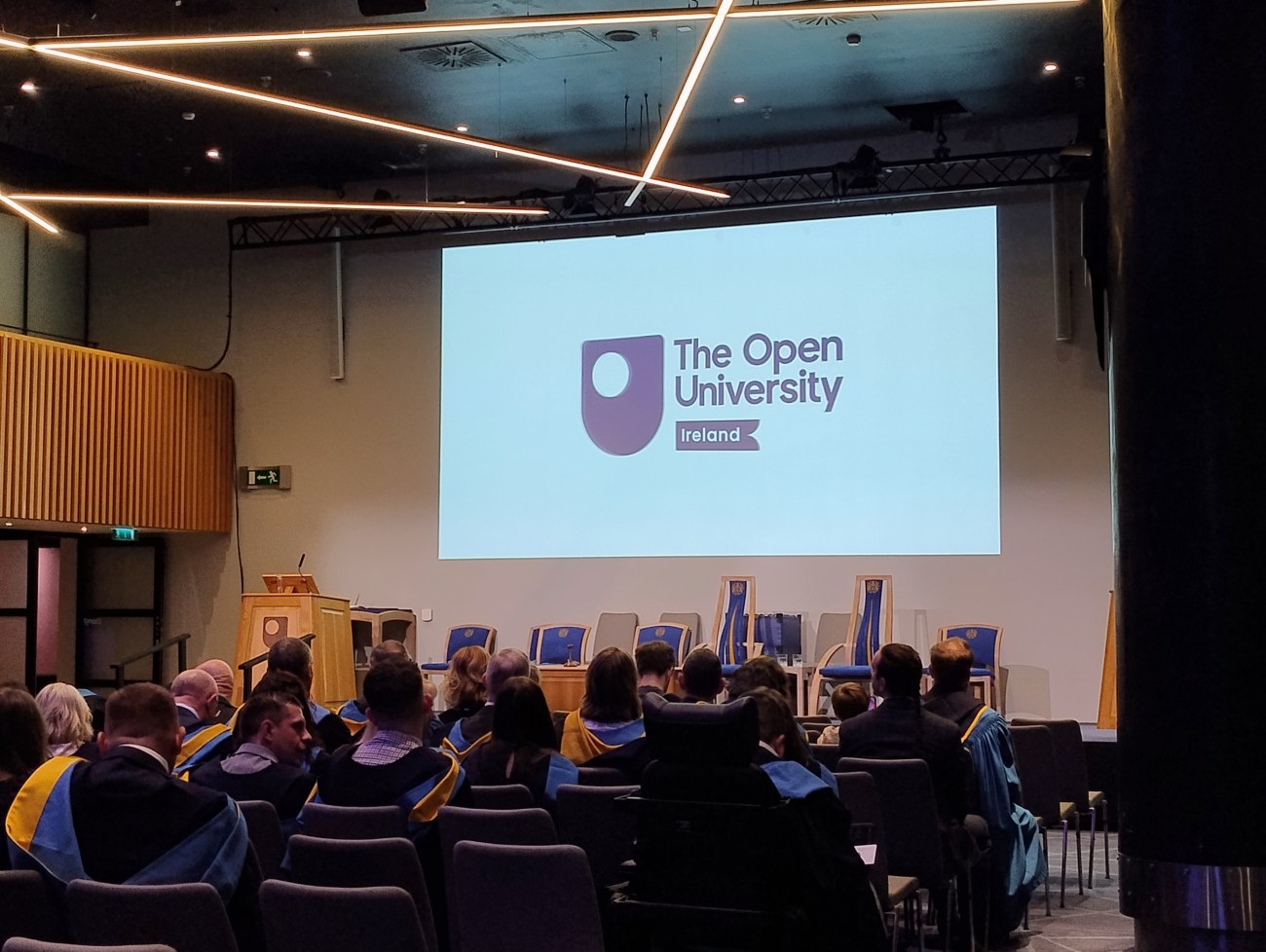
Then, it was downstairs to the large hall where the ceremony would take place. The room was already packed with more than 120 graduates and their families. Although as a staff member, I could have joined the formal academic procession, my natural instinct is always to keep things lowkey, so I slipped quietly into the back of the audience instead.
Open University graduations are very different from traditional university graduations. They’re far more relaxed and inclusive, with an atmosphere that encourages people to cheer and clap as enthusiastically as they would at a concert or a sporting event.
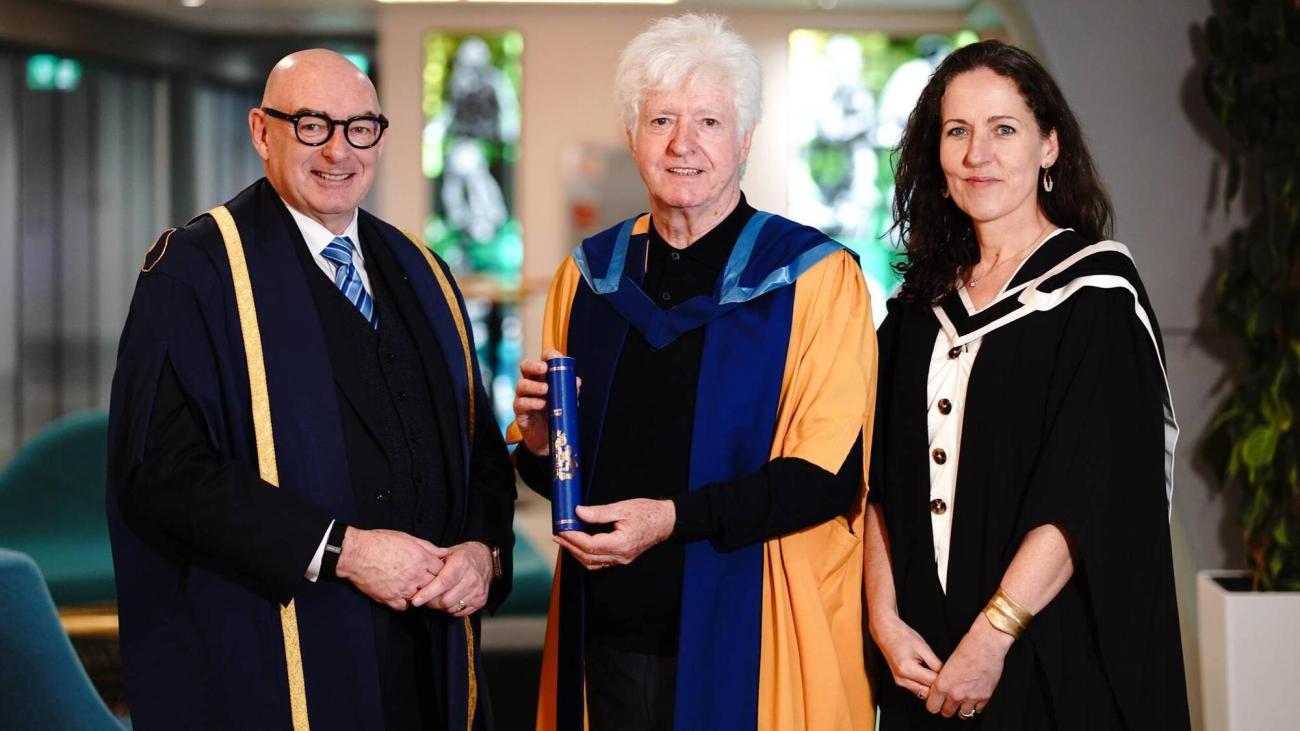
At 2:30, Charpentier’s ‘Te Deum’ began and everyone rose as the academic procession entered. Dónal, looking magnificent in his robes, walked up the aisle following the standard bearer and took his seat in a ceremonial chair on the stage.
John then welcomed everyone and officially opened the ceremony, which was followed by a short film celebrating the Open University and its graduates. In a world that often feels full of chaos and negativity, it was genuinely uplifting to pause and celebrate education and opportunity. One by one, graduates were called up to receive their degrees, each warmly greeted by the audience.
Halfway through the ceremony came the moment for the honorary doctorate. Tara Craig took the stage and introduced Dónal with a wonderful speech outlining his achievements, which I transcribe in full below:
Director, colleagues, graduates and guests, today we celebrate achievements, perseverance and the transformative power of education. At the Open University, we honour learning not as a privilege reserved for a few but as a lifelong pursuit open to all, shaped by curiosity, commitment and experience. It is in this spirit that we honour Dónal Gallagher.
For more than 60 years, Dónal has been a deeply respected figure in the music industry, championing the work of his brother, Rory Gallagher, and helping to foster much needed solidarity and understanding across community divides.
The Gallagher brothers were raised in Cork and grew up listening to great blues, folk and rock and roll artists. Dónal was closely involved in the formation and early promotion of Taste, the blues-rock trio that would become Rory’s breakthrough band. As tour manager for Taste, Dónal oversaw the band’s remarkable ascent, from a residency at the Maritime Hotel in Belfast to a move to London and onward to international tours and landmark performances, including the Isle of Wight Festival and the Montreux Jazz Festival. These were achievements earned through resilience, adaptability and a practical self-directed approach to learning.
Following Taste, Dónal became Rory’s full-time manager, overseeing decades of albums, tours and performances. Under his guidance, Rory became one of the most respected live performers in rock history, regularly cited among the greatest guitarists of all time and a profound influence on musicians as diverse as Johnny Marr, Slash and Brian May. Often described as Ireland’s first major rockstar, Rory helped pave the way for artists such as Thin Lizzy, U2 and the Boomtown Rats.
Both brothers regarded Belfast as a second home and were committed to performing in the city during the Troubles – a time when many others stayed away. Dónal continued to organise concerts at venues such as Mandela Hall and the Ulster Hall. Despite the ever-present threat of violence, these performances brought all faiths together in a shared appreciation of music, standing as a powerful reminder of its capacity to unite communities across difference.
Dónal Gallagher’s influence extends far beyond management. Indeed, he has been at the forefront of British and Irish rock music since the early 1970s. Dónal was one of the driving forces behind Ireland’s first major outdoor rock festival in Macroom, County Cork and was closely associated with the emergence of the influential music magazine Hot Press. He has also run an independent record label Capo Records and publishing company, Strange Music.
It is fair to say that Dónal did not just manage music; he safeguarded history. Since Rory’s death in 1995, Dónal has maintained responsibility for his brother’s recordings, ensuring they remain accessible to long-standing admirers while reaching new generations. Through posthumous releases, archival projects and innovative work such as Kickback City, he has shown how knowledge, when carefully preserved and shared, continues to educate and inspire.
At the Open University, we celebrate the arts not only for their intrinsic value but for their power to connect people, challenge assumptions and shape society. Dónal Gallagher’s life and work exemplify these ideals.
Director, by authority of the Senate, I present to you for the honorary degree, Doctor of the University, Dónal Gallagher.
Then Dónal was called forward. He bowed, shook hands with John and signed the honorary graduates’ book, before stepping onto the podium to deliver his speech. Understandably, he seemed a little nervous at first, but he quickly settled into it. He spoke about travelling with Rory in the early 1970s, when the timing of their journeys often meant they would hear Open University programmes on the BBC while driving across Britain. He also spoke movingly about Uncle Jimmy and his lifelong belief in the value of education. He concluded by congratulating all the graduates and thanking everyone who had made the day possible, before ending with a joke about how he was very much looking forward to a pint afterwards. which drew a big laugh from the room.
The ceremony then continued with the other graduates coming forward to receive their awards, before the ceremonial song played once more as we rose and the academic procession filed out.
The full video is now up on YouTube and can be watched here.
Afterwards, we returned to the VIP suite for a champagne reception, while the other graduates celebrated downstairs. I gave Dónal a big hug, telling him how brilliantly he’d done and how proud Rory would have been. He was then presented with a bound book of photographs and other mementos from the day. After about half an hour, the formalities wound down, but the evening was only just beginning.
We carried on the celebrations at Dónal’s hotel bar well into the evening, where he enjoyed a very well-deserved Guinness (or two!). At one point, a young man who had received an engineering degree at the ceremony came over to congratulate him. His mother then stepped forward, speaking warmly about seeing Rory live in the ’70s. I wish I could bottle the joyous atmosphere in that room and keep it forever.
As someone who lives with a lifelong anxiety disorder, attending events like these is a monumental challenge. I had to push through endless self-doubts, racing nerves and the familiar urge to retreat, but once I was there, witnessing Dónal’s achievement and sharing in the joy of everyone around me, I felt a profound sense of pride and gratitude. I’m so incredibly glad I didn’t let my anxiety hold me back.
If only Rory could have been there too to share in the celebrations.
Postscript
While on my flying visit to Dublin I couldn’t miss the opportunity to do the rounds and visit a few Rory-related places. So, with no peace for the wicked (as a wise man once sang!), I was up early the next morning and straight down to the Irish Rock ‘n’ Roll Museum Experience in Temple Bar.
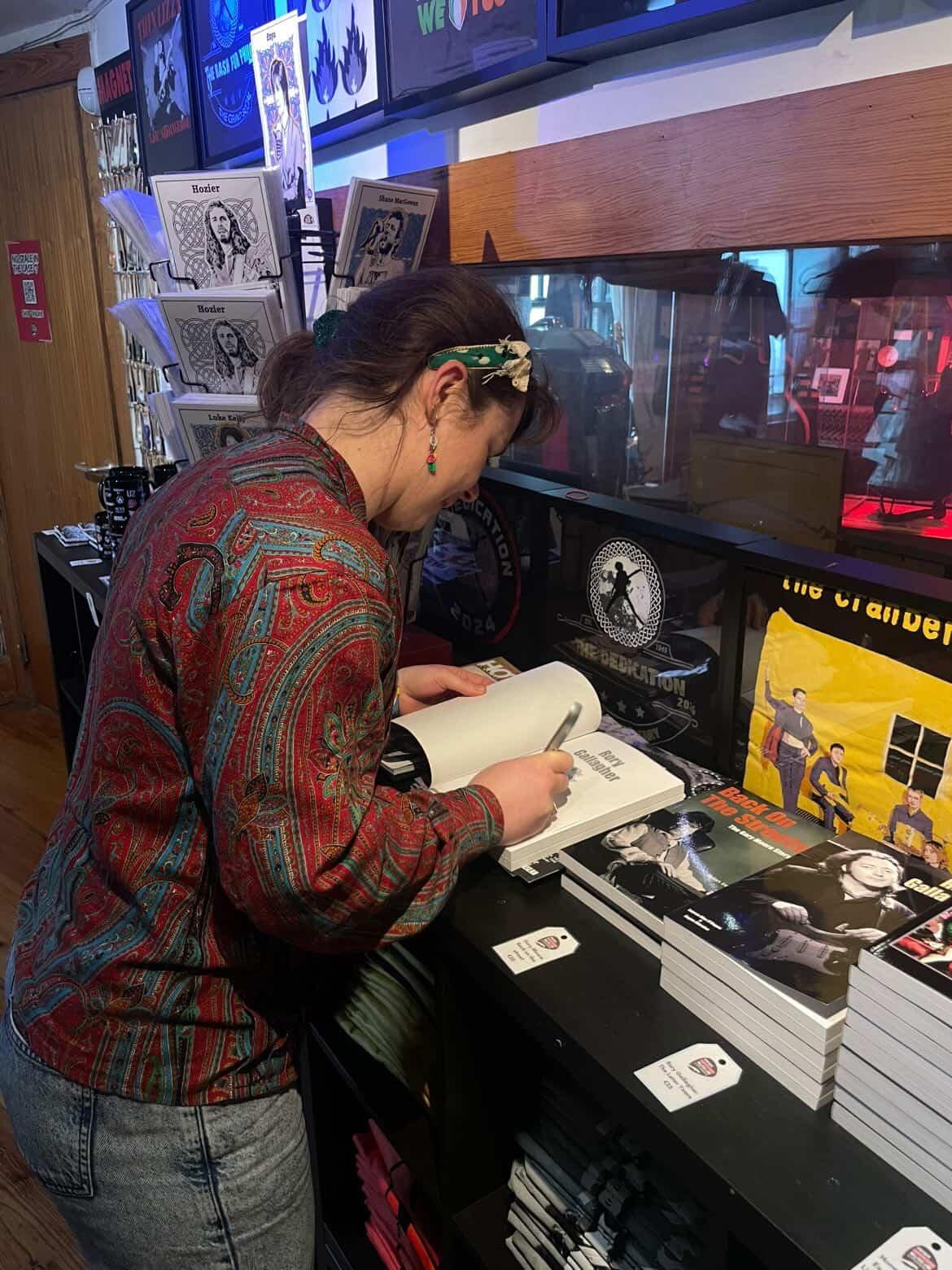
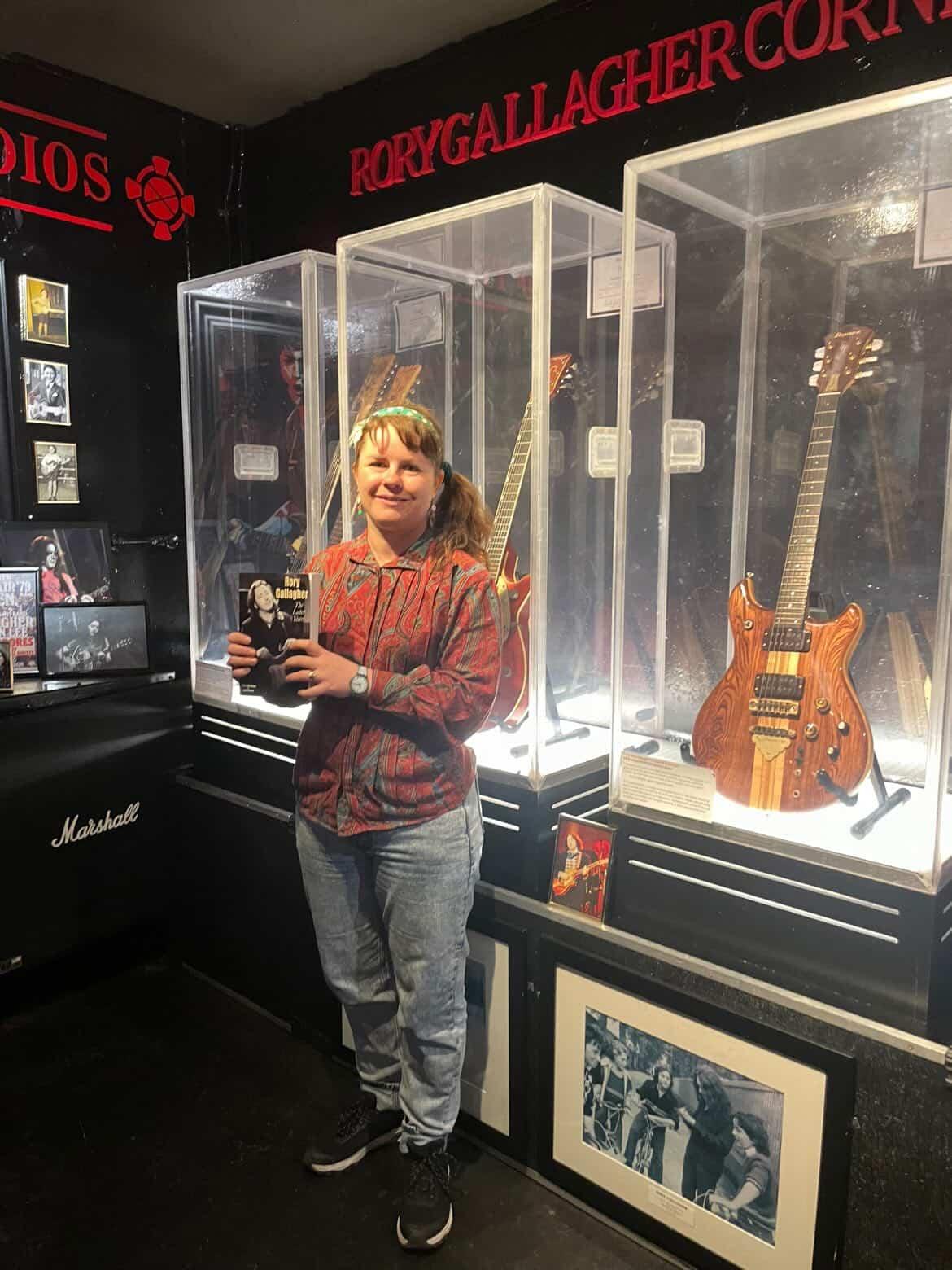
There I met members of their social media and marketing team and signed copies of Rory Gallagher: The Later Years for the museum gift shop. They also very kindly gave me a private tour of their newly acquired Rory and Gary Moore material, as well as the very special Thin Lizzy room, which was incredible. They made me feel so welcome. I also met the head tour guide, who, funnily enough, is currently reading my book!
Next stop was Collins Barracks to see Rory’s beloved Strat. Having seen photos of the display online, I’ll admit I didn’t have particularly high hopes – and sadly, I wasn’t proved wrong.
The guitar is tucked away on the very top floor as part of the “Changing Ireland” exhibition, in a display that does it few favours. Although it’s the first thing you see upon entering the chamber, it sits alone in the corner of the entrance hallway, bathed in a harsh bright pink light that clashes with its natural wood. A tiny plaque simply states that it was Rory’s, with very little additional information and no posters or memorabilia to provide context. The Vox amp and Treble Booster are also not included in the display, which would have helped tell the full story.
Despite all this, seeing it in person still moved me just as much as the first time I saw it at Bonhams in October 2024. So much of Rory is in that instrument. It truly has its own aura, radiating his energy, spirit and intensity.
And the most important thing is that it is safeguarded here in the National Museum, not tucked away in a bank vault. Anyone who walks in – even someone who has never heard of Rory – has the chance to discover his music. And hundreds of years from now, it will continue to inspire.
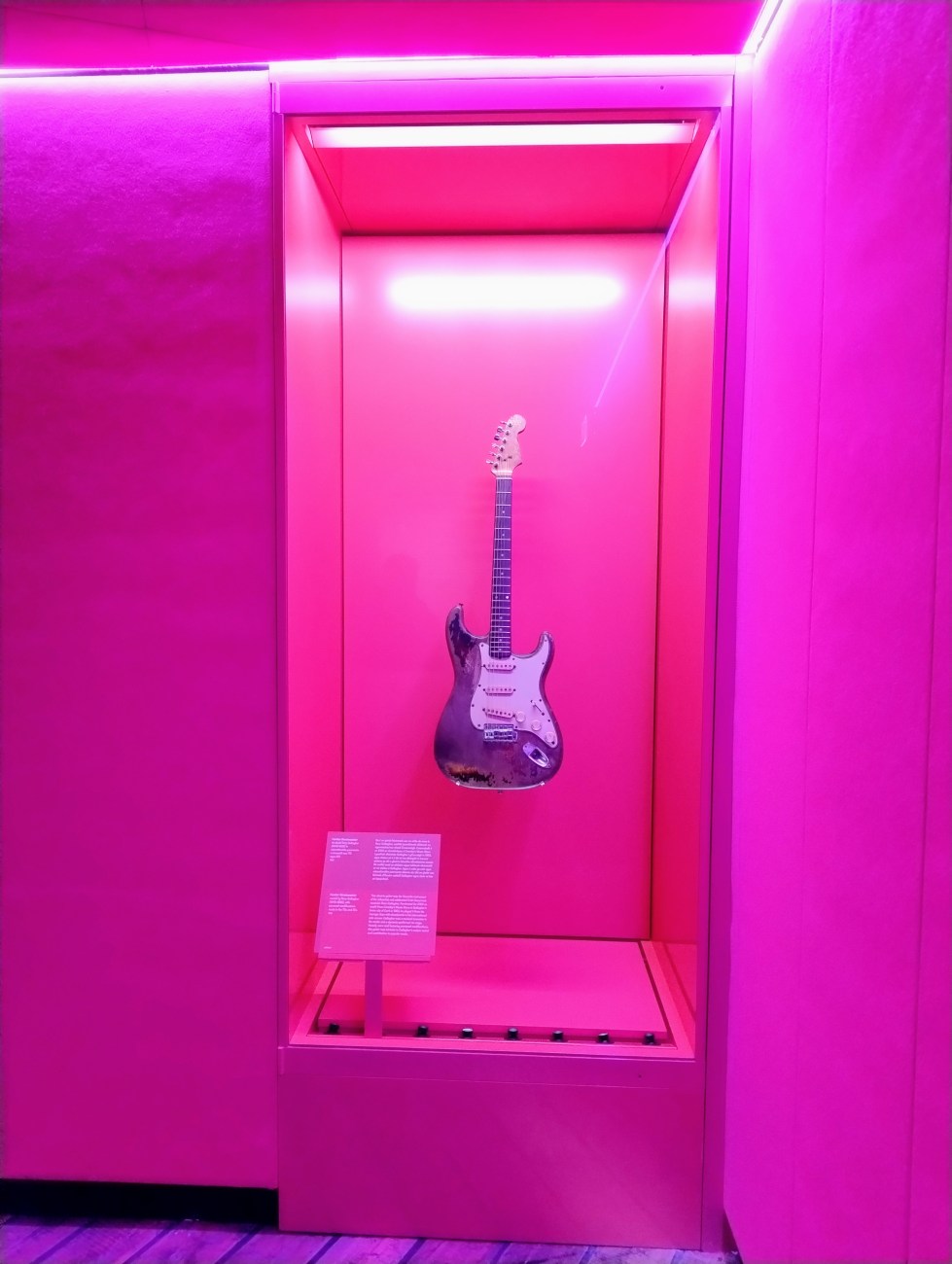
I must also compliment the fantastic poem by Paula Meehan displayed opposite, which I’ll copy in full below. The last lines, in particular, really struck me.
Is Rory Gallagher’s Guitar in This Show and If Not, Why Not?
I figure you as Orpheus, Rory, in your plaid shirt,
lumbering onstage one summer of love, City Hall, Cork;
son of a Muse, guitar for lyre, driving the crowd wild,
all us trainee Maenads ready to rip the head
off any son of a bitch who’d block our urge to dance, to sing,
the whole joint steaming, rocking into ecstasy and peace.
And all of us so into it, and most of us so out of it,
and some of us were twisted, and some of us were straight.
We hammered our air-guitars, rattled our bangles and beads.
We find you, Rory, in the constellation Lyra, rising
to the blue blue night. I dream you tucked up in bed
(trichomaniac that I am), like a long-lost child,
I comb the tangles from your lustrous curly locks,
make you mirror sonnets, lullabies, to soothe away the hurt.
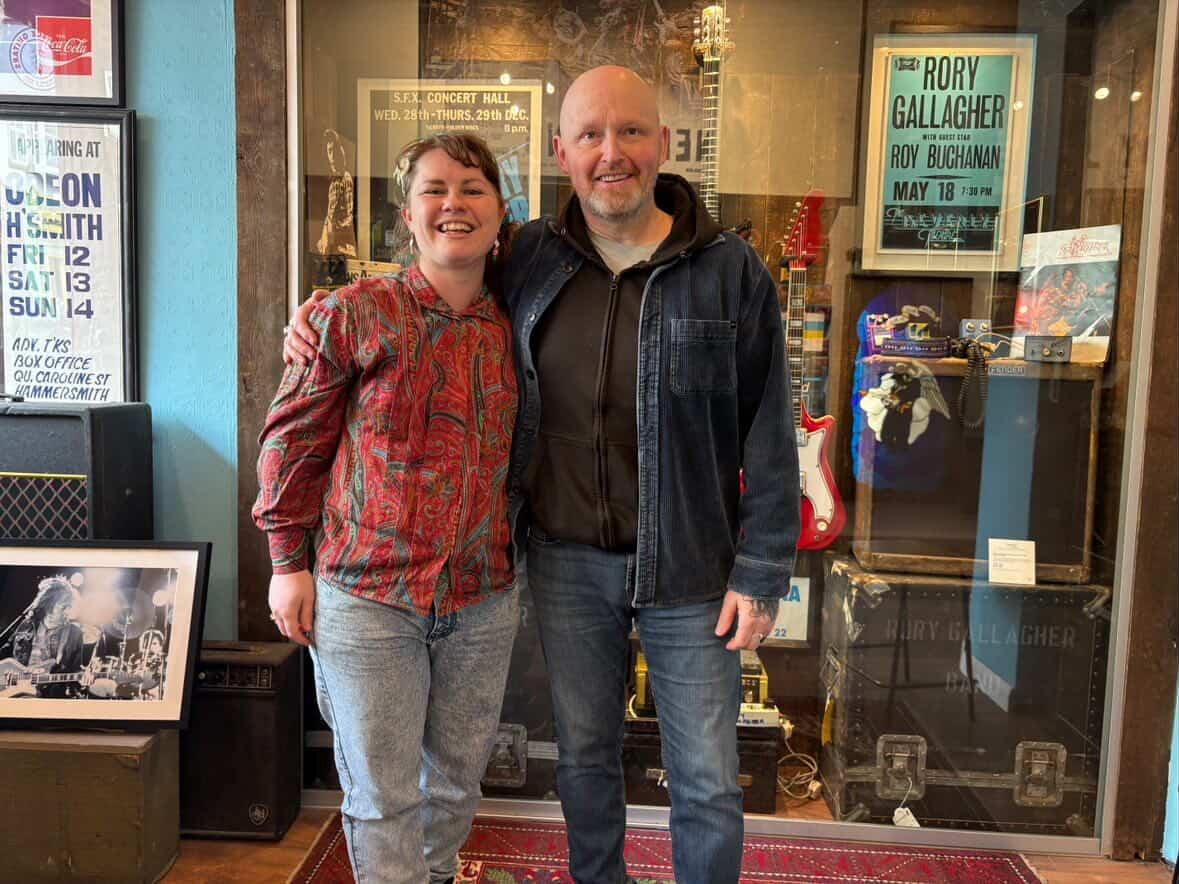
Finally I made my way to Some Neck Guitars to meet Owen McQuail. We’ve been online buddies for just over six years now, so it was wonderful to finally meet in person. Within minutes, we were deep in conversation, united by our shared love for Rory (and oddly enough, also our fascination with the ‘heroic’ age of polar exploration!).
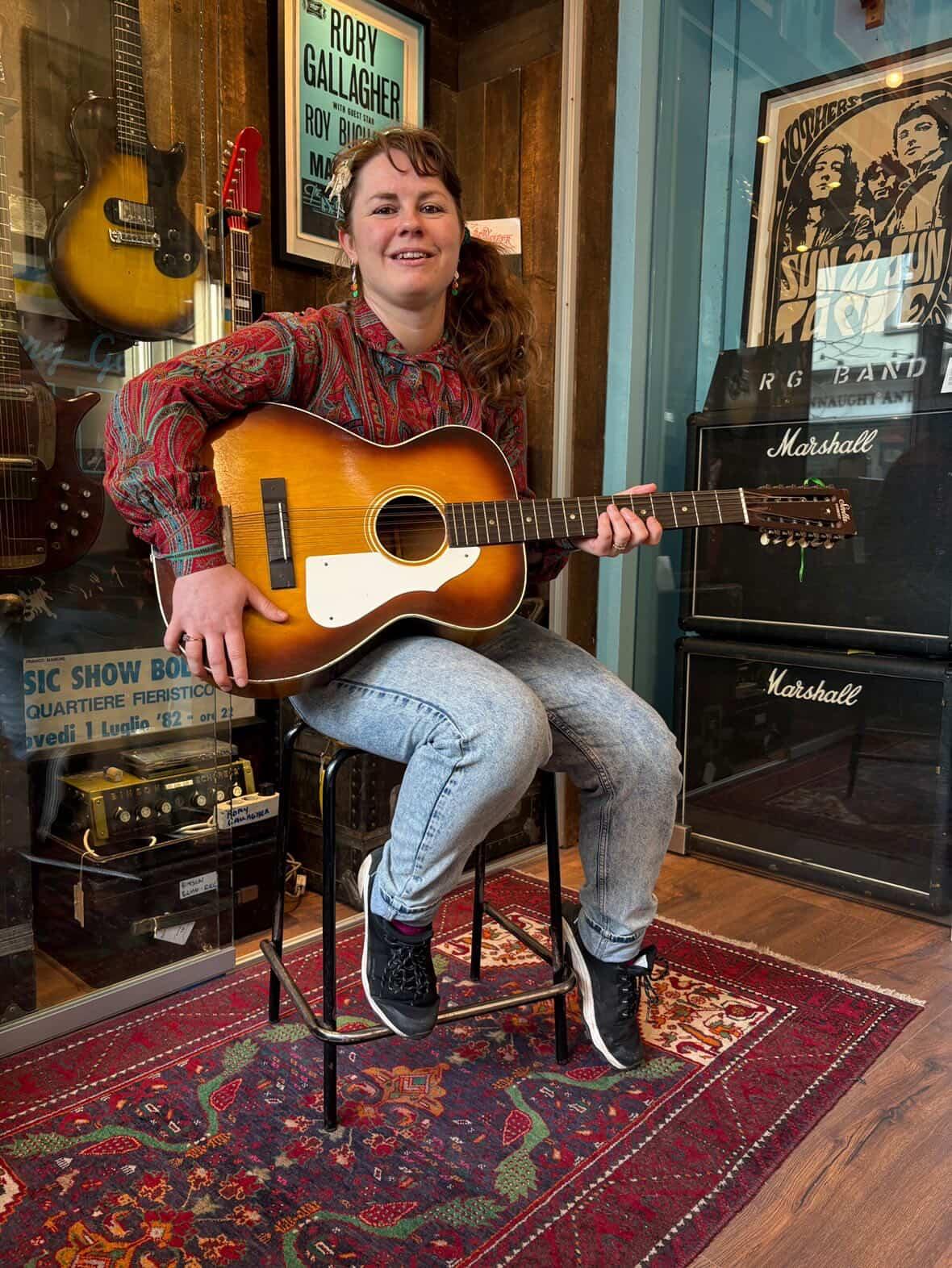
Owen immediately brought me over to the cabinet holding the Rory items he had acquired at Bonhams, opened it up, handed me Rory’s Melody Maker and set up a stool for a little impromptu photoshoot. Then followed the sitar, Airline and Stella. I can’t even put into words just what that meant to me and I found myself welling up.
Holding these instruments in my arms felt truly magical. It may sound strange to say, but I could sense different moods resonating from each one. The sitar, for example, radiated an unbelievable vibrancy and energy. The Stella, by contrast, felt heavy and weighted with sadness.
Owen was also kind enough to give me a spare valve from one of the amps and a 1977 tour badge.
Owen’s set-up is far superior to anything I’ve seen in a museum and I would wholeheartedly encourage anyone in Dublin to call in and see it for themselves. It’s clear how much care, thought and love has gone into preserving these instruments and presenting them in a way that truly honours Rory’s legacy. They couldn’t be in better hands.
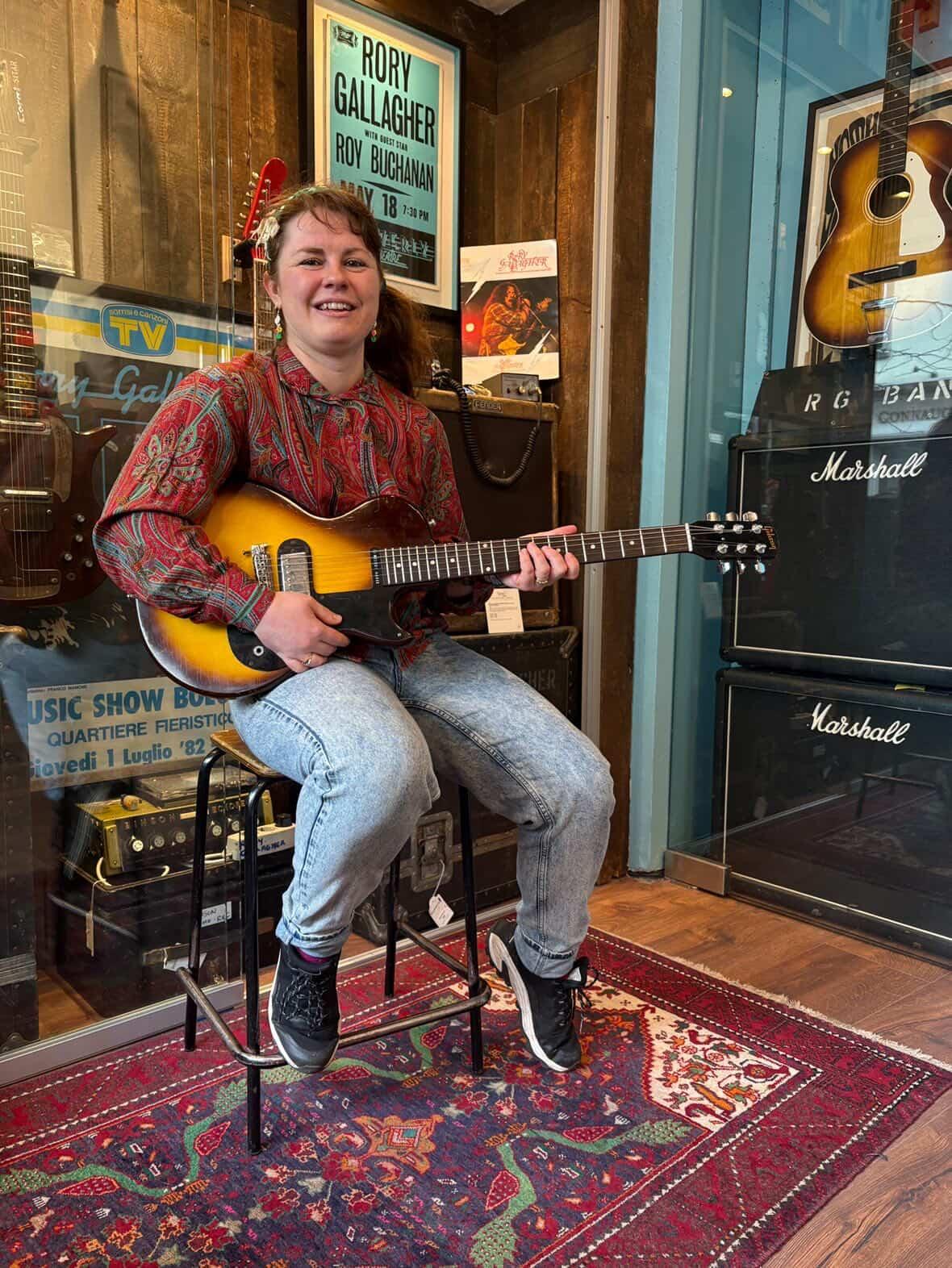
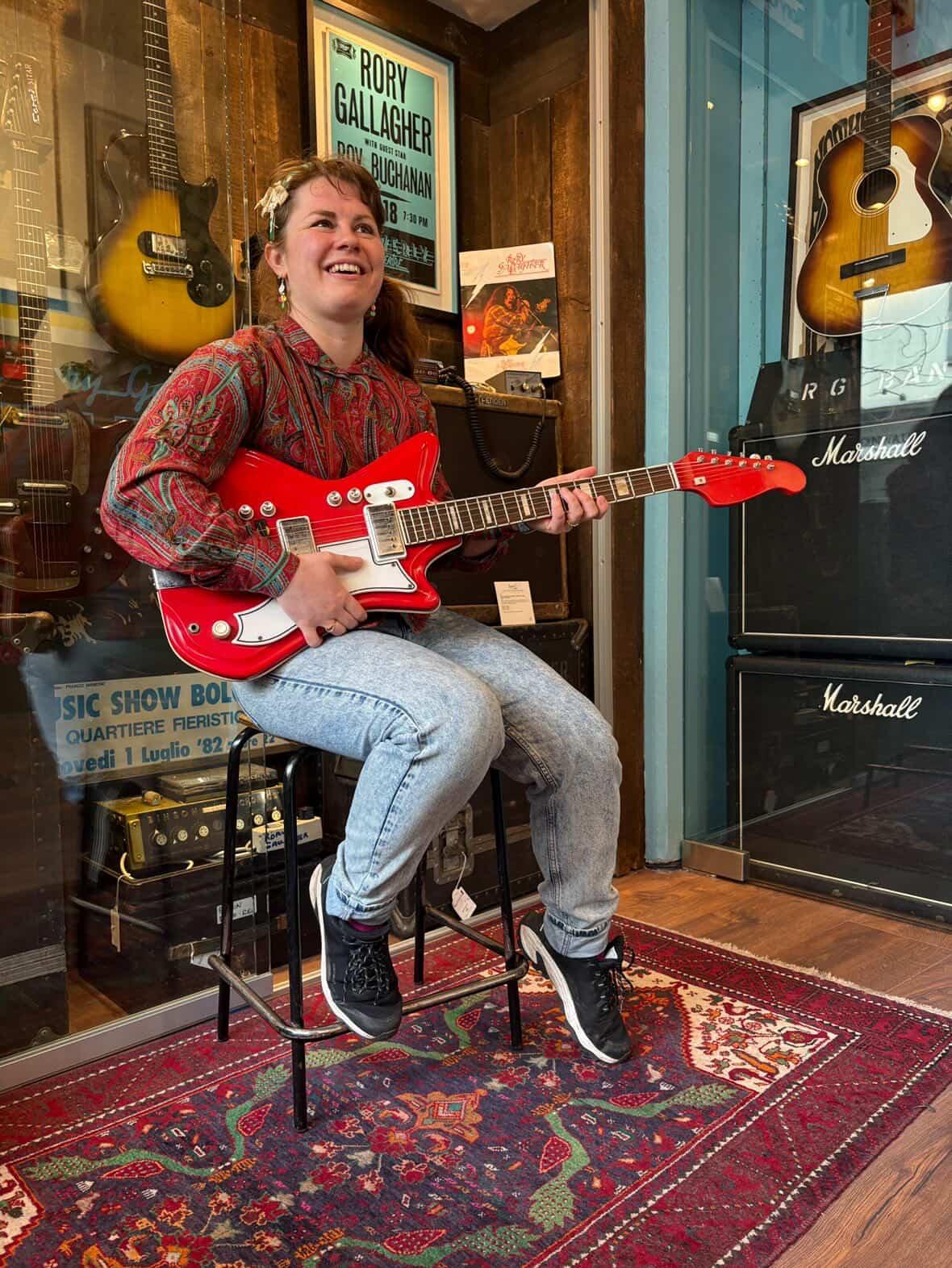
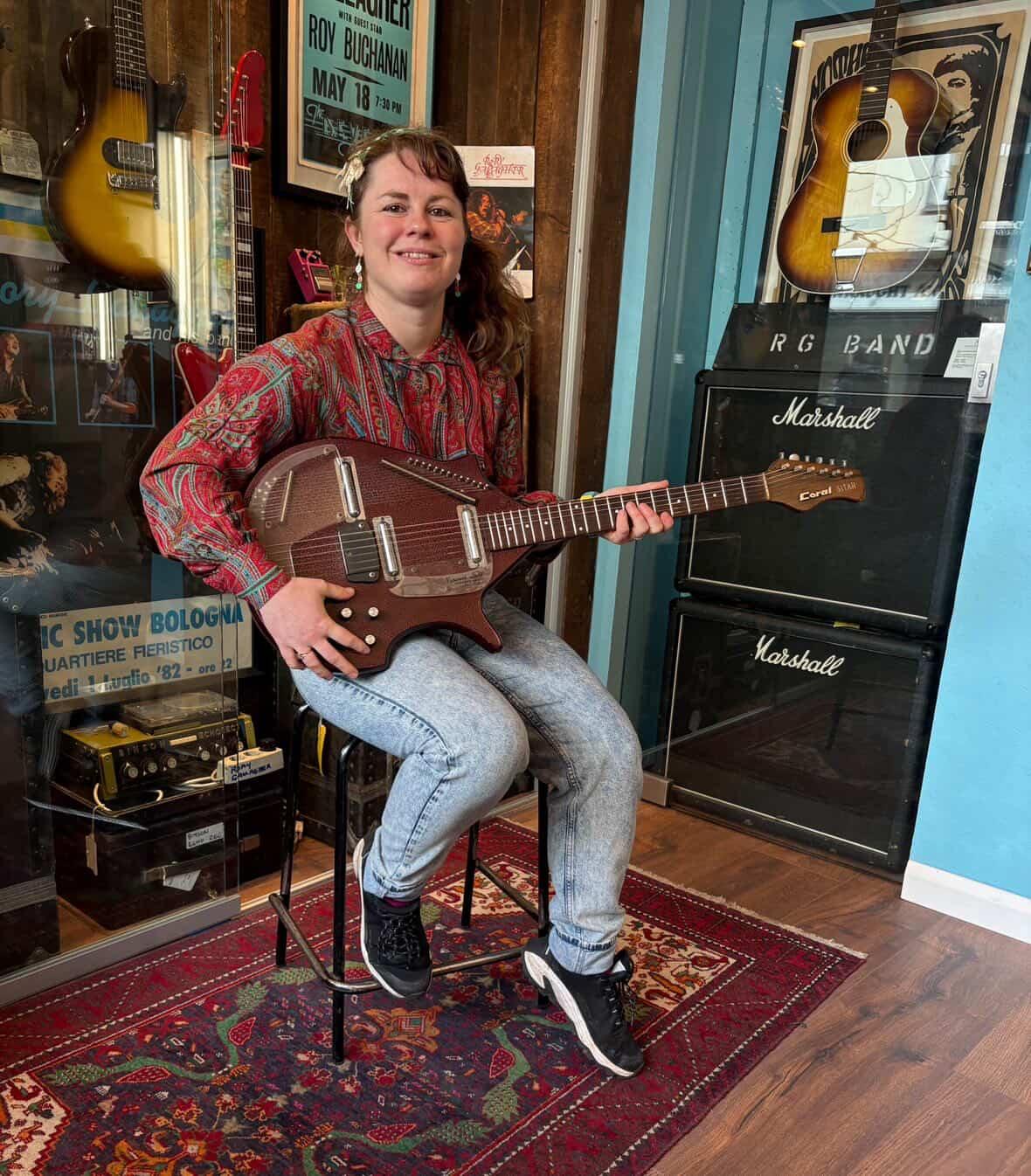
I have always loved Dublin ever since my first visit as a Lizzy-obsessed 13-year-old for the unveiling of the Phil Lynott statue and Thin Lizzy concert at the Point. But this visit – brief though it was – felt particularly special.
What a city.
What people.
As Philo once said:
“Until the next time…”


 REWRITING RORY
Leave a reply to coffeeslowly3116a5902e Cancel reply