
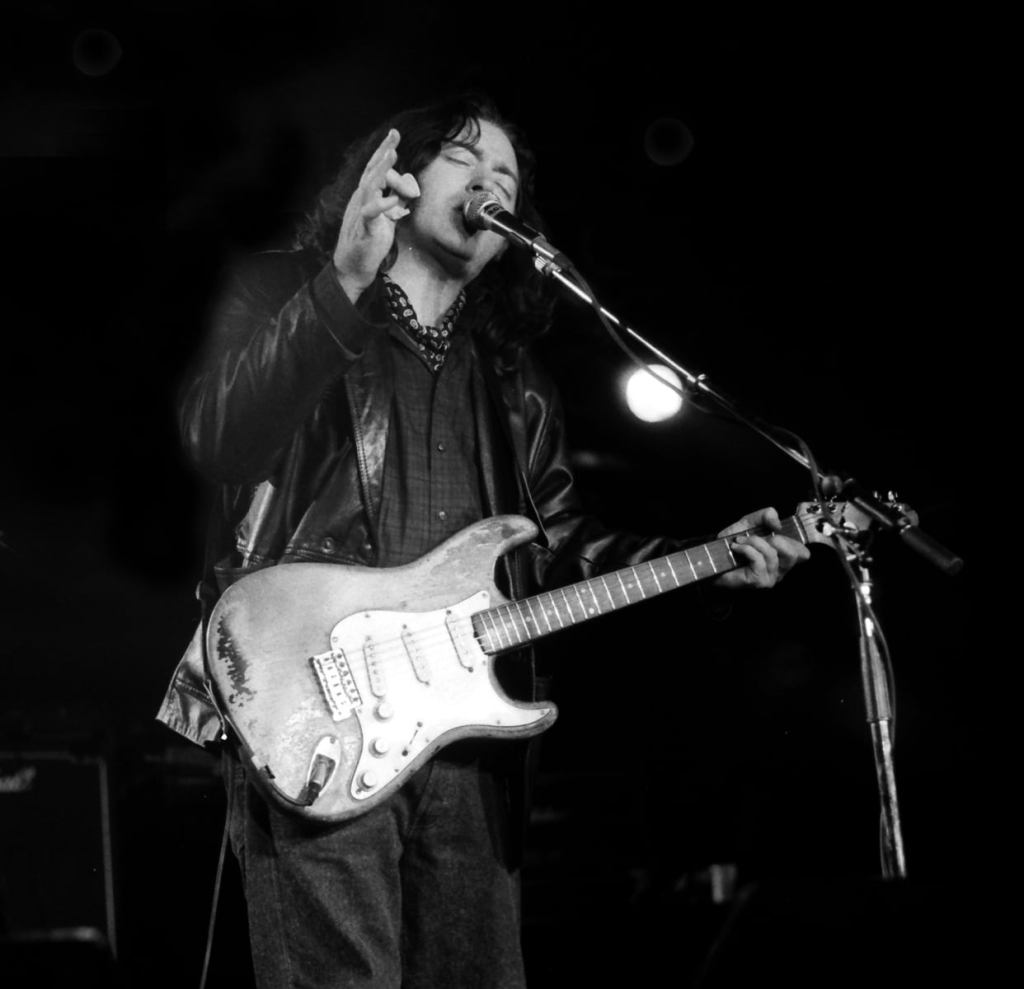
Today, I’m continuing the One Song, Many Lives series with a closer look at one of Rory’s most beloved and revealing tracks: ‘Tattoo’d Lady’. Written for his 1973 album Tattoo, it became a staple of pretty much every live show he played from that point forward.
As with so many of Rory’s songs, ‘Tattoo’d’ Lady was never performed the same way twice. It’s a song that lives and breathes, adapting to both his mood and musical progression, which is what makes it so fascinating to revisit across different recordings. But before diving into a few standout live performances over the years, let’s linger a little on the original studio version.
In a 2023 interview with This is Rock magazine, Rory’s brother and longtime manager Dónal shared that he had a particular “soft spot” for ‘Tattoo’d Lady and actually preferred it to ‘A Million Miles Away’ – another fan favourite from Tattoo. For him, the song is deeply personal:
It’s about childhood memories that we share together. When I hear the song, I immediately smell the scents of the fair. I see the colours and the special figures we encountered. We received a little money from our parents and for the first time we were allowed to decide for ourselves what we did with it. Those were beautiful days.
But Dónal also points to a more bittersweet undercurrent to the song as capturing something transient and elusive:
One day you couldn’t escape the lights and bright colours of the fair; the next day, everything had disappeared. The fairground people packed everything up at night and left. The life they lead has many parallels with that of a touring musician. I think Rory recognised himself in that.
In that sense, ‘Tattoo’d Lady’ is as much about identity as it is about memory. According to Dónal, Rory wasn’t just reminiscing about childhood visits to the fair; he was also identifying with the fairground people as outsiders who did not quite fit into mainstream society. In the fairground, he saw a non-judgemental space where he belonged.
Clocking in at just under five minutes, the original studio cut opens with one of the most distinctive intros in Rory’s catalogue: the nostalgic sounds of the fairground. In a 1975 interview with Australian radio station 2JJ, Rory explained how the effect was created:
I went into Woolworths and bought this organ, cheap child’s organ for £24 and brought it up to the studio and Lou had a go at it and we miked it up and it has that real cheap little sound. And that’s what we use on the track, but the actual intro leading into the sound proper is back to front. It’s backwards with a twelve-string going through a Leslie backwards as well. You know, just creating a kind of a mysterious atmosphere.
From there, the track settles into a beautifully textured piece that expertly weaves together blues-rock and folk into a rich tapestry of musical storytelling. The groove is loose and loping – almost a fast ballad in tempo – and carried by an ensemble that plays with effortless intuition. Lou Martin’s piano work is a standout feature here, adding a touch of vaudeville flair to Rory’s evocative lyrics about fairground life and the different characters who populate that peripatetic world.
Rory’s two solos in this studio version are stunning – melodic, spacious and unmistakably Irish in phrasing. The first sings, not shouts, deepening the emotional tone of the track. And the second closes the song with a fiery yet controlled flourish, perfectly capturing the tension between nostalgia and longing that define the track.
The Melody Maker review at the time picked up on just how rich this soundworld was:
Tattoo’d Lady is founded on a pulsating chord which catches the breath as it boils on. It’s about the biggest sound Rory’s ever come up with… the guitar solos are choice, eddying and melodic with a fuming power behind them. Rory sings taut and gasping.
Rory was famously opposed to releasing singles, and I totally respect his artistic integrity on that front. But I have to admit that this track has a radio-friendly charm that could have easily won over a wider audience without compromising his authentic sound.
Irish Tour ‘74
Ask many Rory fans for their favourite version of ‘Tattoo’d Lady’ and chances are they’ll point straight to the Irish Tour ’74 film version. Director Tony Palmer masterfully captures the electric atmosphere of a Rory gig: from Rory and Dónal backstage walking down corridors to the chants of “Rory! Rory!” echoing from the concert hall, then Rory nervously waiting in the wings with his Strat before casually strolling out on stage. With a quick “2, 3, 4,” he bursts straight into the song. There’s no tricks, fancy costumes or light shows – just Rory plugging in and playing, relying purely on his musicianship and presence.
What starts as the familiar studio version quickly transforms into something transcendent: Rory’s tone is warm and expansive, his smile infectious throughout and his energy utterly captivating. Lou Martin’s piano opens the first solo section with an energetic, boogie-woogie flair, perfectly setting the stage for Rory’s fiery guitar to take over. But it’s Rory’s second guitar solo that truly sets this rendition apart. He pours his soul into every note, eyes closed, drenched in sweat, completely absorbed. The solo flows effortlessly, melodic and deeply expressive, with nuanced phrasing that builds tension and excitement. Remarkably, he plays rhythm parts seamlessly while soloing, even weaving in a subtly out-of-phase guitar effect that adds an eerie texture. The solo ends all too soon, leaving you craving more. With a single hand raise, Rory signals to the band to wrap it up, ending the song with the same unpretentious grace that defines the entire performance.
Rockpalast 1979
If you thought the Irish Tour ’74 version of ‘Tattoo’d Lady’ was a powerhouse, then the Rockpalast 1979 performance is an outright showstopper – a full-throttle explosion of hard rock energy that leaves me breathless each time I watch it. Reflecting the raw intensity of the stripped-down three-piece Rory had returned to, this rendition hits like a sledgehammer, especially following the acoustic interlude that precedes it.
By this point in the ‘70s, Rory’s approach to the song had evolved. He starts with a Hispano-Celtic riff, repeating it several times before elaborating outwards, weaving in darker minor chords that add an ominous edge. The riff builds over and over, tantalising the crowd, before he breaks into the familiar opening of the song, punctuated with staccato notes.
Vocally, Rory’s tone is rougher and more rugged here – perfectly suited to the band’s harder, more aggressive edge. His first solo loosely echoes the studio version’s foundation but soon veers off on wild, improvisational tangents. But like with Irish Tour ’74, it’s the second solo that hits hardest. Rory channels pure fire, pushing the band harder with constant fist signals. His fingers climb the fretboard fluidly, building intensity note by note. You see him tapping, bending, pulling strings – utterly immersed in the moment. He moves across the stage with purpose, playing to the crowd and, at one point, leans right into his Strat, squeezing every drop of sound from it, tapping his foot in perfect time, completely in the zone.
Then, he signals to Ted for a drum solo and takes a moment to shake hands with fans, before skipping his way back to centerstage and launching into a gorgeous riff variant of the original, complete with intricate tapping. He raises the Strat to his shoulder and ‘machine-guns’ the crowd. The reverse camera shot, looking out over the sea of fans, captures the moment perfectly. Rory seems utterly possessed by the music. One minute, he’s jumping and fist-pumping, the next, he’s down on his knees tearing sound from the guitar with such intensity it’s no wonder the wood above the scratchplate bears the scars.
Next, Gerry rips into a killer bass solo, followed by another drum solo from Ted. Rory slowly brings the riff back, pushing the band harder as they ramp up the speed, running the riff faster and faster. There’s more machine gunning from Rory as he runs around with boundless energy. And just when you think it’s over, he pulls another blistering solo out of nowhere – scratching his fingernails along the strings and sustaining a searing note as he faces Gerry and Ted. They drop out, and with a final, gutsy, flourish, he brings the explosive song to an unforgettable close.
Phew, I think I need a lie-down!
Offenburg 1982
It’s audio only, yes, but this version of ‘Tattoo’d Lady’ from Offenburg 1982 practically leaps out of the speakers. With Brendan O’Neill now on drums, the trio’s dynamic shifts, but the same raw intensity Ted brought earlier is very much alive. From the opening seconds, the crowd is all in, clapping along wildly as Rory tears into the riff. There’s no drawn-out Hispano-Celtic build this time; he goes straight for the jugular. At one point, Rory pauses – the crowd is so thunderous he just lets them have their moment – then launches the riff again, this time with Brendan and Gerry locking into a ferocious groove that surges to a full crescendo before the vocals hit just after the one-minute mark.
Vocally, Rory sounds fantastic here. Unlike some of the rawer 1979 recordings where months of relentless touring (300+ gigs that year!) sometimes took a toll, here his voice has regained its tone – still rough-edged, but with more control and power. The first solo echoes Rockpalast ’79 in shape, but is peppered with fresh licks and phrasing. But once again, it’s that second solo where everything goes up a level. Like a story unfolding, Rory starts low and controlled – long, bent notes hang in the air before flurries of intricate picking burst out like sudden thoughts. He sculpts peaks and valleys with his razor-sharp dynamic control: snarling aggression one moment, haunting sweetness the next.
Then, Rory drops out and Gerry steps forward with a funky bass solo that grooves hard. Rory returns, not by blasting in, but by teasing the opening riff in staccato fragments, gradually pulling listeners back into the main theme with a quasi-echo effect. At this point, he begins playing with volume swells and palm muting, almost painting with sound. Like in live versions of‘A Million Miles Away’, he uses silence and restraint as tools – the volume rolls down to a whisper, then explodes back up, hitting like a sonic gut-punch.
The finale is pure forward momentum: a frenzied escalation of the main riff, speeding up like a runaway train as Rory pushes the band to the edge. A perfect storm of rhythm and lead drive the song to its electrifying climax. “This was their night. Nothing went wrong,” wrote a YouTube commenter – and it couldn’t be truer. The sheer power is palpable, even in audio alone.
Cork Opera House 1987
1987, and we have yet another transformation of ‘Tattoo’d Lady’. This version holds a special place in my heart as it was the first time I ever heard the song (Cork ’87 being my intro to Rory). The opening is a masterclass in atmosphere: the Hispano-Celtic riff returns, now fully blossomed into a full flamenco flourish. It builds slowly, creating an almost electric anticipation that must have had the audience hanging on every note. There’s also a discernible touch of sadness woven into the tones – a subtle hint of reflection or longing. But before you can dwell on that introspective moment, Rory deliberately shatters it, launching into the hard-driving opening riff as if breaking free from his own reverie.
Brendan’s pounding drums anchor tightly with Gerry’s bass as Rory walks with purpose to the edge of the stage, illuminated by a bright beam of light – the perfect visual metaphor for a man in full command of his craft. A huge smile lights up his face as he sings the opening lines, their meaning deepened by being back on Irish soil.
And then he’s away with that first solo, which recalls elements of the Irish Tour ’74 version, especially if you listen to them side by side. Yet Rory adds a few extra flourishes like expressive bends behind the nut that bring a quasi-vocal inflection to the solo. In the second solo – my personal favourite – Rory really lets loose his creative spirit, constantly adjusting tone controls and flicking pickups to explore a vibrant palette of sounds, all while never losing the groove or momentum. He truly is in a class of his own when it comes to live performance.
Overall, this rendition is a testament to Rory’s ever-evolving artistry and listening to it is genuinely good for the soul. I can’t help but wonder how the addition of Mark on harmonica might have added yet another layer of magic to this already rich performance.
Temple Bar Blues ‘92
Of all the versions of ‘Tattoo’d Lady’ out there, this one from the 1992 Temple Bar Blues Festival remains my absolute favourite – just edging out Rockpalast ‘79. I’ve written at length about Temple Bar on the blog and in Rory Gallagher: The Later Years, particularly in terms of the rough ride Rory was getting in the press at the time. Leading up to this gig, various articles made comments on his weight gain and changed appearance, with some even questioning whether he still “had it” as a performer.
Rory felt those doubts acutely when returning to Dublin in ’92 with his new band in tow, featuring Richard Newman on drums and David Levy on bass. I’ve often thought that is why he absolutely upped his game here and pulled out all the stops in his performance. It wasn’t just about proving himself to the crowd but also confronting the critics who had written him off. Every note was a rebuttal, a refusal to fade quietly. This was Rory reminding everyone who he was.
Rory introduces ‘Tattoo’d Lady’ with his usual self-effacing charm: “This song isn’t strictly a blues song, but I wouldn’t mind having a bash at it for old times’ sake. I love playing it [hugs his Stratocaster to his chest]. You may like it. It sounds a bit like this…” Then, he slips straight into the teasing flamenco-style opening that had by now become a staple of his live renditions of the song. A touch of vulnerability runs through the phrasing, almost like a crack in the armour. Suddenly, he halts, clenches a fist and shouts “Look out, baby!” like a man about to charge into battle. David whips up the crowd with handclaps as Rory begins to strut and stomp, guitar raised, ready to explode.
And my god, does he explode. His vocals powerfully cut through the large open-air crowd assembled outside the Bank of Ireland. Each line lands with a mixture of defiance and deep feeling. The first solo unfolds with a quiet confidence – a calm before the storm. By the second, he is utterly at ease now, looking out across the crowd and jigging on the spot as all that pent-up adrenaline finds its release.
And then it’s lift off: the solo morphs into an ecstatic, Celtic reel, a wild dance of notes that swirl and tumble like a storm sweeping through the hills. He wrings every ounce of power from his Strat, pulling its strings with savage intensity – so fierce, in fact, that he has to subtly retune mid-phrase, yet never misses a beat. Every note is felt deep in his bones. Every fibre of his being is in the music.
The song ends on a triumphant high, with Rory holding his Strat like a machine gun and firing at the crowd. The moment was caught in a brilliant photo by Independent News and Media. The critics must’ve choked on their words. Rory didn’t just silence the doubters; he scorched the earth they stood on.
Montreux Jazz Festival 1994
The Montreux Jazz Festival 1994 is another part of Rory’s career that I’ve explored extensively. It’s bookmarked by so many sad circumstances: his total disbelief that anybody still wanted to see him perform and daily calls from Martin Carthy to ease his nerves, followed by his retreat after the concert into a four-day isolation in his hotel room, locked away in a deep depression. Yet, when he steps on stage, none of that is visible. Instead, you witness a man utterly in control of his craft, at what I believe was the pinnacle of his musicianship. Montreux ’94 remains my all-time favourite Rory show, one I return to regularly, even though it often moves me to tears. ‘Tattoo’d Lady’ is no exception.
He introduces the song with touching humility: “This is a song that goes back a long time. I hope you still care to hear it.” The intro is so charged with feeling, it’s almost unbearable to watch without breaking down. Rory plays a delicate, heart-wrenching guitar piece that initially seems to promise the familiar flamenco flourish but instead transforms into a mournful, almost balladic lament. The minor key, the close-up of his sore, swollen fingers and the way he looks almost on the verge of tears all add to this fragile, intimate atmosphere. Then, without warning, he breaks into a fierce “Yeah!” and launches into what might be the angriest, hardest-hitting opening riff of ‘Tattoo’d Lady’ I’ve ever heard.
Musician Mícheál Ó Súilleabháin once said Rory’s music always appeared to offer “a necessary healing that he constantly pursued” and, here, that sentiment rings loud and clear. Though his vocals are admittedly not as strong as in earlier performances, the raw emotion fills every note, with John Cooke’s subtle piano accompaniment supporting the mood perfectly.
The first solo is a truly weeping piece of guitar work, complete with sustained notes and expressive bends. Rory even digs his elbow deeply into the side of his Strat at one point, coaxing every ounce of feeling from the instrument. For the second solo, Rory braces himself with legs apart, shoulders hunched, then throws his head back and lets loose an explosive torrent of sound. That he could summon such intensity while so physically unwell is nothing short of miraculous. Richard’s hard-hitting drum work keeps the pulse pounding, perfectly underpinning Rory’s explosive guitar attack. Throughout, Rory seems to physically challenge the guitar, thumping, slapping and pushing its body, interspersed with Pete Townsend-style windmills with his right arm.
“I’m not happy as a person, but I’m happy as a musician,” he wearily confessed in an interview later that month. That tension – the struggle between inner turmoil and artistic expression – finds its powerful release in the closing moments of ‘Tattoo’d Lady’, erupting in a fierce cathartic outpouring of passion and pain that lingers long after the final note fades.


 REWRITING RORY
Leave a reply to Peter Wood Cancel reply