

When I moved to the little town of Örebro in Sweden back in 2019, I had to get my priorities straight. First stop: the tax office (Skatteverket) to get my national insurance number. Next: Öbo – the city’s public housing service – to sort out my accommodation. And then, naturally, the local record shop to see what Rory goodies they might have in stock.
I quickly hunted down Bananamoon on Klostergatan and was thrilled to find a copy of Taste’s Live at the Isle of Wight (1971) LP for just 60 SEK (about £5!). A few weeks later, on a trip to Helsingborg, I picked up Top Priority for the same ridiculously low price. That’s when I started to wonder: “Do Swedes even know who Rory Gallagher is?”
I got my answer the following week in the staffroom at work. I gravitated towards an older colleague with long hair and a rock t-shirt, trusting my instincts that we’d be on the same musical wavelength. Sure enough, we started chatting about Rory, and it turned out he was a huge fan. He’d even gone to London a few years earlier just to visit the holy site of the former Marquee Club.
Rory, he explained, was indeed known in Sweden, but more as a cult figure – someone you heard about only if you were ‘in the know’. In Denmark, on the other hand, he had always enjoyed a stronger following, with both Taste studio albums reaching the top 10 and helping establish his reputation there. In Finland, interest was more marginal, tied mainly to his 1975 appearance at Ruisrock. And in Norway, interestingly, Rory’s popularity has grown more in the years since his passing, with dedicated fans organising annual Rory Nights in Oslo.
Despite this relatively lowkey profile compared to other European countries like Germany and the Netherlands, Rory did play concerts in Denmark, Sweden, Norway and Finland from the days of Taste right through to 1989. Only ill health prevented him from returning for further shows in the years that followed.
As a committed Scandiphile and ever-curious Rory enthusiast, I always knew I wanted to write a longer blog post on this topic – something in the spirit of the original Rewriting Rory posts – but with all my efforts focused on Rory Gallagher: The Later Years, I couldn’t get to it until the book project was wrapped up. Now, I’ve finally had the time to put it together, so please sit back, relax and enjoy this special ‘Nordic Nights’ blog post.
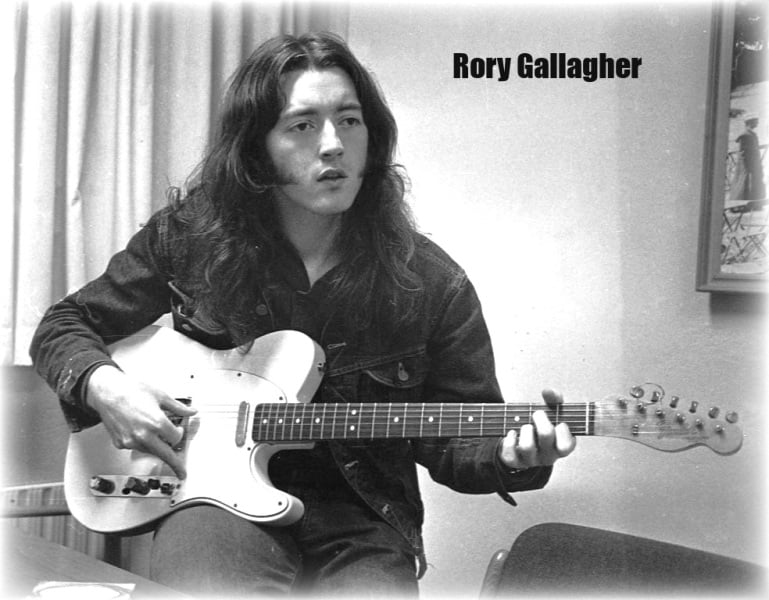
Photographer unknown
A Taste of the North
Rory’s first venture into the Nordics came on 16 November 1968 when Taste played a gig at Hotel Stevns in the tiny Danish town of Store Heddinge. This modest show served as a warm-up ahead of the next night’s much bigger stage: Falkoner Centret in Copenhagen, where they shared the bill with Fleetwood Mac, Chicken Shack and Delta Blues Band. Located in the city’s Frederiksberg district, the Falkoner was a well-known hotel and conference centre that regularly hosted international rock and blues acts. Everybody from Fleetwood Mac and the Rolling Stones through to Dizzy Gillespie and Judy Garland played there in its heyday.
The tour – along with those over the following two years – was arranged by the booking agency Bendix Music. Through Facebook, I managed to track down Jerry Ritz, who played a key role at the company as a concert organiser, booker, tour manager and graphic designer. He confirmed that he had served as Taste’s tour manager during their time in Denmark and was also responsible for designing their posters and advertisements. Ritz worked with many major international acts during this period, including Deep Purple, The Who, The Yardbirds, Ten Years After, The Move and John Mayall.
It was during this first trip to Denmark that Rory picked up his Bjärton acoustic guitar from a pawn shop for just £4. He would go on to use it to record ‘Hail’ on Taste’s debut album. In a later interview with International Musician, Rory explained that the guitar was great for ragtime and that Blind Blake had once played a similar model. He also liked the Bjärton’s distinctive tone, shaped by its 12th-fret neck join and feather-light strings.
For Rory and the band, these two Danish dates were part of a whirlwind itinerary that embodied their ‘have guitar, will travel’ ethos. They had just come off a Northern Irish tour with Cream, followed by a stop at the Red Lion Hotel Blues Club in Leytonshire, before heading straight back to the UK for shows at Southampton University, their regular run at London’s Marquee Club and a prestigious support slot at Cream’s farewell concert at the Royal Albert Hall.
Just four months later, Taste were back in Scandinavia. The plan had been to kick things off with a debut Swedish gig on 26 February 1969 at Gothenburg’s iconic Globe Club, but visa issues meant that they couldn’t secure work permits in time and the show was cancelled. Instead, they returned to Falkoner Centret in Denmark (27 February). By now, Taste’s reputation had begun to swell, thanks to extensive coverage in the country’s music press, and they were presented with a Pop Poll award for Best New Band.
This was followed by gigs at Stakladen in Aarhus (28 February) – a popular student union venue – and Brøndby Pop Club (1 March), sharing the stage with Young Flowers, Rod Alrune and Blues Syndicate. Fan Svend Erik Sorenson still remembers the Brøndby gig vividly: “I was there. Really the first full mind-body experience of musical performance. I was 15 years old. Just amazing… Despite previously experiencing The Who, Blue Cheer, Fleetwood Mac, The Nice, Yardbirds and others, Rory didn’t hold back – he gave you his all.”
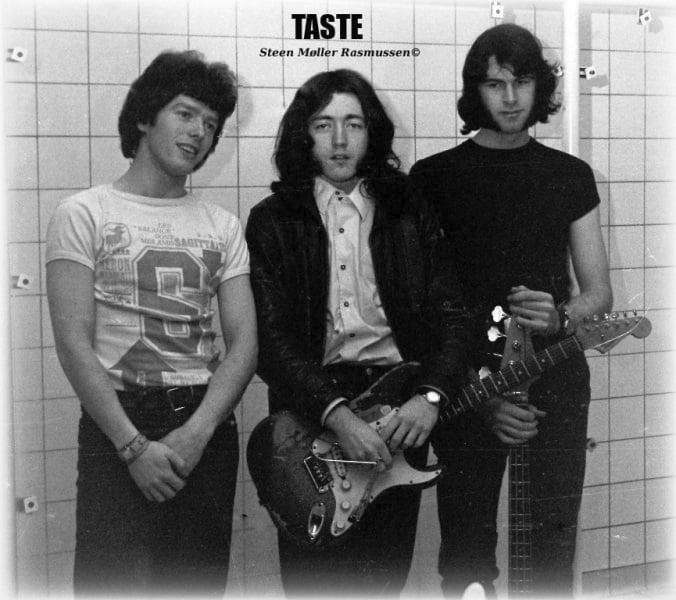
Photo: Steen Moller Rasmussen
Taste returned to Denmark in November 1969, now armed with their eponymous debut album. On 4 November, they performed once again at Falkoner Centret, before making their long overdue debut in Sweden at Cue Club in Gothenburg on 5 November. The Cue Club had opened in March 1966, but five months later, fears that the city council wouldn’t renew its entertainment licence sparked a wave of mod riots, leading to its closure. It eventually reopened in December 1966 at a new address, before relocating again to the former Kungsgillets Danssalong at Kungstorget 14, where it became a key site in Swedish rock history.
Jack McGuinness, who caught Taste’s first Gothenburg show, recalls: “I sat as close to the stage as possible and could smell the burnt AC30. But what impressed me the most was when Rory counted in ‘Sugar Mama’ by stomping his one red plimsoll on the stage floor as hard as he could. Then it was just a matter of going along for the ride!”
The short tour wrapped up with Taste’s first-ever gig in Norway, playing at Oslo’s Club 7 on 6 November – regarded as a centre for the country’s counterculture at the time – followed by a return to Stakladen in Aarhus on 9 November. Thirty minutes of the Aarhus gig survive on bootleg, capturing the band’s sheer raw energy. Highlights include a fiery take on Willie Dixon’s ‘You Need Love’, a tight rendition of ‘Railway and Gun’ and an early appearance of Robert Johnson’s ‘Walkin’ Blues’.
Shortly after the release of On the Boards in 1970, Taste headed back to Scandinavia for a March tour, playing Marselisborghallen in Aarhus (21st), the Falkoner in Copenhagen (22nd), Syvstjerneskolen in Lille Værløse (25th) and the Cue Club in Gothenburg (?) once again. While digging through the Danish Historical Newspaper Archives, I also came across a previously undocumented Taste concert in Copenhagen that took place around the same time at the unexpected location of the cafeteria of FDB furniture factory! According to the article in Samvirke, a group of schoolchildren from Albertslund managed to book Taste for well below their usual fee but had no location. They turned to FDB, who generously offered their cafeteria after hours, free of charge. Over 500 young people attended, with the schoolchildren handling ticket sales and refreshments themselves. The concert was reportedly a great success. Thanks to Claus Rasmussen – who has an incredible collection of Danish tour posters from the 1960s and 1970s – we were able to pin down the date as 23 March.
Taste were back just six months later, with gigs at the same venues in Copenhagen (17 September) and Aarhus (19 September). Sandwiched in between was a show at Stockholm’s Konserthuset – a Nordic classicist venue best known for hosting the annual Nobel Prize ceremony. With a capacity of 1,770, this booking was a clear sign of Taste’s ever-growing reputation across Scandinavia. The concert was broadcast live on Swedish national radio and later released on the Taste I’ll Remember boxset (2015). The set features a brilliant cover of Muddy Waters’ ‘She’s Nineteen Years Old’ and an embryonic version of ‘At the Bottom’, which would eventually appear on 1975’s Against the Grain.
Taste had been scheduled to return to Gothenburg’s Cue Club on 9 October 1970, but by then, things were swiftly falling apart as a band. The gig was cancelled and they were subsequently replaced by Skid Row, featuring Phil Lynott and Gary Moore.

Photo: Jorgen Angel
Reconstructing a full picture of Rory’s early touring history isn’t always straightforward. While many concerts were reviewed or advertised in the press, not everything was documented systematically, and some records simply haven’t survived. As a result, it’s often necessary to rely on scattered traces – ticket stubs, posters or fan recollections – to piece together the details. But even that can prove tricky when posters appear without dates, like one intriguing but incomplete advertisement for a Taste gig at Revolution in Copenhagen with Beefeater and Burnin’ Red Ivanhoe. Thanks again to Claus Rasmussen, who has a list of Burnin’ Red Ivanhoe gigs, we’ve been able to confirm the date as 4 March 1969. There’s every chance that Taste played more shows across Scandinavia, particularly Denmark, during this period than can currently be confirmed.

Solo in Scandinavia: The 1970s
After building a strong following with Taste, Rory was eager to return to Denmark as a solo artist and embarked on a short four-date tour in September 1971. This tour saw him playing in larger venues like Fyens Forum in Odense (24 September), Vejlby-Risskov Hallen in Aarhus (25 September), Aalborghallen in Aalborg (27 September) and Tivoli Concert Hall in Copenhagen (29 September).
As Rory’s touring schedule intensified with repeated visits to the US, coupled with ongoing album commitments, it would be several years before he returned to the Nordic countries. His much-anticipated return finally came on 9 August 1975, when he played Finland for the first time at the Ruisrock Festival on the island of Ruissalo in Turku. Also performing that day were the Mahavishnu Orchestra and Wishbone Ash – testament to Ruisrock’s rapid ascent since its founding five years earlier.
A short video clip survives of Rory and the band powering through ‘I Take What I Want’, but it’s the bootleg that truly captures his electrifying performance. I say electrifying somewhat ironically because it was delivered amid repeated power outages as the PA system blew the local transformers twice. Undeterred, Rory simply switched to acoustic, delivering a particularly stunning rendition of ‘Too Much Alcohol’, to the crowd’s clear delight, as captured on the recording.
The magic of the performance, despite the technical setbacks, lives on in fan testimonies from the night. Matti Helariutta recalled on Facebook: “This gig was such an inspiration for me, changed my life, you could say. I was 13 and really decided to continue with my band after that day!” Equally, Jonas Almquist remembers what a “killer set” Rory played. He would go on to interview Rory one year later in Stockholm.
Their impressions were echoed in the music press. A Sounds review noted: “Rory himself is the infinite showman, orchestrating the group… and the audience… with his guitar, rapping the instrument sharply against the microphone to punctuate a solo burst, strutting back across the stage as if to reconnect with the rhythmic source of the band, trading riffs with Lou or Gerry, then steaming back to the microphone to pick up the vocal.”
The festival brought Rory plenty of press attention, including several interviews. One by Finnish music journalist and radio DJ Jake Nyman appeared in Intro magazine under the title ‘I’ll Perform As Long As I Live’. Fan Aki Ilkka Kuosmanen remembers Nyman later saying in a library talk that Rory was “the kindest and most friendly person” he had ever interviewed. Another interview, of course, is more infamous in the fan community because of its painfully wooden interviewer. Rory remains tremendously calm, thoughtful and unfailingly polite throughout as he is asked why he plays the blues when “it’s Black music originally actually” and why he doesn’t handle the Northern Irish situation in his music.
After such a high-energy performance and amid the festival buzz, the evening took a more playful turn. It just so happened to be Dónal’s 26th birthday and Rory had given him a backgammon set as a gift. Back at the hotel after the show, Dónal wanted to play, but Rory – in mischievous spirits and buoyed by post-gig champagne – had other ideas. He and the band raided the hotel bathrooms for toilet paper, returned to the dining room and started throwing rolls around before trying to wrap Dónal up like a mummy. Dónal gave up on backgammon, and the night ended with the band singing Irish traditional songs together.
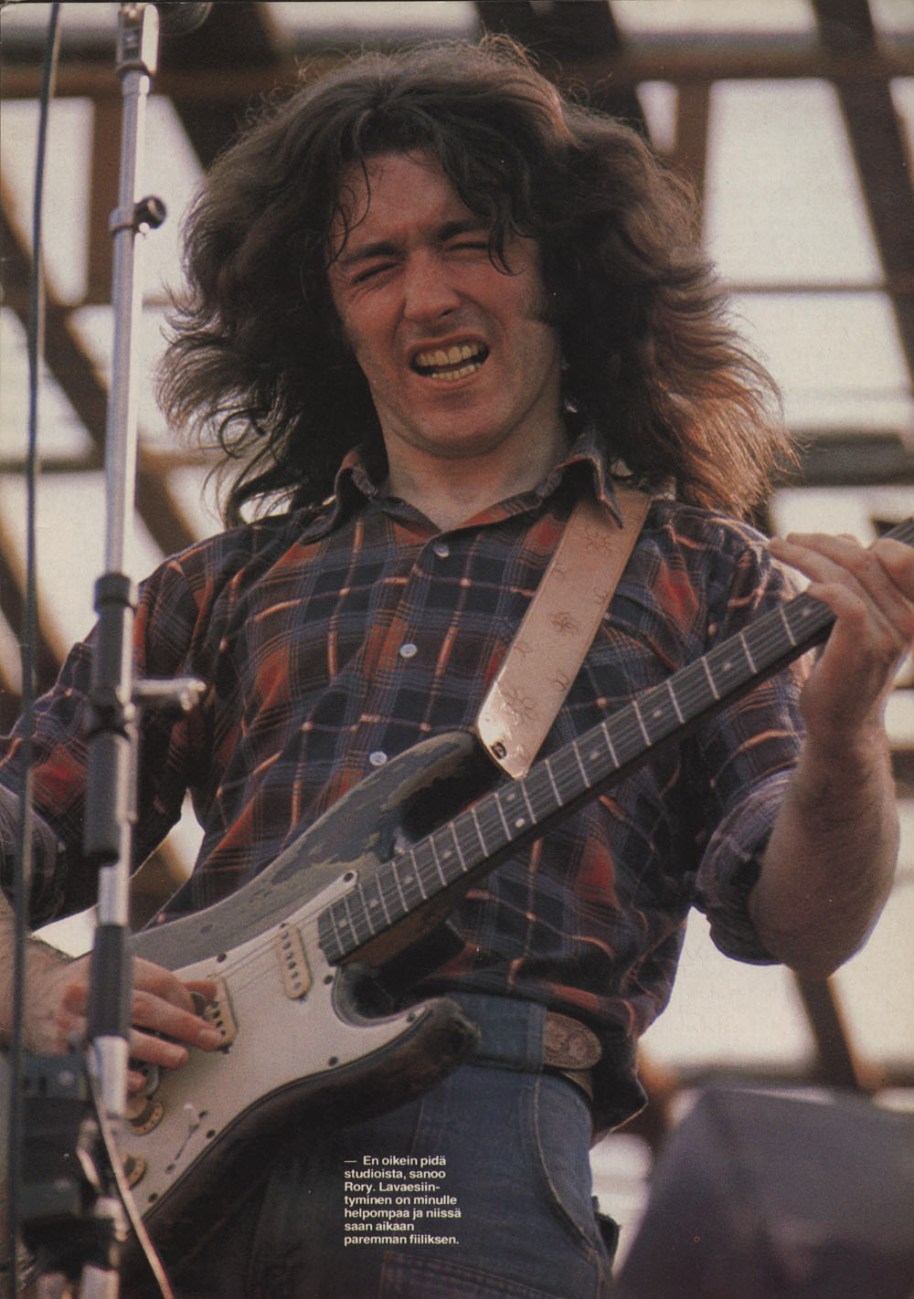
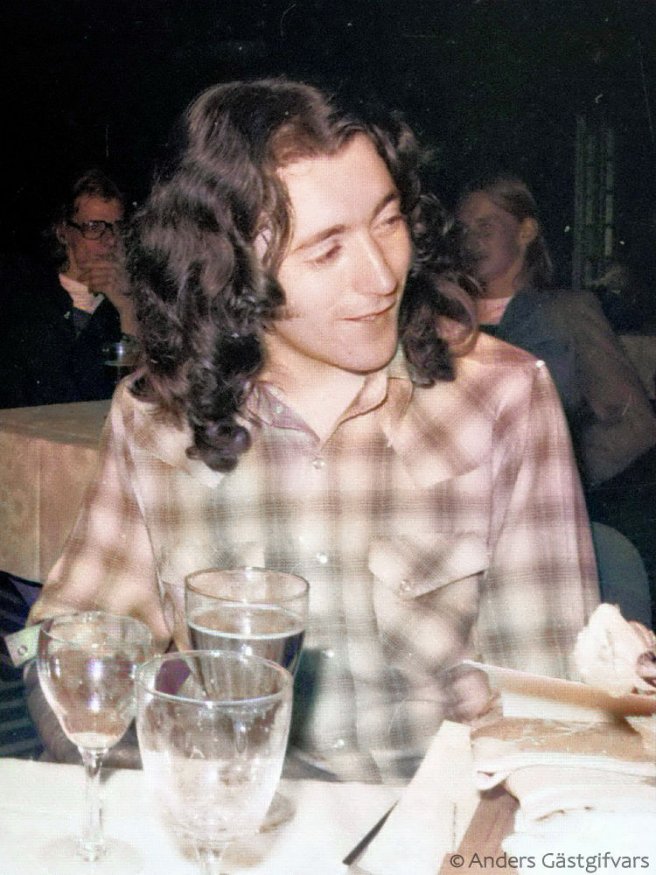
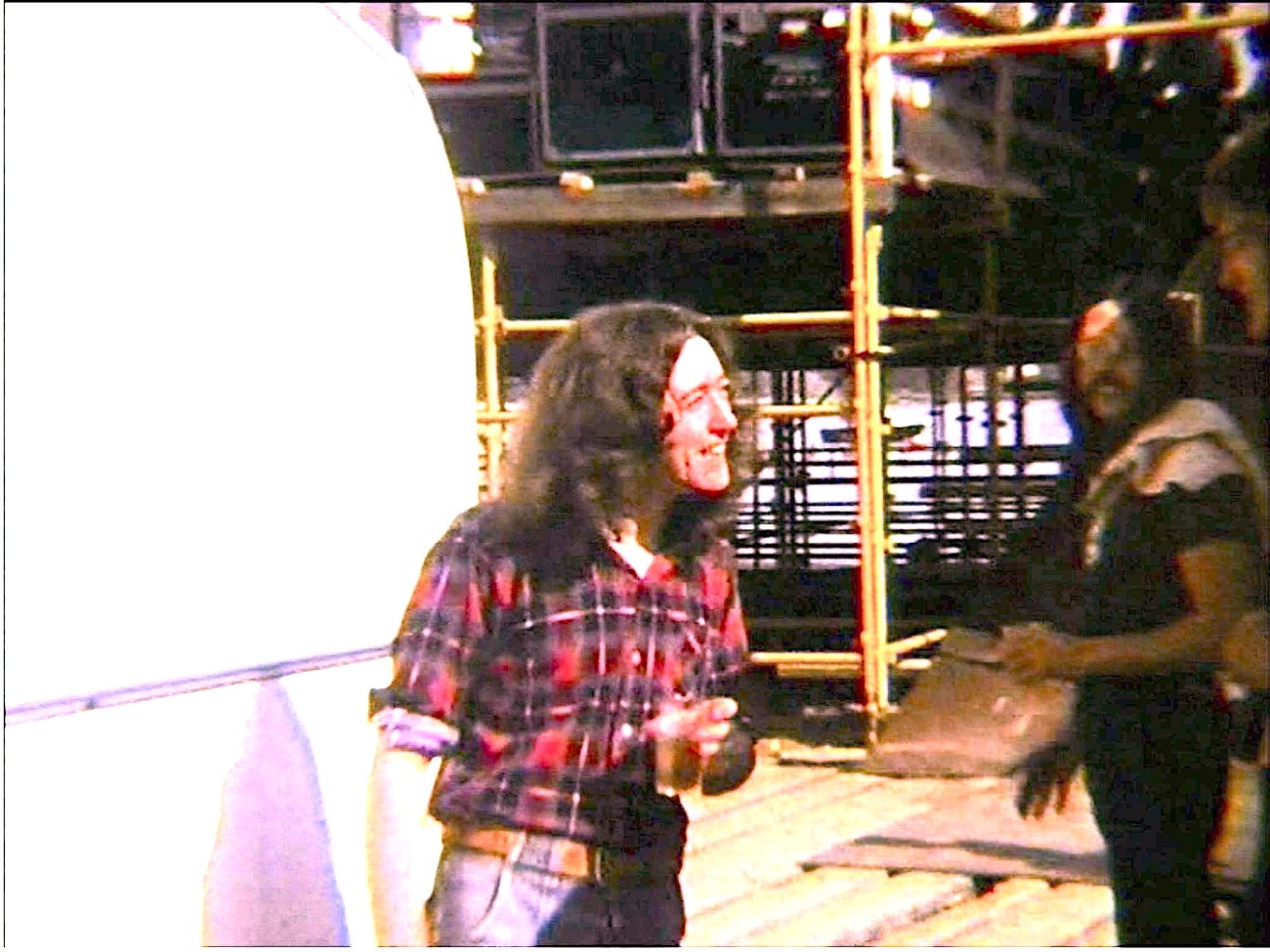
Rory on and off the stage at Ruisrock, 1975
Photos: Seppo Konstig/Anders Gästgifvan
One year later, Rory returned to the Nordics for a short four-date tour, which included three shows in Sweden – Olympen in Lund (15 March), Konserthuset in Gothenburg (16 March) and Konserthuset in Stockholm (20 March) – and a stop in between at Kulttuuritalo in Helsinki, Finland (18 March). Of these, the Helsinki concert remains the most vividly remembered, thanks in large part to the community on the Live in Finland 1955–2020 Facebook group.
Olli Oksala remembers it as a “great concert that has stayed in my top 10 list through the decades,” while for Nipa Niilola, then just 14, the gig “has probably had the biggest impact on my choice of career as a musician.” Kari Toivanen, on the other hand, recalls the strict rules at Kulttuuritalo: “You weren’t allowed to stand up or jam at all – you had to sit the whole time.” The entire 2.5-hour concert was broadcast live on Finnish radio and is now held in the Finnish National Archives.
In summer 1978, Rory – now fronting his leaner, three-piece line-up – was back for the Nordic festival circuit. On 30 June, he took to the stage at Denmark’s Roskilde Festival, which had been founded in 1971 by two high school students inspired by Woodstock and the Isle of Wight. A clip of ‘Tattoo’d Lady’ from his set featured in the German television programme Elf ½ (better known to fans as the Macroom documentary). Two days later, Rory performed at the Horten Festival in Norway (2 July). At both festivals, Bob Marley was also on the bill.
In an interview with Rockman, festival organiser Wictor Faanes remembered Rory’s arrival at Horten with warmth and humour. “We had the ‘rough guys in town’ guarding the backstage area,” he recalled. “Rory didn’t have the right pass and got stopped. The guard told him, ‘I wouldn’t let you in even if you were in the Hep Stars!’ [a famous Swedish band from the 1960s]. But while they waited, Rory and the guard became fast friends and shared a great deal of alcohol. By the time Rory’s pass arrived, he was “in grand form.”
Despite torrential rain and heavy wind slashing the expected crowd from 20,000 to 10,000, Rory’s performance was hailed by the Norwegian press as the highlight of the festival. Sadly, the dreadful weather conditions had longer-term consequences. The hazardous flight conditions in and out of Horten were the catalyst for Rory’s worsening fear of flying and marked the beginning of his dependence on anti-anxiety medication from this date forward.
After Rory’s performance, Anne-Lise Johnsen of Fredriksstad Blad rushed backstage to interview him. When she entered the dressing room, she found Rory jamming with Danish guitarist C.V. Jørgensen. Despite having just come off stage, Rory was “completely lost in his own world,” she wrote, adding: “He plays and plays with such joy that we don’t even have the heart to remind him we’re there – even though we’re starting to get impatient and worried we’ll miss the next act: Bob Marley.” Eventually, Rory looked up, smiled and said, “Oh, is this the press people?” apologising for the delay with characteristic warmth.

Photo: Hans Arne Nakrem
Later that year, Rory embarked on a proper Nordic tour again, starting with Copenhagen’s Tivoli Concert Hall on 27 October. From there, he headed to Oslo’s Chateau Neuf on 29 October – a gig immortalised in a two-hour bootleg showing the band in blistering form. Among the highlights is a swampy, Slim Harpo-style rendition of ‘All Around Man’, markedly different from its studio version and rich with grit and groove. The tour wrapped up at a sold-out Göta Lejon in Stockholm on 30 October, playing to a 2,500-strong crowd.
In its review of the Stockholm gig, Melody Maker raved: “[Rory’s] solos blister through your body, and even his couple of solo acoustic numbers are undercut with a stirring passion. Sweat bucketing from him, he struts prodigiously around the stage, thick mane of hair spraying behind him.” The Swedish press, however, was more reserved. While they acknowledged Rory’s technical skill and loyal audience, some reviews dismissed his music as “worn out” and “lacking imagination” – a narrative that would begin to unfairly shadow Rory in the music press from this point on.
Frankie Miller, playing at a club next door, dropped in to catch Rory’s set. After the show, Rory returned the favour, casually slipping into the crowd at Frankie’s gig. But his attempt to remain incognito didn’t last long and soon a small crowd gathered around him. According to Melody Maker, Rory “regards it all with undue equanimity” – at least until one overly-enthusiastic, tipsy fan began running his hands through Rory’s hair, loudly declaring how wonderful he was. That, understandably, rattled him. Back at the hotel, Rory stayed up late talking and playing music with the band, eventually collapsing into bed at 9:30am, only to be up again a few hours later for a radio interview!
Almost exactly one year later, Rory was back again for another four-date run that took in Konserthuset, Stockholm (27 October), Konserthuset, Gothenburg (28 October), Chateau Neuf, Oslo (29 October) and Tivoli Concert Hall, Copenhagen (30 October). Bootlegs survive for all four gigs, with the Stockholm recording especially sharp, capturing an explosive ‘Wayward Child’ and a stunning ‘Secret Agent’. Deep cuts like ‘Deep Elm Blues’ shimmer with Rory’s gritty slide in Gothenburg, while ‘As the Crow Flies’ takes on a swaggering, barroom looseness. Listening to these recordings is exhausting in the best way – a relentless, high-energy ride that leaves you breathless but wanting more.
Fan Torgny Karlsson hailed the Stockholm show as “a magic concert from a GOAT.” In an almost biblical tribute, Izak Litwar recalled how, by the concert’s end, “some spectators on crutches were able to stand on their own legs without them” – a testament to the healing power of Rory’s music. One Norwegian critic for Dagbladet described Rory as “taking the bull by the horns” from the moment he rushed out on stage… as ever, in top gear – an uninhibited force whose joy in playing was contagious.”

Photo: Tom Myklevik
On Tour in ‘84
It wasn’t until 1984 that Rory returned to the Nordics, this time for a four-date run: Nygårdsparken in Bergen (31 May), Provinssirock Festival in Seinäjoki (2 June), Tromsøhallen in Tromsø (3 June) and Gröna Lund in Stockholm (5 June).
Of these concerts, it is Tromsø that has left the most enduring impression, largely due to its unusual circumstances and the considerable press coverage it received. The show was organised by Rockmekkers, a local company with ambitions to bring more international acts to the far north of Norway. Their plan was to use any profits from concerts to establish a fund dedicated to attracting further touring artists to the region.
They had long hoped to book Rory, and eventually sent him a heartfelt letter explaining their circumstances and trying to tempt him by waxing lyrical about the beauty of Tromsø. True to his generous spirit, Rory not only agreed to play but offered to do so for half his usual fee. Speaking to Yngve Nilssen of the local paper Tromsø, Rory explained that he simply liked the idea of visiting the town: he wanted to “see the midnight sun and take part in fishing trips.”
In the weeks leading up to the show, Rockmekkers launched an extensive promotional campaign across northern Norway. Posters were plastered on every available surface, Rory’s records played on loop in Tromsø’s city centre and a car bearing advertisements for the gig toured the region. Rory and the band were flown in by private jet, and the organisers assembled the largest sound and lighting rig ever seen in Tromsø. Expectations were sky-high.
But despite all their efforts, the 5,000-capacity Tromsøhallen drew fewer than 800 attendees. As the press bluntly put it, it was a “financial nightmare,” leaving organisers with a 30,000 NOK deficit.
Jens Eirik Larsen of Nordlys observed that the crowd response was unusually subdued, remarking that the person having the most fun that night may well have been Rory himself. “Top atmosphere in a cold hall,” wrote Yngve Nilssen in Tromsø, who reflected on the striking contrast with Rory’s Bergen show, which had drawn 15,000 fans. “A Tromsø audience does not take kindly to foreign artists,” he speculated. “Well, I enjoyed myself. We can’t count on everything being like Madison Square Garden,” Rory gracefully told the newspaper.

Source: Åge Eriksen
Yet, reviewers were quick to stress that the lukewarm reception in Tromsø was not due to any lack on Rory’s part. As Tromsø affirmed: “There was never any doubt that one of the greatest interpreters of rock, blues, and rhythm & blues was on that stage – standing, jumping, running and bouncing across it.” Interestingly, the crowd seemed to respond most strongly to the acoustic numbers, which critics praised for their subtle phrasing and distinctive feel, offering “a new angle” that stood out from the rest of the set. However, the song that received the warmest applause was ‘When My Baby She Left Me’, especially when Rory added a little tinge of ‘Caledonia’ to the solo.
Technical issues further challenged the night, with a brief power outage during ‘Bad Penny’ cutting the PA system. But in true Rory style, he didn’t miss a beat. He simply grabbed his acoustic guitar and harmonica and continued playing until the problem was fixed, picking up the song where he’d left off. Even after more than 40 years, every fan I spoke to remembered this moment with wide-eyed amazement. The moment, in fact, survives in a crystal-clear 70-minute bootleg, capturing Rory in peak form, pushing on with relentless energy alongside Gerry and Brendan, improvising brilliantly and never letting the atmosphere dip.
The day after the concert, Rory was interviewed by Trond Hansen and Per Wollen. It’s an interview that I love to revisit as the formalities quickly melt away into a relaxed, friendly chat. Rory asks about life in Tromsø and what it’s like to live through bright summer nights and dark winters, clearly curious and engaged. In another interview with Bergens Arbeiderblad, the conversation shifts instead to Rory’s attitude towards the music industry: “I don’t trust the system. I’d rather not know anything about it. Playing is the best payment. I don’t care about money […] Music should be about the soul. Happy and free like a child. That’s how I want to be.” Rory’s words capture his enduring spirit: choosing joy and authenticity over commercial success.
Rory’s appearance at the Provinssirock Festival was eagerly awaited, as he hadn’t played in Finland since Ruisrock in 1975 – a full nine years earlier. This was the sixth Provinssirock Festival, with Rory headlining the first day (Saturday) and the Smiths closing on Sunday. For fan Jari Mannersalo, it was worth the wait: “it was one of the best gigs I’ve ever seen.” Both Jari Syrjälä (“absolutely amazing”) and Tapio Vuorisalmi (“one of the best gigs of my life”) echoed his enthusiasm.
Just before the concert, Rory was interviewed in his hotel by Jukka ‘Waldemar’ Wallenius for Soundi magazine. Back in May, Matti Ahola kindly sent me a translation of the interview, which you can read in full here. Wallenius was a founding member of the Finnish Blues Society and its paper Blues News in 1968. He went on to establish Musa, Finland’s first rock magazine, in 1971, before launching Soundi in 1975 after a dispute with Musa’s publisher. Rather surprisingly, Wallenius was unfamiliar with Rory’s music and was called in at short notice to conduct the interview. Perhaps because of this, he bucks many of the typical press narratives of the time that focused on Rory’s age and weight. Instead, he chooses the title, ‘The Man Keeps Getting Younger!’ highlighting Rory’s perennial youthfulness and energy. In contrast, elsewhere in the same issue, journalist Mika Junna dismissively refers to Rory as “one of those guitar stranglers to whom I really wouldn’t care to listen, no matter how essential and how legendary a dude he may be.”
Much to the crowd’s disappointment, Rory’s 5 June concert at Stockholm’s popular amusement park Gröna Lund was limited by the organisers to just one hour. The spectators cheered so enthusiastically at the end of his set that Rory had to come back out to explain that he wished he could keep playing but wasn’t allowed. Despite the short set, the performance clearly made a lasting impact on those in the audience. Jan Tisak remembers, “It was a true joy to see Rory and the band perform that sunny evening. They were just superb. This was the only time I saw Rory, and I’m so glad I did.” Mats Andersson also recalls that “Rory and the band put on a great show. Rory jumping around like he did. I am very glad that I saw him live.”

Photo: Pär Sundbäck
Smukfest and Beyond: Mid-Late 1980s
Despite his triumphant 1984 concerts, Rory never made it back to either Sweden or Finland again. A short tour had been scheduled for 1987, with dates advertised for Helsinki (3 November), Draken in Stockholm (5 November) and Pub Sparta in Lund (6 November). However, this was ultimately cancelled. Given that Rory performed at the Cork Opera House on 4 November – a show later broadcast as an RTÉ Christmas special – it’s likely that scheduling conflicts led to the change of plans. Rory, nonetheless, remained a fairly regular presence in Denmark and Norway throughout the latter half of the decade.
On 9 August 1985, Rory appeared at the Skanderborg Open Air Festival – better known today as Smukfest. Set in a scenic beech forest, the festival had launched in 1980, but 1985 saw its rebranding as “Denmark’s Most Beautiful Festival” (Danmarks Smukkeste Festival). The rebranding came with a new budget of just over DKK 500,000, making it possible to bring over Rory as headliner, sharing the bill with Dr. Feelgood and popular local acts like Tøsedrengene, TV-2 and Björn Afzelius & Globetrotters. Never one to disappoint, Rory came on just before 11:30pm and played nonstop until 2:30am.
The week had seen bad weather, but, as Århus Stiftstidende reported, “the summer weather came, the fog disappeared and the clothes went off one by one.” Rory’s closing jam included a guest appearance by local musician Ivan Horn, with the night ending in a communal rendition of Bob Dylan’s ‘I Shall Be Released’ – an experience the paper described as “a beautiful ending that made the beech trees’ moment last beyond the weekend.” Horsens Folkeblad similarly praised the concert, highlighting Rory’s “energetic and almost endless series of guitar solos” that forged “a gigantic rocking community under the proud crowns of the beech trees.”
Rory returned to Smukfest on 12 August 1989, stepping in at the last minute to replace Danish hard rock band Pretty Maids. This meant that he was placed midway down the bill, with headliners that year including Duran Duran and Big Country. The festival drew more than 10,000 attendees and, as it marked the 10th anniversary, organisers went all out. Guests were greeted by singer Jodie Birge dressed as Santa Claus handing out free bottles of Gammel Dansk, and horse-drawn carriages transported visitors from the train station to the festival site. However, the added flair came at a cost, and the festival ultimately struggled to turn a profit.
Rory had been scheduled to return again to Smukfest on 12 June 1990, but was forced to cancel due to illness, making his 1989 appearance his final visit to Scandinavia. That year, Gary Moore filled the slot, with Joan Jett, Uriah Heep and Frank Megabody also on the bill.
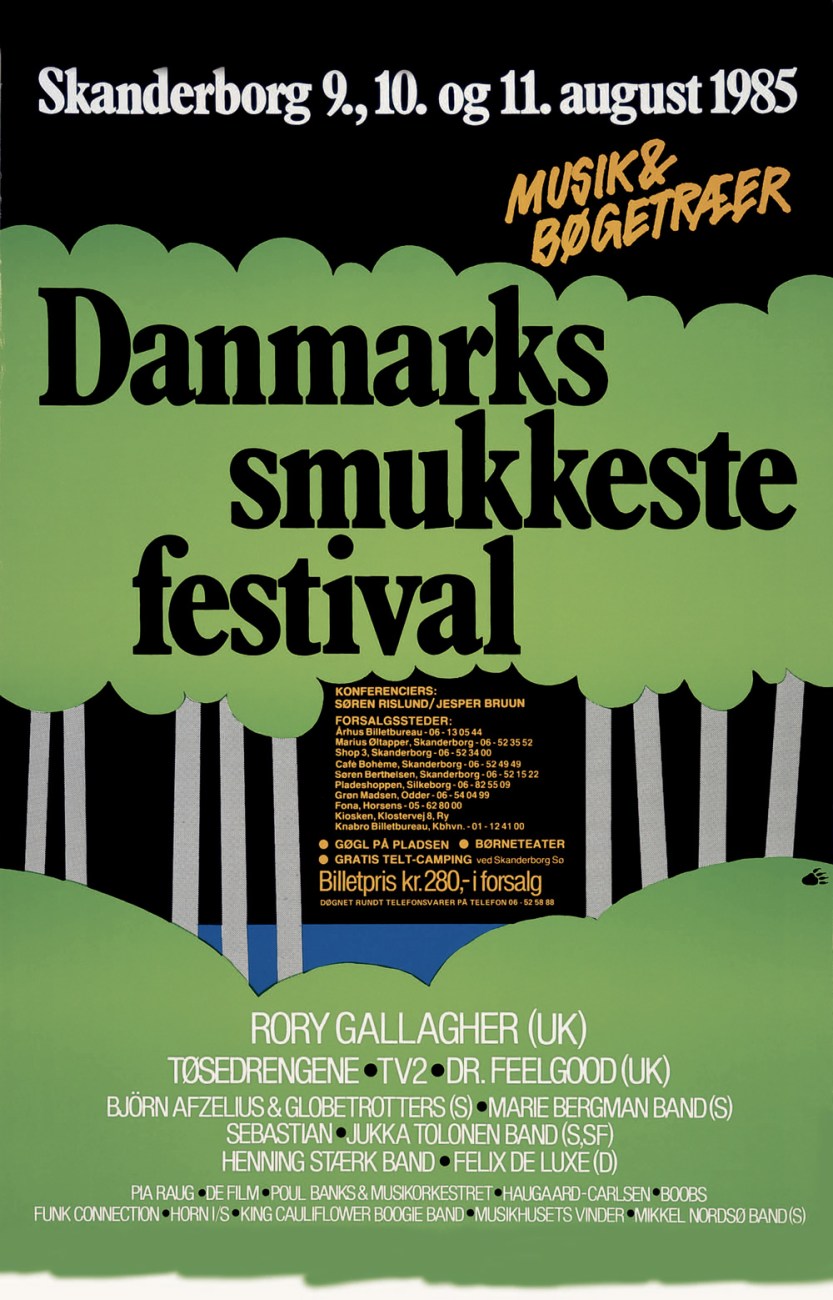
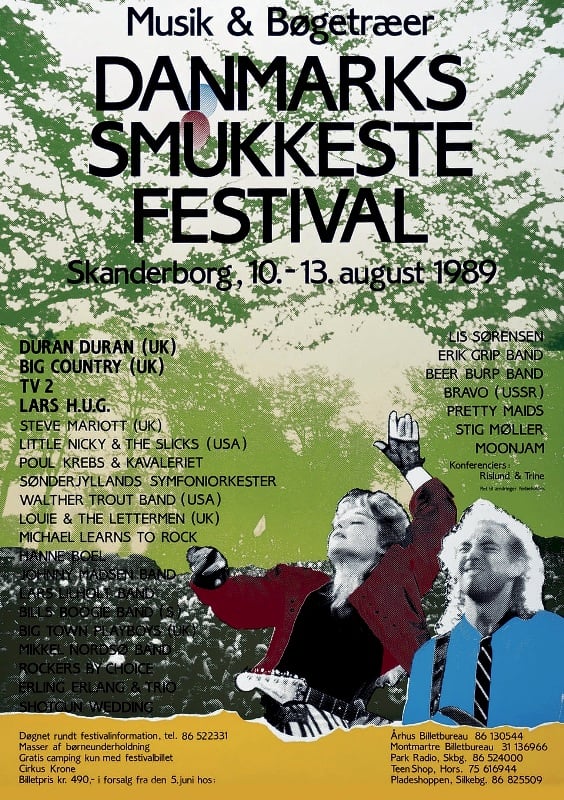
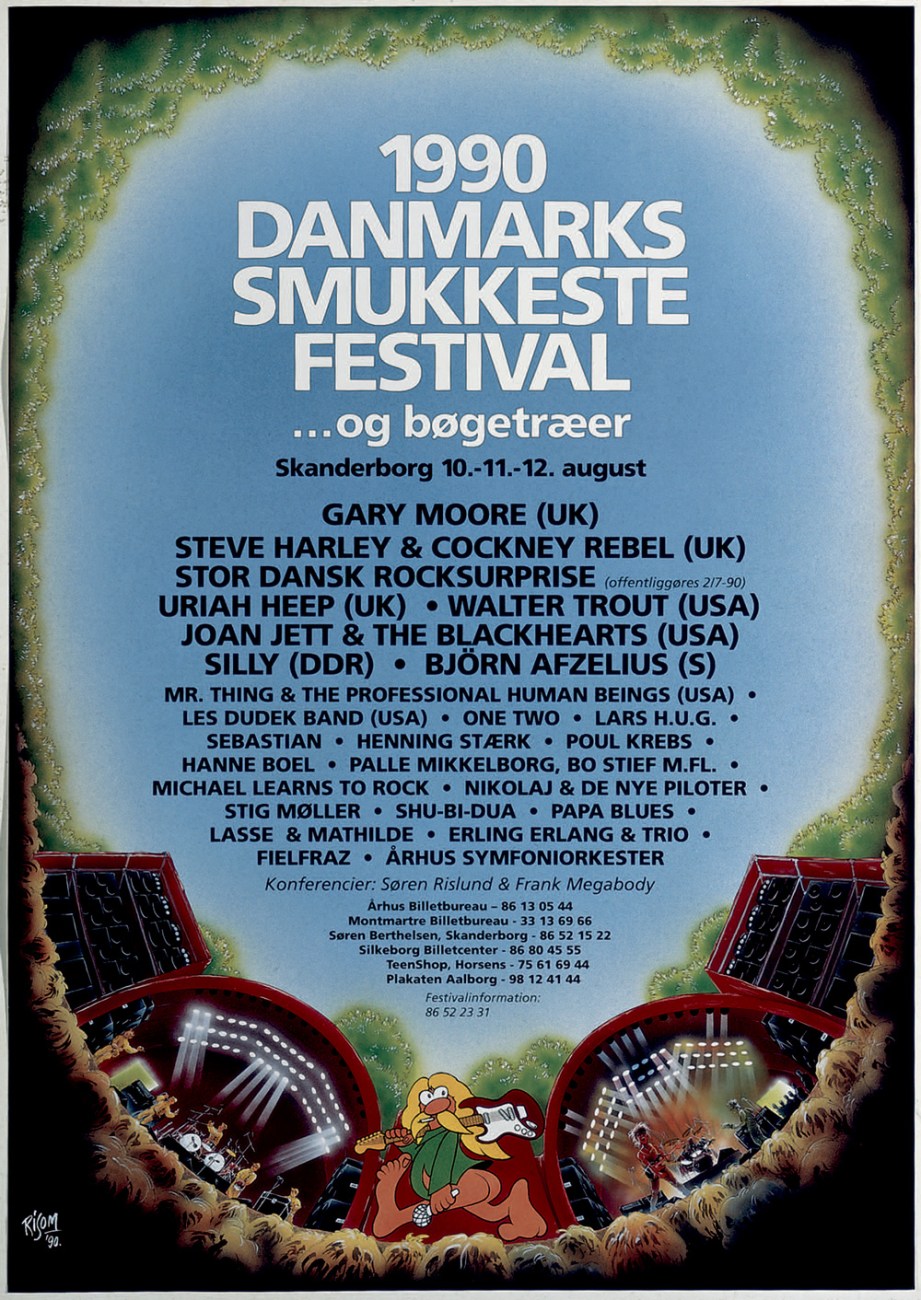
1985, 1989 and 1990 Smukfest posters
In addition to his Smukfest appearances, Rory also played multiple shows across Denmark in December 1987 to support the release of Defender. One confirmed date is 16 December at Saga in Copenhagen. However, verifying the full extent of the tour remains difficult. Many local newspaper listings and advertisements from the time are held only in physical form at the Danish National Library, meaning that confirming additional dates would require an in-person visit. The same challenge applies to April 1988 when Rory returned for another short run of shows in Denmark. One confirmed performance took place at Ridehuset in Aarhus on 15 April 1988, but further details remain out of reach without direct access to those archival records.
Henrik Hansen was working part-time at the Hotel Royal in Aarhus at the time and recalls arriving at work to find his manager in a panic. “A rock band is here and needs a drink,” he was told, and they needed the bar opened immediately. Henrik was hesitant – the bar hadn’t been properly cleaned after the night before and was still in a mess – but his manager insisted, so he reluctantly agreed. As he began serving from the horseshoe bar, Henrik realised that he recognised one of the guests. He had seen him before on Rockpalast, though he didn’t know him well. It was Rory.
Henrik admits he was “really shocked” by Rory’s condition: “He didn’t look well at all. He was very, very overweight, very, very swollen in his face, he was sweating, and his eyes were just [darting around].” Rory ordered a beer, took a few sips without saying a word and soon excused himself back to his suite, while the rest of the band and his brother Dónal stayed behind to chat late into the night. Henrik remembers them fondly: “They were lovely—not arrogant at all.” They wanted to listen to some music, but the “only good rock music” Henrik had at the time was a bootleg recording of The Kinks’ Rockpalast performance, so they ended up playing it on repeat.
As for Norway, Rory played two nights at the Oleana in Bergen on 4 and 5 December 1985, followed by a show at Samfunnet in Trondheim on 6 December. The Bergen concerts drew full houses, with local newspapers noting that the enthusiastic crowds clearly remembered his appearance at Nygårdsparken the previous year. Reviews praised the great atmosphere and Rory’s masterful guitar work, both acoustic and electric, with the addition of Mark Feltham adding a “more airy soundscape,” particularly on the slow blues numbers. As usual, it seemed Rory was just as reluctant to end the evening as the audience was. Critics concluded that there was little indication that his popularity would wane any time soon.
Rory made his final Norwegian appearance on 4 July 1987 at the Midnight Sun Rock festival. The event took place in Tennskjær, about three miles outside Finnsnes, in a natural amphitheatre surrounded by fields and camping space. That year’s edition featured twelve hours of nonstop music, with performances from Hungry John, Stage Dolls, Moby Dick, Ny Gate, M66 and BS on the Rocks. Rory had, in fact, stepped in last-minute to replace Bob Geldof, who had cancelled his appearance. Troms Folkeblad sharply criticised Geldof’s cancellation, accusing him of egotism and dismissing ‘I Don’t Like Mondays’ as his only worthwhile musical contribution. In contrast, they praised Rory as a dependable artist who “instils more trust and promises greater quality,” noting that he had been “at the very top of the second division for more than 20 years,” which was “far more impressive than being in the first division for just one.” They added that Rory had “sweated and bled hard rock and blues out of his virtuoso fingers ever since his early days with Taste.” As always, Rory delivered, lighting up the stage and even returning for a jam session with Hungry John.

A Quiet Legacy
In Scandinavia and Finland, Rory may not have streets named after him or statues raised in his honour, but his legacy quietly endures – much like the man himself – through the memories of devoted fans and musicians. From early on, Rory put in the hard work, repeatedly crossing the North Sea and building his reputation through electrifying live performances and a genuine connection with his audiences. And those who saw him haven’t forgotten. His presence lives on in their stories and the music they treasure. You can feel it in more intimate spaces: Facebook groups, second-hand vinyl shops, late-night rock radio programmes…
In Oslo, annual Rory Nights continue to celebrate his music, and in Finland, Henri Aitakari’s 2015 self-published book Rory Gallagher: Musiikki ja elämänvaiheet (Rory Gallagher: Music and Life Phases) stands as a testament to his long-lasting impact. Six years on from that first chat with my colleague in the Örebro University staffroom, I can assure you that the entire department is now well aware of Rory Gallagher.
So, it may be a quiet revolution, but perhaps that’s fitting. Rory never sought the spotlight for its own sake. He wanted to be remembered in song and sound, and that’s exactly how he is.
All that remains is to share this English translation of a memorial poem by author and radio personality Nis Boesdal, published in Walther Nyt in autumn 1995, paying tribute to Rory’s place in Danish music history.
Rory Gallagher In Memoriam
A festival is usually just a ploughed field
levelled a little for the occasion—
preferably with mud, laced with urine,
and fertilised by optimism and beer.
Then come the impossibilities:
it’s impossible to get to the pub,
impossible to find your friends,
impossible to see the bands,
and impossible to sleep.
A festival fights nature—
cutting trees instead of hanging showers in them,
flattening hills instead of making love in the valleys,
disciplining the wild instead of dancing with it.
But that’s not how we do it in Skanderborg.
Denmark’s Most Beautiful is no ordinary festival—
it’s a blend of garden party, picnic,
and old-fashioned love-in.
Most folks know a drive-in,
maybe even a walk-in, a jump-in,
and, yes, a fuck-in.
But the old-timers at this forest gathering
will tell you:
the first time Irish bluesman Rory Gallagher
visited East Jutland,
it was for a love-in at Marselisborghallen.
Before he came, no one really knew
what a love-in was.
And Rory—true to form—didn’t ask for the rules.
So, he showed up in brown rubber shoes,
a checkered shirt like the ones
farmers wore before nylon took over.
While we inflated air mattresses,
lit our candles, warmed our tinfoil dreams,
Rory stood at the bar, sipping lukewarm Thor.
Then the lights dimmed.
He stepped on stage,
picked up his guitar,
brushed the strings three times,
and began to sing softly:
“Well, I wish I… was a catfish,
Swimmin’ in the… deep blue sea…”
Before he finished—just 16 minutes later—
East Jutland knew exactly
what a love-in was.
We knew Taste.
We knew Rory Gallagher.
And most of all,
we understood that a love-in with Rory
wasn’t about rules or rituals—
it was about the joy of life,
and the joy of music.

Photo: Jonas Almquist


 REWRITING RORY
Leave a reply to rewritingrory Cancel reply