

Back in November 2024, Eamonn McCormack, the renowned Irish blues-rock musician and a dear friend of Rory, kindly agreed to take part in a Q&A for Rewriting Rory. I invited you all to submit your questions, which I then passed along to him. Eamonn and I were thrilled to receive such a wide range of fascinating questions – so many, in fact, that this will be the first of three very special posts shared over the next three weeks.
Today’s Part 1 focuses on Eamonn’s friendship with Rory and the personal connection they shared. As Mental Health Awareness Week approaches—with this year’s theme of ‘Community’—it feels especially meaningful to reflect on their bond here. Eamonn was a true friend to Rory during one of the most challenging periods of his life, offering both support and companionship. It warms my heart to know Rory had someone like him in his corner.
I hope you enjoy this long-awaited blog post!

You had the privilege of knowing Rory during his final years. How would you describe his demeanour and outlook on life during that time?
At times it was a mixture. He would be positive about things and in good form and reminisce about good times, then he would slip into a melancholic mood, especially later in the evenings. But I believe that was mainly because he knew deep down inside, his days were numbered. He dedicated his whole life to music and lots of time to touring and, for sure, he did not seem to regret that. But by the same token, I remember he said to me once that he could understand the comfort Johnny Winter must have had, when I told him his wife arrived in the UK on the last night of his European tour to pick him up and take him home to their house in Connecticut. I think it was the loneliness he felt when he was off the road. I had the pleasure of opening for Johnny on that whole tour and Rory was very curious about it and how Johnny was and his playing and he told me many moons ago, back in the 70’s, he was at a party in New York with Johnny, but it certainly wasn’t his scene, so he didn’t stay there too long, and Johnny gave him a slide that night. That was the first and only time Rory opened up to telling me he felt lonely at times and missed having someone he loved waiting at home for him after tours.
Away from music, what topics of conversation or activities did you and Rory bond over?
We could end up talking about anything. Rory was what you could describe as a ‘well read’ person. He kept up to date with current affairs and sometimes when I’d call to say I’d meet him, he would ask me to pick him up The Guardian newspaper, which he liked. He had an interest in general current affairs and also international world news and he kept an eye on politics. You could never be sure what party he sided with, but if I was to guess his political stance, I would lean towards saying I think Rory was a Social Democrat. He believed in fairness for all. He loved reading books, especially crime novels, and loved old classic movies. He liked football and a little bit of horse racing. I don’t think he watched much football, but he was always up to date on who was leading in the FA Cup and Premier League and he always knew what teams his mates at his local followed, and he was witty about it, and would kind of slag them in a subtle funny way if he knew they were badly beaten in a match that week. Of course, we often talked about music and guitars and he knew exactly what he liked in the different genres of music. He could appreciate anything that was not contrived or fake. If it’s from the heart, Rory could relate to it. Even within the blues-rock genre and even if someone was gaining popularity, Rory would tell me if he liked them as a player or not.
Are there any particular moments or conversations with Rory that have stayed with you?
I always remember the stories he told me about Muddy Waters. You see Muddy was very fond of Rory and he used to insist on holding the recording sessions until Rory arrived because Rory would often be doing a concert, but those days in the UK, concerts were on early, sometimes six or seven in the evening. Rory was so honoured about this and on the days that Rory did not gig, they would drive and pick Muddy up at the hotel and take him to the studio. Muddy really took him under his wing for that short period that he was in London. I think apart from a music hero to Rory, I felt that maybe Rory latched onto Muddy as a kind of father figure that was missing in his life, even for that short period. Rory told me Muddy was a father like figure in general and if a musician in Muddy’s band was heard by Muddy calling a lady vulgar names in his company, he would slap the guy in the face and the guy would not fight back. Muddy did not suffer fools. He had about a dozen kids and took no nonsense. He was also a funny guy as well as wise and he drank only sparkling champagne. Those sessions and the time spent with Muddy was a very important experience for Rory.
Do you have any funny stories about Rory you can share?
When we recorded in the studio he was in great form, so funny as well, cause sometimes he imitated John Lennon and sometimes Paul McCartney as he was talking through the intercom system issuing instructions to Robin, the producer/engineer. We fell about the place laughing. It really sounded like the Beatles. What a fun session it was.
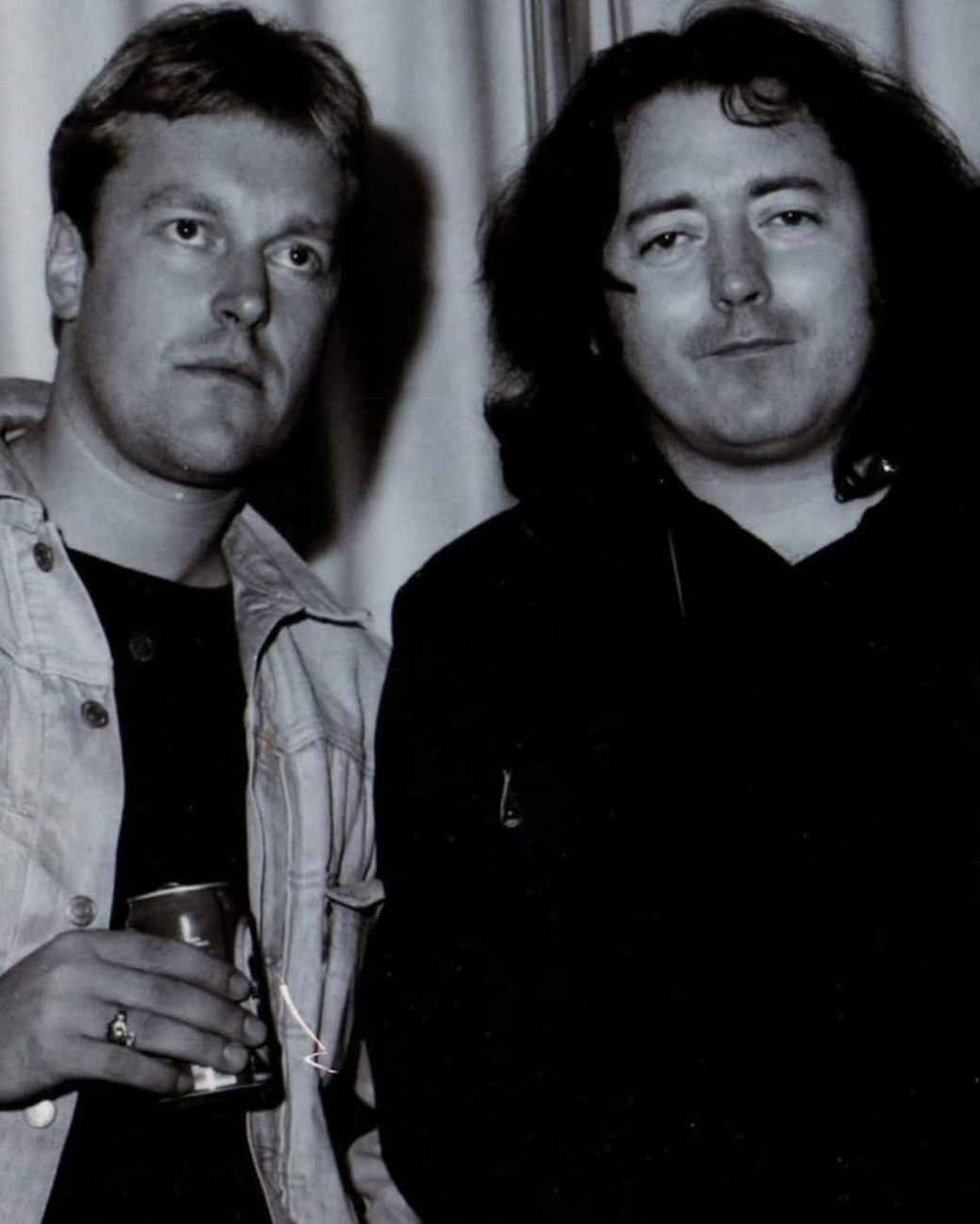
Rory was notoriously guarded in his relationships with others, yet you were one of the few people who had his private phone number. What do you think he saw in you that made him trust and open up to you?
I’m not exactly sure. I was always the fan first. Later, the friendship developed. I met him in 1982 for the first time in Ireland, backstage when he played in Punchestown. I started writing to him not long after that. I guess, fan mail, we used to call it. Then in 1985, we crossed paths again in Hollywood, California. I was actually living in California at the time and playing in a jam band that was an offshoot of Canned Heat, a band he liked. Funny thing, I replaced an American guitarist in that band who had gone off touring with John Mayall and it wasn’t till twenty odd years later I found out it was my friend Walter Trout (who I toured with many times) that I actually replaced. At the time, Rory was playing a concert in Hollywood with Roy Buchanan opening. He invited me over early and we hung out that afternoon just before he got busy sound checking. It was a great performance. I watched it from the side of the stage. Later, we went for a bite to eat and headed out to a great bar in Hollywood. I can’t recall its name, but I remember it had the London tube way maps all along the top of the walls. Needless to say, we burned the midnight oil till the wee hours of the morning. After that, we sort of clicked as friends and when I returned to Ireland, we kept in touch more, and a year or two later, I was over in Holland and Germany and for about eight months, myself and the band were playing almost every night and we actually lived in a big van on the road. I know Rory respected that, and that sort of thing does develop you as a player in a certain way, beyond the norm. Rory knew then I was serious about music because many people say they are going to do something like that but they never do.
Looking back on your time with Rory in those final years, what aspect of his personality or character do you feel people may not fully understand, especially in terms of his personal life versus his public persona?
Towards the end, I believe Rory was in a lot of pain, both physically and mentally, but he did not complain about it. Instead, he suffered in silence. I learned much later, it was the combination of the prescribed drugs he was taking and how they did not mix well with any intake of alcohol. Which brings me to another point. I don’t believe Rory drank quite as much as people think he did. Ok, I know it sounds like a cliché, but in the years hanging out with Rory, he drank no more or no less than most Irish people I know, who liked a few drinks. Like on a night out in Finches, his local in London, he wasn’t drinking faster or knocking back extra drinks in between rounds or anything like that and he never got sloppy drunk. He was great fun and company and if we were in a round with him, say half a dozen people, he would often pay an extra round for everyone. He was always kind like that. He was also very polite and he knew some of the regulars at that pub. For the most part, they worked in TV, theater, and journalism, but if he was introduced to someone new, he would remember their name for the evening and take an interest in them and their story and he was a good listener. One thing I noticed for years was that Rory was not a big eater. He would just pick at his food, nibble at bits and pieces and I often wondered if that was a contributing factor to his liver damage. Alcohol in general, with little or no solid food and nutrients to soak it up, over a long period is not good.
I know Rory struggled with depression, particularly in his later years. It would give me some comfort to know whether you were able to uplift him in any way?
Yes, towards the end in the last few months he certainly became quite down in his boots, but it was good to get him to go out now and again because it did cheer him up. He felt comfortable in the Conrad because he knew the staff there and they looked after him. He was always very polite and tipped them all well too. I’d like to share one story. One late afternoon I was waiting for Rory downstairs at the hotel. There was a guy there, who was often in the corner playing the piano, and he took a break and approached me and asked, ‘You are a friend of Rory’s, I have seen you here a few times with him?’ and he proceeded to tell me that Rory was the kindest man he had ever met. He was married about a year before and prior to his wedding he was searching for an apartment in London and was telling Rory, and one evening, Rory arrived and asked him, did he get the apartment that he and his fiancée had their hearts set on. He told Rory no, as it was a pity because they could afford the rent as they were both working but they wanted three months advance deposit, plus more for security. The next evening, the receptionist told the piano man that there was an envelope for him and when he opened it, there was a note inside from Rory saying, ‘This is my wedding gift. Go ahead and move into the apartment’ and he had enclosed a cheque made out for enough money to cover the move and more.

I read an interview with you where you said Rory told you he had six months left to live. If it’s not too painful, could you share more about this?
Yes, it was a very emotional experience, as you can imagine. It was on New Year’s Day 1995 and we were in Jacob’s Recording Studio. Afterwards, we were ready to go upstairs to eat and drink and everyone went and left Rory and myself alone. I was just standing there waiting for him to get ready to bring him upstairs to eat and I was still buzzing about a great song we had just recorded together. Then he walked over to me and put his hands on my shoulder and looked me straight between the eyes and said, ‘Six months… .six months, Eamonn’. I knew immediately what he meant and we hugged and both got emotional and he repeated into my ear, ‘Six months’. I never questioned it or asked him, ‘Did the doctors say this?’ or is it a real true innate feeling he just had himself, which I believe can often be the case when someone believes their time is almost up. After that, we remained even closer and talked a lot on the phone and I travelled from Dublin to London to visit him as much as I could. He became more introverted and had no interest to catch a taxi cab into his old favourite pub. It suited him better to meet at the Conrad Hilton Chelsea Harbour hotel, which was next door to where his apartment was. Many a good evening we had there and he would often cheer up a bit and have a laugh. All the staff there loved him and the manager was an Irish lad who always checked on Rory if he needed anything.
Can you remember your last conversation with Rory?
Sadly, it was on the phone and he sounded very ill. I was very worried and immediately tried to contact Donal and left messages and then I tried calling Rory back, but no answer. I kept trying every twenty or thirty minutes and eventually Tom O’Driscoll answered Rory’s phone and informed me that they were taking care of Rory now and he was on his way into hospital. Of course, I was relieved to hear this, but who was to know the devastating news later, that he was never to return home.
Looking back, is there anything you wish you could have asked or said to Rory that you didn’t get the chance to?
Not really because one of the last things I said to him in person was that, ‘I don’t think you can fully grasp the huge impact you and your heartfelt music has had on so many people and their lives. Fans, and especially your die hard fans. And you inspired so many people to pick up the guitar and hell, I even met a professional keyboard player in California, who told me he became a full-time musician, after watching Rory Gallagher perform live’. Rory really appreciated the compliment and just sat there in silence for a few minutes letting it sink in. Then, he smiled and thanked me and we picked up our Irish whiskey and said, ‘Slainte!’ and we sipped away and then back to our Guinness.

STAY TUNED FOR PART 2 NEXT WEEK!


Leave a Reply