
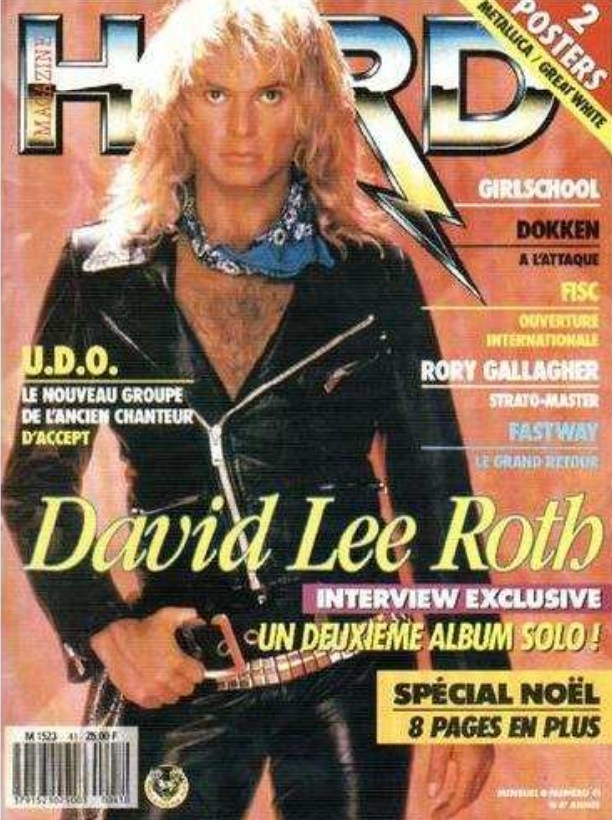
Rory Gallagher
For the past 16 years, Rory has been touring stages around the world, spreading the gospel of blues-rock without paying any mind to passing trends. By choosing this anti-commercial path, he may have missed out on the chance to line his pockets, but in return, he’s earnt the deep respect and admiration of countless fans who would follow him anywhere. Rory’s fans are everywhere—even among the journalists at Hard-Rock Magazine. One of them had the chance to sit down with him and now brings you an intimate look into the thoughts of the man who inspired the likes of Gary Moore, Pat McManus and Vivian Campbell.
The surly British bouncer guarding the backstage entrance of the Hammersmith Odeon is no pushover. Towering at six-foot-nine and hiding behind a thick moustache, he takes it upon himself to mercilessly turn away anyone who rubs him the wrong way—or who happens to be French, for instance. Just a few days earlier, our intrepid photographer George Amann learned this the hard way at a Motörhead concert.
At Rory Gallagher’s concert, George once again found himself turned away by the towering gatekeeper, left wondering what the pass on his jacket was even for. So, imagine his surprise—and then his delight—when the same bouncer came back moments later, full of apologies, after getting a bit of a dressing-down from Rory’s brother and manager, Donal. The Gallaghers clearly aren’t fans of the usual showbiz elitism. Rory’s post-show gatherings feel more like a get-together with old friends, and Donal made sure the security guy understood that George was very much one of them.
The next day, Rory’s minibus rolled through the storm-swept English countryside on its way to Southampton, where he was set to play that night. While Gerry McAvoy—his bassist of over 15 years—drummer Brendan O’Neill, who took over from Ted McKenna in ’82, and harmonica virtuoso Mark Feltham, who joined them for their last French tour in ’86, were catching up on sleep, Rory was fully absorbed in the day’s English newspapers. He keeps a close eye on current events, and it’s honestly surprising to see an Irishman living in England who’s so well-versed in French politics. Rory also has a deep love for classic French crime films—Belmondo, Delon, Ventura, Baye and Deneuve are all names he knows inside and out.
Born on 2 March 1949 [sic] in Ballyshannon, in the south of Ireland, Rory picked up the guitar at the age of nine. “My ambition started very early,” he recalls. “Back in 1958, I only had two passions: music and drawing.”
In the 1950s, the Gallagher family moved to Cork, a small city of about 138,000 people. It was there that Rory really honed his guitar skills.
Rory Gallagher: When I was about five or six, I was listening to skiffle. It’s a fairly simple kind of music—a mix of folk, rock and blues influences. It was really popular in the mid-1950s and had a big impact on a lot of British bands, including the Beatles. One of the biggest skiffle stars was Lonnie Donegan, who even had a hit with ‘Does Your Chewing Gum Lose Its Flavor?’
Rory: Donegan had covered quite a few songs by Leadbelly and Woody Guthrie, and that got me curious about their stories. I’d head to the library and read every book I could find about Leadbelly.
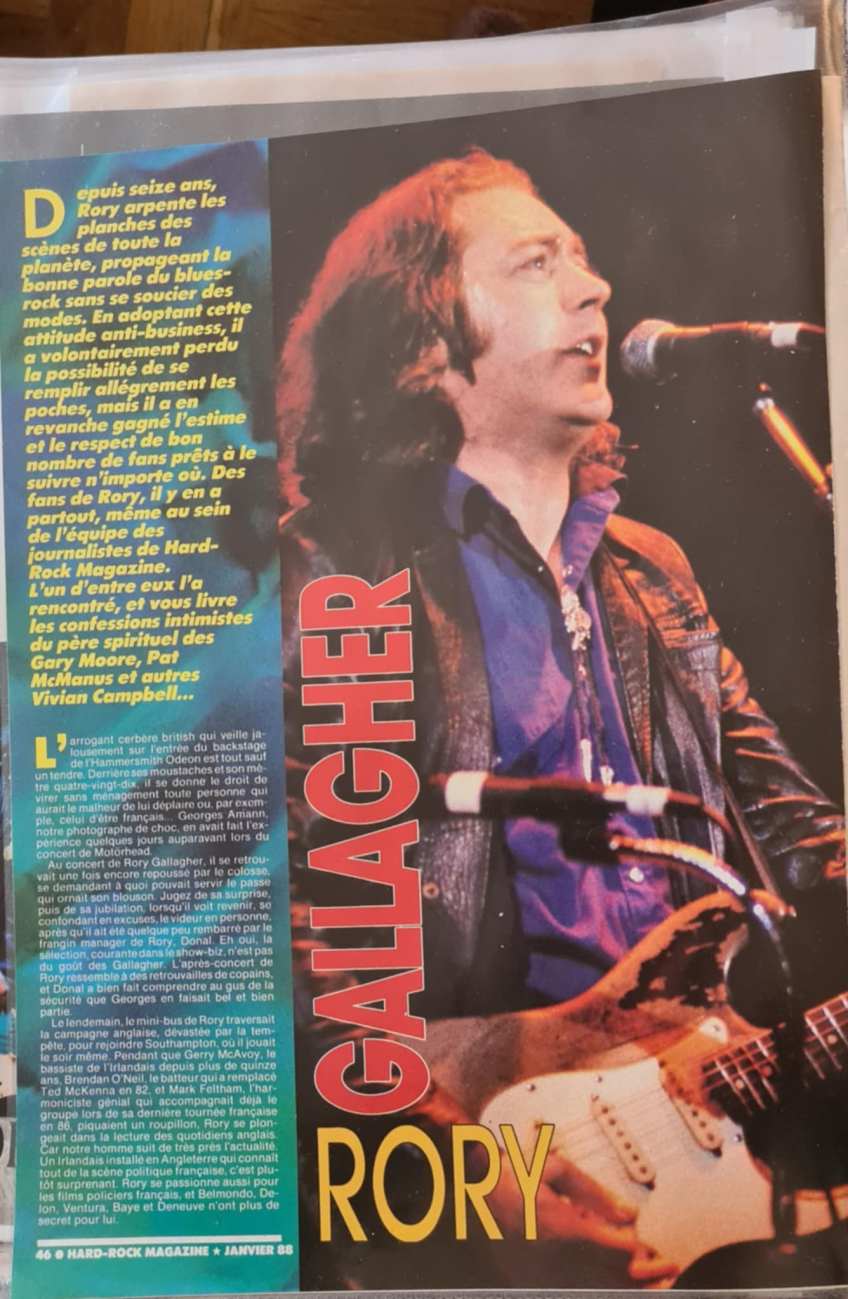
Professional Debut
Rory Gallagher: Big Bill Broonzy had a huge influence on me. There was a radio show that used to play Muddy Waters, Elvis, Buddy Holly, Eddie Cochran and Gene Vincent. We didn’t have a TV at home back then, but I’d often go to the cinema, and that’s where I saw films featuring Chuck Berry, Fats Domino, Bill Haley, and some of the early rock ’n’ roll acts.
I played acoustic guitar until I was about twelve. I’d take part in small local shows and charity concerts. Then I switched to electric guitar for a couple of years. When I was fourteen, I formed my first band with two or three friends. Not long after that, I got hired by the Fontana Showband—a showband—which gave me my first real tour experience. I played with them for two years.
In 1965, I started my first proper band. It was basically the early version of Taste, although we hadn’t settled on the name yet. We set out wanting to play rhythm and blues, but to get club gigs, we had to play just about everything. We ended up going to Germany, after the showband split up. When I got back to Ireland, I formed Taste.
Taste caught the attention of Polydor during a gig at the Marquee, and were signed in 1968. The first album, Taste, came out in 1969. After that, the line-up—Rory Gallagher on guitar and vocals, Richard McCracken on bass and John Wilson on drums—headed to the US for a tour, opening for Blind Faith, the short-lived supergroup featuring Eric Clapton, Steve Winwood and Ginger Baker. But the moment that really put them on the map as one of the standout guitarists of the era was their performance at the Isle of Wight Festival.
Taste broke up in 1971 [sic], a year after releasing their second album, On the Boards.
Rory Gallagher: I’d rather not dwell too much on how Taste ended. There’s no mystery to it—I had a falling out with our manager, and for various reasons, the band members just didn’t want to keep playing together.
People often don’t understand why musicians want to take a different path. But to record my first solo album (Rory Gallagher, released in March ’71), I had to pay a fortune just to get out of my contract with my former manager. I even had to cover the recording costs myself, and at the time, I was completely broke.
Just a month after the release of his debut solo album, in April 1971, Rory hit the road with his new band—Gerry McAvoy on bass and Wilgar Campbell on drums—for a tour across France, the UK and Germany.
After releasing two more albums, Deuce (1971) and Live in Europe (1972), Campbell was replaced by Rod De’Ath, and Rory brought in keyboardist Lou Martin, who also played on his most recent studio release.
With this new line-up, Rory recorded his legendary double live album, Irish Tour ’74, following two well-received studio albums: Blueprint (1972) [sic] and Tattoo (1973).
One thing that’s often overlooked is how well Rory Gallagher has always been received in the United States. From 1970 to 1981, he toured there over twenty times, sharing the stage with some of the biggest names of the era.
Rory Gallagher: We toured with The Faces (Rod Stewart’s band), Rush, Fleetwood Mac, Deep Purple and ZZ Top. Believe it or not, ZZ Top actually opened for us a few times. Kiss too. We did a lot of club tours—stadiums don’t really interest me. We also played a few shows with people like John Hammond and Freddy [sic] King.
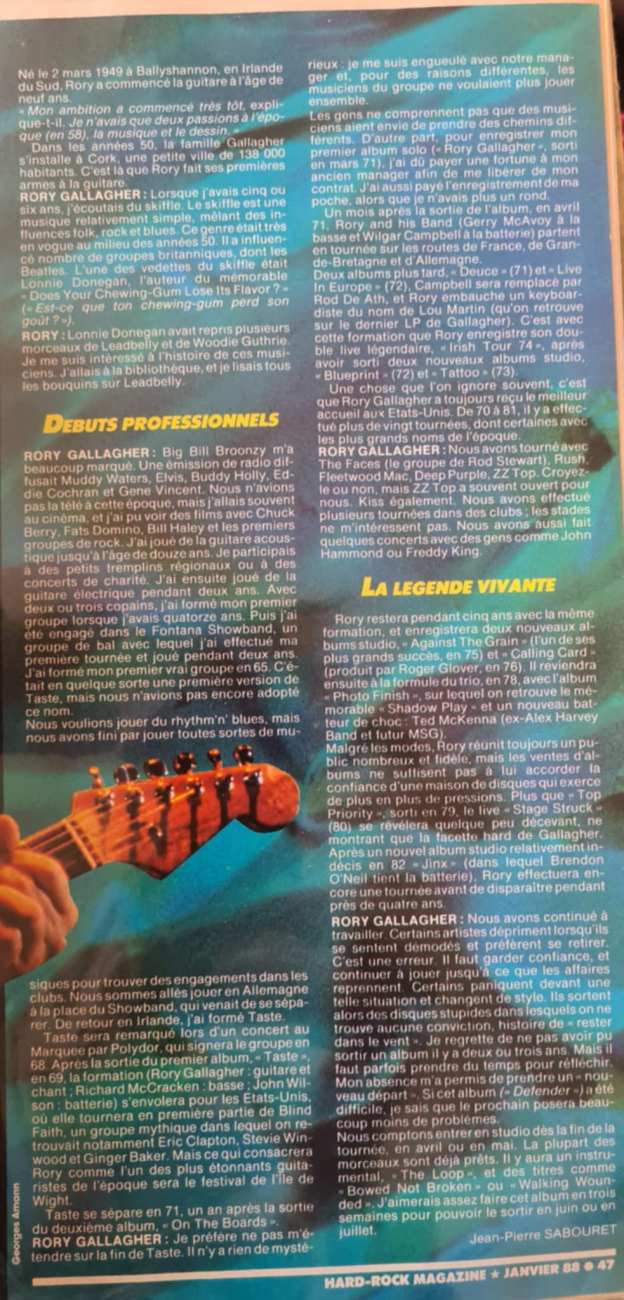
Living Legend
Rory kept the same lineup for five years, during which they recorded two studio albums: Against the Grain (1975), one of his biggest hits, and Calling Card (1976), produced by Roger Glover. In 1978, he returned to a trio format with the album Photo Finish, which included the memorable track ‘Shadow Play’. The album also introduced a new, powerhouse drummer, Ted McKenna (former Alex Harvey Band and later a member of MSG).
Despite changing trends, Rory still had a large and loyal fanbase, though album sales weren’t enough to give him the confidence of a record label that was putting increasing pressure on him. More than Top Priority (released in ’79), it was the live album Stage Struck (1980) that proved somewhat disappointing, showcasing only the harder side of Gallagher’s music. After another somewhat lackluster studio album in 1982, Jinx (featuring Brendan O’Neill on drums), Rory went on tour again before disappearing from the scene for almost four years [I disagree so much with all of this!]
Rory Gallagher: We kept at it. Some artists get depressed when they feel outdated and decide to retire, but that’s a mistake. You’ve got to stay confident and keep playing until things pick up again. Some panic in that situation and change their style, releasing records without conviction, just to ‘stay with the times’. I regret not being able to release an album two or three years ago, but sometimes you need that time to reflect. My absence gave me the chance to make a ‘fresh start’. If this album (Defender) was difficult, I know the next one will be much less of a challenge.
We plan to head into the studio as soon as the tour wraps up in April or May. Most of the songs are already ready. There will be an instrumental called ‘The Loop’, and tracks like ‘Bowed Not Broken’ and ‘Walking Wounded’. I’d like to record it in three weeks and have it out by June or July.


 REWRITING RORY
Leave a reply to rewritingrory Cancel reply