
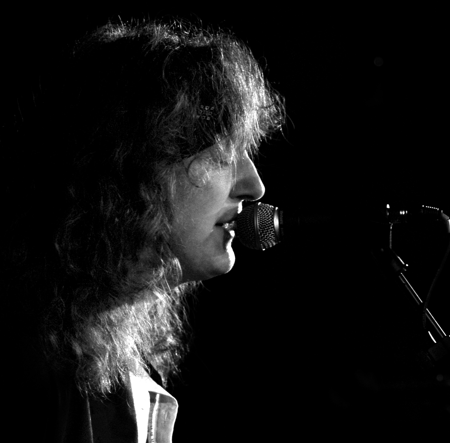
Barry McCabe is a guitarist, vocalist and songwriter from Virginia, Co. Cavan in Ireland whose unique blend of Celtic blues has taken him all over the world. My own personal introduction to Barry’s music was through ‘The Emigrant’ – a stunning instrumental that he recorded in 1998 with Davy Spillane. When I learnt shortly after that the track was dedicated to Rory, I was well and truly – to quote the great man himself – bought and sold. I checked out more and more of Barry’s music and was really struck by its soulfulness, authenticity and emotional depth.
I reached out to Barry earlier this year to talk about the influence of Rory on his life and the ways their musical pathways intertwined over the years. I’m delighted to share the interview below, which I admittedly found extremely moving and had me welling up by the end. I hope you enjoy reading it! And thank you so much, Barry, for sharing your beautiful memories with us all.
When did you first discover Rory Gallagher’s music, and what was it about his style that initially caught your attention?
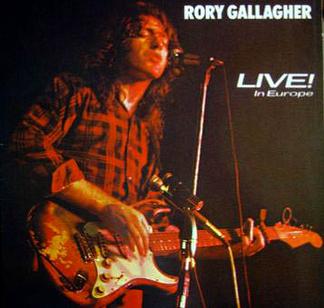
My introduction to Rory’s music was his Live in Europe album, back in the summer of ’72. I was working my first summer job at the local hotel and I finally had some money to spend. We didn’t have a record shop in our small town, so I had to hitchhike to another town 12 miles away.
I went there intending to buy Rod Stewart’s Never a Dull Moment album. Rory’s album was displayed high up on the wall, and for whatever reason, I said to the guy, “And I’ll take that one as well.” I had never heard of Rory before—Irish radio at the time played a very limited amount of music, mostly folk or traditional.
So I took my two albums home, played Rod’s first, and then put on Rory’s. What can I say… I had never heard anything like it and didn’t understand it at all. I played it over and over, trying to make sense of it. However, there was something about it that intrigued me and kept me listening.
The breakthrough came with In Your Town. There’s that moment where Rory takes it right down—the band stops playing, and it’s just him and his guitar. From the first moment I listened to the album, it had always felt like a runaway train thundering down the track. But by slowing things down in the middle of In Your Town, it was as if Rory was saying, Here, give me your hand. It’s safe to jump on board, and you’ll understand it better from here! That was the key moment, and there was no looking back after that. Suddenly, I knew what I wanted to do with my life—travel and play music, just like Rory.
Was Rory an influence on your own musical development? If so, in what specific ways did his work shape your approach to music?
Absolutely! He was a huge influence in shaping my musical style. Let’s be honest—when you’re a young musician, you don’t really have a style of your own. All you know is what you hear around you. You’re basically a magpie, picking up bits and pieces all the time. Having Rory as a focal point really helped me define what I liked and what I wanted to play.
For example, I was introduced to the blues through Rory. By playing covers of Junior Wells songs or Blind Boy Fuller songs, he prompted me to seek out the originals, and in doing so, I developed a real love for the blues. That love started with Rory’s covers.
Also, by not sticking purely to blues in his repertoire, he made it completely natural to include folk, rock, or whatever else felt right in your music. That was hugely important to a young and impressionable musician like me.
He was also a major influence on my development as a performer. I loved the way he ran out on stage, as if he couldn’t wait to get going—it set a tone of excitement before he even plugged in his guitar. I admired the way he cajoled the audience into clapping or singing along. He never ordered or demanded it; he just reeled them into his world.
The fact that he never used a setlist was impressive. I really liked that. It meant the show could always be spontaneous and left room to change everything at a moment’s notice. I incorporated that lesson into my own shows because when you’re playing night after night in town after town, you need to keep it interesting—for yourself as well as your audience.
I remember we played a club in Stockholm, Sweden, where we were booked for a week—six nights in a row. To me, it went without saying that we’d change the show every night. A couple of years later, a guy came up to me and said he had worked at that club for many years, and in all that time, we were the only band that changed the set every night. The fact that he noticed and remembered us for that made it all worthwhile—and that approach was directly influenced by watching Rory perform live.
I know you supported Rory on his 1992 European tour, but before that, had you seen him live in concert? If so, do you have any standout memories of those performances?
Oh gosh, yes, I’d seen him numerous times before that. My first time seeing him live was at the Carlton Cinema on O’Connell Street in Dublin. As you know, those shows later appeared as part of the Irish Tour ‘74 album—so somewhere in that crowd, I’m there, urging Rory on!
Rory would come home every Christmas and play shows in Dublin, Belfast, and Cork. Sometimes other cities were added, but those three were always part of his Irish tour.
The Stadium in Dublin was primarily a boxing venue, but it was also used for concerts, and Rory played there many, many times. The bouncers were tough—if you did anything out of line, like standing too long at the front of the stage to take a photo, you got thrown out. No argument, no discussion.
As I was very interested in music, I went there regularly to see international bands and solo artists. I couldn’t help but notice that when Rory played, the bouncers seemed to be a bit nicer. I never knew if Rory or Dónal had a word with them, asking them to be as kind as possible to the kids.
One reason I remember that is because, one year, I just couldn’t contain myself—I had to get up and dance. There were a few areas where you could do that without disturbing the rest of the crowd. Anyway, I, along with others, got away with it. Rory played, and we danced. Rory played, and we danced… and then he ran overtime, and we missed the last bus home! That meant walking all the way across the city—but we did it gladly, having just experienced a night to remember.

Photo by Eric Luke
Equally, did you ever meet Rory before 1992? If so, what memories do you have of this?
Yes, I did!
Going back to those Stadium shows, we heard through the grapevine that if you hung around a certain section of the hall, the bouncers would leave you alone, and you could go backstage to meet Rory. It sounded unbelievable, but it was true. Very few—probably no other big artist—did this, so it was a very special thing. Most people just asked for an autograph or a photo.
I remember one year mentioning Gary Moore, as he had just released his first solo album. Rory’s eyes lit up, and he asked if I’d heard it yet. I hadn’t, but we spoke about Gary, Belfast, and music in general for quite a few minutes. He was genuinely interested in things and in having real conversations with people. Over the years, I had many, many conversations with him about all sorts of topics.
Some years later, after I had left Ireland to play music on the European mainland, I met up with Rory and the lads in Hamburg, Germany. He was surprised to see me there.
“What are you doing here?” he asked.
I told him I’d packed in the day job and was now a full-time musician, doing things the old way—going out on the road and touring. Perhaps because it reminded him of his own early days, I always had the feeling that something changed in our interactions after that. Every time I bumped into him, he’d always ask, “How are things with the band these days? What clubs are you playing now? Did you try such-and-such a place?”
He still knew all the clubs. He’d tell stories from his early days, and after a while, I realised he was dropping nuggets of advice in a very subtle way.
How did the opportunity to support Rory on his 1992 European tour come about? What are some of your specific memories from that experience?
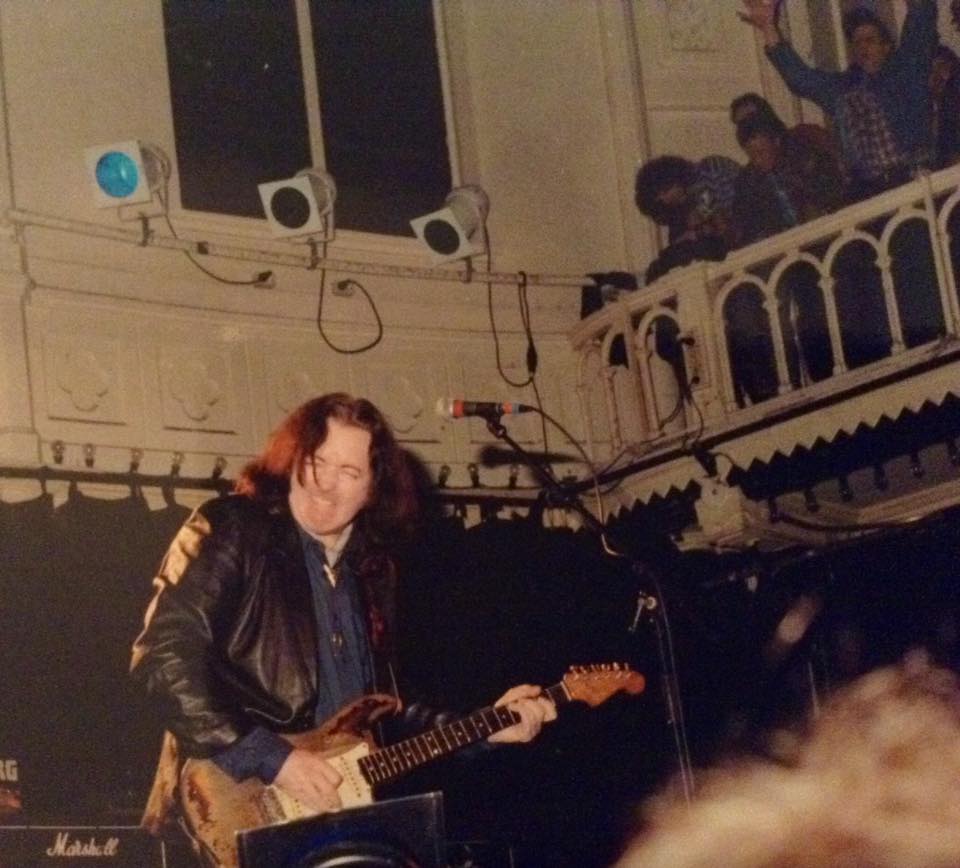
We played with Rory at the famous Paradiso Club in Amsterdam, Holland. That opportunity came through our Dutch booking agent.
Now, you’ll have to cast your mind back to a time before mobile phones and the internet. We were playing in Paris, France, and were just about to take a ferry from northern France over to England, drive across England, and then take another ferry to Ireland—because that’s how it was done back then.
In those days, I made it my business to stay in touch with all the various booking agents we worked with across Europe. During one such phone call, Rob asked me where we were and what our schedule looked like. I told him, and he said, “I think I have something nice for you. How would you like to open for Rory Gallagher at Paradiso in Amsterdam?”
He knew what Rory meant to me. I couldn’t believe it—talk about a Christmas present come early!
The experience was fantastic. By that time, Rory, Dónal, the band, and the crew all knew who I was and what I was doing, so they were incredibly welcoming. In fact, I remember Dónal saying to the stage manager or sound engineer (I can’t remember which), “These boys are friends of ours, so give them anything they need.”
It wasn’t always like that when you played support.
What did you take away from that tour, both about Rory as a musician and as a person?
Well, like I’ve said already, those shows were really just a continuation of the interactions we’d been having for years. I wouldn’t say I knew Rory well—he valued his privacy and was good at compartmentalizing things—but at the same time, we’d have conversations about the books we’d been reading or the albums we’d bought. He had clear opinions on things and was always articulate in expressing them.
Normally, when you’re onstage playing, your mind is racing. You’re trying to settle into your own groove, making sure your guitar sounds the way you want it to, feeling out where the other guys in the band are at, and picking up on the energy of the audience. It’s only when you’re back in your hotel room that you have time to replay the show in your head and process how you feel about it.
That said, I did have one moment of clarity during the first Paradiso show. We were a three-piece band at the time, so the stage crew didn’t need to change the setup for us. Suddenly, it hit me—I was standing in the exact spot Rory would stand on later, singing into the very mic he’d be singing into, and hearing myself through the same monitors he’d be using.
Can you imagine that feeling? From the moment I first thought, I want to travel and play music just like Rory, to actually standing on the same stage, using the same equipment as him. Who says dreams can’t come true?
Did you stay in touch with Rory after the tour? If so, what was your relationship like in the years that followed?
Less and less, I’m sorry to say. You have to keep in mind that we were incredibly busy at that point in our career. We were constantly on tour, and exhaustion was a constant companion. If we had a rare day off, the last thing I felt like doing was traveling to see another show—I just wanted to sleep.
In Rory’s later years, it became clear that he was struggling, and things weren’t unfolding the way any of us would have hoped. It was heartbreaking—for Rory, for his fans, for everyone who admired him. At that point, I decided it was best to preserve my memories of him as the giant he was and leave it at that.
You can never truly walk in another person’s shoes, so beyond that, there’s not much I can say.
Can you remember where you were when you heard the sad news of Rory’s passing? Were you able to attend his funeral or requiem mass?
Of course. I’d been playing in Denmark, and after that, I had a couple of shows lined up in Holland. I was sitting in the dressing room when I overheard two Dutch guys talking quietly. There was something sombre in their tone, and then I heard one of them mention Rory.
I asked, “Are you guys talking about Rory Gallagher? What’s going on?” That’s when I heard the news—he had passed.
I can’t say it was a complete shock, but at the same time, Rory had always spoken about those old bluesmen who grew old but kept playing. I suppose, subconsciously, I thought that would be his path as well. Even so, hearing he had passed hit hard.
In many ways, I had always seen Rory as a kind of big brother figure. He introduced me to the very lifestyle I was living. He was there to offer help and advice, and he had paved the way—out front, leading—so that all I, and others like me, had to do was follow in his slipstream.
And yet, alongside the sadness, I also felt a sense of relief. I hoped that, at last, his spirit was at peace.

Tell me more about the beautiful song you recorded ‘The Emigrant’. How much did Rory inspire that track, and what led you to write it?
I originally set out to write a kind of revised version of Oh Well – Part 2. You might remember that Peter Green composed the original on a nylon-string Spanish guitar. There was no point in me trying to replicate that, so I decided to give it an Irish flavour. In the end, it evolved into something entirely different.
Davy Spillane came on board and played some beautiful low whistle on it, which really helped shape the track. There was already a Rory connection in the room as we worked—Rory had played on Davy’s Atlantic Bridge album—so it felt like everything naturally aligned.
Dedicating The Emigrant to Rory felt right because I wanted to highlight aspects of him that weren’t always in the spotlight. Most people knew him for his fiery stage presence and powerful guitar playing, but I wanted to draw attention to his gentleness, his deep Irish roots, and the fact that he, too, was an emigrant for much of his life. That experience shaped both his music and his personality, and I wanted The Emigrant to reflect that.
Looking back, what are your lasting impressions of Rory? How did he impact you personally and/or professionally?
I hope the answers above have shown the lasting influence Rory had on me, both personally and professionally. But there’s one overriding memory that stands out, and it’s the one that crowds out all the others.
In 1984, Rory did an extensive tour of Ireland, and I made sure to travel to all the shows. Each one was a unique experience. For example, when I arrived in Omagh, Co. Tyrone, I discovered the hotel I’d booked had been bombed the night before!
There was also a show in Kilkenny, which was definitely off the beaten path for most big artists. It was held in a hotel with a large ballroom. At one point, I looked toward the back of the hall and couldn’t believe my eyes—there was a group of elderly couples waltzing around on the dance floor! I often wonder if Rory noticed, because suddenly he seemed to get into a giddy mood on stage and started playing snippets of old songs you could dance to. Rory had his roots in the world of showbands, where getting people on the dance floor was a big part of the show.
That playful atmosphere carried over to the hotel bar later, where we all gathered for a drink. Rory joined the festivities, and at one point, he was sitting right next to me at the bar. I can’t remember what we talked about, but the conversation was flowing, and we’d probably had a few by then. At one point, the barman said, “Lads, do you want another before I close up? We need to start setting up for breakfast.” We both said we were fine and got up to leave. As Rory stood up, his stool got caught on a footrail, and he bumped into a wall behind him. Without missing a beat, he said, “They build fast around here, don’t they?” I just started laughing at his quick wit, and then he laughed at me laughing.
He turned to head off to his room, and as he walked away, I said, “Sleep well, what’s left of it.” Without turning, he waved his arm and chuckled as he left.
That moment is a happy memory I’ll always cherish, and it’s how I’ll always remember him best.
Click here to find out more about Barry McCabe and his fantastic music!


 REWRITING RORY
Leave a reply to Dan quinn Cancel reply