
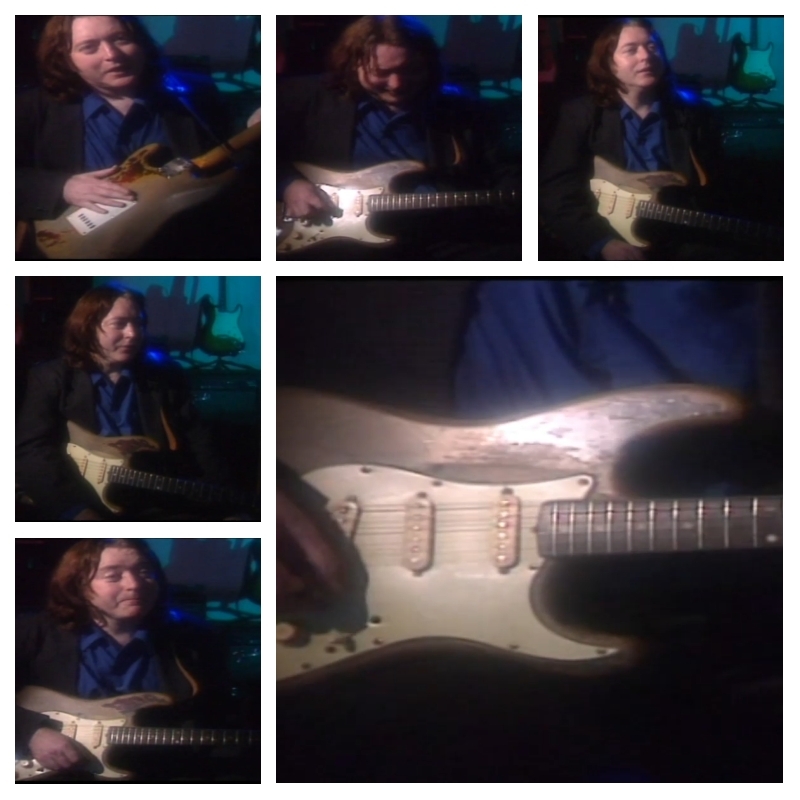
I don’t know about you guys and girls, but it’s been almost a month since the fantastic news broke that Rory’s beloved Strat will be returning home to Ireland, and I’m still on a high! Wanting to continue riding that crest of a wave (see what I did there 😅), I thought it would be nice to do a little blog post about the Stratmasters documentary, of which Rory was an integral part.
The idea for the documentary first came about in July 1990 when filmmaker Michael Bayley Hughes approached rock journalist Bob Hewitt at the Bodelwyddan Blues Festival about a project focusing on the Fender Stratocaster, which would be broadcast on the Welsh TV station S4C.
Rory was Bob’s immediate first choice to take part in the programme. Speaking to me back in 2022, he explained that Rory’s inclusion was vital because “he was the people’s choice [and] had a rapport with his audience and fans like no other.”
In early 1991, Bob sat down with Rory at the small Fender showroom in London’s Nomis Complex for an interview about the Stratocaster’s distinctive sound and history. He recalls that Rory was initially nervous, but once he picked up his guitar, his confidence grew. In fact, Rory was the only guitarist to demonstrate techniques on camera (the documentary also featured such guitarists as Robert Cray, Hank Marvin and David Gilmour).
The documentary originally aired on New Year’s Day 1992. Additional footage from Rory’s interview was later used in the Bayley-Hewitt documentary Stratmasters, conceived in 1994, but not officially released until 2007. A few years ago, Bob – a fervent supporter of Rewriting Rory since day one – kindly gave me a copy of this hard-to-find DVD. He has recently uploaded the whole documentary to YouTube and it’s well worth a watch!
Bob has allowed me to reproduce a transcript of Rory’s contributions to the documentary here. So, sit back, relax and enjoy!
—–
Yeah, I started on an acoustic guitar, just a cheap, little, plywood looking guitar with a sunburst painted body doing Lonnie Donegan type material, which was basically Woodie Guthrie influenced stuff, and I also played some Leadbelly songs, but at the same time, I was listening to the early rockers like Eddie Cochran, Buddy Holly, Chuck Berry. So, I tried a few lead lines early on just to see if I could do it, but it was a good two years before I got into electric guitar because it took me quite a while to learn all the standard songs like ‘It Takes a Worried Man’, ‘Lost John’, ‘The Grand Cooley Dam’, ‘Rock Island Line’.
But eventually, I got a Solid 7, a Rosetti guitar. I think they were made in Italy. It was quite good. It was a very distorted guitar, which I didn’t like at the time because clean sounding guitars were the thing. I reckon if I had it now, it would be quite usable as an Elmore James type guitar.
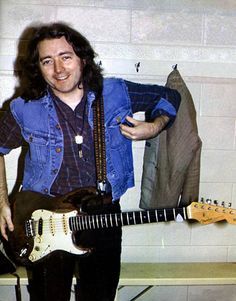
And then, when I was about… ’63 or something, this guitar [holds up his Strat] came into the local music shop, Crowley’s, and it had been owned by the guitar player of the Royal Showband. He actually wanted a red one like Hank Marvin, but this Sunburst one came in instead, so he had to wait for six months to get a red one and then he let this one go, and I saw it in the shop and I was knocked out because it was the first Strat guitar I ever saw and it was Buddy Holly’s image and so on, so luckily, I was able to get it and pay for it every week for I don’t know how many years. And it’s held up well since and it’s been through the wars, but I still like it a lot.
The Stratocaster looked really futuristic when it came out on the Chirping Crickets album, plus Hank Marvin would have been a factor because he popularised the Strat in this part of the world. But it just looked right, and the sound off a Strat, which was so chirpy and zingy appealed to me.

Over the years, we clocked up I don’t know how many hundred gigs and this neck, it just absorbed so much sweat and wear and tear that it was just playing up a little bit, so somebody advised me to take it off the body and hang it up in a dry, warm room for about six months, so I put a replacement neck on for a while, and then after six months, I stuck the original back on and it felt better. It kept more in tune, but I missed it when it was off the guitar [laughs] because the neck is a vital part of the sound. People think the body is the important thing and it’s not really. If you put a bad neck on a good body, the guitar will sound bad, whereas if you put a good neck on an average or even a poor body, it’ll work. I don’t know why that is, but it’s just something to do with the make-up or wherever the resonance is or whatever it is. Plus, the metal bar down through the neck. That’s probably where the sound starts and moves down, but that’s all science, I don’t understand any of the reasons why.
Even though they’ve done very good things with the new designs and the new finishes, for myself, I prefer the old style. I don’t even use the tremolo block. I’ve got it blocked up at the back, whereas on the anniversary Strat, I have used the tremolo arm a little bit in the studio by taking two springs off the five on the back, it gives you a bit more leeway, but the older tremolo units weren’t that accurate, whereas the new ones on your average standard Strat are quite good, and I prefer them to, say, the ones that are very floppy like the Floyd Rose or Kahler. They’re very good for the Eddie Van Halen style, but I think if you… I like a tremolo arm that’s not too easy. There’s a little give in it, but not too much.
But you can create those kinds of effects without the arm? You have a way?
Well, it’s all down to your fingers really. You can also just [bends behind the nut] use the behind the nut type tricks, but you have to be in full flight to do that really. But you really can’t get all six strings to go up and down, but you can get two [demonstrates]. Common-or-garden things that everyone does, but the trouble is if you use tremolo, it can be overused like a lot of metal bands, the guitar players tend to use it in every song and it becomes overdone. Hendrix just about had the right balance. He would use it a lot, but it worked… he used to make his guitar sound like it was going backwards on tape. He seemed to have it just about right, but I think it’s overdone now, to be honest with you.
Do you still like the idea of the springs in the cavity? Do you feel that gives it a built-in reverb effect?
It does because I had another Strat that just had a bridge piece without the metal block on the back and so on, and it didn’t sustain as long and it didn’t have that ultra zing, so even though I’m not using this metal stuff, it does help the guitar to sound crisp and bright. It’s strange. And a Telecaster, that doesn’t have all the metal block and so on, it has a sustain of a different kind. It’s a lighter sustain. There’s a good reason for leaving it there really.
What do you think makes the Stratocaster so special for you?
It’s just the versatility. You’ve got three pickups but you have the in-between positions, which are used a lot by people. The tone control is really near your hand. The volume control goes… the guitar stays alive as it goes down, whereas in some guitars, if you turn your volume from… [turns down volume] you see, this is still happening as it goes down, whereas on some guitars when you take it below eight, the guitar starts being very dead and unresponsive, so that’s another plus. Plus, the scale of the guitar, you know? Your hand feels right on the E chord. It’s just obviously a perfect design, for some people anyway. Plus, the controls really are very important. If I have two volumes and two tones, I get confused. And any time I jam or play on that type of guitar, I end up turning the guitar off by mistake because I get confused, so I just like the one volume and one tone. But it’s the sound of a Strat really, when all is said and done, that’s the main feature.
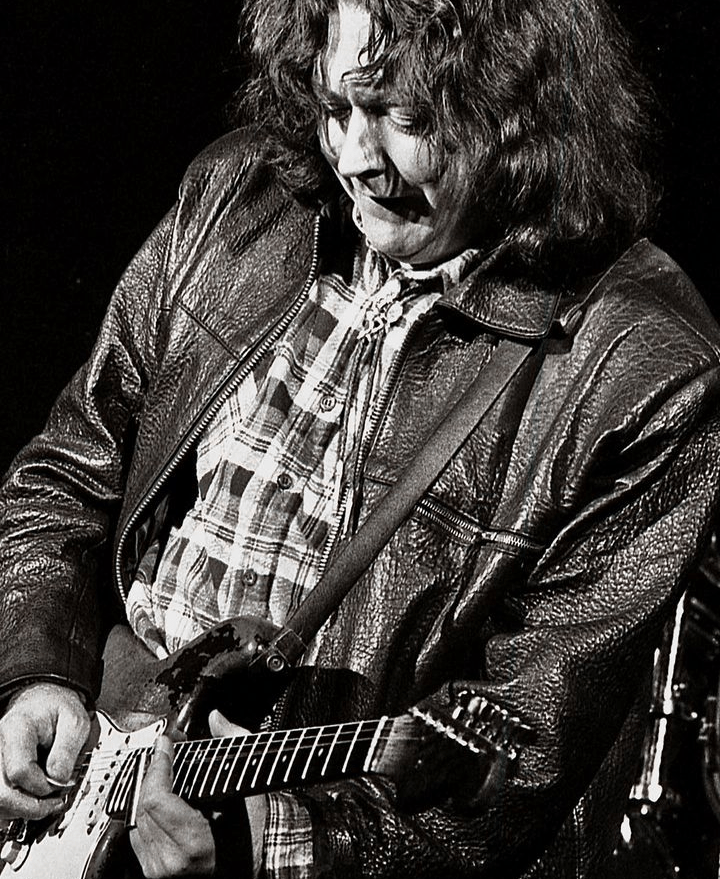
Photo by Bob Hewitt
All Strats sound sort of similar, but each player has his own personality, his own approach to the guitar. Like Buddy Guy would be going [mimics Buddy Guy’s style]. Very kind of staccato. Whereas, say, Buddy Holly would have been using fairly medium-gauge strings. Didn’t really do lead lines except maybe [mimics Buddy Holly’s style]. Plus, you get a great [plays a Buddy Holly riff]. It’s a good guitar for Buddy Holly stuff. Hank obviously gets that ultra true clean sound. Hank, to the best of my knowledge, doesn’t use the in-between sounds that much. He tends to use whichever pick-up he’s using at the time. [mimics Hank Marvin’s style]. Sorry, Hank [laughs]. I can’t. I need the tremolo arm for that. I don’t know. Eric Clapton, Robert Cray, people like that, use the in-between sound a lot. Since [Eric] moved from the Gibson to the Strat, it has changed his playing slightly, but he still gets quite a big tone and he has a very eloquent [mimics Eric Clapton’s style] overtone he gets. I suppose the nice thing that, asides from lead guitar, it’s got a lovely rhythm guitar sound, so it doesn’t sound too mushy or muddy [demonstrates]. Of course, Ry Cooder plays great slide on a Strat. At one point, he put a P90 pick-up here [points], which worked very well, but most of the time, he’s just using a regular Strat. He’s not using one of these Supros or Danelectros or whatever, but it’s really very hard to describe anyone’s style.
It’s strange that so many people play Strats nowadays. It’s just a versatile guitar. I mean, soul guitarists are likely go [plays soul style riff] and you can play… if your amp is dirty enough or you’re using distortion, you can get quite a nasty, raunchy sound. I suppose that’s why Hendrix was really the man in a lot of respects because he went from clean rhythm to extreme distortion and a lot of effects and so on, so it’s a credit to the instrument that you can do anything. Plus, it doesn’t break in your hands if you attack it fairly harshly. It’s gonna be around for a while yet, I’d say.
Could you describe some of your techniques for us?
It’s quite hard really to look in on yourself and say, ‘I do this, I do that’. I like to play rhythm and also… I don’t really have little tricks that I can think of. I also use a lot of damping for certain parts. Also, if I’m doing a solo, I quite often take the edge off the song, so it’s not quite as bright as most Strats. I try and aim at something like a cross between a Tele sound, a P-90 pickup and a Strat sound. I don’t really do that many tricks. Sometimes I do this string-pulling thing [demonstrates], which is something like a tremolo-arm thing or if you want to be really showy, you can pull the string out [demonstrates], but you have to be in full flight, like I said before, for that kind of thing. So, I just try and do everything I can that feels right for the song. The great thing is you can subconsciously play… change pick-ups. Maybe use one position for the verses, one for the solo or even halfway through the solo change it without it being a big deal of changing this. But somebody else would be better at explaining my style than I would because I don’t really have a textbook style.
—–
For more details on Stratmasters, see Chapter 4.6 in Rory Gallagher: The Later Years.


Leave a Reply