
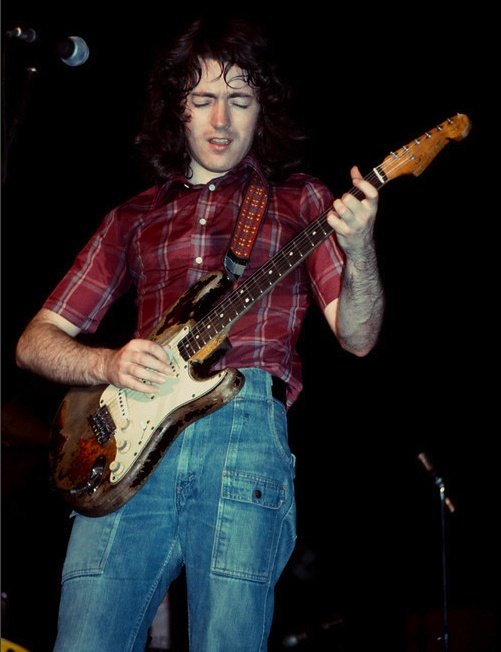
When conducting research for our recent article on Rory’s Australian tours, Rayne came across a copy of an interview with Rory which is held in the archives of the State Library of New South Wales. The interview was possibly conducted by Chris Winter for the Sydney radio station 2JJ and took place on 8th February 1975. The Library very kindly digitised it for us and recently sent us a copy. Although we are not permitted to share the original audio file, we include a transcribed version here for you to read. We hope you enjoy it!
Well, Rory, welcome to Sydney.
Thanks very much. Thanks. Good to be here.
How are you finding Australia?
So far so good. Really, it’s been a very good reaction, both Perth and Adelaide, and I’m looking forward to Sydney. It’s been a very keen reaction, you know. Quite a bit of… quite a following that I didn’t think that was there, you know. And the weather is suiting us. We’re getting a bit of a tan. I nearly got killed in a swimming pool. Lots of events have occurred, so it’s been pretty eventful. It’s been enjoyable. Not a dull moment, yeah.
What brought you here to Australia?
Well, it’s inevitable that we should have gone to Australia to do a tour. And we were, in fact, due to come here last year, but it fell through and after years of playing in Europe and America and making so many albums, it’s time to get here really. It’s such a big listening audience and, you know, we had a certain amount of feedback coming through to London. You know, people writing letters saying, ‘When are you gonna come?’ There was, you know, quite a bit of interest. You know, it’s such a big area that we had to come here anyway.
Mmm. If we could do a great leap back… it’s a long way from Cork [laughs].
It is indeed.
Perhaps we can go over some of the early period of your life then.
Yeah. [coughs] Well, I started… I was living in Cork. Well, I was born in Donegal, which is in the north west of Ireland and I moved to Cork when I was a toddler and musical family, musical relationships, Irish traditional music and opera.
No blues.
No blues, absolutely. None. And then I heard Lonnie Donegan, Bill Haley, Elvis Presley. You know that whole glut of artists that came out. And I was knocked out. I was only eight or nine years of age. So, I got an acoustic guitar. I’d already been playing kind of a ukulele, that sort of thing and singing. And I started playing in talent contests and school concerts and pioneer rallies. [laughs] You know teetotal rallies, that sort of stuff. My grandmother’s bars. You know, playing every kind of thing. Everly Brothers, Fats Domino, you name it. Then I started playing, when I was twelve, thirteen, electric guitar.
What sort of guitar was that?
A Rosetti Solid 7. Twelve guineas and the amp was twelve guineas as well. Little Giant, it was called, with four rods. So, I started playing every kind of thing. You know, rock ‘n’ roll really. And then later on, I played in a dance band for two years called the showband… the Impact Showband doing everything from the Clancy Brothers to Chuck Berry. I did the rock ‘n’ roll section, somebody else did the comedy section, all that. So, I played with them in Spain and England and Ireland. I left them when I was seventeen cos I didn’t want to play all this conglomeration of music and started playing what I wanted to play. Rhythm and blues and rock ‘n’ roll and eventually blues as I began to hear more and more records.
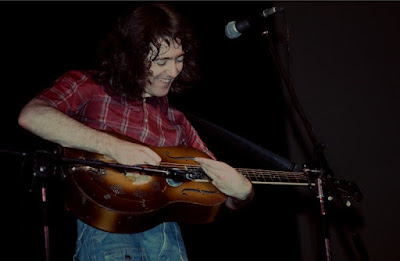
Photograph by JMP
What period was this? What year?
This would be… when I left the showband, it was ’65 and I started with a three-piece band in Germany, in Hamburg, in the clubs, Lübeck.
It strikes me always that English people always seem to find something in Germany and then they come back. What’s that about?
Well, the English and the Irish, I suppose. I don’t know.
Oh sorry, the English and the Irish [laughs]. Common mistake.
Okay. That’s alright. Well, no, the thing was that if you couldn’t get work locally or you couldn’t get gigs in London, which was the big deal, you just sort of… Germany was wide open, to a certain extent. You were offered a contract to do two weeks in a club and two weeks somewhere else, seven hours a night. A semi-guarantee that you’d be paid. Terrible living conditions. That sort of thing. But nevertheless, you could play what you wanted as long as it didn’t get boring and for someone like me and the band, we wanted to do raunchy material. You know, rhythm and blues, rock ‘n’ roll, whatever it is. And it was a great opportunity and we enjoyed every minute. We were swindled from left to right, but we enjoyed it and came back in a van… there was no key for the van. We just had to start the ignition with a screwdriver. Honestly, this is true. Thank you. No luck on the van. Left our guitars and everything in the van at night. It was a great experience, so… I don’t know. It was just kind of a refuge at the time or a sanctuary for rock ‘n’ roll or whatever it was and… so, I came back anyway, enjoyed the three-piece idea and started up a group called Taste and we started doing our own material and blues-influenced stuff and that developed into the second line-up of Taste in 1968 when we moved to England, to London, and we started playing the Marquee Club and all the clubs in England, festivals, things like that, and in Europe, and we had a great run for two years and we finished in 1970 and we had about two studio albums on Polydor and a couple of other stray albums that came out after and that was it. I went on my own with my own band in ’71. I’ve been doing that since. We have six albums since and we have done about seven tours of the States, a lot of work in Europe, two tours in Japan and this is the first in Australia, so that is…
Not a bad career [laughs]
A potted… a potted career.
Getting back to that Taste period, Taste got a reputation for being really volcanic. You know, generating excitement in live performances. What was the basis of that?
I don’t know. It was pretty… it used to get pretty exciting alright. There was a lot of improvisation just done on the spur on the moment. Maybe too much really. But nevertheless, when we got cooking, we really got cooking. Do you know what I mean?
Do you think that was ever captured really on record?
It was on a bootleg album that I have that was recorded in Hamburg and that was… that really got us… the essence of the band, but it’s a terrible bootleg. You can only hear the band; you can’t hear the vocals. They brought out two live albums after we split up, but I can’t listen to those properly because I’m biased because the band wasn’t consulted or I wasn’t consulted, but I don’t think any exciting band, if in fact, we were exciting, can ever really be captured. I mean, I think the band I have now is more exciting than Taste and more controlled because Taste, you know, was very exciting, but it used to just go off the rails on the odd night, but when it was exciting, it was really like a house on fire. And you had… we had an Irish drummer and he was a highly explosive person and whatever kind of excitement I could add myself, you know. It was a nice thing, but it burnt out quickly. It was like a meteor. It couldn’t lost, you know.
What about the… well, not the solo period, but when you went out as Rory Gallagher, that first album.
Yeah.
Were you happy with that album when it came out?
Oh, I was. Yeah. That had a good blue mood to it, that album. It’s always very difficult to record me, you know. It’s… you know, it’s… I need kind of an audience to play to and also, I like to record live lead guitars, live vocals, everything live, very little overdubbing or mock echo, mock gimmicks.
Have you drifted into effects at all?
No, I haven’t. I’ve tried here and there, you know, because it is essential on records. It’s strange. But over the last couple of years, they’ve developed sort of new techniques, sort of recording in kind of ordinary domestic surroundings with a mobile unit outside a sixteen-track studio or something so that musicians such as myself can record in a relaxed fashion. Otherwise, you’re in a studio that looks like a dentist’s operating table or something and you’re looking at this balding engineer glaring at you. You know…
A long way from the Marquee [laughs]
Yeah, you know. And then, like live albums aren’t completely the answer either because they’re like very much a thing onto themselves, but we’re getting closer to the proper studio sound.
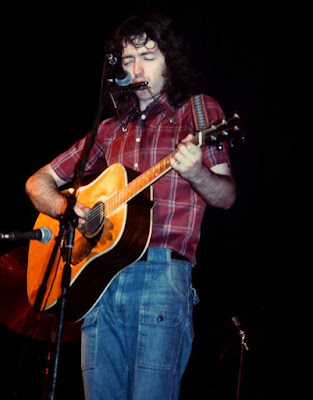
Photograph by JMP
When did you get the reaction in the States? When was that building up?
Well, I went with the Taste in 1969. We supported Blind Faith on their one and only tour and then we didn’t go back until I got the Gallagher band on the road in 1971 and we did a tour in September. We played with Buddy Miles and we did some clubs. It was a pretty immediate reaction, thank God, and then we went back in ’72 for a long tour for four months with Savoy Brown, Fleetwood Mac and a couple of odds and ends, clubs and things. And we went back with The Faces, Deep Purple and a load of odd gigs with the Beach Boys and God knows who. Freddie King, John Hammond. Plus, you know, the States is such a mixum gatherum. You know, you could be supporting one night, the next night you could be the headliner. It varies. But then the last two tours, we’ve headlined on our own, so it’s really a hot bed there now. All we need is the right album, the right time, which I hope is gonna be the next one. You know, where everything is gonna click at the one time and get an album doing well, you know.
You got a reputation as sort of a cult figure in the States, which I suspect you went over.
No, I… no, I don’t go after any cult reaction cos that’s… cult reaction kind of can go too far too, you know. I just wanna get… I don’t know. I like the word-of-mouth reaction. I don’t like hype. I don’t like grabbing the audience or the public in general by the scruff of the neck and saying, ‘Look. Listen, like this thing or we’ll shoot you.’ This kind of heavy style. No, I mean, a gentle… gentle persuasion to the public isn’t… doesn’t do any harm because that’s part and parcel of it, but… you know, I like… whatever reaction I get, I like to think it’s pretty genuine as opposed to… I like that the audience should like the act, the music and the sound as opposed to liking what kind of shoes I wear or what kind of… what I said in the paper last week or what cloak I wear and that stuff.
What about Deuce and the Live in Europe album?
Yeah. Deuce is kind of still an old favourite on mine.
I think it’s my favourite.
Yeah? Oh, good. Good. That’s the American favourite. The Americans like that the best. We did that in a very small studio in a sort of unpopular area of London. It’s only eight-track, but I still have a soft feeling… there are some rough edges on it, but it has a certain sound… atmosphere to it. At least, I think… if one thing we can get is a certain atmosphere on the albums… that one I like. It’s got quite a… I think. Deuce, we did that in the summer… what was it? August of ’71, I think. August? Maybe it’s October. It came out in that late autumn.
You produced that yourself?
Yes. Yeah.
The first album was Eddy Offord.
No, I produced that too.
Did you? There is a credit on that.
Was it? Produced by Eddy Offord, was it?
I thought so, yeah. I looked at my copy last night.
Yeah. You could be right. I don’t know. No, officially…
Was he involved with it?
No, no. But I mean, I absolutely give him ninety percent of the credit [laughs]. He’s such a genius as an engineer and it was a very easy album to produce. Let’s put it that way. Because there were very little overdubs, no messing about and he just recorded it like a monk and put it down. You know, he stayed with it…
How many of those tracks were actually put down straight?
[tape stops and starts again]
We were talking about Deuce. Which tracks were put down straight.
I think we were talking about the first album, weren’t we? Eddy Offord because…
Oh, the first album. Sorry, yeah. I got confused.
Most of them. I mean, in terms of overdubs or what? Well, let me see. Oh yeah. ‘For the Last Time’, absolutely live. ‘I Fall Apart’, I added rhythm guitar. What else? We’ve got ‘Sinner Boy’, live. ‘Hands Off’, absolutely as it was. Ninety percent. I mean, the only thing we added on was maybe ‘Laundromat’, we added a little bit of harp and tambourine. In fact we probably… we should have overdubbed a little more maybe. These are the regrets you have after, you know, but I was totally dogmatic at that point. I just said… I just…
Would you consider that now? Would you consider putting a track down straight?
Oh I still do it. You know, it’s in conflict all the time. I like… I don’t like to do anything I can’t do live. You know like these certain guitar players do 3D guitar solos the own time, echoes in the mountains and things that physically aren’t possible. You know what I mean? Which is all very well, but I’m into… it’s kind of a pride, I suppose. I like… whatever I play on the record, I want to be able to do and do even better live, you know.
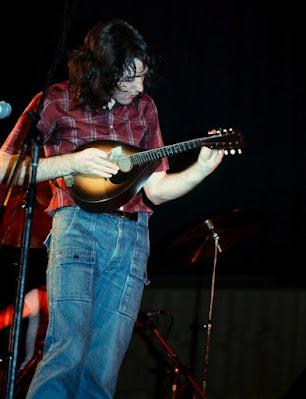
Photograph by JMP
I: Which guitar are you using now? Still that…
Stratocaster. For the last twelve years. And Telecaster for slide. I’ve got a couple of acoustics. A National when I wanna play a kinda brash sound, or a Martin. They are mainly my guitars. I have a few odds and ends besides that, but for recording I’ve played on a…. on Tattoo, I used a $15 Silvertone on ‘Cradle Rock’ and ‘A Million Miles Away’ and that’s got a nice sound, but it’s not a versatile neck, you know, so you couldn’t use it on stage.
Yeah. What about the Irish Tour album, which is out now? What was the basis of that tour? What made you do it?
Well, we… well, since we kind of… say, the last how many years… since the days of Taste, we’ve just… we’ve done two Irish tours a year or one tour, in fact, the last couple of years. And the only year we missed was 1973 cos the situation in Belfast was too rough, really insane, but we did… we went in every other year and we did… the Irish Tour album comes from the Christmas before last and the New Year before last. We just went in and did Dublin, Belfast, Cork and I wanted a new live album and an Irish live album for a change and we…
Would you consider going back there now?
Yeah, I was there at Christmas.
In Belfast?
Oh yeah. Yeah.
What are your feelings as an Irishman about the whole thing? Did you get involved in that?
Emotionally, I do. Of course. But you know what I mean, the impressions that you might get here, you ought to put a question mark behind them because, you know, it depends on where you’re getting the reports from. Ah no, it’s… things are… I’m optimistic there. There’s a light at the end of the tunnel and everyone’s talking and things are beginning to look peaceful. There was a wee… there was a truce on at Christmas, but then who’s gonna have anything against a musician? There hasn’t been one incident at any form of entertainment, any concert, you know.
What about in the other direction? Can you see yourself writing any blues songs about that?
No. I could maybe, but…
There must be a Belfast blues around somewhere [laughs]
There’s more to the north of Ireland than Belfast. There’s Derry and a lot of other places. In fact, we should really do Derry City as well as Belfast, but…
Just getting back to the whole subject of blues…
Yeah.
Whereabouts do you see yourself now fitting on that sort of spectrum? If you are talking about Lead Belly and the Stones, whereabouts are you?
Oooo, that’s a big question. It depends on how purist you wanna get, you know. Spiritually, I’m still head and shoulders in the blues. No doubt about it. But it’s 1975, you know, and I’m a contemporary writer and I was brought up in the rock ‘n’ roll days, so these things will have a lot to do with it. And I don’t wanna be just an imitator or a recreator of the old blues country stuff, even though I do some of that material with my own slant on it, but emotionally, I appreciate what the blues does and, you know, it’s… I don’t know. It’s a thing like, for instance, Little Feat now is a good example of what the blues can be in a modern sense because it has the… all kinds of influences. Motown, funk, soul, so all kinds of things. And you know, there’s no point in just doing Elmore James stuff over and over again. I never did it. Taste never did it. Whereas the British blues boom was very much a bit apey that way, you know. But I still get such a kick out of the blues either in the old way or the new contemporary way or with whatever stamp I can put on it or whatever, you know.
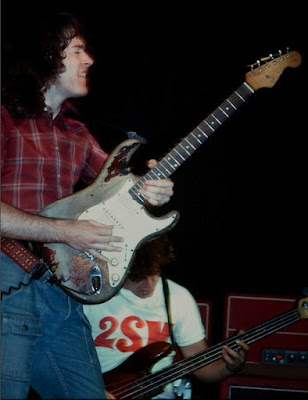
Photograph by JMP
Who would be the most… your favourite popular blues guitarist? Not anyone you know intimately in the industry, but just a popular artist.
As a popular artist? Buddy Guy, Muddy Waters, John Hammond. The list is as long as your arm. It really is. I don’t know. So many other people. There are so many country acoustic players. I love the acoustic players and the twelve-string slide players. Willy McTell, people like that. But like I don’t have one idol. You know, I don’t have… like I don’t bow to Mecca every time I hear one guy, you know. There are so many good players in and out of the blues, but Buddy Guy, I think, is the most impulsive player. I like him. The Kings are great. Freddie King, Albert and BB are great.
Freddie King. In Rolling Stone, they mentioned that he was putting out a new album with something called ‘Laundromat Blues’. Is that your ‘Laundromat’?
No, it isn’t. That’s Albert King, in fact. That’s one of his.
Is it?
Yeah. And then he had the ‘Answer to the Laundromat Blues’, but when I wrote ‘Laundromat’, I didn’t even know that track. And it’s got a totally different twist to it anyway.
What prompted your ‘Laundromat’?
Well, the place I was staying in London, there was a laundromat in the basement and… it sounds pretty corny, but I don’t know. Just something struck me. I mean, it was… going down there to get your clothes done late at night after a gig or something these couple of years ago. It was really a very depressing place to be, you know [laughter]
Yeah. They always are.
Well, it wasn’t depressing. It was just… it was just something novel that hit me. And also, I had been reading about people sleeping in laundromats in New York and things like that and they were kicking them out at three in the morning, you know. It was just one of those derelict songs. You know, one of those things.
Yeah. What about Van Morrison, another Irishman? Do you have any contact with him?
No. No. I met him once. A hello, you know. I was very aware… he’s one of my favourites as it happens, but… I don’t have very much contact. He just did one English tour recently. I saw him. He was fantastic. A great show. But I didn’t know him in Belfast. The bass player, Gerry McAvoy, he kind of knew him to say hello to, but I don’t think not that many people know him anyway. He’s fairly…
Who?
Van. He’s…
You mean know him intimately?
Yes. I don’t even think he knows himself intimately. He’s great though.
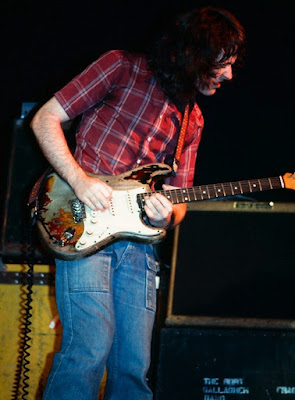
Photograph by JMP
Yeah. Your whole thing seems to be playing small clubs. Personally, you feel that you do better jobs there. I mean, you played at The Rainbow, did you, last year?
Yeah.
What was that like?
Well, we did at Christmas, two nights. We sold it out and that’s a fairly big deal in London really. It was great. I don’t like The Rainbow that much. It’s alright, you know, but this year it was really good. Previous years, they had the stage high and a big kind of moat between the audience…
Carpet thing…
Well, no. You literally could fall down… Frank Zappa fell down twenty-four feet and broke his arm or something, and that is a terrible thing, you know. But a club is great.
You played the Marquee in…
London.
In ’73. I saw that in ’73. That was a really incredible night. Early ’73. I think it was January.
Yeah, we did three nights, I think. We did a weekend. Like we kind of… how can I do it without sounding self-righteous or whatever? We just do it. We don’t have to do it. No one else of their concerts acts, I suppose… we could just exist on concerts. We just do it cos… you know. And we do a lot of clubs in America. I mean, you can do great concerts, whatever. But in a club, anything can happen. You know, you can have a beer, play a game of bowl, foosball. The whole atmosphere is congenial. It’s just proper for this kind of music. There’s no big compère coming out and… you know, it’s really rough and ready, and there’s nobody looking at their watch. ‘What time are you coming off the stage?’
Also, from the audience point of view, it’s much better, the club feeling.
Ah yeah. Yeah. Yeah.
Just talking about playing first of all or whatever, what’s life like on the road these days? Is it getting better for you?
I don’t know. I don’t think it’s as good as it used to be years ago. The rock scene has become so kind of big time and sort of star like and running into limousines and all this caper. No. Musical people used to invite you to parties. Ordinary… I mean, just anybody would come up and you could end up anywhere, you know. But it’s so like back to the hotel and… not for us. We’re probably the… we’re very much an [?] band in that sense, but it’s pretty enjoyable. We’ve… we just find out what’s happening in town and… but we’re all keen on a beer and a game of pool, you know, whatever. But I do remember it being more of a kind of… I mean, just the stars are untouchable thing has kind of shied away a lot of people, you know. If you can follow me [laughs]
Just looking to the future a bit, what’s the next album going to be like?
I’m very optimistic that this is gonna be the album. Absolutely. I’ve most of it written. A lot of great ideas for it and…
What sort of style?
I can’t wait to get this album out. Well, let’s put it this way. I think we’re really gonna get an album that’s gonna completely put its foot on this old question, ‘Can you get this stage excitement onto record?’ We’ve done it on lots of tracks and so on, but a real keen album, a real slick album. It’s gonna be… I don’t know. I can never predict. I’ve predicted albums before and it’s always turns out different.
What are you calling it?
Eh?
What are you calling it?
I’ve a few titles, but I won’t… I can’t… a few, a few… I wrote… no, it would be unfair to give you the title. No, I have a few songs. A few songs ready. We’ve been working on them. I just don’t know when it’s gonna come out.
Your albums always seem to be a composite of various styles. Do you ever consider putting out just a very raunchy album or a country blues album?
I feel I should do that, you know. I mean, this is… it’s the trouble when you’re so diversified, you know. It’s a bad thing really. I definitely will do an acoustic album during the year. I mean, I could do that…
This year?
Maybe. Well, autumn, say. That’s definitely on the cards. And a lot of people keep asking me to do that, you know. And I’d love to do it cos I could do kind of other kind of acoustic things that I don’t get a chance to do and then people say, you know, ‘You should do an out and out vicious rock album’ or whatever too, you know. No, I think it’s… I think we’ve got the right balance material wise, but I think we… if we can get the sort of… step up on the sound and production wise, we should get a really hot album.
The last studio album Tattoo, the opening on that is really beautiful. What’s the background there?
The opening?
Yeah, the opening.
That’s… well, ‘Tattoo’d Lady’ is the song, of course. Well, it’s a song about the small circuses in Ireland, which are really sort of cheap little… they don’t have any animals or anything, just push pennies… carnivals. I don’t know. What do you call them here in Australia? Fairgrounds?
Sideshows.
Sideshow, that sort of thing. So, we were trying to create a kind of music box sound they have. You know that [?] sound.
That’s with the squeeze box as well?
That sort of thing. So, I went into Woolworths and bought this organ, cheap child’s organ for £24 and brought it up to the studio and Lou had a go at it and we miked it up and it has that real cheap little sound.
Tinny sound.
Yeah. And that’s what we use on the track, but the actual intro leading into the sound proper is back to front. It’s backwards with a twelve-string going through a Leslie backwards as well. You know, just creating a kind of a mysterious atmosphere.
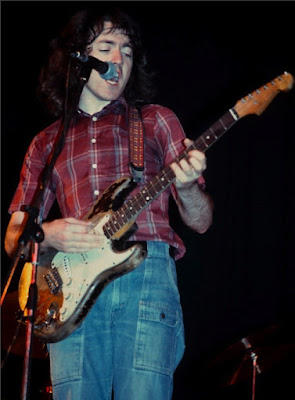
Photograph by JMP
[?]
Yeah, that’s right. And that’s all.
It works very well.
Ah. Thanks.
Another good track on that is ‘A Million Miles’, which has got a tremendous build-up in it. Is that a very popular track on live performances?
It is.
It seems to go very well live.
Ah yeah. Yeah. That was done on a cheap guitar, on a Silvertone. That was live. I mean, like vocally and so on right up until the chorus, the middle eight. There’s a couple of saxes I play coming in and we added a bit of organ, but that’s all. And tambourine. It’s pretty…
You’re pretty versatile with other instruments. You play a bit of sax and that sort of thing.
Yeah. Yeah.
Where did you pick that up? Recently or since you were a child.
No. No. I played sax on the second Taste studio album. On the Boards. That was ’68, ’69. I started… I became very keen on the alto sax. I was actually gonna play it on stage as a sort of alter instrument, but I never…
Sounds like Van Morrison [laughs]
Yeah. But it’s inevitable with Irish musicians because you play in dance bands, where there are saxophones all around, you know, and all that sort of thing. So, I still play it at home. It’s handy because… I’ve very much a guitar player’s ear for a saxophone. I’m not really a technician on it, but I can make a certain thing out of it and I can play little riffs and things, so it’s worked out handy. I can… instead of hiring a complete sax section, I can dub in three saxes, you know. But I like saxophones, you know.
What are the economies of rock… sorry, what are the economies of blues like these days? Is it paying very well?
Paying very well? Oh God, I don’t know. How do you mean? [laughs]
Well, I mean, are you making money? [laughs]
We are keeping our head above the water anyway. Yeah.
It’s getting better.
Well, you see, we don’t have expensive sequin dresses to pay for, learjets or anything.
Fair enough. Just finally, Rory, what about this year coming up? You’ve got a couple… a new album coming out, a possible acoustic album.
Yes.
What about live tours?
A very probable acoustic album. Well, we’ve got a Spanish tour and a German tour after we finish Australia and New Zealand. And then we’ve got a States tour and an album and a load of European work. We haven’t been to Scandinavia – can you imagine? – since 1971. And it’s such a small territory really. There’s some talk about going behind the Iron Curtain. Yugoslavia, Poland which I look forward… I’d love to see Warsaw in Poland. I’m very interested in Poland as a country. So, it’s gonna be a fairly hectic year. But I’m gonna leave a little more breathing space for recording and playing on other people’s albums if I can get a chance.
People like who?
Well, I’d like to do some recording with John Hammond. Do you know him, John Hammond? King Biscuit Boy. Play on his album maybe. So, it depends. You know, it depends on what’s going. That’s the trouble. I’m never… people ring me up and I’m not at home, you know. I’m on tour.
[laughs] Okay.
[The interview ends and Rory is asked to record some promos for 2JJ].

Photographer unknown


 REWRITING RORY
Leave a reply to Exclusives – REWRITING RORY Cancel reply