

Following his 1987 ‘comeback’ alongside the release of Defender, British entertainment magazine The List dubbed Rory Gallagher “the Vasco da Gama of rock”, inspired by the Portuguese explorer who united Europe and India by sea. Similarly, Rory was able to unite folk and blues, and explore not only the globe through touring, but also many musical landscapes, continually striving for the next rhythmic horizon and aiming to conquer the next territory of the roots music he loved and appreciated so deeply.
For September and October’s posts, we focus on Rory’s final international tour in 1991 (as we know, Rory continued to perform in and around Europe until his passing, and so for the purpose of this article, we define international as outside of Europe). A few dates around England in December 1990 kick-started Rory’s return on the road following a lengthy period of absence throughout the year due to illness. The beginning of Rory’s final tour of Northeast Asia, Oceania, and America took place in February, ending in New York on March 31.
We have designed this post to fall into three parts, coinciding with each country: Japan (Part One), Australia (Part Two), and the United States of America (Part Three). Due to the insufficient documentation of Rory’s touring history in Japan (1974, 1975, and 1977) and Australia (1975 and 1980) in Rory literature, we will also include a detailed overview of these missing shows in parts one and two alongside our analysis of the 1991 shows.
Our aims for this article are similar to those outlined in our 1994 summer European tour guide (part one and part two) and Masterclass/Temple Bar Blues Festival retrospective. As always, we are interested in filling in the gaps that past Rory literature lacks, and in particular we balance the previous narrative written regarding this late period of his career. As you, the reader, will discover, the Rory we present in our article is a man at one of the many high points in his career, beginning a world tour on the tail end of a critically acclaimed album (Fresh Evidence). We bring to the narrative both editorial clippings and fan testimonies in order to reawaken the ghost that has become Rory’s later career in past biographies and documentaries.
“The Hope of Young Guitarists”: Japan and Rory
“It’s wonderful whenever I come to Japan.
The audiences have a really good vibe [and]
really bring my technique out”
Rory delivered these comments to Japanese music magazine Ongaku Senaka in 1977 while on his third tour of Japan in four years. Although Rory would never single out a favourite country, Japan always held a special place in his heart and he would talk warmly about his memories of Japanese concerts and fans in interviews throughout his career. His love affair with the Land of the Rising Sun goes back long before he had even visited the country for the first time, however. The erudite that he was, Rory had a great interest in Japanese culture. He was particularly fascinated by the country’s rich cinematic history and was a huge fan of the old black and white movies of Akira Kurosawa, Yasujiro Ozu and Nigisa Oshima, while Ken Takakura was one of his favourite actors (read more on this in our interview with Rory’s friend Shu Tomiaka).
The feeling was mutual and, from the days of Taste, Japan had always embraced Rory, the music press showering him with praise and framing him as “the hope of young guitarists.” When Rory first toured the country in 1974, he was given an extremely warm welcome, met by hordes of fans at Haneda Airport who offered him flowers and boxes of chocolates – much to his embarrassment. The 1974 tour was so successful that Rory returned to Japan just one year later, this time playing to sell-out venues across the country as word had spread about his breathtaking live performances. Then, two years later, he was back again for a slightly longer tour, this time taking in Nagoya, Hiroshima, Osaka and Tokyo, often performing twice a day in each city. After this flurry of activity, it would be fourteen years until Rory returned to Japan again, his chronic fear of flying leading him to cancel scheduled visits in 1980 and 1988.
Despite the importance of Japan in Rory’s career and the large number of fans he had there (and continues to have, if the popular annual Rory Gallagher Tribute Festival in Tokyo is anything to go by), his tours of the country are overlooked in all biographies. Rather surprisingly, there is not so much a word – or even a footnote – on Japan in Dan Muise’s Gallagher, Marriott, Derringer & Trower: Their Lives and Music (2002), Marcus Connaughton’s Rory Gallagher: His Life and Times (2012) and Julian Vignoles’ Rory Gallagher: The Man Behind the Guitar (2018). While we are a blog focused on the last ten years of Rory’s life, we feel it is necessary to give attention to these earlier Japanese tours in today’s post because they have not been covered in depth by any other publications and are important parts of Rory’s career trajectory, leading up to his ‘comeback’ tour of the country in 1991. Here, we wish to provide extensive details of each tour for the first time, using a combination of press articles, fan memories, bootlegs and archival material.
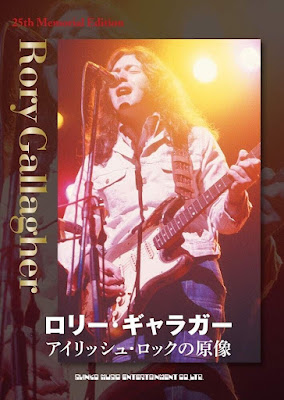
One significant exception to the rules is the fantastic Rory Gallagher 25th Memorial Edition book, published by Shinko Music Entertainment Co. Ltd. in 2020. Although the book has received practically no publicity online, it is by far our favourite book on Rory to date. We discovered it together by chance in one of our lengthy Zoom calls last autumn when sifting the depths of the internet for new Rory material. Even without speaking a word of Japanese, we were instantly mesmerised by its content and the 200+ pages of glossy images, and immediately snapped up two copies for ourselves. We’ve all heard the tales time and time again of how Rory was “painfully shy” and “a man of few words,” using his music and performances to do the talking for him. Therefore, the way that the book largely relies on visuals to tell Rory’s story is a highly creative and effective tool. The book is extremely well put together with its combination of biography, discography and bibliography, as well as archive and eyewitness interviews, details on all of Rory’s band members and an extensive focus on Rory’s gear. But the highlights for us are the chapter dedicated to Rory’s four Japanese tours, as well as a special appendix by Shu Tomioka, featuring previously unpublished personal photographs of Rory in his final years. Unlike some of the other books published on Rory, Rory Gallagher 25th Memorial Edition is respectful, accurate, inclusive – a real essential for all Rory fans to have in their collection. It took us a 12-hour Zoom call to go through the book together and helped us fill in many of the blanks when it came to Rory’s relationship with Japan. Much of this blog post would have been difficult to write without it, so we take the space here to thank all those behind the fantastic compendium and encourage our readers to purchase a copy for themselves at the following link.
“Rory Gallagher is a Legend”: The 1974 Japanese Tour
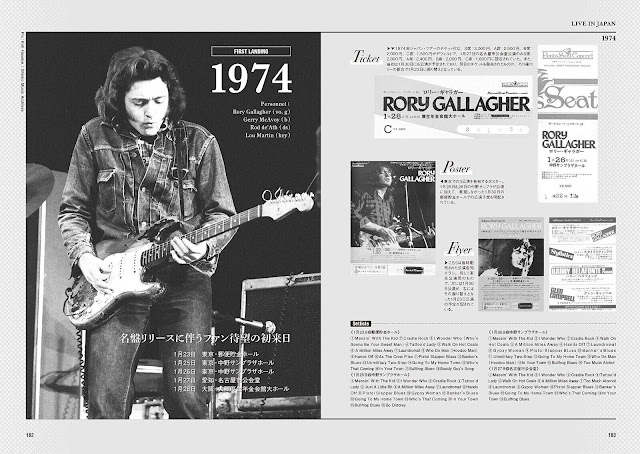
“Legend” is a rather weighty word to describe a person, especially when they’re just 26 years of age. Yet, in this case, I think we can all agree that the Japanese were 100% right in using the term in the heading of an article on Rory in his 1974 tour programme. Rory was riding high when he arrived in Japan for his first tour, having just completed a ground-breaking Irish Tour, which would be released on vinyl and film later in the year and has since gone down in history as one of the greatest live albums of all time. He was excited to be in the East for the first time and his brother Dónal was keen to capture everything he possibly could with his Super 8 camera. Thanks to Dónal’s efforts, there is a great deal of surviving footage of everyday life on the road in Japan, which was released as a bonus feature on the 2011 DVD of Irish Tour ’74.

Photographer by Koh Hasebe
The footage, overlayed with a live rendition of ‘In your Town’, wonderfully captures a range of scenes that must have seemed rather alien for a group of men coming from a rural Ireland still steeped in tradition: bullet trains, skyscrapers, flashy billboards. We also get more personal moments like Rory eating with chopsticks in a restaurant, reading a book and travelling by car around Tokyo, while extra footage online shows him brushing his hair in front of the mirror and jamming backstage with Gerry. In an interview for the Rory Gallagher 25th Memorial Edition book, Mutsumi Mae, ex-president of the Japanese Rory Gallagher fan club, notes how many of Rory’s Japanese fans were girls, captivated by his good looks. This is apparent from the 1974 footage, which shows groups of young women hanging around the airport, train station and hotel with large banners stating, “WELCOME TO JAPAN RORY GALLAGHER.” Japanese press reports of the time note that Rory was “very polite” to the fans, but “extremely embarrassed” by their attention. We see this in the film with his bashful smile and the endearing way he ducks behind Dónal and roadie Tom O’Driscoll at the train station.
The tour was a relatively short one by Rory’s standards, beginning in Tokyo on 23rd January (where he would play for three nights) and ending in Osaka on 28th, taking in Nagoya along the way. Thanks to the music magazine Ongaku Senaka, full details of Rory’s schedule were printed, which have enabled us to piece together his movements across the week.
The band flew on Pan American Airways from London, arriving in Tokyo on 22nd January and staying at the Hotel New Japan. According to an anecdote by Canon Cashman told at Rory’s funeral in 1995, Rory wouldn’t go to bed that first night until he knew where in the city he could find a Catholic church to take mass the next morning. Luckily, he did find out and was able to rest easy. The following day, after a late breakfast (and presumably mass), Rory did some press interviews before his first show at the Yubin-Chokin Hall. In the Rory Gallagher 25th Memorial Edition book, Mutsumi Mae explains that security was very lax at the time, so she was able to call the hotel and ask if Rory was staying there. When she received a positive response, she decided to go with a friend after school to drink tea in the hotel’s café. Once there, they spotted Rory at a nearby table on his own and watched him from afar for about an hour, too shy to say anything to him. Mutsumi attended Rory’s concert later that evening and was blown away by his performance:
As I had listened to his live album before, when I saw him, it was like a video. Naturally, it wasn’t, so the first time I saw him moving when I watched, it was shocking. Very hard live! It’s strange to say… I mean, there was a great momentum. When it started, he ran out onto the stage. Suddenly, he played greatly. With much enthusiasm and heat. Anyway, I really enjoyed it. Watching for the first time, it was amazing. Yes, the impact when I watched, it is true. It was amazing. By the way, that was his first visit to Japan. The concert hall performance (23rd January 1974). As I said, Rory rushed out and rock and roll!
Similar remarks on Rory’s opening night in Tokyo were captured by the music press. Kazuhisa Yoneda of Music Life wrote that Rory “overpowered the audience with his earnest passion for blues.” Yoneda also provided a rather evocative description that perfectly captures the passion that Rory put into his live shows: “he [looked like] a mouse who had been under water for a long time and just got his head out to breathe and had his mouth wide open as if he wanted to inhale as much as he could.” Yoneda uses all sorts of adjectives to capture the magic of Rory’s performance from “exquisite” and “sensitive” to “pounding” and “exciting” with energy “gushing out from inside.” He also praises Rory’s lack of effects and his commitment to the blues, and emphasises the sheer power of the encore when Rory’s “sweat flew everywhere, a string broke and his guitar strap slipped off.” Yoneda’s summarising statement is one that we have encountered ourselves from many fans over the years: “it is hard to squeeze Rory into the narrow grooves of a record – once you’ve seen him live, even his live albums don’t appeal as much as before.”

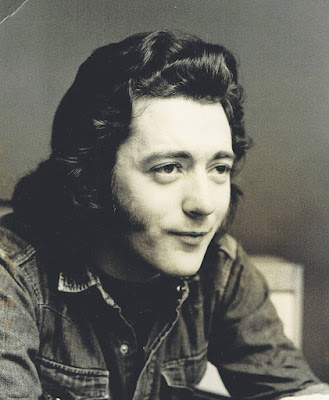
Following the first night in Tokyo, Rory slept until the afternoon and then did more radio and press interviews. Then, on 25th and 26th January, he performed in Tokyo again, this time at the Nakano Sunplaza Hall. By the third night, Rory’s reputation had spread around the city by word of mouth, leading the concert hall to be packed with spectators. One member of the audience was Akiko Watanabe, a music journalist. Akiko worked for Stereo magazine at the time and had interviewed Rory earlier in the day at his hotel. She has kindly given us permission to share the photograph taken during this meeting (see below). Although Akiko never met Rory again, she did see him play later in the year at Central Park in New York – the now mythical gig when he upstaged Aerosmith. She has fond memories of both occasions.
Photograph kindly shared with us by
Akiko Watanabe
On 27th January, Rory said goodbye to Tokyo and set off for Nagoya, catching the Shinkansen bullet train for the first time. Ongaku Senaka notes that Rory enjoyed the experience and was “very surprised at the speed.” With little time for rest after the journey, Rory played the Nagoya-shi Kokaido the very same evening. The show is captured in full on bootleg and is seen by many Rory fans as superior to Irish Tour ’74. It is certainly a strong contender with its raw energy and hard-driving blues! Indeed, given the close proximity of the concerts, the setlists are almost identical: ‘Messin’ with the Kid’, ‘I Wonder Who’, ‘Cradle Rock’, ‘Tattoo’d Lady’, ‘Walk on Hot Coals’, ‘A Million Miles Away’, ‘Too Much Alcohol’, ‘Laundromat’, ‘Pistol Slapper Blues’, ‘Bankers Blues’, ‘Going to My Hometown’, ‘Who’s That Comin’’ and ‘In Your Town’. However, here – and in other gigs throughout the tour – he does throw in a few surprises to keep the crowd on their toes, from ‘Just a Little Bit’, ‘Hands Off’ and ‘Gypsy Woman’ to ‘Bo Diddley’, ‘Hoodoo Man’ and ‘Unmilitary Two Step’. Although not captured on the recording, apparently, a skirmish broke out in the crowd during the encore, so security had to cut the show short. I say short, but, in true Rory style, it was already two hours, 45 minutes!
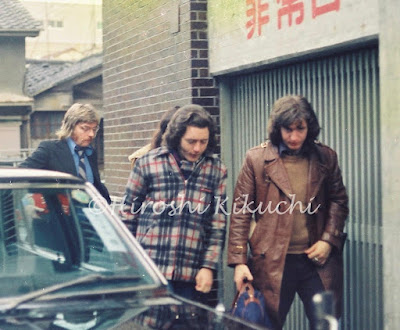
The next day saw Rory and his band on the move again, this time to Osaka. They briefly stopped in Maibara on the way to admire the snow on the Ibuki Mountains. The Osaka show on 28th January was described by the music press and Japanese fans alike as “the best performance of the tour” with Rory on stage at the Kousei-nekin Kaikan for almost three hours. The concert certainly stood out for Hiroshi Kikuchi who was just a teenager at the time. Since the age of 12, Hiroshi had been a passionate follower of rock music, always listening to the radio, going to record shops and buying music magazines, which is how he discovered Rory. According to Hiroshi, Rory was “distinct from others” and was “the embodiment of blues rock and passion for blues.” The day of the concert, Hiroshi left school early by pretending to be sick. Then, he headed to Rory’s hotel and waited in the lobby. He managed to meet Rory and Dónal briefly there (we include a wonderful photo he captured of them here), before meeting him again later at the stage door. Hiroshi had been “eagerly awaiting” Rory’s concert for some time and he certainly wasn’t disappointed: “I was so excited about his bluesy and overwhelming technique, and powerful voice. I got the impression that Rory is the burning guitarist. The audience was so enthusiastic.”
Photograph by Hiroshi Kikuchi
Some fans might have noticed that the 1974 Japanese Tour poster also shows a date in Tokyo on 30th January. Is this a forgotten or lost show? No, in fact, the original plan was for Rory to play two nights in Tokyo at the beginning of the tour and then return to the city for a third show at the end at the Yubin-Chokin Hall. Due to the flight schedule, it was decided to move this date to the 23th instead. This meant that Rory had a rare day off on 30th, which he used to go shopping. According to Ongaku Senaka, he picked up a camera and electronic calculator for himself, and a kimono and doll for his mother. The five-day tour now complete and a resounding success, Rory headed to the airport to fly home. At the airport, he was met again by more groups of devoted fans, who thanked him for his visit, bid him farewell and begged him to come back soon. They wouldn’t have to wait too long.

“Never a dull moment”: The 1975 Japanese Tour
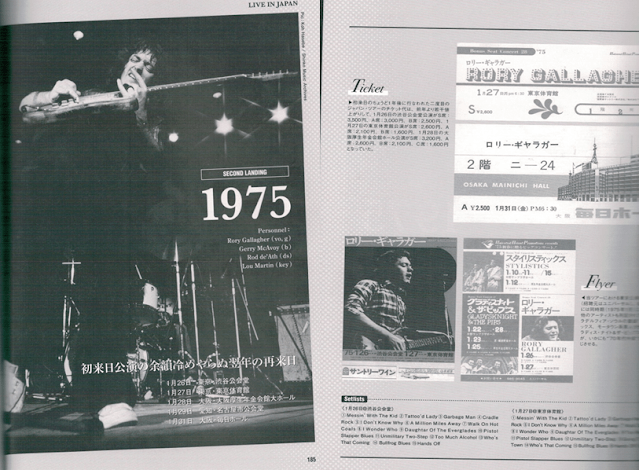
Demand for Rory was so strong that he was back in Japan just one year later. Perhaps more well-known than the Japanese tour itself, however, is the events that occurred leading up to it with the Rolling Stones. According to Dónal, Rory received a telephone call from Ian Stewart, asking him to go to Rotterdam and play with the band; Mick Taylor had just left and they were looking for a new guitarist. Recognising that this was an audition, Dónal told Rory that he wanted to come with him, but Rory played down the matter, saying – much to his naivety – that he was sure it was just a jam session. So, Rory flew to Rotterdam on his own, met the Stones and jammed with them. The sessions went well and, on the final night, Mick Jagger told Rory to go up to Keith Richards’ suite and speak to him (i.e., to find out if he was in the band). But when Rory got there, Keith was comatose in the bed. After failing to wake Keith on multiple occasions, Rory left a note saying, “You know where I am if you need me” and caught a plane back to Heathrow, ready to immediately travel to Tokyo. He was keen not to let his Japanese fans down and cancel his prior commitment. Although Dónal was frustrated at Rory’s decision and thinks that joining the Stones would have been a big career break for him, we are more inclined in this case to agree with Bob Geldof’s comments in the Ghost Blues documentary: “Rory could never have been able to put up with the bollocks of Mick and Keith.”
Given the hype around the Rolling Stones sessions, when Rory landed in Tokyo on 25th January, he was met not just by fans, but by a large crowd of music journalists, wanting to know whether the rumours were true about him joining the band. Rory batted off these questions, repeating that he had only jammed with them and that now he just wanted to focus on his Japanese tour. The 1975 tour of Japan was a similar length to that of the previous year, taking in Tokyo on 26th and 27th January (Shibuya Koukaido and Taiiky-kan venues), Osaka on 28th and 30th (Kouseinenkin Kaikan and Mainichi Hall), and Nagoya in between on 29th (Nagoya-shi Koukaido). Despite Rory’s increased popularity, there are surprisingly less press reports of the 1975 tour and Ongaku Senaka did not print a detailed schedule of Rory’s travel. Perhaps being Rory’s second time in the country, the novelty had partly worn off and there was not as much publicity and attention surrounding his visit. Nonetheless, all five concerts were well attended, showing that there was a clear appetite for his music in the country.
Due to the short time between tours, Rory’s setlist remained much unchanged from 1974, with many of the tracks that are now forever associated with Irish Tour ’74 still featuring heavily. The lack of new material was mentioned by some journalists as slightly disappointing, but they note that it clearly didn’t put fans off who were just happy to see Rory back in Japan. Bootlegs exist of Rory’s two Tokyo concerts, where we are met with a crowd far livelier than in 1974. Rather than sitting still and applauding politely after songs, they clap and cheer throughout, which really adds to the buoyant atmosphere of the recordings. The only non-Irish Tour songs that feature in Rory’s setlist are ‘Garbage Man’, ‘I Don’t Know Why’ and the spectacular ‘Daughter of the Everglades’, which is a real treat to hear live.

Photograph Koh Hasebe
Press reviews following Rory’s inaugural concert at the Shibuya Koukaido in Tokyo were glowing. Yoichi Shibuya of Music Life perfectly captures the tension in the venue leading up to Rory’s appearance on stage, describing the ringing of a bell, sudden darkness, loud applause and then, finally, girls screaming. He notes how Rory “couldn’t be better” and there is “never a dull moment” as he runs all over the stage, almost falling at times because he is “so excited.” Despite the hall being large, Shibuya has the impression that he is in a “small cabin,” Rory working “in perfect harmony” with his audience, taking requests and doing everything he can to please them. During the encore, girls and boys break into tears and fans rush the stage, leading security to panic and put the house lights back on. However, after ten minutes of non-stop cheering for Rory, they allow him to hit the stage once again for more songs. “I don’t recall ever experiencing such a pleasant and thrilling concert,” Shibuya concluded. His takeaway image was that of a high school boy with tears running down his face repeating “awesome just awesome.” The second night in Tokyo saw similar reviews, with Rory described in Ongaku Senka as a “virtuoso” who was somehow “even better than last year” and could “manipulate his [Stratocaster] as if it were a part of his body.” Unfortunately, no press reports, bootlegs or even setlists seem to have survived from the Osaka and Nagoya concerts.
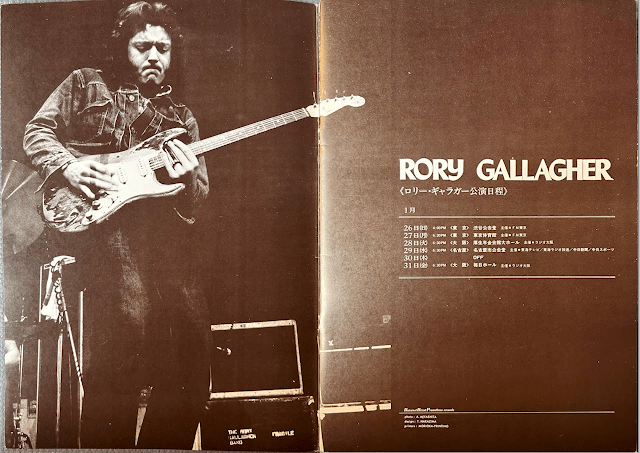
Rory returned to London on 1st February, again met by press at the airport who snapped photos of him amid shouts of “It’s the new Rolling Stone!” Rory found the whole experience uncomfortable and, when asked for a statement, he firmly replied, “No, I’m not joining the Rolling Stones.” Just a few days later, he flew out to Perth, ready to begin the Australian leg of his international tour. By the time he returned to the UK later that month, Ronnie Wood had been chosen as the new Rolling Stone.
“Energetic, earnest and refreshing”: The 1977 Japanese Tour

It was two years later in 1977 when Rory returned to Japan for a third tour. During this time, he had released two new studio albums – Against the Grain and Calling Card – so, unlike before, he was coming back with new material to offer. He was also now with a new promoter, UDO Productions (replacing Universal), who invested hugely in publicity for this tour compared to the 1975 one. There was also greater momentum around Rory’s return thanks to Mutsumi Mae who had established the Japanese Rory Gallagher Fanclub earlier that year. Aware of the fan club, Dónal had provided Mutsumi with a full itinerary for Rory’s tour in advance, as well as key contact details, which she published in the fan newsletter.
Prior to Rory’s visit, Mutsumi had also sent him a questionnaire to fill in for the fan club, where he gave responses on his favourite musicians, albums, novelists, actresses, cars and food (amongst other things) and offered advice to young guitarists (“Practice. Try to play in public as much as possible and play with other musicians informally”). Rory also left a message for his Japanese fans, telling them that he was happy to be back in Japan soon and that he hoped they would enjoy the concerts and the new album. The interview that Toshinori Yajima conducted with Rory at his mother’s house in Cork in the summer of 1977 also generated increased interest in Rory when it was published in The Handbook shortly before his visit to Japan. The article contains a selection of wonderful photographs of Rory looking very much “the boy next door” as he plays with his dog in the garden and sits on a patio chair strumming his acoustic guitar, leading Yajima to muse, “What in the world gives the quiet, kind, young man so much tough energy up on stage?”
At fifteen days in length, the 1977 tour was much longer than the previous ones, but the schedule was also much tighter. It began in Nagoya on 25th October; then, for the first time, Rory would perform in Hiroshima on 27th, followed by two days in Osaka (31st and 1st November) and three days in Tokyo (3rd, 4th, 5th), two of the Tokyo gigs being both matinee and evening performances. After, Rory and his band were heading straight to San Francisco to record a new album – what would become the infamous album scrapped by Rory on the day that it was to be presented to Chrysalis.
The general setlist on this tour was very different from 1974 and 1975, somewhat harder and reflective of Rory’s new albums, although, of course, a couple of staple songs remained: ‘Moonchild’, ‘Bought and Sold’, ‘Calling Card’, ‘Secret Agent’, ‘A Million Miles Away’, ‘Tattoo’d Lady’, ‘Out on the Western Plain’, ‘Too Much Alcohol’, ‘Barley and Grape Rag’, ‘Going to My Hometown’, ‘I Take What I Want’, ‘Edged in Blue’, ‘Garbage Man’, ‘Souped Up Ford’, ‘Bullfrog Blues’, ‘All Around Man’ and ‘Do You Read Me’. Unlike previous tours, bootlegs survive from all concerts and show a band that is extremely tight, having now played with each other for a number of years. While the sound quality is variable, the quality of Rory’s performances certainly is not, always going over and above to please his audience and display his phenomenal talent. On a performance level, it comes extremely close to official releases from the same year, including Live in Rockpalast 1977 (2004) and Check Shirt Wizard: Live in ’77 (2020), and that’s high praise indeed!
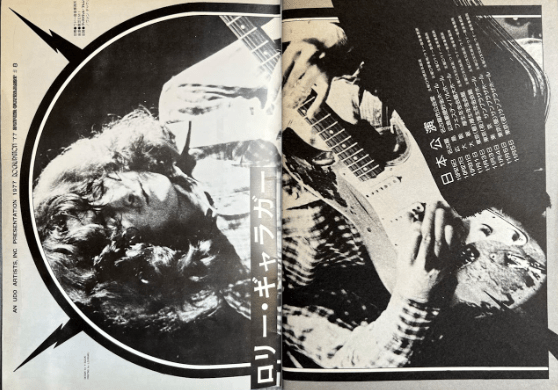
Unfortunately, there are no surviving press reports from the first concerts in Nagoya (Nagoya-shi Koukaido) and Hiroshima (Yubin-chokin Hall), but if the enthusiastic screams on the bootlegs are anything to go by, then we can assume that they were (unsurprisingly!) excellent. The first details we have from the tour come from Osaka, where Rory gave an interview for the local radio station on 28th October with his tour manager Peter Collins. According to the DJ, Masami Tanaka, it was the first time that Peter had ever appeared on radio, and he was so nervous that he didn’t blink the whole time and ended up straining his eyes. Apparently, Rory found this highly amusing and couldn’t stop laughing. Following the interview, Rory went to Miyako-Record shop for a one-hour autograph session. Although Rory didn’t typically give autograph sessions, press reports say that he enjoyed the opportunity to talk with fans (approximately 300 were gathered) and that he had a “full smile” on his face the whole time.
The next day (29th October) was dedicated once again to interviews with the music press, this time held at the Osaka Grand Hotel where Rory was staying. Ongaku Senka notes that Rory was nervous, yet in a “relaxed mood” when talking about guitars and his home country of Ireland. Although the following day was supposed to be a day of rest, Rory called his band into a studio in Osaka to rehearse some new songs. Thankfully, a bootleg of these sessions exist and although the sound quality is poor, they expertly demonstrate the origins of what would become Photo Finish (and Notes from San Francisco): ‘Rue the Day’, ‘Wheels Within Wheels’, ‘Out on the Tiles’, ‘B Girl’, ‘Cut a Dash’, ‘Brute Force and Ignorance’, ‘Cruise on Out’, ‘Persuasion’ and ‘Overnight Bag’.
The day after the recording sessions, 31st October, Rory’s concert at the Festival Hall in Osaka took place. Once again, we could find no press reports of the show, unfortunately, but we did find a nice anecdote from Ongaku Senka about the band spending time backstage playing with remote control cars they had purchased; Rory, however, was too anxious about the concert and spent the time practising guitar instead. The next evening, Rory played a different venue in Osaka: Kousei-nenkin Kaikan. He had caught a cold from the unseasonably warm weather and was not feeling well, yet he still insisted on performing.

autograph session
Photographer unknown
The Tokyo leg of the tour is far better represented in both press and fan reports, so we are able to provide a full account of the days in the capital. According to Ongaku Senka, by the time Rory arrived in Tokyo, his cold had worsened and a doctor was called to the hotel to assess him. The doctor advised him to cancel a planned autograph session that afternoon at the Yamano-Gakki record shop, but Rory – not wanting to let down his fans – decided to put on a scarf and attend the event anyway, where he met approximately 100 fans. The autograph session was followed by a screening of his performance at the 1977 Montreux Jazz Festival. A report from Teizo Aoyama of FM Tokyo who was in attendance reflects on Rory’s down-to-earth nature: “It was like we had one of ourselves, a buddy on the stage.” He also expresses bemusement at a scene during the concert when an excited fan gets up on stage to play harmonica and Rory allows him to stay and jam along. We wish this had been included in the 2006 Live at Montreux boxset! After the screening, as a means of thanking Rory, Yamano-Gakki presented him with an Uchide-no-Kozuchi (Japanese lucky mallet). Ongaku Senka reports that Rory was really pleased with the gift and particularly liked the fact that it was specifically for people born in the Year of the Rat (as he was).
It was on this jampacked day that Rory and Dónal also met Mutsumi Mae of the Japanese Rory Gallagher fanclub for the first time. They had tea together in the Hotel New Japan, where they discussed a potential name for the fan newsletter. Rory suggested “Deuce”, given that there was already a newsletter in Switzerland with that name. Mutsumi agreed and Rory handwrote the title on a piece of paper, which she subsequently photocopied and used on the cover of all future newsletters. Mutsumi explains how she “felt like a fan” in this first meeting and, as a high school student, had limited English and was too shy to say much. Nonetheless, she does recall telling Rory that she liked Live in Europe and asked him to name his favourite musicians. She also shared an anecdote typical of Rory’s kind heart: when she left the café and went to pay, she was told, “I’m sorry, the foreigner paid for it already.”
The next day, despite his worsening cold, Rory fulfilled his promise to give two performances at the Shinjuku Kousei-nenkin Kaikan in Tokyo. ‘Utam’ attended the matinee show, noting that he went “right away” to buy a ticket when the concert was announced and managed to bag seats three rows from the front. On Reiko’s Rory Gallagher Japanese website, he describes how Rory was “sweaty and giving it his all on the guitar.” For Utam, seeing Rory was “life-changing,” his only regret being that the batteries of his tape recorder died on the way to the concert, so he wasn’t able to capture it for posterity. After the matinee show, Rory was presented with a Guyatone guitar, which he immediately tested out in the empty auditorium. Once satisfied, he returned to his dressing room to play with a remote control car.
According to Yukio Mawa of Ongaku Senka, Rory “tried hard to give a good performance” in the evening, even though his throat was very sore. Rory “turned up on stage and kicked my ass with full power,” he notes, describing how he had a huge smile on his face as he played and the whole audience “went crazy” from the very beginning. Miwa explains that, despite being ill, Rory gave “100% of his energy” and his guitar was “the screaming of his soul and joys of life.” He also highlights an unusual moment following the encore of ‘Country Mile’, where the audience was so overcome with emotion that they were unable to stand up and remained in their seats totally enraptured. Bootleg recordings offer a different account of this romanticised story, however: before the song, a promoter can be heard angrily shouting: “Stay in your seats! Don’t run onto the stage! You are acting like childish maniacs of Bay City Rollers! Behave like adults!”

On 4th November, Rory was back to another day of interviews for the music press, including one with Yusaku Matsumura of Ongaku Senka. Matsumura writes that Rory met him with a “warm handshake and a big smile,” even though he had a fever and was shivering throughout from the air conditioning. In the interview, Rory talks about Calling Card, differences between performing in the studio and on stage, plans for his new album and the arrival of punk. He rather sweetly describes his Stratocaster as a “good loveable friend of mine,” before adding, “I can’t say no to guitars!” When told by Matsumura that his performances seem stronger than last time, Rory laughs shyly and apologises for being “too tired” on his last tour. Like in other interviews, Matsumura notes how Rory was “quite nervous” and only relaxed when the topic turned to guitars. His overall impression of Rory? “A nice and kind person […] I have never ever seen such a considerate artist, taking care of fans or other people.”
Following the interviews, Rory performed at the Nakano Sunplaza Hall. Eyewitness accounts say that the intimate setting with a much closer distance between the stage and audience meant that spectators “went wild,” but there are no surviving press reports, unfortunately. Nonetheless, there are details in Ongaku Senka of an aftershow party held by Toshiba EMI (Rory’s record company in Japan) at a Chinese restaurant in Akasa. The magazine notes that Rory was the only person in attendance who did not drink any alcohol, sticking to Coca Cola instead. When asked, he explained that he didn’t drink alcohol during the tour because he wanted to put all his energy into every show, for which they call him a “true professional.”
The final day saw two more concerts at the Nakano Sunplaza Hall. At the evening show, over 100 tape recorders were discovered and confiscated at the entrance. According to Ongaku Senka, the matinee performance was “impressive,” but there was not a “big reaction” from the audience for some reason. The evening show, however, was “totally dynamite” and “fully energetic,” considered to be “the best show of the tour” and a clear demonstration of why Rory is the “top live act.” Published setlists show that Rory threw a “soul medley” into the evening performance, which, regrettably, is not included on the bootleg.

While it is clear that Rory hugely impressed both Japanese fans and the music press with his performances on this tour, they were even more won over by his personality. Reflecting on his meeting with Rory in 1977, music critic Kensho Ohnuki wrote:
I don’t know a nicer guy than Rory. He is energetic, carefree, exhilarating and warm whenever he shows up in front of me. A big-hearted, pleasant, nice guy. My first impression of him has never altered. I am attracted by his character even more so than by his wonderful guitar playing.
The Tours That Never Happened: 1980 and 1988
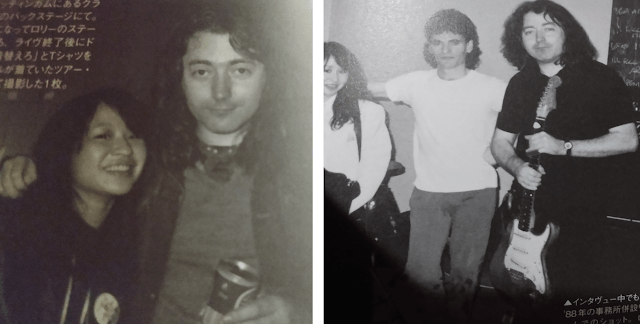
As we know, Rory suffered from a fear of flying and this got progressively worse throughout the 1980s, meaning that he could no longer tour as he used to and had to cut down his hectic schedule. Despite taking medication to help ease his anxiety, the problem worsened throughout the decade and he even struggled to get home to Ireland, which was less than an hour’s plane journey away. So, the thought of catching a 14-hour flight to Japan must have seemed nigh on impossible to him at the time. As a result, two scheduled tours of the country in 1980 and 1988 had to be cancelled.
Photographer unknown (printed in Rory Gallagher 25th Memorial Edition book)
Mutsumi Mae believes that this undoubtedly affected Rory’s popularity in Japan: “When he didn’t visit, he was forgotten about a little. And on the flipside, more and more bands had started coming to Japan, so everyone forgot about Rory.” According to Mutsumi, Rory kept reassuring his Japanese fans, through announcements in the fanclub newsletter, that he would return to the country, but he couldn’t follow through on this promise. When Mutsumi visited London in the mid-1980s, she stopped by Dónal’s office to find out when Rory would return to Japan, but he told her that his brother couldn’t handle the thought of a long-haul flight. In 1988, finding herself in London again, Mutsumi tried to convince Rory directly, popping into a rehearsal session to meet him. She now worked for Virgin Records and she told him about the recently established Virgin Atlantic airlines. “I told Rory, ‘I’m with Virgin now. You could come to Japan first class with Virgin Atlantic,” said Mutsumi. “I’m sorry, I can’t” was Rory’s reply.
“Rory is still Rory”: The 1991 Japanese Tour

“This is a miracle […] My prayers have been answered,” Rory told music journalist Jas Obrecht in 1991, clearly relieved at finally being able to tour in Japan, Australia and the US once again after so many years. “To beat that flying phobia was quite an ordeal for me,” he continued, “It’s the last thing I needed after all those years of touring and flying two times a day.” Elaborating on his phobia in a 1991 interview with a Toronto radio station, Rory explained how he had taught himself little mind tricks, games and word pictures to combat his “Buddy Holly complex” and the feelings of claustrophobia he experienced when on a plane. However, it wasn’t until three years later that he wrote optimistically to friend Paul Fenton in Canada: “I’ve almost beaten the flying bug!!! So you may see me in a couple of months.” As someone who also suffers from a huge fear of flying and struggles to go more than an hour on a plane, I can’t even begin to comprehend how Rory managed to work through his fear and travel such long distances on this international tour, especially when he was so unwell. But with the true tenacious spirit he had and his strong desire not to disappoint fans, he did so, and on 18th February 1991, he stepped foot in Japan for the first time in fourteen years.
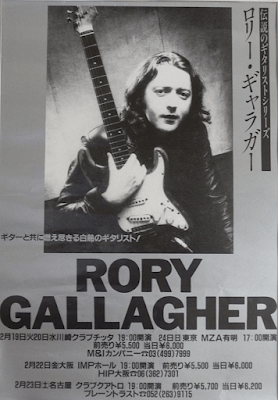
The tour consisted of five dates, starting with two nights at Club Città in Kawasaki (19th and 20th February), one night at Osaka IMP Hall (22nd February), one night at Nagoya Club Quattro (23rd February) and one night at Shiba Mielparque Hall in Tokyo (24th February). While some might say we’re biased given the focus of our blog, it is our belief that Rory’s final tour of Japan was his greatest. Although just one full bootleg exists from his Tokyo concert, it showcases a mature, confident musician with full command of his audience. Although Rory was nervous about returning to Japan after so many years and was unsure how fans would take his new material, as well as his changed appearance, you wouldn’t know it to listen to his performance. His vocals are dazzling – stronger than they have been in years – and his musicianship exemplary, while his band perfectly support him, predicting his every movement on stage. This is not so much the sounds of a dying man doing his international swansong, but rather the battle cries of a powerful warrior ready to deliver blow after blow, crushing any enemies (critics) in his way and coming out triumphant.
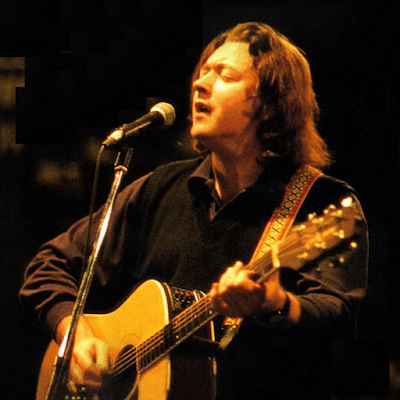
Photographer unknown
The setlist over the last years of Rory’s life didn’t change too much, made up largely of material from Defender and Fresh Evidence, as well as fan favourites from Tattoo and Calling Card, but in our opinion, this was his strongest setlist throughout his career, exemplifying Mr Blues at his very best. Most nights in Japan saw some or all of the following songs: ‘Continental Op’, ‘Moonchild’, ‘Mean Disposition’, ‘The Loop’, ‘Tattoo’d Lady’, ‘Bad Penny’, ‘Don’t Start Me Talkin’, ‘I Wonder Who’, ‘Out on the Western Plain’, ‘Walking Blues’, ‘Pistol Slapper Blues’, ‘Loanshark Blues’, ‘A Million Miles Away’, ‘Kid Gloves’, ‘Middle Name’, ‘Shadow Play’, ‘Messin’ with the Kid’ and ‘Bullfrog Blues’. However, Rory also threw in some delightful surprises like ‘I’m Leaving’, ‘Keep Your Hands Off Her’, ‘I Ain’t No Saint’, ‘Nadine’ and ‘Roberta’. My personal highlights, however, are a gritty and downright sexy version of Robert Nighthawk’s ‘Going Down to Eli’s’, a dynamic, show-stopping encore of Little Richard’s ‘Keep Me Knockin’ (Mark’s harp playing is off the charts here!) and a fiery and sophisticated ‘Laundromat’, which is great to see back in the set again after so many years (all from the Tokyo show). An honourable mention also goes to a sample of Elvis Presley’s ‘Heartbreak Hotel’ (from Club Città, Kawasaki), which Rory delivers with such conviction, enhanced by Mark’s sultry accompaniment.
On his first day in Japan, Rory went guitar shopping in Kawasaki and managed to pick up a Takamine Dreadnought Style acoustic guitar, which he used as a back-up/live alternative for his Martin D35 from this point forward. In a later interview with Guitar for the Practicing Musician, he said he was “impressed” with the Takamine and described it as being “as close to the Martin” as he had heard. Rory must have felt in guitar heaven – in much the same way as “the night of the 12 Nationals” in 1985 – as later that day he was presented with a red prototype Guyatone Marroly before his first show at Club Città. The guitar company had heard that he was a big fan of their guitars and offered one to him as a gift (Rory can be seen with the guitar in the cover photo of this blog). “I jumped into the swimming pool straight away and tried it. That’s the only way to try a guitar,” he told Steve Harris of Young Guitarist Magazine a few days later. Rory played it for the opening numbers of ‘Continental Op’ and ‘Moonchild’, delivering his verdict that “it sounded good, it was nice.” To listen to the audio of this interview, Rory’s voice becomes so animated and excited as he talks about the Guyatone, which is a real pleasure to hear, given how shaky and flat his voice could often sound in later years when he spoke.
At the Club Città performances was ‘Utam’. Sharing his memories on Reiko’s Rory Gallagher Japanese website, he said that although Rory seemed “tired and sick” and “didn’t run around the stage” or “have as much power as he used to,” as soon as he started playing, it was clear that his ability hadn’t changed at all. Utam’s comments are similar to those we come across time and time again when writing our blog and what we try to emphasise in all our posts: just because Rory looked different and couldn’t move like he did as a young man, it by no means meant that his musicianship had declined in any way at this stage in his career. Press reviews of the Kawasaki performances were extremely favourable, with journalists expressing delight that Rory threw in a few Japanese words between songs: “konbanwa” (good evening), “arigato” (thank you) and “sayonara” (bye bye). A sweet anecdote of the concert comes from Japanese guitarist Dannie Good who met Rory after the second night in Club Città. Dannie brought along his own battered Strat to show Rory. After autographing it, Rory told him with a smile, “Young man, you should treat your guitar more carefully.”
Mutsumi Mae also attended the Club Città concerts. She was thrilled that Rory had finally made it back to Japan and met him and Dónal backstage to express her happiness. By that time, she knew Dónal particularly well through her fanclub work, so he told her to hop on the tour bus and head back to the hotel with them to have dinner. Mutsumi says that she could speak better English by this point (she had, in fact, retrained as a translator) and that she was able to talk to Rory about his love for Akira Kurosawa films, as well as his general interest in Japanese culture and history. Although she felt that she never knew Rory that well, she did get on “tremendously well” with Dónal, who she describes as a “good person.” Concerned about Rory’s appearance, she asked Dónal (out of Rory’s earshot) about his brother’s health. Her account of their conversation is worth copying in full to set the record straight, as we always strive to do on our blog:
[Rory] was not so good when I met him. It was a feeling I had. And when I met his brother and asked, ‘How is Rory’s physical condition?’ he came to me and said he wasn’t doing well at all […] People say it was to do with alcohol, but it wasn’t. His liver had worsened. That’s what his brother told me. The immunity in his body was too strong and it was this constitution that killed his liver. I heard the story. So, he started taking medication and due to the side effects of the medication, his face swelled and he became fat, or at least that kind of appearance because he had been in such poor physical condition for so long. It seems that it was going on for a while, right from the early 1980s.
Their meeting in Kawasaki was the last time that Mutsumi saw Rory. Her lasting impressions of Rory are of somebody “sincere” who “remained single his whole life,” was “married to his music” and was “happy that way.” Given his dedication to his craft, she really hoped that his time “would come again” with the blues revival of the 1990s, but, as we know, things sadly did not turn out this way.
After one day of rest, Rory travelled to Osaka, where he performed at the IMP Hall. In attendance was K.G. Takeda. K.G. told us how he felt “nervous” before the concert about seeing Rory live for the first time and wondered if he would live up to expectations. However, he was not disappointed and found Rory’s guitar sound to be even “harder than earl[ier].” Other views from fans at the Osaka concert have been published on Shinolez’s Japanese Rory Gallagher blog. “I was a little surprised by his appearance,” Shinolez admits, “But even if he was fat, it was still Rory.” Shinolez states how Rory “played with passion” and that only he can play songs like ‘Continental Op’, the live version somehow being “even more beautiful” than the studio one. Similar remarks come from username ‘§’ who explains how he rushed to the concert from work and “was surprised for a moment” at how Rory looked when he appeared on stage. However, “that didn’t matter once the performance started.” “Even though he had got fat and become older, Rory is still Rory!” he concluded. In the same vein, ‘Kumi’ says that he was “relieved to hear Rory’s sound” and that although he had “become older,” he clearly hadn’t “changed at all.” To be in such a small venue “where you can see the whites of Rory’s eyes” was a “precious experience” for him. ‘§Whoa _’ still remembers the opening song ‘Moonchild’: “I had a fever. Everyone was in high spirits!” He also recalls ‘Tattoo’d Lady’ as a particular high point of the concert, as well as crying when he heard ‘A Million Miles Away’. “If only I could go back in time and see it again,” he added.

Photographer unknown
The following day saw Rory in Nagoya at the Club Quattro. Although we couldn’t find any press reports of the show, an excellent account is provided by Tsutsomi on Reiko’s Rory Gallagher Japanese website, which really captures the mood:
When I rushed [to the concert hall] after work, there was a line of people on the stairs from the 8th floor to the 1st floor before the performance, after all it was popular … I think most of the songs were selected from Fresh Evidence released that year. It seems that the [band] members were basically [the same] as [the band] members of Fresh Evidence. Of course, there are also big hit songs from Tattoo and Irish Tour […] [There was] a great sense of unity. Blues, zydeco, Celtic, violent and intense performances, and a glimpse of the very naive, mysterious harmony and emotional performance. [Rory’s] guitar playing is great, but the songs are [also] good too. I saw Kizaiya Jones and Rainbow Hall in Quattro and Clapton in the Prefectural Gymnasium and found it wonderful, but Rory Gallagher’s songs are even more wonderful. It was a moving live performance.
The final concert on this tour took place at the Mielparque Hall in Tokyo. This concert has been nicknamed “Rory’s First Live & Last Live in Japan” by Japanese fans due to a curious bit of trivia: the first concert that Rory ever played in Japan (23rd January 1974) was at the same venue (formerly called Shiba Yubin Hokin Hall). Originally, Rory was scheduled to play at 17:00 at a venue called MZA Ariake. However, the management company went bankrupt, so the venue was changed and the concert was pushed back to a later start time of 19:00. Although a small newspaper advertisement announced this change, many fans unknowingly went to MZA Ariake and then had to rush to Mielparque Hall after the concert had already begun. Interestingly, the person who recorded the Tokyo bootleg was one of these fans, hence why the audio starts halfway through ‘A Million Miles Away’.
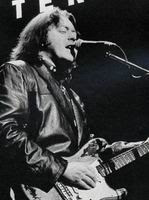
Photographer by Koudai Miura
Press reports from the Tokyo concert note that many long-term Rory fans – now in their 40s – had gathered in the hall still wearing their business suits because they had dashed straight from work to see him. According to Ongaku Senaka, when Rory first walked out on stage, whispers went around the auditorium of “Who is he?” because he looked so different from 1977. However, as soon as he started to play, they were “silenced” and realised that he was the “same person.” Echoing the words of so many other Japanese fans, the magazine wrote, “Rory was Rory. His exciting playing never changed.”
These final words lie at the bedrock of Rewriting Rory and summarise in a nutshell what we set out to do with our project. Whether showband or solo, Deuce or Defender, Beat Club or Borderline, Rory was always Rory. We love him through thick and thin. Unconditionally, non-judgementally and infinitely.
Rory in His Own Words

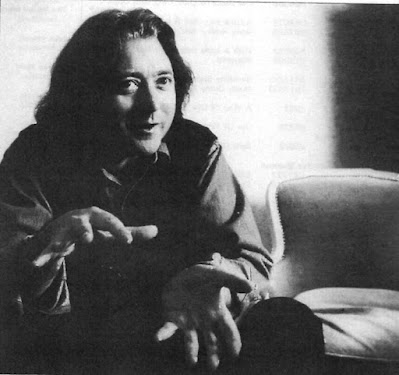
The day after Rory’s first show at Club Città in Kawasaki, he gave an interview for Young Guitarist Magazine in his room at the Takanawa Hotel. This 30-minute interview is, in our opinion, one of the best that he ever gave in his career and is one that we return to time and time again to listen to his words of wisdom. Rory sounds unusually relaxed and open here, and speaks so knowledgeably on a range of topics. As there are far too many high points to cover in this post, we encourage all our readers to give it a listen if they haven’t before. Nonetheless, we wanted to end this article by summarising our top twenty parts below, using Rory’s own words. These quotes encapsulate all that we love about Rory – his humility, kindness, intelligence, sense of humour – and why he holds such a special place in our heart:
“I’m delighted. That is good for my morale”
On hearing that the journalist had “the time of his life” at Rory’s show at Club Città the night before.
“We always got a good reaction here before, but I think it’s just as good if not better.”
On the audience’s reaction to his performance and the fact there was a mixture of older and younger people who recognised a variety of material and enjoyed the blues songs as much as the rock songs.
“I wish I hadn’t wasted my time, but obviously it was necessary […] That’s why I’m broke, but that’s okay”
On the abandoned Torch album and the pattern every ten years of scrapping an album.“I: Was that a self-defence move?”
“[laughter] That’s a good way of putting it”
On buying the rights to his own material and his past bad experience in the days of Taste.
“[My brother] is younger, but he seems about 50 years older than me mentally. He’s very clever with things like that”
On Dónal and his expertise as a manager.
Photographer unknown
“You can’t live complaining all your life. All you can do is continue and learn from your mistakes”
On pushing forward, despite setbacks along the way.
“It’s good to start from difficult circumstances”
On the early days in Cork when he first started playing guitar and the difficulties of accessing music compared to today.
“I wouldn’t say that all the players do not play with emotion and feeling, but there is more emphasis on extreme speed and technique.”
On guitarist nowadays and their reliance on equipment and effects.
“Everybody wanted to be fast and clever but not at the expense of the soul of the music”
On his generation and how they differ to current guitar players.
“You still have fantastic accidents happening, like John Lee Hooker has a hit album and Muddy Water, because of a jeans ad, there is a blues song in the charts”
On his hope for the future of blues music in the modern world.
“It would be a pity if music just becomes like Teletext or a two-second ad on TV”
On the speed of the world today and the lack of time for reflection and music ‘outside the system’.
“There is an overemphasis on guitar players being lead players. There is more to guitar than just lead guitar.”
On the importance of chops and rhythm players like Keith Richards and John Lee Hooker.
“In one night you try and create different moods”
On his live shows and the need to create depth and soul.

Photographer unknown
“The principle of a trio is good because anything can happen”
On the freedom of a three-piece and the room it leaves for changing arrangements.
“It’s been through everything but Iraq, that one”
On his beloved Fender Stratocaster.
“The sound of the old Guyatone pickups were peculiar. They were very microphonic, you could almost talk into them”
On the benefits of Guyatone guitars.
“I felt it this morning, I tell you”
On playing with thick-gauge strings (13) for hard slide guitar.
“I try to create an octave with my nail, so sometimes you can get a high octave plus a low electronic octave and a note in the middle and then feedback, so it can get spacey!”
On his lack of equipment and special effects.
“He is so good you can play things and he repeats them”
On Mark Feltham and how well he fits in to the band.
“Open your ears to other kinds of guitar players. Don’t think that unless they are speed merchants that they’re not worth listening to. It’s worth checking out some of the old acoustic players. Even if you’re an electric player, if you can afford it, you should have an acoustic at home because it keeps the hands tough and you hear different things”
On advice for young guitarists.

Photographer unknown
After his five-day tour of Japan, Rory flew straight to Melbourne, ready to begin the Australian leg of his 1991 international tour. We pick up from here next month in Part 2, which offers a detailed retrospective of Rory’s many tours of Australia and New Zealand, drawing upon archival material, fan accounts, bootlegs and press reports.
We would like to thank the following people for their help in preparing this article: Akiko Watanabe, Hiroshi Kikuchi and K.G. Takeda. We are also grateful to the fan accounts offered on Reiko’s Rory Gallagher Japanese website and Shinolez’s Japanese Rory Gallagher blog, as well as the fantastic Rory Gallagher Live Archives website (created by Megumi Manzaki) and the Maybe I Will… Japanese Rory tribute site by Nerory. The interview with Mutsumi Mae in the Rory Gallagher 25th Memorial Edition book was also extremely useful and we, once again, encourage all our readers to pick up a copy of this excellent book.
Thank you for reading!

 REWRITING RORY
Leave a comment