

“The phoenix hope, can wing her way through the desert skies, and still defying fortune’s spite; revive from ashes and rise.”
Miguel de Cervantes, Don Quixote
Thirty years ago today, Rory hit the stage at the inaugural Temple Bar Blues Festival in Dublin, giving a free concert before 20,000 spectators on the steps of the Bank of Ireland on College Green. Three days prior, he had kicked off the festival with an intimate masterclass with five budding young guitarists at the Guinness Hop Store in the city’s St James’s Gate district.
These two performances are some of the best that Rory ever delivered in his long career, showcasing his phenomenal versatility as an artist and summarising in a nutshell not only what made him such a great performer, but why he as a person so dearly captured the hearts of anyone who crossed paths with him, even for just one fleeting moment. Listening to these contrasting recordings, we draw a number of conclusions about Rory, both as a musician and a person, such as: how he could effortlessly move between the electric and acoustic guitar; his ability to build a strong rapport with his audience, whether made up of just a handful of invited guests (in the case of the Masterclass), or several thousand people (in the case of Temple Bar); and finally, the demonstration of his encyclopaedic knowledge of the blues.
Despite Temple Bar Blues Festival being a clear standout event in the Rory story, as well as Dónal’s favourite show that his brother ever gave, for some unfathomable reason, it is hardly ever spoken about. Moreover, when it is, it is never mentioned in the same breath as earlier Rory triumphs on home soil, such as Irish Tour ’74 or Live at Ulster Hall ‘84. To us, given Rory’s personal circumstances surrounding the 1992 Temple Bar Blues Festival, his triumph is even greater, even more of an achievement, a victory. With that tenacious spirit that he always had, Rory rose to the occasion and proved that – to quote a song from Fresh Evidence – he may have been bowed but he was by no means broken.
Leading up to Rory’s appearance at Temple Bar, there was much expectation. He hadn’t performed in Ireland for four years and now he was back, for the first time, without long-term band members Gerry McAvoy and Brendan O’Neill. Would he still be liked? Would the new band make a good impression? Was he still capable of headlining a major festival? He was also back with a slightly changed physical appearance as a result of the medication he was taking for numerous health issues. What would people say about the way he looked? Would they ask him questions about his weight gain? Would they still want to see him? Rory was never confident, but he was increasingly riddled with insecurity at this time and whether he would be able to live up to the high standards that people had of him (and indeed his own, given that he was always his own worst critic).
His nerves were not eased by press reports leading up to the event that were keen to write him off before he had even arrived in Dublin. This headline from The Sunday Tribune – ‘Return of a Flawed Prodigal’ – almost tried to set Rory up to fail. Journalist Tony Clayton-Lea frames the 1970s as Rory’s “most inspiring period,” differentiating this by informing the reader that he now “has problems,” including significant weight gain, a glandular disorder, and “obsession about straightening pictures.” Clayton-Lea provides a detailed summary of Rory’s work in his early career, though omits information regarding album releases from 1982 onwards. The article briefly discusses the recent compilation Edged in Blue (1992), describing this selection of Rory material as how “clear and sharp Gallagher’s vision – in every sense of the word – once was [our emphasis].” Ironically, six out of the eleven tracks on Edged in Blue were chosen from Jinx (1982), Defender (1987), or Fresh Evidence (1990). Therefore, the majority of this “stunning collection” of Rory “at his blues best” was not from the “prime” stage in his career, but rather later on, and the failure to recognise this from Clayton-Lea’s perspective is either from poor familiarity with the material, or just journalistic carelessness. Clayton-Lea concludes by questioning whether Rory will be able to pull off a headlining performance at the Temple Bar Blues Festival and obtain a “happy and satisfactory ending.” Although we have concentrated on this one example, articles from the Evening Herald and Irish Independent follow the same template, establishing an uneasy pattern that we’ve come across time and time again in our research for Rewriting Rory: journalists continuously and ludicrously equating Rory’s change in appearance to a sudden inability to play guitar anymore.
While Rory was likely hurt by such remarks, to some extent, they appear to have spurred him on, knowing that he had something to prove. Just as he had come back in 1971 with an impressive solo debut, which shut up critics from the opening notes of ‘Laundromat’, we see a similar situation here. As Rory took to the stage on 15th August 1992, it was immediately apparent that this was going to be a night like no other. He arrived with the energy of a hurricane, breaking into a powerful rendition of ‘Continental Op’ that left no doubt that he was back and stronger than ever before. Energetic. Gritty. Passionate. Soulful. Yes, like a true phoenix, he had risen from the ashes, stunning the whole of Dublin city with his fire and zeal. Against all odds, he had returned with his new band and put on – what to us – is one of the greatest performances of his life.
So, on the 30th anniversary of the Temple Bar Blues Festival, we wanted to celebrate Rory’s triumphant return to Ireland and offer, for the first time, a detailed account of this event. Through new research and first-hand accounts of fans and musicians who were at the festival, we hope to show how Rory was absolutely at the top of his game here and, more than anything, proving the age-old proverb that you should never judge a book by its cover.
Pure Genius: Wales and the Masterclass
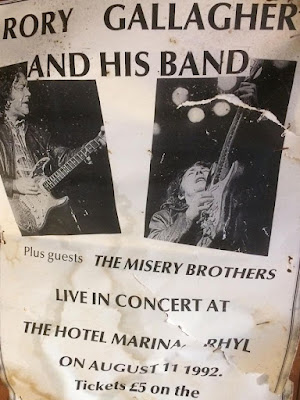
designed by Bob Hewitt and Chris White
Photograph courtesy of Bob Hewitt
There are two reasons to distinguish Rory’s Masterclass and Temple Bar Blues Festival appearance from other events in 1992: firstly, as Rory says in his introduction to “Walkin’ Blues” at the Masterclass, it had been approximately “four years” since he visited Dublin, and therefore anticipation was high for his return; and secondly, on top of audience expectation, the Temple Bar Blues Festival would mark the debut of Rory’s new band since the departure of Gerry McAvoy and Brendan O’Neill in March 1991. In an article for the Weekly News, it was reported that Rory had made a “surprise date” at the Marina Hotel in Rhyl, Wales, with photojournalist and friend of Rory’s, Bob Hewitt, helping to organise the event, as well as be a support act on the night with his band the Misery Brothers. Bob elaborated in the article that Rory wanted to use the Rhyl gig as a “warm-up for himself and the new band”, particularly with the Temple Bar Blues Festival on the horizon later in August. We had the great opportunity to speak with Bob about this performance, providing a full account of the evening for us:
Dónal contacted me to say that he and Rory were calling in to say hello on their way through to Dublin (via Holyhead). As we got talking, Don suggested arranging a low-key gig in my hometown as a warm up with Rory’s new bassist and drummer […] I got together with my bass player [and] pal Chris White to try and find a venue, and to sort publicity / poster campaign. Eventually a guy called Hughie Shaw came to the rescue. He said we could use his Marina [Hotel] venue right on the Rhyl seafront and overlooking the Irish Sea. It was perfect – just the right intimate atmosphere and sufficient capacity (about 1,000) for a short notice gig … or so I thought!
It was a £5 entry on the door, and on the evening of the show it was warm and sunny, [and] as I arrived, [I saw] a queue down the promenade as far as the eye could see! I soon realised we would have to turn people away to avoid exceeding the capacity licensing laws […] As it transpired, we managed to squeeze everyone in who came along that evening – including the local fire safety officer!!!
Bob said that introducing Rory to the crowd was the “greatest thrill” of the night for him, the audience’s warm reception “deafening” when Rory finally walked onto the stage. Despite the small venue and low-key publicity, the gig has since become “the talk of the town,” and Bob recalls Rory’s new band as “brilliant.” Unfortunately, this would be Bob’s final meeting with Rory prior to his passing. “The last thing I did was write his obituary for Guitar Magazine,” Bob said, “I didn’t write anything else for ten years after that. I was heartbroken.” To read the full transcript of Bob’s memories of the Rhyl show, please click this link.
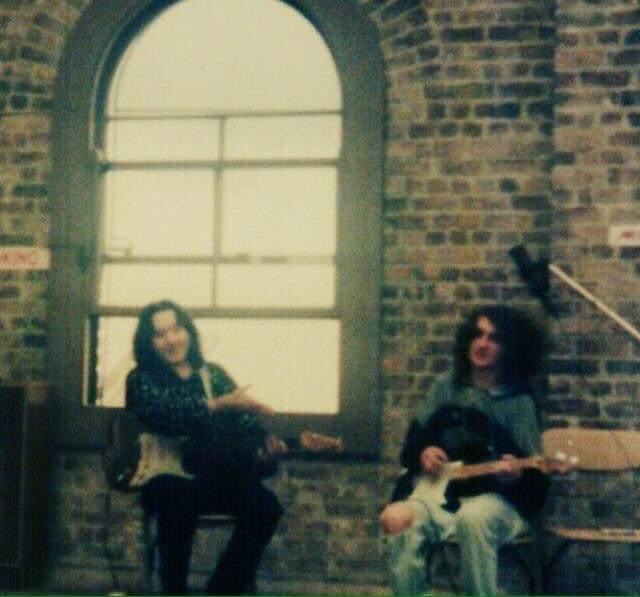
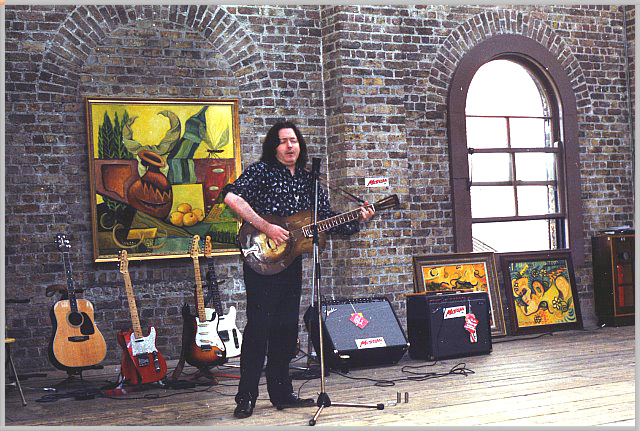
Similar to the Rhyl date, Rory’s performance at Dublin’s Guinness Hop Store for a guitar Masterclass was a low-key event with a selected audience. Five recent graduates (Colm Quearney, Daragh Brennan, Michael Duff, Eamonn Griffin, and David Gunning) from the Ballyfermot Rock School were the lucky few to be chosen as audience members for this occasion. Rory played his usual acoustic and electric repertoire (from “Out on the Western Plain”, to “I Wonder Who”), whilst speaking between songs about his preferences for slide tunings and favourite blues artists. Ronnie Drew joined Rory for “Barley and Grape Rag” (which they had recently recorded for The Dubliners’ 30 Years A-Greying, as we discussed in our April post), and at the end of the set, Rory jammed with the students for a few numbers. One of the Masterclass attendees, Daragh Brennan, kindly shared with us his memories of what it was like to play with the great bluesman:
It was intimidating initially as I was a young metal/rock player with no blues influences at the time and had only found out about the session a couple of days beforehand. The other guys chosen were much more suited and influenced by Rory and more mature players than I was, but once I sat down with him I was less nervous and he helped me feel at ease by being very relaxed and chilled. He was a total gent and very easy to play with. I had to have a distortion pedal which mostly sounded terrible, and he was smiling away being very relaxed and making it a pleasure to jam with him.
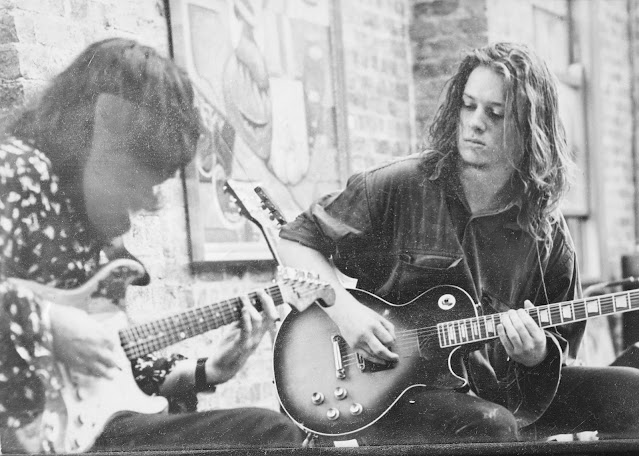
Photograph courtesy of Daragh Brennan
Daragh admitted to mainly listening to “rock and metal players” during this time, and it was only a few years ago that, “I really started to find myself looking to move out of my comfort zone and explore the bluesier side of guitar playing.” This eventually led Daragh to delve further into Rory’s catalogue, in particular his live recordings and blues covers. Re-discovering Rory years after meeting and jamming with him “really brought home” to Daragh just “how amazing [Rory] was as a player, whether using slide or not, and how great his voice was.” Moreover, apart from the Ballyfermot Rock School graduates, two Rory fans were lucky to score the only tickets advertised to the general public. Joseph Cavenagh became a Rory fan in 1972 when he saw him at the National Stadium in Dublin, and was “immediately struck by [Rory’s] talent, energy, and music […] I knew I was listening to something very special.” Joseph’s sister happened to be listening to RTÉ radio when they announced that only two tickets were left to Rory’s Masterclass in 1992. She immediately called the radio station and won the tickets by telling the presenters that “[Joseph] and her husband Alan followed Rory everywhere.” Here is what Joseph remembered of the day:
[What I remember most is Rory’s] engagement with his ‘up and coming] guitarists. My brother-in-law [and I] were the only two ‘fans’ of Rory that were there that afternoon. We had the front seats and were no more than eight feet from the man himself. Everyone behind us were from the music business or dignitaries in one form or another.
After the Masterclass we were immediately brought over to him by one of his ‘bodyguards’ whom we had met earlier and had a quick chat with him. It was there that he signed all my albums that I had bought over the years which he recorded and I still proudly have today. We then got our photo with him, which I have on my wall to this day.

Photograph courtesy of Joseph Cavenagh
As we mentioned in our March post, the Lord Mayor of Dublin, Gay Mitchell, and Fender representative Tom Nolan honoured Rory with the Fender/Arbiter Hall of Fame Award at the Masterclass. As reported by Eilish O’Regan in the Evening Herald, behind James Burton of Elvis Presley’s TCB band, Rory is the second guitarist in the world to receive this award. At the Inaugural Rory Gallagher Memorial Lecture in 1995, Marcus Connaughton revealed that Rory was extremely touched by the induction because, firstly, he “valued and respected James [Burton] as a player”, and secondly, he felt he had received very few accolades in his career, putting this down to the fact that he “always stayed true to the music.” Overall, the Masterclass itself (in addition to the Fender/Arbiter Hall of Fame Award) is rarely included in Rory literature. The only documentation of the Masterclass is as a footnote in Julian Vignoles’ Rory Gallagher: The Man Behind the Guitar.
Fortunately for us, the Masterclass was recorded, though unfortunately, this recording has never been officially released. Tracks from the Masterclass have recently circulated on Soundcloud, and if you have never listened to this recording, we highly recommend you do by clicking this link. We have always envisioned the Masterclass tracks to be the perfect Record Store Day (RSD) release from the estate. Disappointingly, apart from 2013, the estate has never issued an LP from Rory’s career post-1970s for RSD. When we contacted Colm Quearney to participate in today’s article, he informed us that additional tracks were recorded, yet did not appear on the Soundcloud listing. When we initially reached out to Colm, we went through our usual procedure of sending questions. In addition to those answers, Colm shared with us a short and wonderful piece about the day at Guinness Hop Store that he had intended for a memoir, which we are happy to include here:
I once got a chance to play with Rory Gallagher. He was shy. I thought I was nervous meeting him, but when we met he seemed to be more so. I helped the conversation along. I was 19.
I was dizzy walking to the stage. I had never played in front of a crowd like that before, they were so enthusiastic, I was getting to step in and share Rory’s light. I could see his fans truly loved him. What a vantage point. I knew I was privileged and lucky.
Going into it I knew I had an advantage. I had learned a lot of his songs and guitar licks from watching a VHS that my Dad had recorded from TV ‘Rory Gallagher live from the Cork Opera House’.
He introduced me and we got straight into playing. “Blues in A?” he said. I sneaked an eye open once or twice to see what he was doing, [and] he was just smiling his way through the song/jam and that made me think it must be going okay.
He was encouraging. After the first jam we played and the applause calmed down Rory said to the crowd, “Colm’s playing speaks for itself really, he has a similar sound to Buddy Guy.” That really gave me a confidence that I still carry with me today.
We played three songs together without vocals. Rory said, “how about a blues in A?’” “Sounds good to me,” says I. It went down great. There was 60 people invited from the press and radio. Then we played “Hoochie Coochie Man”. We done one more for good luck, this one a shuffle in the key of E7.
At end of the masterclass we spoke for a while and then he signed my cassette tape and then it was over [and] I was walking home back down James Street. Why was it me that got to play with him? It gave me inspiration to keep going. And I’m still playing the blues 30 years later. Actually I’m playing tonight with my band Square Pegs at the Howth Blues festival. I might even play ‘Messin’ with the Kid’.
If interested, we encourage our readers to check out the Square Pegs and Colm Quearney on Spotify, or visit Colm’s website for more information about his career and music.
Photographer unknown
“Nervous with evidence of fragility”: Reappraising the ‘Writing Off’ of Rory
Given what we have uncovered to date with our Rewriting Rory project, it should come as no surprise to our readers that Rory’s appearance at the Temple Bar Blues Festival is yet another in the long line of his later-day achievements that is poorly represented in previous literature. Moreover, on the scant occasions that it is mentioned, emphasis – lo and behold – is on his poor health and changed appearance rather than his performance. Quite shockingly, for a documentary that claims to offer a full account of Rory’s life, Ian Thuillier’s Ghost Blues: The Story of Rory Gallagher (2010) doesn’t so much as mention Temple Bar Blues Festival. While Marcus Connaughton’s Rory Gallagher: His Life and Times (2012) fares slightly better by mentioning it three times, he only uses the event as a marker on a timeline (e.g. “Rory Gallagher was in Dublin for the first Guinness Temple Bar Blues Festival in August 1992), which completely underplays the fact that Rory had been selected from dozens of possible candidates to headline this inaugural event.
Julian Vignoles’ Rory Gallagher: The Man Behind the Guitar (2018) also mentions the Festival in passing, but only to point out that Rory was “apprehensive about how he would go down with the audience.” To stress this point, he uses quotes from musicians Brian Palm and Mary Stokes who met Rory in the bar of Blooms Hotel the day before the gig and noted that he was “nervous” and showed “evidence of fragility.” While we know that Rory was plagued with increasing self-doubt at this time and his anxiety and stage fright were getting progressively worse, Vignoles tries to frame this as something new, something that was suddenly having a detrimental effect on his later performances. But no, anxiety and stage fright were things that Rory had suffered from throughout his career. You only have to see the clips of him backstage in the Irish Tour ‘74 film to get a sense of the tension in the room or read Dónal’s testimony of the 1977 Macroom Festival and how “terrified” Rory felt before going on stage and “worried” whether anybody would turn up and see him. There are also countless articles in the music press throughout the 1970s that mention Rory’s nerves, such as a 1978 piece for French magazine Rock and Folk where the journalist notes that Rory was “shaking like a leaf” in the car all the way to the concert hall, and Rory himself spoke often about his stagefright, including in the 1978 Elf 1/2 documentary (better known as the Macroom documentary) and the 1982 Rockpalast interview with Alan Bangs.
So, understood in this broader context, we see how Vignoles – and others – have a tendency to overemphasise Rory’s poor mental state during this period, which massively takes away from the high level at which he continued to perform. Yes, he was undoubtedly more nervous than before and perhaps more fragile too, but like a true pro, he knew how to channel his nerves into giving a high-energy, adrenaline-fuelled performance. As he joked in the aforementioned interview with Alan Bangs, “As Sarah Bernhardt said, ‘You need the nerves to give you the extra injection of adrenaline’,” and that is certainly what he did in Temple Bar.

Photograph by Independent Newspaper Ireland
Mary Stokes, in fact, reflected on her encounter with Rory for Hot Press magazine’s special edition to mark Rory’s 25th anniversary in 2020 and her account is far more balanced than the selective quotes that Vignoles chose to use in his book. She notes how she was helping Brian Palm hang up paintings of his favourite blues artists for an exhibition in Blooms and that she saw Rory sitting at the bar. She introduced herself and, with a boyish grin, he replied, “I know. Who else would be hanging up paintings of Sonny Boy Williamson?” Mary says that she then had a talk about the blues with him and they swapped some stories about other musicians. She then mentions Rory’s anxiety, but says how she spent a long time reassuring him that “it would be great, that he was loved by Dublin, by Ireland, that people were excited that he was back.” In this account, we see similarities with the way that Martin Carthy would reassure Rory two years later before the Montreux Jazz Festival. It paints a far different picture from Rory as a lonesome figure drowning his sorrows in a bar and rather Rory as someone who could confide in others when he felt at ease with them and who relied on their words of comfort to help him in times of need.
As we said in the introduction to this piece, most press reports on Rory leading up to the Temple Bar Blues Festival are pretty damning. They highlight his weight gain and health problems, ridicule his superstitions, question his ability to ‘pull off’ a headlining performance – essentially, they do everything, but actually focus on his music. A passing comment made by Rory that he is playing on the anniversary of Elvis’s death is jumped on by journalist Joe Jackson as an opportunity to talk about early death and excess in rock and unfairly link this to Rory. Of course, Julian Vignoles picks up on this point in his own book, using it in such a way that completely detracts from Rory’s performance and segues into an account of the infamous Town and Country Club gig a few months later when Rory was unable to perform due to a reaction to his medication when taken with a single glass of brandy.
So, let’s forget about the critics for now and delve into Rory’s appearance at the Temple Bar Blues Festival for ourselves in order to provide a far more balanced account of the event.
“Look out, baby!” : A Retrospective on Rory at Temple Bar Blues Festival
The Temple Bar area of Dublin underwent significant development from the mid-eighties onwards, with then-Taoiseach Charles Haughey expressing desire for the space to appeal to the younger generation “to relax and enjoy themselves.” As reported in a 1991 RTÉ news broadcast, Temple Bar exhibited “lots of art space, activities, small businesses, [and] low to moderate priced restaurants.” One of the earliest announcements about the upcoming Temple Bar Blues Festival comes from Catherine Murphy’s Ad Lib column in the Evening Herald from June 1992. Murphy comments on the high anticipation regarding the festival, and how it “could equal the Cork Jazz festival in content and popularity.” The festival was organised by Guinness and Temple Bar Properties, and early press releases proclaim Rory’s open-air concert on August 15th to be the “highlight” of the three-day event. In addition to Rory’s concert, other blues related activities included the ‘Guinness 12 Bar Blues Trail’, which offered free live music at twelve pubs in the area, as well as a series of blues concerts by different artists at the Olympia at midnight on August 14th/15th. In the late 1990s, the festival changed its name to the Guinness Blues Festival, and expanded to Vicar and Abbey Street, as well as dropping the free outdoor concert in College Green. At present, Temple Bar offers a number of music and art festivals, such as the Tradfest Temple Bar (Irish traditional and folk music), to the Dublin Theatre Festival.
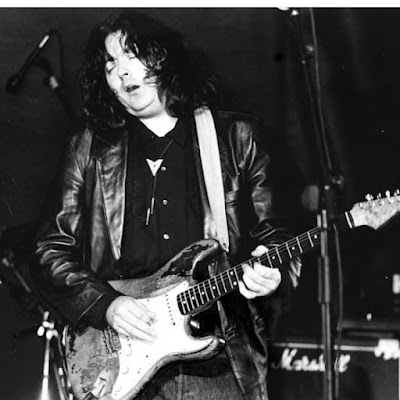
Photograph by Independent Newspaper Ireland
A full bootleg of Rory’s performance at the Temple Bar Blues Festival has been circulating online for many years, and about three years ago, 30 minutes of video footage of the concert shot from the crowd appeared on Vimeo. There is also a small clip from the concert in HD quality at the beginning of a repeat of Rory’s 1976 Old Grey Whistle Test performance, which gave us hope that the whole concert had been filmed. Our hope turned to joy when we followed the clue that the footage had been shared “courtesy of Temple Films” and tracked down the company directors Ed Guiney and Stephen Bradley who confirmed that the whole concert indeed had been recorded. They told us that the footage was delivered to Temple Bar Properties who commissioned the material and they were not entirely sure what had happened to it since, but would try and find out. We are still waiting for further news on this front, but given that the whole concert was recorded in HD, we are hopeful that it will see an official release in the future.
The Vimeo video footage begins with Ronnie Drew taking to the stage to introduce Rory. “It’s been three years now since he played in Ireland, played in Dublin, so when he comes out, I want you to give him a real welcome home, Ireland’s own blues legend, Rory Gallagher!” to which the crowd erupts into thunderous applause. The band slowly walks out on stage, while Rory – about ten seconds later – enthusiastically runs on, Strat in hand. He waves several times, bows and shouts “YEAH!” followed by a quieter “thank you.” After a small adjustment to his amp, he then kicks into ‘Continental Op’. His energy is electric from the very first note. This is Rory on fire, revitalised by his new band and releasing all that nervous tension from the days building up to this big concert. His vocals are extremely powerful and his slide-playing is flawless. Despite his fears that nobody would want to see him, the crowd is immediately on his side and pushing his performance to new heights with their cheers and claps. If Rory had left the stage after this song, it would have been enough to declare him the top performer at the Festival, hands down. But no, this is just the start of an almost two-hour spectacular musical display.
Unfortunately, the video footage cuts out after ‘Continental Op’, so it is over to the audio recording for the next part of our analysis, just in time for Rory to greet the crowd. “It’s fantastic to be back in Dublin, back in Ireland. It’s lovely to see you. Thanks for showing up. Thank you very much,” he says so humbly before introducing the band and adding “It’s great to see the blues come to Dublin at long last. It took a long time!”With a “one, two, three” countdown, he then breaks into a magnificent rendition of the instrumental ‘The Loop’. Considering that Rory and his new band had only performed one gig together before this show, it is incredible how tight they are and how well they all work together. Others may beg to differ, but for us, the absence of Gerry and Brendan is not felt. David and Richard make a brilliant rhythm section, providing solid support for Rory and Mark. The result is a fresh, youthful and invigorating sound.
From ‘The Loop’, Rory moves into ‘I Wonder Who’, humbly introducing it with “this is a tune you might remember from a few years ago.” Dónal has often said how Rory used to throw in little hints of his poor state of mind into songs in later years and we see that here. “Take my hat | take my comb | take my phone | take my keys | take my room | take my plane,” he starts the song. “But you can’t take the pain,” he poignantly adds. Again, Rory’s vocals are on point here, full of emotion and soul and perfectly complemented by Mark’s virtuosic harmonica playing, while his guitar solos clearly demonstrate why nobody will ever play the blues like him. He gives over and above, chopping and changing licks spontaneously, improvising lyrics, preaching those blues as if his life depended on it, before bringing the song to a dramatic climax.
After six thank yous, Rory informs the audience that he “would like to do a little tune that’s a bit faster.” Here, Rory’s breathlessness when he talks is the only hint of his health problems, contrasting sharply with the sheer bulldozing force of his music as he starts up ‘Ghost Blues’. Again, we see how well the new band work together, not missing a beat as they come in after Rory’s lead riff. This is one of these performances where words are not enough to describe how good it is, so we encourage you instead to listen for yourself. We also challenge you not to get up out of your seat and go wild, which is practically impossible! The way Rory and Mark communicate with one another is a real feast for the ears and no matter how many times we hear them, we cannot get over what perfect musical chemistry they had.
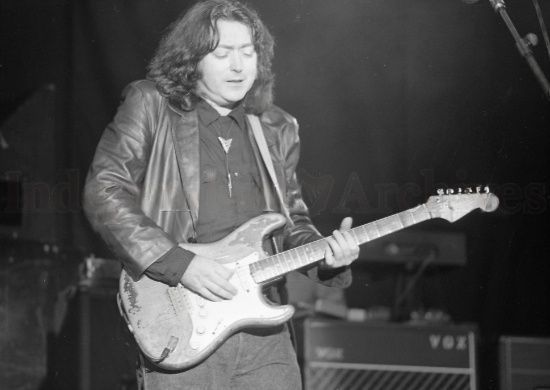
It is back over to the film footage for the next song – ‘Tattoo’d Lady’ – and boy, are we glad that it is caught on film because it is the greatest version of the song that Rory ever did. We find his self-effacing introduction so sweet and reflective of the gentle man he was: “This song isn’t rhythm and blues, but I wouldn’t mind having a bash at it for old times’ sake. I love playing it [hugs his Stratocaster to his chest]. You may like it…”He then starts up the iconic opening, adding a little Hispano-Celtic flavour to the riff, before a cry of “look out, baby!” Once again, considering how poorly Rory was here, we are so bowled over by his energy and magnetism. He is transformed into a 20-year-old again as he moves all over the stage as he plays, kicking his feet and raising his guitar above his head. On many occasions, we’ve heard fans joke that his solo in the Irish Tour ’74 version of ‘Tattoo’d Lady’ should be on the UNESCO World Heritage list, but we make a strong case for the second solo in this version to be on the list instead. Rory pulls out all the stops, using all his classic techniques, from string-pulling and bending behind the nut to knob-twisting and random pinch harmonics. Eyes closed, he is clearly in his own world, having transcended to that happy place he always goes when lost in his music. The song ends with Rory holding his Strat like a machine gun and firing at the crowd, an iconic moment captured in photographic form.

Photograph by Independent Newspaper Ireland
We move back to the audio recording for ‘Off the Handle’ to “cool it down a little,” as Rory says. The honky tonk piano provided by John Cook here is a nice addition, while David lays down a strong groove throughout that perfectly supports Rory’s rhythm. Like with ‘I Wonder Who’, Rory seems to use the song as a channel to express his own mental state through both lyrics and music, the line “I feel I wanna slow down and fade away,” catching us off guard and gaining added significance when listened to in hindsight. The song’s highlight is the closing two minutes, featuring an astonishing piece of jazz guitar by Rory interspersed with beautiful melody on the harmonica by Mark.
‘Off the Handle’ is followed by a cover of Sonny Boy Williamson’s ‘Don’t Start Me Talkin’, which is thankfully captured on film. Whenever Rory played this song, he always seemed to be having such a good time and, with the new band, this feeling of euphoria is even more apparent. Mark described the final Rory Gallagher Band as his favourite and it is easy to understand why. There is a real sense of optimism and fun about them. We see this in a lovely part where Mark and David look at each other and smile, Mark mouthing the lyrics along with Rory. Similar moments come later in the song when Rory, Mark and David all interact with one another, before David turns to Richard and nods and smiles, while Rory moves next to Mark, playing off one another effortlessly. Simply stunning!
The band then leave the stage as Rory introduces the acoustic part of his set, beginning with a beautiful instrumental of the Irish folk song ‘She Moved Through the Fair’ that leads into the timeless ‘Out on the Western Plain’. Rory’s version of this Leadbelly classic really showcases his mastery of the acoustic guitar and makes us so sad that he never had the opportunity to record the acoustic album that he always wanted to. Rory feeds off the crowd’s enthusiasm here, his fingers moving faster and faster on the fretboard in the solo, almost of their own accord. He smiles during the call and response part with the audience, clearly overwhelmed at the positive reception on his homecoming to Ireland.

Photographer unknown.
After a huge cheer from the spectators, he starts up ‘Walkin’ Blues’ with an emotive piece of slide. As he moves into the familiar rhythm part of the song, the crowd claps along. Rory is totally relaxed into the set and at ease now. As per usual, Mark’s accompaniment on the harmonica is impeccable and we love watching Rory’s reaction to him playing, always a mixture of awe and happiness at having found a musical kindred spirit, as Dónal once called them. Once the song has come to a close, Rory introduces ‘Barley and Grape Rag’ and dedicates it to “the people from Belfast and Cork city and Derry city and for various parts of the globe.” As he tells the crowd that he will be joined on stage by Ronnie Drew, the footage frustratingly cuts out, so we return to the audio once again.
The duet between Rory and Ronnie is one of the highlights of the Temple Bar concert. At this stage in his career, Rory had developed a growing interest in Irish folk and, from this performance, we can see how he could have perfectly fitted into the scene had he wanted to. Rory and Ronnie were good friends and the camaraderie between them is particularly apparent here through their cheeky banter and laughs. After singing the opening verse, Rory asks “What do you think?” as he passes over to Ronnie who starts up “My baby’s done me wrong…” in his iconic voice. “You’re under arrest!” Rory later shouts to him after the line “I’m mixing the barley with the grape again.” Then, their two voices meld together on the chorus in a wonderful blend of gravel and soul. We see more hints of their banter with Rory’s “Good God, Ronnie, you look like you could do with it too” to which Ronnie replies “One for you too, Rory!” Other standout moments in the song are Rory’s improvised “I’m coming into Dublin,” which is met with a huge cheer from the crowd, as well as the singalong of “mmms” at the end between Rory, Ronnie and the audience. What an iconic moment for those present!
Rory then swaps back to his electric guitar for a blazing rendition of ‘Messin’ with the Kid’. Here, he makes a nod to the 15th anniversary of Elvis Presley’s passing (on August 16th), improvising some lyrics halfway through: “There’s a man in New Orleans who plays the guitar | He’s up there in heaven living on a star | oh, Mr Presley we know where you are!” He also follows this up with his own sample of Elvis’s ‘You’re So Square (Baby I Don’t Care)’. While Rory is known for his blues, he has always been able to deliver fantastic rock and roll too, such as covers of Ritchie Valens ‘La Bamba’, Chuck Berry’s ‘Nadine’ and The Animals ‘Roberta’. He delivers this Elvis tune dazzlingly, putting his own firm stamp on it, before transitioning back into ‘Messin’ with the Kid’ again.
Rory continues with a cover of Muddy Waters’ ‘Mean Disposition’. He added this song into his set around 1990 and the early renditions of it tend to be fairly dark and melancholic (e.g. Ohne Filter, Rockpalast), reflective of the particularly bad place that he found himself in at this time. However, this version has a somewhat more tenacious and defiant edge. Rory shows himself as the master blues storyteller with his improvised lyrics – “I roam and I ramble just about every known town | can’t find myself no heaven, no matter where I look around” – while his vocals are, once again, extremely sharp here, perfectly fitting the tone of the song. Mark’s supporting harp work is also breathtaking. An absolutely brilliant version and a fine example of how Rory could take the same song and do something completely different with it on each occasion.
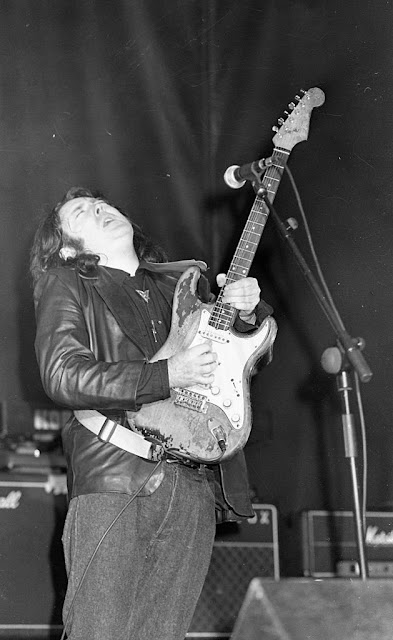
Photograph by Independent Newspaper Ireland
Rory closes his set with an intense and spirited version of fan favourite ‘Shadow Play’. There are echoes of the iconic Montreux ’79 version of the song here in Rory’s high energy and the way that he constantly brings the pace up and down, playing to the crowd and getting a rapturous response that fuels him on further. We only wish that we had video footage to witness him in action to accompany the audio. Richard’s drumming here is particularly strong and the additions of harp from Mark and keyboard from John to support Rory’s solo add a terrific edge to the song. There is a wonderful moment towards the end when the entire audience sing back the chorus of ‘Shadow Play’ to Rory, their warmth for him extremely apparent. We hope that it left no doubt for Rory that he was still so well loved by his fans. “I’m most grateful to you for coming this evening,” he politely tells the crowd as the song comes to an end. “It’s beautiful being in this fair city of Dublin. I hope we can come back in the next couple of years or something like that. We love you. Thank you.” As we know, this was sadly Rory’s last time in Dublin, but what a way to leave his mark on the capital.
As the crowd continues cheering for Rory and clearly want more, he takes to the stage one final time for a blistering 12-minute version of ‘Bullfrog Blues’. The energy of this performance takes us back to Rockpalast ‘77 or ‘79 renditions, yet the performance reaches a whole new level of superiority with Rory’s mature vocals and perfected musicianship. Every member of the band makes a fantastic contribution here – bass, drums, harmonica, keyboards all adding to Rory’s magnificent slide-playing – while Rory’s addition of “Dublin” to the lyrics sends the crowd into a frenzy. The feeling is so good here that Rory bursts into a spontaneous medley, starting with a few licks of Eddie Cochran’s ‘Summertime Blues’ before weaving into Larry Williams’ ‘Dizzy Miss Lizzy.’ He then treats the audience to a version of ‘All Around Man’ à la ZZ Top. It is such a wonderful, creative take on his original slow blues version of the song and shows that he indeed was an All Around Man when it came to musical virtuosity. He then smoothly moves back into ‘Bullfrog Blues’, bringing his set to an end and delivering the musical equivalent of a KO to anybody who had doubted him beforehand.
What a concert!
Rory well and truly brought the blues to Dublin that night, and the steps of the Bank of Ireland have been reverberating with the haunting sounds of his beloved Stratocaster ever since.
“Full of energy and really packed a punch”: First-Hand Fan Accounts
Just hearing the bootleg from Temple Bar Blues Festival or watching the short 30 minutes of footage that are available is enough for us to declare this concert of Rory’s as one of the greatest in his long career. We get goosebumps listening to the sheer intensity and emotion of Rory’s performance on the audio recording from this Festival, so we can only imagine just how heightened those feelings would be to experience them live and in person. Luckily, we were offered a glimpse of that and an opportunity to live vicariously through the accounts of several fans who attended Rory’s concert that day and very kindly agreed to be interviewed by us and dust off the cobwebs of their minds to share their memories.
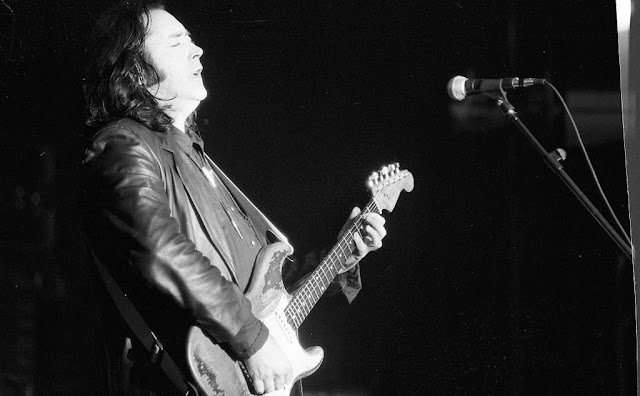
Photography by Independent Newspaper Ireland
Mick Mixile Shanahan still remembers Rory’s performance at Temple Bar Blues Festival with great affection, being not only the last time that he saw Rory live, but also the first time that his son (just a baby in a pram) attended a concert. Mick had been a Rory fan since hearing Live in Europe, which “changed everything” for him and he first saw Rory live in 1978 when he hitchhiked from Waterford to Macroom for the Mountain Dew Festival (for more on Mick’s memories of this event and other Rory concerts, click here). On the day of the Temple Bar Blues Festival, Mick and his family drove from Waterford to Dublin and headed to College Green “just in time for the master to arrive on stage.” He describes Rory’s performance that evening as “wonderful” with “so many favourites,” including the “epic closer” ‘Bullfrog Blues’. During the concert, Mick recalls a funny moment when his boss (“an unpleasant little man”) happened to walk past, saw him and “berated [him] for listening to ‘this garbage’.” Mick could do nothing but laugh!
Although Mick never met Rory, he believes that he changed his life “in subtle ways” that he is “forever grateful for.” He considers Rory to be his “musical hero” and, like many others, he cried when he passed away. Although Mick mainly listens to and creates electronic music today, he says that “there are those occasional nights when nothing is going to scratch that itch than pulling out [his] favourite Rory album.” He says that he always discovers “something wonderful and new” whenever he listens and that only Rory “holds that place” for him.
Paddy Tierney Meakin was also at Rory’s concert that evening in Dublin. It was the first and only time that he saw Rory play live and he describes it as a “gig [he’ll] never forget.” Paddy grew up in a very large family with various tastes in music, but his brother Brian enjoyed the blues and he discovered Rory through him and he became “a part of [his] life” ever since. Paddy learnt that Rory was playing the Temple Bar Blues Festival by chance on the day of the performance. He had gone record shopping with a friend in Dublin and was on his way to College Green to Tommy Teigh’s Sound Cellar. As Paddy recounted:
As we rounded the corner from the O’Connell Street direction, we noticed a stage being set up. At that moment we had no idea that anything was happening that evening, let alone a blues festival that was taking place in Dublin that weekend. Before making the pedestrian lights, I grabbed my friend and said, ‘Let’s find out what’s happening.’ We could see drums, amps and lighting equipment being set out on the stage. One of the roadies was quite close to the railing just off the street. As we approached him, I shouted over to him asking, ‘What’s happening? Is there live music on here?’ He yelled back over the railing, ‘Yeah!’ ‘Who’s on?’ I asked. ‘Rory Gallagher,’ the roadie replied. I looked at my friend and said, ‘Rory’s playing!’ I then quickly asked the roadie, ‘You’re not having me on, are you?’ ‘No, buddy,’ he replied and added, ‘He’s playing later.’ ‘Jesus!’ I said to my friend, ‘We have got to see that!’ He replied eagerly that we have to get the Dart (train) and get home. ‘It’s Rory! and I’ll walk home if I have to!’ I said. I then added, ‘I’m not missing the chance to see Rory play!’ My friend then quickly agreed.
Paddy says that, several hours later, they made their way to the concert amid throngs of people of all nationalities that had gathered. All the large street and footpath areas around the stage were full and people had even “taken up positions on the Trinity College gates.” A couple of “eager spectators” had even turned a lamp post into a “good lookout tower!” Paddy recalls the real sense of anticipation in the air as cans cracked around him, the audience chattered and “mounting excitement” grew as Rory’s performance approached. Then, suddenly, Ronnie Drew appeared on stage giving a warm welcome to Rory. In the next breath, there was Rory running onto the stage in his black leather jacket and trusty Strat in hand. Paddy remembers that Rory shouted out “YEAH!”, which was closely followed by his “ever humbling thank you.” According to Paddy, the audience were “overleveraged” with Rory and his opening number ‘Continental Op’. He was “full of energy” and “really packed a punch” and left Paddy in “pure amazement and disbelief” at his playing in ‘Tattoo’d Lady’ and ‘Off the Handle’ in particular. In the acoustic set, he was intrigued at how Rory was able to stand there on his own and “keep the audience in the palm of his hand.” All in all, Paddy considers the occasion to have been a “high privilege” for him.
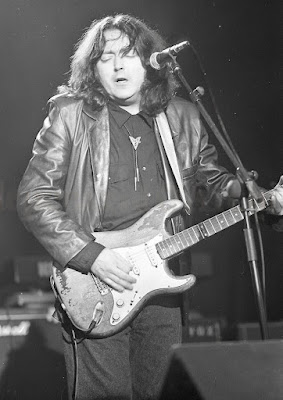
Photograph by Independent Newspaper Ireland
Paddy is a guitarist who has played in a Doors tribute band and he believes that Rory has been a “great influence” on his playing. Rory’s slide helped him find his own style and gave him the confidence to play guitar solos, while Rory’s acoustic finger style and picking also inspired him. Paddy’s lasting impressions of Rory are a man with “no airs and graces” and the contrast between how shy he was offstage and his “dynamic energy” on stage where he “really came to life,” “let it all go” and was “so comfortable with his audience.” For more of Paddy’s memories, click here.
Another fan who was in Dublin on 15th August 1992 was Kieran Devitt. Kieran had first become aware of Rory’s music when he was 13 and first saw Rory in concert at Punchestown Racecourse in 1982, the legendary concert where Phil Lynott came out and jammed with Rory (we can’t help but be a bit jealous that Kieran was there!). Although Kieran had always found Rory’s studio albums to be excellent, “every song reached a whole new level of excellence” for him when performed live. Ten years after the Punchestown gig, Kieran found himself at the Temple Bar Blues Festival with his younger brother and his friend. Kieran notes that it was very apparent that Rory was struggling with his health. However, he still gave an excellent performance and there was a huge crowd who “all wanted to be there to see a proper legend.” Kieran felt that the new line-up with David and Richard had the “possibility of a new era” and a chance to “reinspire Rory,” but perhaps Rory didn’t realise “just how delicate his health was.”
Eugene Curran’s memories of the Temple Bar Blues Festival also echo many of Kieran’s own. He could see from Rory’s appearance that he was unwell and “retaining a lot of fluid,” but “he had lost none of his energy.” Eugene was “amazed” at “how smoothly” the concert went, as well as the “massive buzz” from the crowd who “really got going” right from the first notes that Rory played. It was the first and only time that he saw Rory play in concert. Eugene had first discovered Rory when on holiday in West Cork, where he made friends with some other kids from Macroom who told him about Rory and the Mountain Dew Festival. He went on to buy Photo Finish and Top Priority, which are still his favourites today because he feels that Rory “had perfected his techniques by then in the studio.” One of Eugene’s favourite things about Rory is how much fun he always appeared to be having on stage and how “infectious” that was for spectators. He considers Rory to be “one of the greatest musicians” that Ireland ever produced and “certainly the best guitarist by a country mile.”
Temple Bar Blues Festival was also the first and only time that Johnny McMonagle saw Rory in concert. However, his connection with him goes back much further than 1992. Johnny cannot pinpoint the exact moment he discovered Rory, but believes it may have been after hearing ‘Follow Me’ as the theme tune for RTÉ’s MT-USA. As a guitarist, Rory inspired Johnny’s playing. As he so nicely put it, “I figured if a white guy from Donegal could play the blues then so could I, another white guy from Donegal.” Rory also influenced Johnny’s sartorial choices, encouraging him to grow his hair long and wear a checked shirt and denim jacket combo. In fact, when Johnny moved to Cork to go to college, a girl asked him if he was a fan, considering the way he dressed. This girl, in fact, turned out to be Rory’s cousin and gave Johnny some limited-edition records, a Top Priority badge and a Defender tour t-shirt. The cousin mentioned Johnny to Rory, telling him, “There is a guy in my class from Donegal who looks like you and dresses like you.” Rory (jokingly) replied, “At least I still have one fan!” Johnny’s Defender t-shirt got torn off by a machine in his first week as a printer, but Rory’s cousin stitched it back together and he still has it. Johnny’s lasting memories of Rory’s 1992 performance are the “great atmosphere” on College Green and how good it felt to finally see one of his “musical idols”. He summarises Rory in four words: “passion, virtuosity, honesty, integrity.”
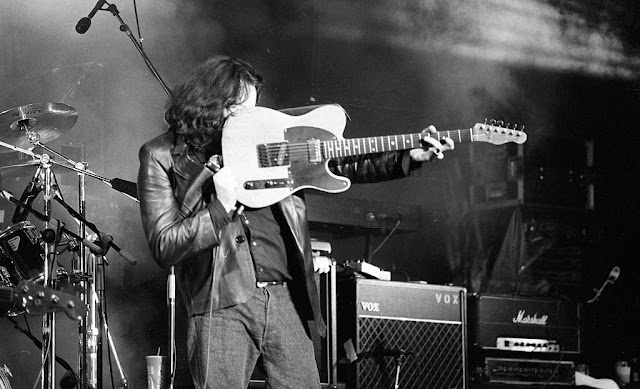
Photograph by Independent Newspaper Ireland
Finally, Barney Toal also attended the Temple Bar Blues Festival and described Rory’s gig as “brilliant.” Although it was clear that Rory was “probably not in the greatest of health,” he still performed to an extremely high level. Barney describes Rory as his “hero”, having gone to see him regularly at the Ulster Hall in Belfast throughout the 1970s when The Troubles were raging and nobody else would perform in Northern Ireland.
“Liberating, heartfelt and downright wicked”: The Critics Eating Humble Pie
After the many negative press reports leading up to Rory’s appearance at the Temple Bar Blues Festival, the very same critics were forced to eat a big slice of humble pie after watching him perform. It was clear that something magical had occurred in Dublin on the evening of 15th August 1992, and contrary to what many journalists had been predicting – and indeed hoping, in some cases – Rory more than lived up to his role as headliner and proved that he was still a major force to be reckoned with and that few – if any – compared to him on the live scene.
Eugene Maloney’s report for the Irish Independent, headlined ‘Thousands Thrill to Rory’s Blues’, noted how his concert “stopped the traffic in the centre of Dublin” and “blew Guns N Roses away.” He describes the wide range of people in the crowd, dispelling the myth that Rory had lost audiences and was failing to connect with young people: “blues buffs, heavy metal heads, fans from the old days – some with their grown up kids – mingled with tourists and the just plain curious.” Reflecting Paddy Tierney’s own account, Maloney describes fans “spill[ing] out from the railings of the Bank of Ireland to the gates of Trinity College,” with some even “climb[ing] on top of the traffic lights to get a better view of the show.” He emphasises how watching Rory’s hands “move up and down” and “respond to the emotions he was feeling inside” was “more electric, more fascinating than any amount of high-tech special effects.” Now – unlike before the concert – Rory was no longer seen as old fashioned or uncool, but rather recognised as the genius bluesmaster that he was.
Photograph by Independent Newspaper Ireland
Eugene Maloney wrote another review for the Evening Herald, entitled ‘Rory still so sharp’. Despite the unnecessary remark that Rory was a “somewhat portly man of his 40s,” the report is highly favourable yet again, noting how Rory “squeezed out note after note of raw, passionate blues” and showed that “he is still resisting any attempts to dull the edges of his music.” Once again, these comments stand in marked contrast to some of the prior claims in the press that Rory’s music was becoming boring and showing no progression. Maloney goes on to write how it was “intoxicating to watch a man perform a music that still trod that thin line between being liberating and heartfelt and being downright wicked.” These words really speak to us as we have always seen Rory as pushing the limits with his music and being an “outlaw” for doing so. Sticking to his guns and staying true to his own musical vision makes him much more of a “rebel” and a “bad boy of the blues” in our eyes than any other musician who lives a sex, drugs and rock ‘n’ roll cliched lifestyle.
Other glowing reviews of the concert came from Tony Murphy who, writing in his Tony Murphy’s Musical Miscellany column, described Rory’s performance as “tremendous.” Equally, John Waters of the Irish Times wrote: “On the night Gallagher was, if possible, even better than I remembered. He captivated the huge crowd – half curious bystanders, half now-greying lumberjackshirted hordes – like the angel he was.” These reports, again, show how not only was Rory attracting all sorts of people to his concerts, but that, as always, he was able to create a deep, meaningful connection with them.
Away from critics, those close to Rory were also rightfully proud of his performance. Mary Stokes, who had provided Rory with some encouraging words the night before the gig, told Hot Press: “As I stood beside the stage that evening, I saw Rory Gallagher take the stage like a man possessed – and the audience roared back in affirmation.” For Dónal, the show was also “one of the best” that he ever saw Rory play, with one of his favourite versions of ‘Tattoo’d Lady’. And Ronnie Drew also thoroughly enjoyed the concert, describing it as “a great thrill” and “one of the big times” of his life to introduce Rory and later perform ‘Barley and Grape Rag’ with him. When interviewed in 2001, Ronnie stated that his tape of the show is “probably one of [his] most treasured possessions.” When we spoke to Richard Newman several months ago, he told us that Rory really “blew the roof off” that night in Dublin and that the festival was “something else” with “thousands of people there.” David Levy echoed Richard’s own words when we asked him, also describing the concert as “something else” and saying that it made him realise “how much Rory was loved and what a huge and talented artist he was.” Along with Montreux Jazz Festival 1994 (which we covered in last month’s post), Temple Bar Blues Festival is David’s standout concert when he reflects on his time in the Rory Gallagher band.
And what did Rory himself think of his performance? Well, according to Dónal, in his own humble way, he was “quietly satisfied rather than particularly happy.”

Photography by Independent Newspaper Ireland
From time to time, we do come across newspaper clippings from the period of 1985-1995 that successfully capture the artist that Rory was. During our research we found a piece by Michael Ross for the Sunday Tribute (“Praying at the Temple of the Blues”), which provides a succinct review of both the Guinness Hop Store Masterclass and Temple Bar Blues Festival. The article continues with a generalised artist profile, and of course, like others, the 1970s takes up more space than the rest of Rory’s career. However, unlike Tony Clayton-Lea, at least Michael Ross refers to the release of Defender in 1987, which “showed that [Rory] had grown considerably as a writer.” Ross addresses the “drink problem” that has surrounded Rory’s name in the press, though he doesn’t conform to the judgement that usually frames Rory’s ‘eccentricities’, either committed by the Irish or international press (see for example, David Sinclair’s 1990 Q magazine article). Rather, Ross describes the “mutterings” of alcohol dependency by journalists as a “cruel suggestion” for a man like Rory – a man so full of “dignity”, yet so “evidently in distress.” Unlike other press publications, Ross doesn’t allude – or like some, frankly state – that Rory is an artist of the past, but rather as an artist “trying to progress blues beyond Muddy Waters and Robert Johnson,” and therefore he is still “one of the leading modern interpreters of the blues.” Throughout his artist profile, Ross cites the many challenges Rory has faced, both professionally and personally, such as the scrapping of two albums, a fear of flying, and disorganised lifestyle. However, rather than leave us with an image of a man haunted by many challenges, Ross flips the narrative to show that whenever Rory is faced with a crisis, he is able to “pull out” of it, whether by faith in a higher power, a faith within himself, or simply faith (or a “prayer”, as alluded to in the article title) to the music itself. We have provided for you Ross’ concluding statement.
It would be easy for Gallagher to appear as a rich white man with the poor black man’s blues. It would be easy also for him to live out the hackneyed, booze-addled lifestyle which is supposed to accompany the music. But there is an optimism in Gallagher which keeps him going through the bad spells; and it is this which keeps him focused on getting something new from the blues.
In 1992, Rory was greeted into Temple Bar with suspicion from critics, a majority of them Doubting Thomas’ in the presence of a blues master. Now that it has been twenty-seven years since Rory has left us, he has since been honoured at Temple Bar with the naming of Rory Gallagher Corner. The renaming of the street was commemorated in a ceremony on June 16th 2006, and featured the unveiling of a sculpture of Rory’s beloved Fender Stratocaster, mounted just underneath the street sign. The sculpture was created by Rory fan Mark Walsh who Dónal thanked at the ceremony for his “perseverance and hard work in bringing this endeavour to fruition.” On the other hand, work still needs to be done in bringing to light Rory’s stunning musicianship displayed on the 1992 Guinness Hop Store Masterclass recordings. It is simply disgraceful that this professional and personal achievement in Rory’s career is omitted time and time again in Rory publications. We hope that this article is the start in changing this cycle of journalistic negligence.
Photographer unknown
We would like to thank the following people for sharing their memories with us of the guitar Masterclass: Daragh Brennan, Colm Quearney and Joseph Cavenagh. If you would like to read the full transcripts to their interviews, please click this link.
In addition, we would like to thank the following people for sharing their memories with us of the Temple Bar Blues Festival: Ed Guiney, Stephen Bradley, David Levy, Richard Newman, Mick Mixile Shanahan, Paddy Tierney Meakin, Kieran Devitt, Eugene Curran, Johnny McMonagle and Barney Toal. If you would like to read the full transcripts to their interviews, please click this link.
Thank you for reading!

 REWRITING RORY
Leave a reply to Anonymous Cancel reply