

As our readers know, the time period we write about is the final decade of Rory Gallagher’s life, and the year 1994 is highly important (though highly unrepresented) in regards to discussing his professional achievements. 1994 showcased some of the best-recorded output of Rory’s career, guesting on three sessions (rEnergy Orchard, Peter Green tribute sessions, and Roberto Manes and Pete Lockett). For more information about these fruitful sessions, please refer to the second part of our April post. In addition, 1994 saw an increase in touring (roughly 7-8 months of the year), contrasting to the 2-3 months on the road earlier in the decade.
Between July and August of 1994, the Rory Gallagher Band was filmed performing at four European festivals: Pistoia Blues Festival (July 2), Montreux Jazz Festival (July 12), Festival interceltique de Lorient (August 9), and SDR3 Festival in Stuttgart (August 21). As we know, Rory would never live to see July 1995. But what has always been fascinating for us is that less than twelve months prior to his death, Rory was still pushing himself to deliver (both emotionally and physically) intense and exciting performances. Whether this was because Rory knew nothing else except the life of touring is a separate question, and one we are not about to attempt to answer here. Instead, our job is to fill in the blanks that past Rory literature (both written and cinematic) have failed to document. Where do they go wrong, why do they go wrong, and what can we do to fix this?
To begin to answer these questions, we must first address what exactly past literature has said about the four festivals featured in this month’s post. Marcus Connaughton’s Rory Gallagher: His Life and Times (2012) excludes any information or analysis about these four festivals. Rory Gallagher: The Man Behind the Guitar (2018) by Julian Vignoles fares slightly better and mentions at least three of the 1994 festivals (Montreux, Inter-Celtic, and Stuttgart). However, the commentary provided is not only severely limited, but also underrepresented in contrast to the other performance milestones included from Rory’s career. The Montreux appearance is mentioned as simply a reference point in the timeline, describing Rory as being at “[a] low ebb” during his Swiss and Austrian tour, “which included his last appearance at Montreux Jazz Festival.” It gets worse when Vignoles misidentifies Rory’s show at the Inter-Celtic Festival to occur in October instead of August, the new edition (2021) failing to resolve this mistake. Finally, most of us have come across video stills of Rory’s cut hand at Stuttgart’s SDR3 Festival on the Internet, which Vignoles has cited with the description “Gallagher was clearly struggling” and that the action of striking at the microphone was “out of character” for the bluesman.
Rory’s injury occurs during the first song (“Continental Op”), and is after motioning to the sound engineer four times about his dissatisfaction with the microphone’s volume. As for this behaviour being “out of character”, in 1977 Melody Maker published a review about his first of two shows at the Hammersmith Odeon, and emphasised an early part of the concert where Rory “lashed out at the mike stand and sent it crashing to the ground” after suffering bad sound during the first song. The reviewer Brian Harrigan notes that after this gesture, “Gallagher was like a new man”, bringing a higher level of energy to the performance that sustained throughout the set. Similarly, during the first song (“Follow Me”) at the 1986 Self-Aid Festival, Rory can be seen shaking his head during the chorus after a particularly rocky start with the sound. However, like the flick of a switch, Rory recovers and by the second solo in “Follow Me”, he is rejuvenated and maintains an outstanding level of musicianship in the twenty-minute performance. What these examples indicate is that Rory, like any performer, could get frustrated onstage when things didn’t go as planned, and that instead of spoiling the show, he was only motivated further to please his audience. Perhaps what happened at the 1994 SDR3 Festival was fuelled by additional mental demons rather than solely a mechanical fault. Perhaps he wasn’t able to flick the switch as easily as he could in previous decades – but this doesn’t mean that Rory didn’t put on a fucking darn good show.
So far, it has been a poor account with biographies, and the documentaries about Rory do not give us much hope either. In Gallagher’s Blues (1995), none of the four festivals are mentioned or shown. Moving into the twenty-first century, Ian Thuillier’s 2010 Ghost Blues: The Story of Rory Gallagher is a slight improvement in that it features portions of “I Could’ve Had Religion” from the Inter-Celtic Festival. What alarms us is the, quite frankly, lazy editing decision to not provide any details or context about this performance, and instead clips are spliced between anecdotes and narration about Rory’s bad health at the time. Many impressions arise by the end of this documentary, and one of them is the familiar narrative that Rory’s musicianship declined alongside his physical decline. Rory might not be the same guitarist as he once was, but that’s because Rory was not the same artist as he was when twenty-one years old, and therefore his career should be viewed as a comprise of stages rather than on opposite sides of the spectrum of ‘young/good’ and ‘old/bad’. What these accounts of Rory Gallagher’s life are unsuccessful at capturing is his musical progression, his development into not only a great guitarist but also a storyteller of the blues, an accomplished songwriter as well as a blues traditionalist.
Overall, we write this post to achieve two aims. To start with, we hope our two-part article can contribute to Rory Gallagher literature by providing a definitive document of Rory’s performances at these four filmed European festivals in 1994, including background information, musical analysis, and fan testimony. Secondly, we intend to contradict the downward spiral Rory’s artistry is typically framed within at this late point in his life, and instead balance the narrative by acknowledging his musical achievements whilst battling physical and personal challenges. In Part One, we focus on Rory’s 1994 shows at the Pistoia Blues Festival and Montreux Jazz Festival, with Part Two scheduled to be released next month and delve into Rory’s appearances at the Inter-Celtic and SDR3 Festival.
PISTOIA BLUES FESTIVAL, 2nd July 1994
The Pistoia Blues Festival is a music festival that has taken place annually in Italy since July 1980. The festival was founded by Raffaele Barki and the Associazione Isola del Tonale (of which Barki was president at the time) with the support of both Pistoia City Council and the Tuscany Tourist Office. The festival quickly made its mark with such legends as Muddy Waters, Fats Domino, BB King, Alexis Korner and Dizzy Gillespie all hitting the stage in Piazza del Duomo for the first edition in 1980. However, just four years later, its fate was unclear due to financial instability, so much so that the 1984 festival had to be stopped on its second day. After being taken over by the Associazione Blues In and Giovanni Tafuro in 1985, the festival recovered and went from strength to strength throughout the rest of the decade, reaching a real high point in 1988 with a star-studded guest list that included John Lee Hooker, Johnny Winter, Bo Diddley, Otis Rush and Louisiana Red. This was also the first year that the event was broadcasted on Italian television channel RAI – the start of a tradition that still remains in place today. Throughout the 1990s and 2000s, the festival expanded to incorporate other musical genres, such as rock, folk and even reggae, welcoming such range of stars as Bob Dylan, David Bowie, Elton John, Skunk Anansie, Damien Rice, Alanis Morrissette and James Blunt. Today, the festival is bigger than ever, now running for nine days (instead of the original three) and with performances all over the town rather than just limited to the main square.

Rory first appeared at the Pistoia Blues Festival in 1984. As we recounted in our achievements post in March, the “Father of British Blues” Alexis Korner had passed away in January and the festival wanted to do a special tribute night in his honour on 16th July, so they invited Rory to participate, along with Jimmy Page, Georgie Fame and Ginger Baker. The bootleg of Rory’s performance is available online and, as per usual, it is spectacular. This gig is known for being the first with Mark Feltham and his influence is immediately clear, his harmonica expertise enriching old classics like ‘I Wonder Who’ and ‘Off the Handle’. It would be ten years until Rory returned to Pistoia again for what would sadly be his last appearance on 2nd July 1994 – the focus of the first half of this post.
Rory’s performance was much awaited, an article from La Repubblica noting how “one of the greatest guitarists of English [sic] blues rock” would be closing the second evening. The article also stated that this festival was set to be the biggest yet, with John Mayall and Paul Rodgers also on the bill and young artists and emerging bands taking over the town’s Casermette district. Press reports were also extremely positive following Rory’s performance, with Rory and his band described as “superb.” “The audience practically fell silent as soon as he started playing,” said the local Pistoia gazette, “Everyone was enraptured by his way of delivering music and by his sincerity, something hard to find in the music business.”
Given these glowing reviews, you would expect there to be countless information about Pistoia 1994 online or for the concert to be discussed in Rory biographies. But no, as we mentioned in our introduction, it is not even so much as mentioned in Marcus Connaughton’s Rory Gallagher: His Life and Times or Julian Vignoles’ Rory Gallagher: The Man Behind the Guitar, despite both books claiming to be a “testament to [Rory’s] musical life.” Neither has it been the focus of any dedicated articles to date in the music press. We are, however, very lucky that there are numerous videos of Rory’s Pistoia gig on YouTube, which offer a visual and aural testimony to the fact that he was indeed superb that night, as the Italian press reported. Nonetheless, we were extremely disheartened to see that whenever footage from the concert is shared on Rory Facebook groups or music forums, far too often, the comments centre around Rory’s appearance rather than the performance itself. “I only like to watch Rory when he is young and beautiful,” one person commented on an Italian thread dedicated to Pistoia Blues Festival, while “Stop posting fat Rory videos” was another person’s cruel response to a Facebook upload of a video clip from the concert.

Photograph by Monti Giuliana
As we said in our opening Rewriting Rory post last November, it is one thing for ‘fans’ to critique Rory’s performance (not that they will find anything to critique here, in our opinion), but when it starts turning into body-shaming, that is truly unacceptable and we will defend to the death these sorts of comments every time we read them. As anyone who has taken the time to research a little will realise, Rory himself was well aware of the way his medication and illness had changed his appearance and was extremely self-conscious about how he looked. So much so that official photographers were asked not to take photos at many of Rory’s later gigs and, as Dónal has recalled, his brother often looked at himself in the mirror during this time and cried. Given all the above, people who somehow consider themselves to be fans should truly think twice before opening their mouths and posting such pointless and nasty comments. Not only are they totally disrespectful to Rory, but you never know the effect that they could be having on other readers who are also struggling with their body image, weight or physical/mental health in general. Anyway, back to Pistoia 1994…
Given that the current literature is not just scarce but practically inexistent when it comes to Pistoia, we decided to turn to the internet to track down fans who were at the festival. We hoped that their first-hand accounts could offer a reliable way to learn more about the gig and fill in glaring gaps in the Rory story. Through Facebook, we contacted Umberto Berlenghini, an Italian Rory fan who has attended Pistoia many times throughout the festival’s 42-year history. Umberto agreed to speak to us and shared his excitement of learning about the 1994 festival bill, as well as the hours leading up to the concert:
The Pistoia Blues Festival [is] one of the best in Europe and certainly the most beautiful in Italy […] My friends from Todi [Umberto’s hometown] and I went to Pistoia for the first time in July 1988 to admire John Lee Hooker; since that time I have often returned to Pistoia at least until 2012. When in 1994 I learned that Rory Gallagher and Paul Rodgers would play in Pistoia, I understood that I was about to realize a dream, to see two of my idols live […] On that Saturday 2 July 1994 I left Todi with my friend Adamo Valentini. We first went to Pisa to pick up a friend of Adamo’s who was studying at the Physics Faculty of the University of Pisa, then we went to Pistoia.
Umberto admitted that he was so overcome with emotion at seeing his two heroes live that he remembers very little of the actual performances and that it all passed in somewhat of a blur. However, he did recall that Rory’s audience was “adoring” and that he looked like he was “having fun” up there on stage. Umberto also very kindly shared with us his ticket from the evening and some special photos from the book Pistoia Blues Festival 80-94, which we are delighted to share with our readers throughout this post.
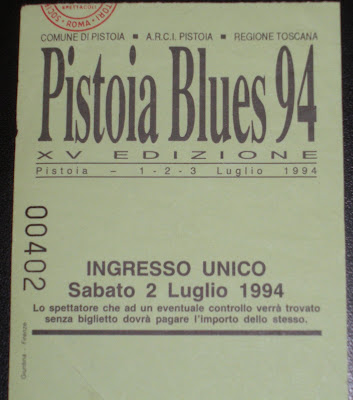
We came across several more fan accounts in the recently published Italian biography Rory Gallagher: Il Bluesman Bianco con la Camicia a Quadri by Fabio Rossi that provide some more details of the concert. Martino Palmisano still remembers the emotions of the concert as if it were yesterday. According to Martino, watching Rory perform was “sweat, tears and goosebumps at full throttle,” followed by “more tears” during the “devastating” encore, but it is “useless to try and describe the feelings” because “if you weren’t there, you just can’t understand” how incredible Rory was. For Franco Serena, seeing Rory at Pistoia 1994 was “the fulfilment of a dream” he’d had for twenty years. From his response, it is clear just how special the evening was for him:
I had been to many concerts up until then, but I had never seen so many people come away with a smile on their faces and overjoyed by such an intense, hot and enthusiastic performance by an artist literally feeding off the audience and playing as if this were his last ever chance. Rory was physically on the stage, but he and his guitar emanated so much feeling, warmth, charisma that everyone present felt his heart beating as if he was playing individually for every one of us. The phrase that I heard repeated over and over by the crowd was ‘Mamma mia!’ An unforgettable memory that will be forever engrained in my brain and still today gives me shivers. I would have so liked to have met Rory and shook his hand, but it’s like I did because I consider Rory to be one of my friends. He’s been part of my family for a long time.
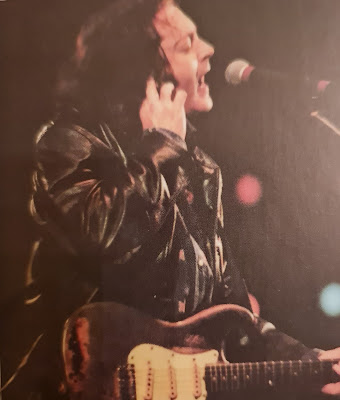
Photograph by Primo Tormentoni from the book Pistoia Blues Festival 80-94
It is somewhat of a coincidence that the Pistoia Blues Festival 80-94 book mentioned above was written by Italian blues expert, Ernesto De Pascale, as we also managed to find a short account of Rory’s Pistoia 1994 performance from Ernesto, taken from the June 2002 edition of his radio show Il Popolo del Blues. Ernesto said that Rory gave a “rousing show” at Pistoia, noting that his music was just as good as when he last saw him play in 1972, even if Rory looked “tired and bloated.” A similar opinion was given by Silvano Martini, a long-term Rory fan who found himself doing festival security at Pistoia 1994. On his music blog, Silvano wrote that Rory was “clearly fatigued” and “heavier” in 1994 than when he saw him in 1972 in Florence, but he “didn’t spare himself on stage” and was “S-P-E-C-T-A-C-U-L-A-R.” He also noted rather poignantly how, despite the temperature being around 30°C, Rory dressed in a thick long-sleeved denim shirt and black leather jacket in a bid to hide his body.
A comment we came across on YouTube under the pseudonym Tazzina Sellout echoed the views of Ernesto and Silvano. This person also attended Pistoia 1994 and stated that “few artists, in the same health conditions, would be able to OFFER so much ENERGY and PASSION.” We wholeheartedly agree with all of the above comments, which resonate strongly with one of the main reasons we set up Rewriting Rory. Yes, Rory was sick and may have been struggling immensely offstage, but that is no reason at all to write him off and ignore the last ten years of his life as if he didn’t exist. When Rory got up on that stage, he transformed, his problems momentarily forgotten. He became a young man again and still performed as he always had – if not better. Rory himself said as such in a poignant interview with French magazine Hard Rock: “Sometimes half an hour before the show, I feel like I’m 90 years old. I feel unable to even walk, but once on stage, I forget everything and I feel nothing.”
In preparation for our post, we also had the opportunity to speak to Gianni Franchi, lead vocalist and bassist in Jona’s Blues Band who played Pistoia on the same day as Rory in 1994. Although Gianni didn’t get the chance to see Rory’s set or meet Rory due to the strict organisation of the event (his band opened Day 2), he was able to take some photos of Rory’s guitar during soundcheck. We are very grateful to Gianni for letting us share them in our post, along with an original poster from the festival.

Photograph by Gianni Franchi
Ernesto and Silvano did get to meet Rory that day, however, and have some bittersweet memories to share about the experience. Silvano notes that when they entered the dressing room, they could see that Rory was “extremely upset.” We know from Dónal that Rory rarely came off stage satisfied and that these feelings of disappointment at himself seemed to increase over time. Despite his sadness, Rory thanked Silvano and Ernesto politely when they complimented him on his performance. The two men then presented Rory with a gift: a photo that they had taken of him when he performed at the Space Electronic Club in Florence in 1972. According to Silvano, Rory inspected the photo for a while, thanked them and then smiled sadly. “The smile betrayed his embarrassment at seeing himself young and in perfect physical shape,” Silvano mused. Ernesto gave an almost identical account of meeting Rory in his 2002 Il Popolo del Blues programme, explaining how Rory [tried] to “hide his physical pain, his sadness too” as he looked at the photo.

Photograph by Monti Giuliana
Through our work, we feel privileged to have access to these “behind-the-scenes” glimpses into Rory and his state of mind, but at the same time, they can be deeply unsettling to hear and often hauntingly stay with us long after our conversations have ended. We believe, however, that such anecdotes are important in better understanding Rory and they serve to increase our pride, admiration and love for him. Rory was such a selfless person who always put others before himself, who valued his fans so highly and who never ever let them down. Despite being noticeably tired at Pistoia and having both physical and mental difficulties, he still went out on stage and gave a phenomenal performance. The public didn’t realise the deep pain that he was in, didn’t see his sad smile or tears backstage, didn’t know he went back to his dressing room as a defeated man (in his eyes). Again, bringing this information to light further emphasises the insensitivity and even danger of comments that judge Rory on his appearance and fail to look beyond and see what was going on in his life at that time. Furthermore, they do a total injustice to Rory, somehow ridiculously equating his change in appearance to a sudden inability to perform and play guitar. Pistoia 1994 is a fine example of Rory continuing to play at an extremely high level, despite his challenges offstage. So, without further ado, let’s dig into the concert itself and see what makes it, as Stefano said, so S-P-E-C-T-A-C-U-L-A-R.
II: ‘A thin beam of magic light’: Description and Discussion of Rory’s Performance
As was often the case in later shows, Rory opens his set at Pistoia 1994 with “Continental Op”, a fabulous homage to Dashiell Hammett, one of his favourite authors. Frustratingly, the video footage kicks in halfway through Rory’s blistering slide solo, so we miss out on the first few minutes of the song. We are, however, met with some great close-ups of fellow band members Richard Newman (on drums) and David Levy (on bass), providing a solid rhythm section to support Rory. The two young men have a different style of playing to Gerry and Brendan that adds fresh energy and new ideas to the band. We are very much looking forward to sharing more on them in a blog post later this year as they have been wrongly left out of the Rory story to date, despite their fabulous contribution. Here, Rory’s vocals are wonderfully raw and bluesy, perfectly suiting the gritty theme of the song. With a shout of “come on, baby, let’s go,” he bursts into another spinetingling guitar solo around the 1.5-minute mark. The song comes to a scorching finale several minutes later that culminates with a Pete Townsend style windmill, closely followed by the Strat ‘transforming’ into a machine gun as Rory tucks it into his shoulder and pretends to aim at the audience. What a lively opening!
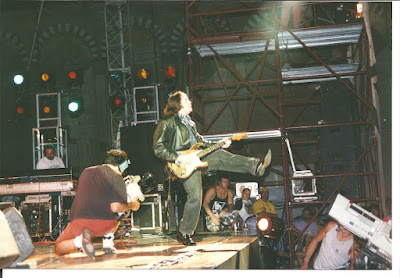
Photography by Silvano Martini
No time to rest, Rory breaks straight into “Moonchild”, again delivering a performance full of passion and vitality. Rory is well known for never doing the same rendition of a song twice and we love hearing the little changes that he makes to “Moonchild” each time he plays. Here, there is no string-pulling like in the famous Rockpalast 1982 version, but we are treated to other classic Roryisms during the first solo, such as bending behind the nut and controlling tone with his pinkie on the Stratocaster’s knobs. The second solo is somehow even better than the first, the camera angles adding to the intensity as they move swiftly between shots of Rory from above, below and the sides. Sweat pouring, he duckwalks across the stage, giving his everything and living up to Franco Serena’s testimony that Rory fed off his spectators and played at Pistoia 1994 as if it were his last ever chance.
Now relaxed into the gig, Rory cracks his first smile of the night, blows a kiss to the crowd and points at his fellow band members, generating a loud cheer for them. Rory then thanks the audience in Italian and tells them that he was last in Pistoia for the first Alexis Korner tribute, before introducing David (with the James Bond theme song) and Richard, as well as keyboardist John Cooke and harmonicist/saxophonist Frank Mead who was filling in for Mark Feltham on this occasion. With a modest “I hope you still like it,” he introduces “I Wonder Who”, and boy, is this version epic!
“I Wonder Who” is always a highlight of Rory’s shows and was a regular set feature from as early as 1974. Listening to the song over its twenty-year period, it is fascinating to see how it evolves, changes and is influenced by the fellow musicians playing with Rory, and this version is no exception. Rory takes the listener on a rollercoaster of emotions here, giving us a smile with his hand on hip and stomp to the lyric “she’s walking on down the street,” before taking a more sombre turn with his improvised, quasi-autobiographical lyrics: “Baby, I get nervous. I gotta cry myself to sleep. Baby, I get nervous. Sometimes I cry myself to sleep.” The mood is lifted once again on the next line, however, with the humorous: “I think about divorcing you, honey, but even in Mexico the price ain’t so cheap.” “Hit me, Frank! Hit me, hit me!” he then shouts as he passes over to Frank Mead for a solo.

Photograph by Primo Tormentoni from the book Pistoia Blues Festival 80-94.
Although we can’t help but miss seeing Mark at Rory’s side, Frank is an excellent substitute whose solo is faultless and extremely expressive. Rory really lets the song breathe here, giving the floor over to John Cooke for a superb keyboard solo. He then loses his jacket and guitar, following up John’s solo with his own on a harmonica that he pulls out of his back pocket. As Rory rolls up his sleeves, we get a glimpse of the psoriasis on his arms, which he suffered from in later years. It’s a fleeting visual reminder of his vulnerability, strangely juxtaposed with the sheer strength of his performance. The rest of the song is filled with a beautiful assortment of borrowed lyrics and weeping guitar. We have everything from Bob Dylan’s “Just Like a Woman” to Buddy Guy’s “The First Time I Met the Blues”, delivered passionately with both of Rory’s hands around the microphone stand, as well as a breathtaking piece of closing slide.
After twelve magical minutes, “I Wonder Who” comes to an end and leads into fan favourite “Tattoo’d Lady”. In later years, Rory often provided a long opening to this song in a unique Hispano-Celtic blend. Here, the opening is perhaps one of the most impassioned, tinged with a huge sense of melancholy that captures without words the way that Rory was feeling at this time. Then, Rory switches back into high energy as he starts up the song’s familiar riff, accompanied with enthusiastic claps from David that really get the crowd going. People often speak about the Irish Tour ’74 version of “Tattoo’d Lady”, but for us, it’s a crying shame that these later versions never so much as get a look in when they are filled with so much emotion, the type of emotion that only comes with life experience and the trials and tribulations met along the way. There’s also a very sweet part halfway through this version when Rory looks over his shoulder at David and smiles. We had the pleasure of talking to David recently about his time in Rory’s band and he described his favourite memory as Rory “smiling at [him] when things were going well on stage,” so it is lovely that this special moment is captured for posterity. The song concludes with some skilful tone control from Rory using his pinkie, before a final effortless lift of the guitar over his head and back down again to ‘machine gun’ the audience.
From fan accounts, we know that the next song that Rory played was “Ghost Blues”, but sadly, the broadcast skips over this. It cuts back instead just as he switches over to his Martin D35 for the acoustic portion of the concert, opening with the timeless “Out on the Western Plain”. A staple of pretty much every Rory show since 1975, “Out on the Western Plain” is a cover that Rory very much made his own. It is practically unrecognisable from the Leadbelly composition, its Celtic tuning adding a unique twist that puts the song into that rare category of covers that are better than the originals. Like “I Wonder Who” and “I Could’ve Had Religion”, it is intriguing to see how Rory developed the song throughout his career, the solo becoming increasingly elaborate with time. As Rory’s fingers move faster and faster on the fretboard, the crowd cheer louder and louder. Always a true high point in his set!
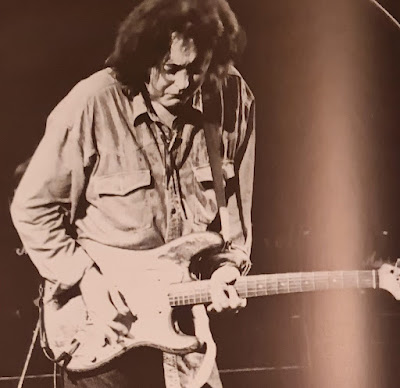
Photograph by Primo Tormentoni from the book
Pistoia Blues Festival 80-94.
Unfortunately, more songs are missing from the Pistoia footage. We are deprived of “Walkin’ Blues” (combined with “Amazing Grace”), “The Loop” and “Shadow Play”, which is a real pity as it would have been interesting to hear Frank’s own take on the former two and whether he added accompaniment with his harmonica or saxophone. Instead, the footage starts up again as Rory returns to the stage for an encore, now dressed in a cornflower blue shirt and looking very handsome indeed. With a cry of “look out, baby!” he plays the opening riff of “Messin’ with the Kid” – a song with which he often ended his shows in later years. “Messin’ with the Kid” pretty much never left Rory’s set once it was first played in 1972 and appeared in a variety of renditions throughout his career. Once again, it is the later versions of the song to which we are particularly drawn for their intensity of emotion. As to be expected, Rory’s soloing is fantastic here, not to mention his scatting, but a special mention must be given to Frank who provides a magnificent saxophone solo halfway through that offers a nice twist to the song’s usual format. A shout-out is necessary here too for David and his groovy accompanying bassline. Rory also adds a new layer to the song with his speedy finger tapping that leaves Eddie Van Halen – the supposed master of the technique – in the dust. Rory said himself in an April 1990 interview with French magazine Guitarist that he had started to explore this technique more, but that it was important to use it in moderation and no more than one to two minutes for maximum effect. He definitely uses it to perfection here, bringing the song to an exciting finish.
The final song of the evening is an excellent cover of “La Bamba”, a tune made famous in 1958 by Ritchie Valens and again in 1987 by Los Lobos. This is such a feel-good song and Rory and his band seem to be having a great time playing it together. The audience equally appear to be having the time of their lives as they jump up and down and applaud. We love listening to Rory’s sloppy attempts to sing in Spanish, the words somewhat incomprehensible, which Rory seems to acknowledge himself as he regularly laughs and smiles along the way. Yet this is no criticism of ours; it just adds to the overall light-hearted feel of the song. Once again, Frank plays an enthralling saxophone solo, and we particularly love his interaction with Rory as they stand opposite and play off one another. Rory’s emotion is apparent in the way he starts jumping up and down enthusiastically towards the end of the song, as well as a hint of a tear in his eye as the camera pans in on his face. “Ciao, ciao, bambinos!” he addresses the crowd at the end, both arms raised to the sky, before removing his Strat and exiting the stage. As Franco Serena said, mamma mia indeed! What a performance!

featuring interview with Rory from a
day after Pistoia 1994
MONTREUX JAZZ FESTIVAL, 12th July 1994
III: ‘Fire in the sky’: A History of Rory’s Presence at the Montreux Jazz Festival
Founded in 1967 by Claude Nobs, the Montreux Jazz Festival is a world-famous music event held every July in Switzerland, which has featured a diverse range of performers over its 45-year history. The first festival lasted for three days and was headlined by the jazz artists Charles Lloyd, Jack DeJohnette and Keith Jarrett. Throughout the 1970s, the festival opened up to broader musical styles, including blues, soul and rock, and attracted a list of names that reads like a roll call of musical legends: Led Zeppelin, Pink Floyd, Canned Heat, Deep Purple, Van Morrison, BB King, Stevie Ray Vaughan, Eric Clapton… In the 1980s, the festival developed into a true world music festival (although it continued to specialise in jazz), while the 1990s saw the growth of an off-festival site with workshops, competitions and themed shows around the town’s lakeshore promenades and cafes. This expansion led the festival to move from its usual location of Montreux Casino (rebuilt in 1975 following a fire during Frank Zappa’s 1971 set that was immortalised by Deep Purple’s ‘Smoke on the Water’) to the Montreux Convention Centre, which has two concert halls: Auditorium Stravinski (3,500 capacity) and Miles Davis Hall (1,800 capacity). Today, the festival is the second largest annual jazz festival in the world (after Montreal), lasting two weeks and drawing some 200,000 visitors. It has welcomed over 1,300 artists to date, one of whom was, of course, Rory – a guaranteed crowd-pleaser.

1994’s Montreux Jazz Festival
Rory first came to Montreux with Taste in 1970. In August of that year, Claude Nobs had attended the Isle of Wight Festival, hoping to convince The Doors and Jimi Hendrix to play at his new jazz festival. Blown away by Taste, he decided to hire them too. The band agreed and, just three days later, they performed at Montreux Casino, a performance that was unofficially released as Live Taste in 1971. “My friendship with Rory was immediate as we both love the blues,” recalled Nobs in 2006, “[He] was one of the nicest people I ever met, as quiet backstage as he was wild on stage.” Throughout his solo career, Rory returned to Montreux five times: 1975, 1977, 1979, 1985 and 1994, the latter date being the main focus of this post.
The sleeve notes by Chris Welch in the 2006 Rory Gallagher Live at Montreux DVD describe Rory’s appearances at the festival as a “homecoming.” Welch states how Rory always greeted the cheering audience with “self-effacing charm” before strapping on his Fender Stratocaster and transforming into an “aggression-fuelled performer.” Rory had an immediate impact at Montreux 1975 when he took part in Guitarist Night along with John Martyn, Philip Catherine, Larry Coryell and Steve Khan. Spectators and journalists both unanimously agreed that Rory stole the show with his boogie shuffle, “setting light to the audience” and “inspiring the other players” to give the best of themselves. The next day, Rory was back to perform with his band. “You can’t get rid of me,” he joked as he walked out on the stage, before delivering a dynamic set which, according to Welch, “brought happiness” to the audience with the “seductive power of [Rory’s] unstoppable enthusiasm and energy.”
Two years later, Rory returned to Montreux with another impressive performance, which responded to the arrival of punk with its harder, faster and more aggressive edge. This was followed up by another explosive visit in 1979, which is perhaps best known for the epic 10-minute version of “Shadow Play”, where Rory places his guitar on the ground, drags it across the stage and then skips towards it, pointing animatedly before fanning it with a white towel. It would be six years until Rory performed at Montreux again, this time in a more intimate setting. Yet, as usual, he delivered over and above with so many standout songs, from the blistering ‘I Wonder Who’ on his Airline guitar and the beautiful ‘Walkin’ Blues’ with Mark to the extended version of ‘Bad Penny’ and the dazzling ‘Philby’ with its false ending (stay tuned for a special post on this 1985 concert later in the year). There was an even longer break of nine years before Rory blessed Montreux with his presence once again in 1994, giving what – to us – is one of his greatest ever performances. However, much to our frustration, upset and disbelief, this performance barely makes a footnote in discussions of highlights in Rory’s career.

of “Shadow Play” at Montreux Jazz Festival 1979
On the scant occasions that Montreux 1994 is mentioned in publications, it is usually only to highlight Rory’s personal struggles during this time in his life. We hear, for example, how he locked himself away in his hotel room for three days after the concert, convinced that he had done terribly, or how just a week or so later, he was saved from a suicide attempt by a chance phone call from his friend Rudi Gerlach (see last November’s post).
This idea that Rory had “lost the plot” and was “past it” or whatever other ridiculous and insensitive statements we have come across over the years, has not been helped at all by the quite frankly appalling sleeve notes by Pierre Perrone in the 2006 Rory Gallagher: Live at Montreux DVD release. Perrone gives positive accounts of Rory’s 1975, 1977, 1979 and 1985 Montreux performances, but then describes 1994 as “bring[ing] home how much the years of alcohol and prescription medication abuse had taken their toll on Gallagher.” As if that isn’t bad enough, Perrone goes on to say that “thankfully [our emphasis], the bonus acoustic tracks from 1975, 1977 and 1985 restore the blue-collar musician to his glory years when few white bluesmen could touch him.” How dare Perrone brush aside Rory’s absolutely incredible 1994 appearance with such callous and inaccurate remarks! And furthermore, how dare he focus solely on the way Rory looks rather than the way he plays (more masterfully than ever!), the way he still commands the stage, the way he had truly become a bluesmaster up there with the very greatest of all time. Claiming that the 1970s were Rory’s “glory years” totally discredits the superior level of virtuosity he had reached by 1994.

Photographer unknown
Writing with the knowledge that Rory would pass away less than one year later, it is all too easy to tag this Montreux performance as his last, his final and, therefore, not as good as earlier performances, but this is unacceptable. Had Rory lived, he would no doubt have gone on to headline many more Montreux festivals throughout his career and we would just consider 1994 to be one more fantastic performance in a long line of fantastic Rory performances. But instead, it gets sadly pushed to the margins of his story and cast in a negative light, which is so unfair to Rory and his music. We know that he was both mentally and physically unwell here, that he was fragile and vulnerable, but this overwhelming focus on his appearance – because let’s face it, most comments tend to be related to his appearance, not his musicianship – overshadows and detracts from the best 90 minutes of music you’re ever likely to hear. Sadly, the idea that Rory’s 1994 performance is somehow worth less than his other appearances at the Montreux Jazz Festival isn’t helped by the fact that the accompanying Live at Montreux CD did not contain a single song from 1994. Instead, it featured two from 1975, three from 1977, five from 1979 and two from 1985, which is such an oversight in our opinion.
The renowned folk musician and Rory’s good friend Martin Carthy has often spoken about how anxious Rory was before the Montreux gig. As he recounted in Ghost Blues:
He was really jumpy about it [Montreux]. I phoned him up and sure enough he was as jumpy as hell. ‘I’m not sure if I can do this.’ Of course you can. You’ve done it before. Just lay the table. Go back and lay the table and decide what you are going to go and sing and do that, and people who turn up will actually want to see you. They’re not there to shoot you down. They’re there because they love you. You are Rory Gallagher. They know your albums, they know what you can do and they’ll be really excited that you are coming to Switzerland, so you have to tell yourself, ‘What’s the problem?’
Sadly, it would seem that, in many ways, Rory’s concerns still ring true if the comments on social media are anything to go by whenever any photos or videos from Montreux 1994 are posted by the official Rory page or fan groups. Just like with Pistoia, if you take the time to scroll through comments, you will see that nine times out of ten, Rory is indeed ‘shot down’ by ‘fans’ who focus on his weight gain, as if in some way that makes him less of a performer.

with us by Marlène Rivet
Sometimes, however, the comment sections do offer glimmers of hope and that is how we felt when we came across the positive words of Marlène Rivet, a long-term Rory fan who was in the Auditorium Stravinski that evening and thoroughly enjoyed the concert. We reached out to Marlène last month and she elaborated further for us. She noted that, although Rory was clearly unwell, his “pleasure and willingness to give everything he had for his audience” was extremely apparent. Marlène was an established member of the Swiss Rory Gallagher fan club who had seen Rory in concert around twenty times and met him on many occasions throughout the 1970s and 1980s (Rory even sent her a greeting card when she got married in 1986 to a French member of the fan club!). Her lasting memories of Rory are of someone who was “always very very polite to his fans” (you can read more of Marlène’s memories here).
As it should be clear by now, this concert holds an extremely special place in our hearts. While many cite Irish Tour ‘74 as Rory’s finest hour, for us, it is definitely Montreux 1994. This concert was, in fact, the second Rory gig that I (Lauren) ever watched after Cork Opera House 1987 and the only thoughts that crossed my mind were how could one man be so unbelievably talented and how heartbreaking it is that he is no longer here. Montreux 1994 is the Rory show that I watch the most (apart from his 1977 acoustic set for RTÉ’s ‘Me and My Music’ programme) and it is a show for which my love has grown stronger over the years. I often watch with a mixture of tears in my eyes and a smile on my face. Tears at how sorely Rory is missed, at how much he still had to give, at how much wonderful music we’ve been deprived of since his death, but even more so, of what a beautiful, kind, gentle human being we’ve been deprived of. And a smile at his passion, his artistry, his humility, his goodness, all of which shine out from the screen like a beacon.
Some people might see a dying man up there on stage, a “shadow of his former self” as we’ve shockingly heard at times, but we only see a man full of life. An accomplished virtuoso who lived for his fans and wanted to entertain them with his magnificent music for as long as he possibly could. A graceful genius who, despite his state of mind, was able to temporarily escape from his demons and find solace in his music and use it as a healing force. A guitar wizard who was electrified by the great talent of his new band, by the shot of revitalising energy that Richard Newman and David Levy brought with them. When we spoke to David recently, he described Montreux 1994 as one of his standout shows, with Rory being “really on fine form.” He noted his “clear and honoured” memories of being in the dressing room with Rory and Bob Dylan (the other headliner) as they exchanged stories, as well as the “great respect” they had for one another. So, let’s delve into this flawless performance for the first time and give Rory the credit that he so truly deserves.
Photographer unknown.
IV: ‘Burned the place to the ground’: A Look at Rory’s Masterful Show at Montreux
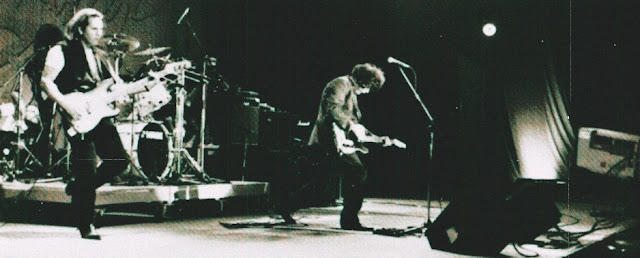
While the Rory Gallagher Live at Montreux DVD only contains excerpts from Rory’s 1975, 1977, 1979 and 1985 performances, the 1994 concert is included in its entirety – much to our delight. Rory enters the stage in an understated manner, stopping at his amplifier to adjust the sound and then making his way to the microphone. With a cry of “let’s go to work,” he breaks into “Continental Op”. Right from the beginning, the chemistry between Rory and his fellow band members is extremely apparent, Richard and David perfectly supporting Rory’s hard-driving sound. Although it’s hard to choose, this version of “Continental Op” is possibly our very favourite for its spectacular end slide solo alone, which sets the pace for a thrilling ninety minutes of music ahead. Rory appears to have more energy at this show than Pistoia and looks relatively well; it is only his bouts of intermittent breathlessness between songs and rolled-up sleeves (later in the show) revealing his patchy skin that act as faint reminders of his ill health.
As the song finishes up, Rory thanks the audience in English, German, Italian, French and Irish, before shouting “Alright!” as a lead into the iconic riff of “Moonchild”. Once again, this version is probably the best that Rory ever did. Whoever says that he lacked energy in his later years just needs a small dose of this song to see how mistaken they are. Here, the energy is channelled not by running around the stage like he did in the 1970s, but simply by fuelling every note and every word with huge feeling and intensity. It is the subtle energy of a wise master who knows that slow and steady wins the race, although he is not afraid to throw in a few tried-and-tested uniquely Rory techniques from time to time, such as string-pulling or bending behind the nut for tremolo effect.
As “Moonchild” comes to a close, Rory introduces Richard and David, as well as keyboardist John Cooke and long-time harmonica player Mark Feltham who joins the stage for the classic ‘I Wonder Who’. While it is hard to pick a definitive version of “I Wonder Who”, this version ranks right up the top of the list. We particularly love the way that Rory improvises many of the lyrics here, really preaching the blues to his listeners. Rory begins by almost speaking the opening lines: “So I got my key | got my razor | got my hat | you took the flat | you took the car | you took the kids | you beat me down for everything I did | but you can’t take my soul, babe.” After a few light strokes on his guitar, he points at the audience and bursts into the opening line “I wonder who” in his rough and bluesy voice. Rory pours so much emotion into this performance, meaning every single word he sings and note he plays. His slide solo is stunning and, as usual, Mark’s accompaniment is impeccable, somehow always knowing the right moments at which to come in and then fade back out again. Here, Rory really gives the song space to breathe, demonstrating how one weeping, sustained note can mean one thousand times more than the speed-playing of guitarists like Eddie van Halen or Yngwie Malmsteen.
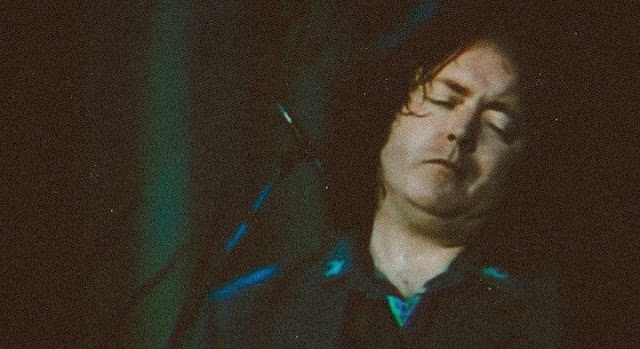
Dónal once described Rory’s performances as “making love to the audience” and it is easy to understand why in the way that he knows perfectly how to bring the pace up and down throughout his set. We see this in the transition from “I Wonder Who” into the instrumental “The Loop”, which Rory briefly introduces as a song about the raised railway that runs around the centre of Chicago. “The Loop” truly shows the band at their finest, all five members with huge smiles on their faces and looking like they are having the time of their life as they play. We love the way that Rory gives everybody a chance to shine here, both Mark and John delivering excellent solos and Richard and David providing superb backing.
“This is a song that goes back a long time. I hope you still care to hear it,” Rory says self-deprecatingly as a means of introducing “Tattoo’d Lady” – the next song in the set. Like with the Pistoia version, the opening of this version is extremely melancholic and wistful. No matter how many times we have heard it over the years, it’s very hard not to cry. But our tears quickly turn to smiles as, with a screamed “yeah!”, Rory cranks the mood back up to positive as he plays the song’s classic riff. The control he has over his Stratocaster here is truly remarkable. Within the solo, we are treated to more string pulling and bending behind the nut, pinch harmonics and even the use of his right elbow. A mighty rendition indeed!
Bringing the pace down once again, Rory introduces “I Could’ve Had Religion”, which he tells the crowd is a “traditional song that’s been adjusted by Junior Wells and Muddy Waters.” When we spoke to David Levy, he told us that this song was always a particular highlight of Rory’s shows and that he “can still hear Rory’s Telecaster blaring in [his] ears!!!” Watching the Montreux 1994 version, it is easy to see why David enjoyed performing this song so much. Here, Rory treats us to 11 minutes of pure blues mastery. Like “I Wonder Who”, “I Could’ve Had Religion” was performed throughout Rory’s career and evolved frequently over the years, but the later versions are particular standouts as they are delivered with the mature voice of experience and wisdom. Once again, the whole band work beautifully with one another, responding immediately to Rory’s hand raise after his opening riff and coming in with a heavy drumbeat, a punchy bassline and a wailing harmonica. It goes without saying that Rory’s slide-playing is astounding, as are his improvised lyrics, which seem to capture his inner torment and are somewhat cathartic:
Matthew, Mark, Luke John
Old Testament, New Testament
Tell me about it
Well, I was sick but I got cured
I got me a freight train running
Right down onto Lourdes (Texas, that is)
Hey, nurse! Com over here
Take away my pain
I can’t take it, honey
This man’s gonna have to [pray]
Something else that strikes us here is just how much Rory feels the music. Even playing rhythm during Mark’s blistering harmonica solo, he has his eyes closed, totally in the zone. All in all, this performance marks a major high point in Rory’s long career.

Rory leaves no time for us to recover from this mind-blowing performance, instantly breaking into ‘Ghost Blues’ – a haunting track from the Fresh Evidence album. By this point, he seems to be really at ease and plays with clear enjoyment, making the lyrics come alive with his accompanying actions (“face looked like marble, my blood burned just like toast”). The moment halfway through the song when Rory walks across the stage to Mark and they play facing one another is truly a joy to watch. People often talk about Rory and Gerry as a dynamic duo, but in our opinion, the connection between him and Mark is on a whole new level and is completely untouchable. John’s keyboard solo is also another great moment in the song, as is the way that Rory masterfully lowers the volume to practically zero at the end of his own solo, before Richard’s rumbling drums start up, setting the whole band in motion once again for a climactic finish.
In his typical humble style, Rory then addresses the audience – “I hope you are not too tired of music. I will try a little acoustic song for you next” – and switches to his Martin D35 to play ‘Out on the Western Plain’. “I hope you like my interpretation of it,” he adds self-effacingly. Rory never disappoints with his interpretation of this Leadbelly classic, always adding something new and exciting each time he plays it. Here, the solo is particularly sublime, a fine example of Rory’s acoustic ability, while the call and response part epitomises the special bond that Rory had with his fans, which is a real pleasure to watch!
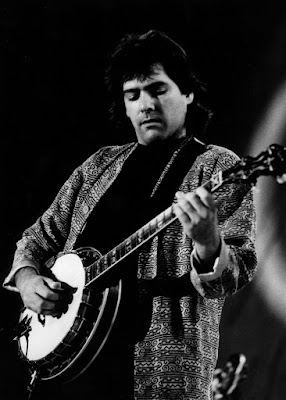
Then comes the pièce de résistance of the set: the jam with the American banjo virtuoso Béla Fleck. There had been plans for Bob Dylan to guest with Rory but, for some reason, this didn’t materialise. Therefore, Béla was called in at the last minute. As he recalled in a 2012 interview with the Irish Examiner, he was quite literally “grabbed by the scruff of the neck and pushed out onto stage” by the promoter. Béla stated that he didn’t know Rory or his music “in the slightest,” but that he quickly realised Rory was a “dynamo” and that he has been a fan ever since. To watch Rory and Béla together, it is almost impossible to believe that they had never played with one another before, nor that Béla had no knowledge of Rory’s music. It is a true testimony to their musicianship just how well they gel together from the moment Béla steps out on stage. Rory always gave full credit to the people who played with him and he introduces Béla with such respect (“we are going to be graced on stage with the fine player…”) and touches his face affectionately before they start.
Festival 1994.
Photographer unknown
Then, a cordial musical duel breaks out between the two of them, Rory playing a riff to which Béla instantly responds. As with his own band members, Rory gives Béla the freedom and room to play as he wishes, happy to sit back and let the younger man take the lead. As the intensity of their exchange increases, Rory moves across the stage until he is directly opposite Béla. He then begins a weeping rendition of “Amazing Grace”, Béla filling out the spaces with his expert banjo-playing. As the short tune comes to an end, Rory changes the pace once again, breaking into the opening riff of “Walkin’ Blues”. What we love more than the performance itself is just how much Rory seems to be enjoying himself and how music was truly his salvation at a time when he was feeling so low offstage. Throughout “Walkin’ Blues”, he is beaming, even throwing his head back to laugh at one point, which leads him to skip the next line of the song.
Not wanting to upstage his guest and being the gentleman that he is, Rory lets Béla direct the solo and sticks to rhythm himself. This song in particular epitomises Rory as bandleader, directing each member to their solo, as well as initiating smooth transitions within the medley. The result is a beautiful blend of sounds that are truly hard to describe in words; they must be heard (and seen) for yourself! As Béla continues to showcase his skills, Rory cries out “YEAH!”, which always makes us smile, and then passes over to the Maestro for his chance to shine. Here, Rory momentarily does a little Irish jig in response to Mark’s tune, which is another highlight for us. The song then leads into “Blue Moon of Kentucky”, with Béla delivering yet another exquisite solo. The total performance comes in at just under 10 minutes, and that’s 10 minutes too short for us. We could go on listening all day! Rory too is suitably impressed, shaking Béla’s hand at the end and putting his arm around his shoulder and bowing. What a moment to have been captured on film!
Leaving no time for the crowd to pick their jaws up from off the floor, Rory removes his blazer (you know things are getting serious then!) and goes straight into the seductive opening to “Off the Handle”. This is yet another performance delivered with absolute heartfelt passion and warmth, from the way he hits the frets with his fingernails to evoke a screechy wail or the actions that accompany the lines “Well, my cat won’t scratch or show its claws | It just prowls around the house all day” through to the improvised lyrics towards the end (“once you was my baby | locked in just like a solid rock | but you packed up and left me | man, that was a lowdown shot”). The end result is nine minutes of sheer blues power, clearly showing Rory at the top of his game and completely dispelling the absurd claims about his (in)ability to play in the late 1980s/1990s.
Rory then thanks the audience, tells them that it is “always a pleasure to play” for them and to “please invite us back.” We love how he says goodbye on behalf of the band, slipping in “and the Messiah himself” at the end, but find his “we’ll see you again…hopefully… sometime soon” somewhat heart-wrenching. No time for pause, with a “look out, baby,” Rory then breaks into the timeless “Messin’ with the Kid”. Mark’s harmonica and John’s keyboard add a new layer to the sound here, which we perhaps controversially prefer to earlier versions of the song. When “Messin’ with the Kid” comes to a close, Rory seems truly overwhelmed by the crowd’s response as he waves goodbye, smiles and bows. As Martin Carthy stated in Ghost Blues, when he spoke to Rory at a later date about the concert, he found Rory to be “slightly perplexed” that people had still wanted to see him perform.

Rory then leaves the stage, but returns a short while later, informing the crowd that “we’re gonna have a little quick jam before we send you to bed” and adding “I hope you’ve enjoyed it so far.” He is then joined by Montreux founder Claude Nobs, Béla Fleck and “the whole kit and caboodle” (as he jokes) for a version of Muddy Waters’ “I’m Ready”. This version is superior (and far less chaotic) than the version performed in the 1982 Rockpalast jam session, which saw the stage flooded with a dozen or so musicians, including Eric Burden and David Lindley. The harmonica exchanges between Mark and Claude are particularly delightful to see, as is the opportunity to hear Rory and Béla trade licks again. The performance brings the 90-minute set to a thunderous end. Forget Frank Zappa. It was Rory who quite literally burnt Montreux to the ground in 1994 with an outstanding concert that is still echoing around the Auditorium Stravinski 28 years later.
—–
Stay tuned for Part 2 of this blog post early next month, which will focus on Rory’s performances at the Festival interceltique de Lorient and the Stuttgart SDR3 Festival.
For further details on Rory’s state of mind backstage at Pistoia 1994, Italian journalist Giancarlo Trombetti has written a short piece for his blog, which we have translated here. See also a translation of an interview that Rory gave with Stefano Tavernese of Chitarre magazine, the day after the Pistoia Blues Festival. A short clip of Gianni Franchi’s Jona’s Blues Band playing at the Pistoia Blues Festival in 1994 can be found here.
Finally, today’s post wouldn’t have been possible without the input of David Levy, Umberto Berlenghini, Gianni Franchi and Marlène Rivet. We use the space here to thank them very much for sharing their memories of Rory and Pistoia/Montreux 1994 with us. Although they didn’t speak to us directly, we are also grateful for the testimonies of Martino Palmisano, Franco Serena, Ernesto De Pascale and Silvano Martini, which all strengthened this piece and helped demonstrate that Rory had, by no means, lost his fire in 1994.
Thank you for reading!


 REWRITING RORY
Leave a reply to Anonymous Cancel reply