

Rory Gallagher: The Man Keeps Getting Younger!
By Waldemar Wallenius
“You’re Irish but it seems you’re not a hard drinker?”
“No, not on the Irish scale. The English especially claim that the hardest drinkers in Europe are the Irish and the Finns. I saw a statistic recently, where the Finns were number one, and the Irish had dropped down on the list. Punishments for drunk driving are now harder, and the price of alcohol has gone up considerably.”
And down go our prejudices.
It’s easy to see that Rory Gallagher isn’t your ordinary Irish beer drinker after you’ve seen how young and lively he still looks. But us Finns drinking more than the legendary Irish, that takes a while to sink in.
On the subject of prejudices, let it be said that I did NOT go to Provinssirock especially to listen to old glories like Rory and Jukka Tolonen. I wasn’t expecting much from either of them, so it was a pleasant surprise that Gallagher was at least as good as I remembered he’d once been (and Oreo Moon was even better, but that’s another story…).
And it wasn’t me who was supposed to be interviewing Rory. That was Juho’s post, but then Juntunen flipped out. So, I went.
Rory was terribly nice. Quiet and polite. He only had two beers. But he and his manager/brother took good care that our glasses were kept full. After a while, my partner especially was positively babbling. Me, I never flipped out. I plunged into a river.
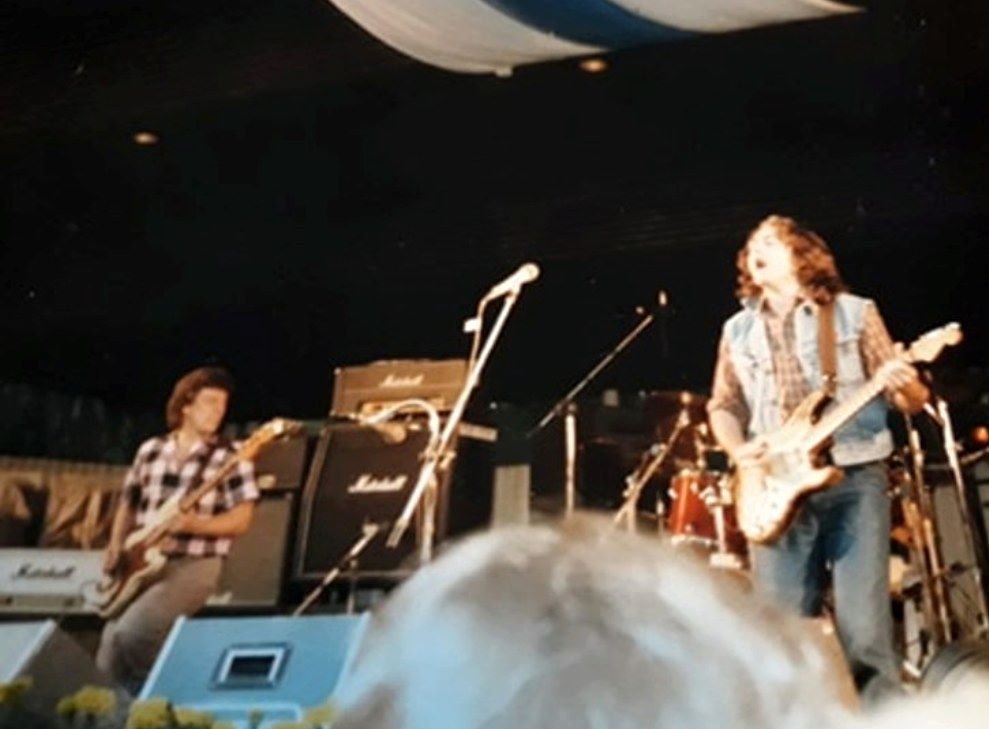
It’s been 15 years since Taste, On the Boards, and Live Taste introduced the young Rory Gallagher. He’s been releasing solo albums since 1971. Rory Gallagher and his battered Stratocaster are now institutions, cornerstones of guitar rock and white blues.
Do you ever think of yourself as a carrier of a tradition?
Maybe I am, but it’s not something I think about. One can appreciate keeping alive traditions, but it’s not supposed to be an academic exercise, or it becomes too teacherlike. If you’re carrying on traditions, you must also create traditions of your own, be yourself.
You have the steadiest of reputations. It looks like the fashions and waves have not changed you. And it doesn’t seem like you’re about to let them do so, either. You’ll just keep on keeping on?
Absolutely, absolutely. I’m not interested in things like constant publicity – but I do not wish to be unknown either. It’s not a sin to make hit records, but there are limits to what I’m prepared to do to get one.
—–
Rory’s latest album is Jinx from 1982 (by the way, Jinx means a bad luck charm, and to “put a jinx on somebody” is to cause harm). While he’s not celebrated on the front pages, his fiery playing and singing are much in demand around the globe. People don’t get tired of hearing him, although there are those willing to condemn him to the rubbish pile of oblivion.
Frankly, I was surprised how popular he was in Provinssirock. In the interview before the show, I tried to find out if the man himself suspects he’s old news.
Do you even have gigs, I wondered?
We used to be on the road for 8-9 months a year, but nowadays not so much, 6-7 months. I haven’t been counting.
Is this more a question of you not wanting to do more, or the promoters not asking you to do as much as you used to?
No no, if it was up to the promoters, we could do twelve months a year. These days we want to use more time on the albums and also organise the tours better to avoid unnecessary zigzagging.
You’re still popular in Europe. What about America?
We were there for five months in 1982. That went well. We did our own tour, but we also supported Rush. I really wouldn’t care about being a support act, but it’s good sometimes – we get to play places where we wouldn’t otherwise play and get better exposure. As headliners, we can fill 2-3,000 capacity halls, but not football stadiums of 40,000.
Which audience size would you prefer?
The smaller one. But the way things are in America, if you get to play on the same bill with Carlos Santana and Jeff Beck, it’s not an opportunity to be missed. But there are a lot of good clubs in America, and they are nice for playing long sets. The music gets tighter in clubs. In a bigger concert, you have to move about more.
What amount of amplifications do you usually use and find ideal?
I usually have two Vox amps together and one Marshall on the side. I don’t like huge stacks of amps. They tend to sound too standardlike.
You don’t find pure volume alone attractive?
No, no. I do want the loud parts to sound loud, but I don’t want the whole show to be loud. I don’t like deafening noise.
You don’t wish to be linked with heavy music?
Not really, although I do like some heavy bands, like Michael Schenker. I used to like UFO, and I’ve always likes the guitar playing of Eddie Van Halen, too. But I’m not into these bands that go for chains and metal and smoke bombs.
You’re a no-frills kind of guy. What do you think of producers? Do you have any ideal producers?
I can name some: Phil Chess, although he’s not producing anymore… Nick Lowe and Dave Edmunds… the guy who produced Doug Sahm and Dougie Meyers, what’s his name again…
I don’t want a producer who can only get one sound. A good blues producer may not get the rock elements in my sound, and vice versa. But I’d say that I’d rather use a producer who’s a musician himself, because these days the most common kind of producer just makes products. I like people who can rise above that.
There’s all sorts of comparisons. What do you say if you’re compared to Johnny Winter or Stevie Ray Vaughan?
They’re both white guitarists from Texas, I’m from Europe. I don’t mind being compared to them, because I’m not imitating anyone. There are so many good guitar players, from Buddy Guy to Ry Cooder, from John Hammond to Keith Richards. They all have their own approaches, and if someone thinks my style sounds similar to someone else’s, that’s for the most part just a coincidence. I’ve been compared to Johnny Winter… well, that’s fine. Whenever we play in Texas, they treat us really nice, like one of their own. While the roots of my music are in America, I’m from Europe, and that affects my choice of words and sounds. Take Van Morrison, for example, whose starting point is a perfect fusion of Irish and American.
I happen to mention that these days Soundi magazine is a subscriber of Hot Press, the leading rock paper in Ireland. What do you think of Hot Press?
It’s quite good – especially when compared to the English ones, because it also covers folk and blues, and such. It’s not as narrowminded as NME or Sounds. I think it’s healthy to provide information along not just one line of taste. In Ireland, it’s not considered odd if you’re a heavy fan and yet go to see De Danan, a folk group.
The only Irish music one hears in Finland is Rory Gallagher, but I recently found Clannad. Do you like them?
Yeah, they’re terrific.
What other good bands are there in Ireland these days?
Chieftains – you know them? Great. De Danan – it’s more traditional than Clannad nowadays. Three former members of Horslips have a new band called the Host.
These are all folk or folk rock, what about rock?
U2 are good, and I also like some of Phil Lynott’s old stuff. I also respect him as a human being because he’s still nice and optimistic after all these years. Constant touring and making an album every nine months would have worn a lesser man down. He should take it a little easier and not try to push out twelve new songs every so often. He has a new band now, called Grand Slam. Oh, and Paul Brady is also great – have you heard of him?
Yes, I know he was in folk groups the Johnstons and Planxty, and that his solo records are much praised, but they’re impossible to find in Finland. By the way, folk again…
I was making this interview before Rory’s show, so I asked him about his repertoire (not folk, right?). I’m guessing that most are his own songs, but will there be covers?
Ninety per cent are my own, and the rest are blues covers: ‘I Wonder Who’ by Muddy Waters, ‘Ride on Red’ by Louisiana Red, and so on. I can do any amount of Chuck Berry and blues songs that I play according to my mood. Sometimes I play Blind Boy Fuller, or Leadbelly’s ‘Out on the Western Plain’. Sometimes we may jam on something that’s not strictly blues, like Eddie Floyd’s ‘Knock On Wood’.
Could you name some of your favourite artists?
In general, or just in blues?
I’m aware that you must surely have a lot of blues favourites, but let’s start with rock in general.
Bruce Springsteen, Bob Dylan, The Band, Waylon Jennings, Bert Jansch…
Okay, folk again. Have you ever played something by Bert Jansch, for example?
I can play some of his numbers but haven’t done them on stage – they are a bit difficult.
Too difficult for you?
No, no, but they require that I sit down and concentrate, which is a bit difficult in the kind of places where I play. David Lindley and Ry Cooder are also my favourites.
How about blues then?
Robert Nighthawk, Earl Hooker and Buddy Guy are probably my biggest favourites of the guitar players. Of the singers, Junior Wells, both Sonny Boy Williamsons, Muddy Waters… and the guitarist that played with him and Howlin’ Wolf, Hubert Sumlin, should not be forgotten. In country blues, I like Blind Boy Fuller… and many others.
The reason I’m asking is that you’re known as blues influenced rather than a heavy guitar player, and I think it would be appropriate if your fans could see in print some of the names that have influenced you.
Good. I’ve been asked these things before, but mostly reporters can’t even spell the names right, let alone know what they’re all about. ‘Big Bill Boozy? How do you spell that, and who’s he?’ Most reporters, who don’t know this stuff, go away and write that I like Woody Guthrie and Elvis Presley because they can write those names. I like them, too.
Well, this is your chance to maybe zoom into the kind of characteristics that you enjoy in the work of your favourites.
I like people who play raw but with a feeling. Take Robert Nighthawk, for example – he sounds perfect and perfectly in tune one minute, but then suddenly he breaks a string, and everything goes completely mad. It’s not about not making mistakes. I don’t like the Las Vegas element that has crept into blues. B.B. King is fantastic, but sometimes a little bit too much Nat King Cole. Blues should be a little rough around the edges. It’s hard to rate blues players. B.B. King is easy, as is T-Bone Walker, because he created the whole style. I like the kind of records that Earl Hooker did with Freddie Roulette – you know this steel guitarist? John Hammond is the best white blues guitar player, in my opinion. He plays rhythm and solo simultaneously and gets very aggressive. Perhaps the only guitarist in rock who gets the same effect is Keith Richards – he has a mean rhythm hand. I also liked the late Mike Bloomfield. It’s a long list. I don’t have any ‘one and only God’!
What about some of the newer players. You must have heard of Fabulous Thunderbirds.
Oh yeah, I like Jimmie Vaughan even more than Stevie Ray, because he understands rhythm. He comes up with these great clusters of notes.
Would you perhaps have favourites that we haven’t heard yet?
You know Lonnie Mac? One of my absolute favourites. What about the Canadian harpist, King Biscuit Boy?”
I’ve heard enough of both to know that I should be more familiar them.
There’s any number of them, like Doug Sahm. He’s a fine T-Bone Walker style guitar player, a good Texan guitarist. He’s much better than most people understand, He’s perhaps known for his rhythm guitar style, but have you heard the longer version of ‘She’s About A Mover’, with all that psychedelic feedback guitar much longer towards the end than on the former version? It’s on a compilation album on Chrysalis.
Have you met him?
Only briefly. He’s a nice guy. It’s not fair that people like him don’t get any attention. In some places he does. In Scandinavia he’s almost a star. Years of labour are bearing fruit.
How about you – are you satisfied after all these years of hard work?
I have no complaints. I’m doing fine.
That’s easy to see. You look perhaps even younger than you used to!
That’s because I’m not really me. As a matter of fact, I’m my son. Don’t tell anyone. Or spread the rumour around!
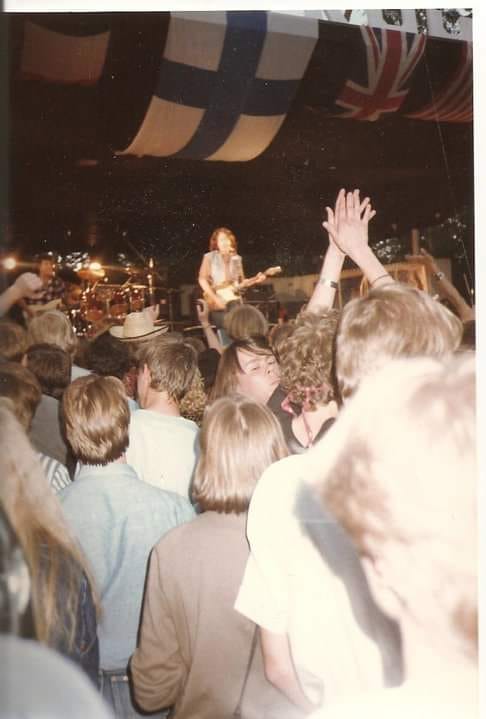
My thanks to Matti Ahola for translating this interview from Finnish to English and sending it to me. Matti also provided the below contextual information:
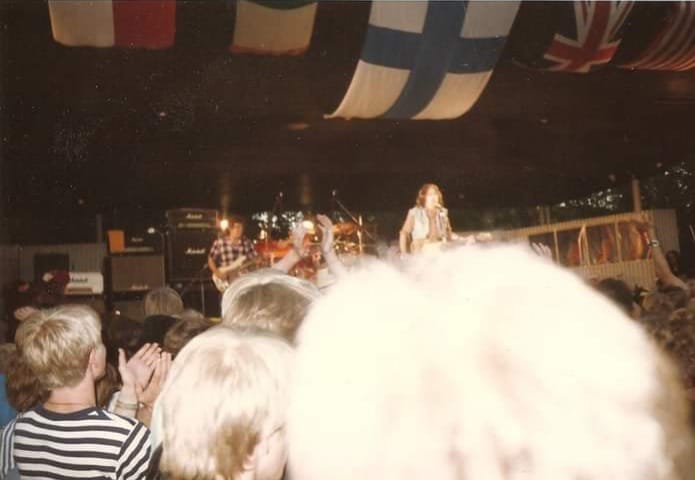
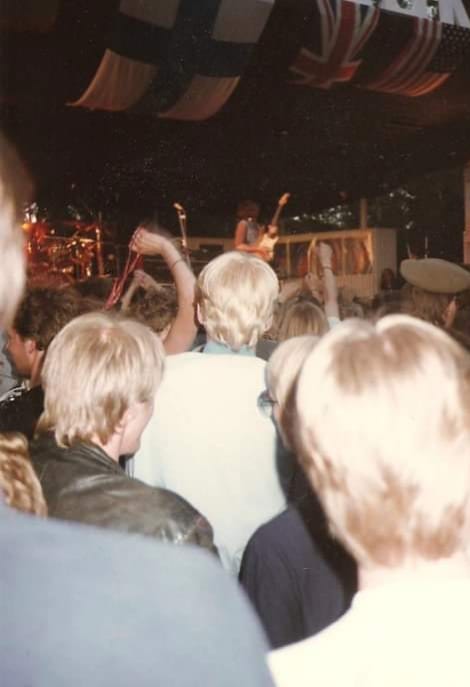
The interview was done on the second of June in 1984 in a hotel Rory Gallagher was staying at in Seinäjoki, Finland. Later in the evening, Gallagher played the Provinssirock festival not far from the hotel. This was the sixth time Provinssirock was organized, and the festival is still going on strong. Rory was the headline act on the first day (Saturday), the Smiths headlined on Sunday. The festival is held on an island on a river, which may, or may not, explain how the reporter ended in the river.
The man conducting the interview wasn’t just any old random dude. Jukka ‘Waldemar’ Wallenius (1948-2021) had been one of the founding members of the Finnish Blues Society and its paper Blues News in 1968 (both still going on strong), then founded Musa, the first rock magazine in Finland, in 1971. After a dispute with Musa’s publisher, Wallenius and most of the Musa staff came up with Soundi magazine in 1975 (yes, still going on strong after fifty years). Wallenius was known for his loo-oong band histories and record reviews, and particularly enjoyed music from Texas, from Bob Wills to Doug Sahm, from Blind Lemon Jefferson to Fabulous Thunderbirds, touching T-Bone Walker and Lightnin’ Hopkins along the way.
But! Apparently, he had not paid any attention to Rory Gallagher’s solo career and got the call to do the interview in such a short notice that he just had to wing it.
I don’t know what happened to Juho Juntunen, the guy who was supposed to do the interview. 85 pages later in the same magazine (the next weekend in real life), he is interviewing James Hetfield and Lemmy at a festival in Belgium, having driven 1962 kilometers across Northern Europe to get there. So, at least physically he was alright. Juntunen was a better and funnier writer than Wallenius and he would have been familiar with Rory’s career, too, so in that sense, this was very much a missed opportunity. But that’s the way it goes.
Some names are mentioned in the interview:
Jukka Tolonen was one of the few internationally known Finnish guitar players and, as I understand it, he mainly played jazz-influenced prog rock. Oreo Moon was his then current line-up. He’s still alive but arthritis only lets him play organ these days.
Johnny Winter and Stevie Ray Vaughan had new albums out: both Guitar Slinger and Couldn’t Stand the Weather were reviewed in this number of the magazine. As was Bruce Sprinsteen’s Born In The USA.
Doug Sahm and Augie Meyers… I’m just guessing, but maybe pld Waldemar was wearing a Doug Sahm t-shirt under his perennial black suit jacket. Or perhaps Wallenius was carrying a plastic bag full of Doug Sahm LPs. After all, he reviewed no less than four records by him in this very same issue. Something like that may have caught Rory’s eye.
One of Soundi’s ‘things’ were the bad jokes on the contents page. Here’s the one with Rory:
Rory visited Ruisrock ten years ago. When he arrived in Finland this time, he was still wearing the same chequered shirt, same jeans and the same battered Fender. ‘Doesn’t he ever change clothes?’ wondered Wallu from behind his five-year old stubble, wearing the same black suit he’s worn for fifteen years.
So, how did Rory’s gig go? We know that Wallenius and the audience very much liked it, but Mika Junna, who covered the Provinssirock festival at large, only had this to say: “Rory Gallagher is one of those guitar stranglers to whom I really wouldn’t care to listen, no matter how essential and how legendary a dude he may be. I assume Wallu will sing his praises on a page nearby.”
Being sixteen at the time, I had already learned to avoid even reading Mika Junna’s record reviews, being deeply aware that our tastes wouldn’t match. He was ecstatic about The Smiths show the following day; even the thunderstorm could not hinder him from being moved to tears. I bet he didn’t know how much Gallagher meant to Johnny Marr.
One thing I noticed as I was translating the interview was that Rory wasn’t very active. He just answered the questions. There was no ‘hey, a funny thing happened on our way here’. When talking about record producers, for example, he never mentioned that he himself had produced most of his own records, a fact that Wallenius was very much unaware of.

 REWRITING RORY
Leave a reply to 1984/1985 Articles – REWRITING RORY Cancel reply