
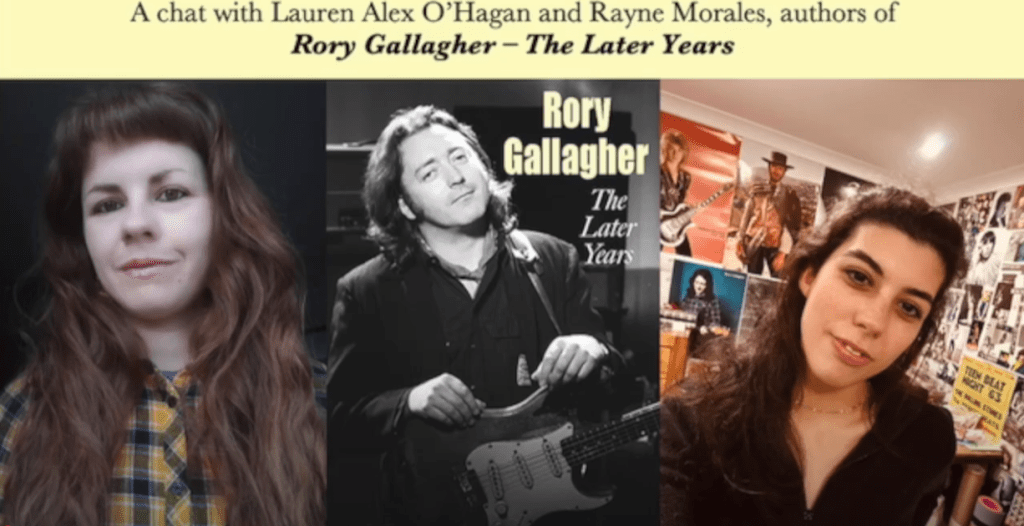
Earlier this January, Rayne and I were interviewed by US journalist Mark Stevens about Rory Gallagher: The Later Years. The 45-minute video is now up on his YouTube channel and can be found here:
I’ve been asked by a few people who do not have English as their mother tongue whether I can write up a transcript of the interview for them to follow. So, here it is below!
A Chat With the Authors of Rory Gallagher – The Later Years
MS – Mark Stevens
LAO – Lauren Alex O’Hagan
RM – Rayne Morales
MS Thank you, both, for being willing to talk about one of my absolute obsessions with Rory Gallagher. I just feel so honoured to be able to chat with you both. What a treat for me. Thank you for all the work you put into this fabulous book, Rory Gallagher: The Later Years.
LAO Thank you.
RM Thank you.
MS Let me just start by asking you each how does it feel to have accomplished this, what you set out to do, and then also what has the reaction been?
LAO Yeah, it still feels really surreal, to be honest, because it’s been… for the last few years, our whole life has just been dedicated to this heavy, intensive research, the writing process, and even now, a couple of months down the line, I still wake up and think, ‘I’ve gotta submit the book’ and then realise, ‘No, actually, it’s come out already,’ so yeah, it feels really surreal. The reaction, on the whole, has been really positive from fans. It’s been really nice to hear their feedback on the book. I think particularly because this is an aspect of Rory’s life that hasn’t been looked at in much detail in the past or there’s very biased perceptions, as we show in the book, of those final years, so I think, yeah, people have found it refreshing. I hope.
MS Yeah. How about you, Rayne?
RM Yeah, I think Lauren has been in touch with a few other people more so than I have about how the book has been received, but I think what really put it… made it real was I was just looking at the reviews of the book on Amazon to see, ‘I wonder how it’s doing’ because after it came out, I tried to distance myself from it just to… I got too close to it so I just wanted to take time out, so I was like, ‘I’ll just check the reviews, just to see them’. And I think seeing those and reading them… I think one of the main things we wanted out of the book is that the fans to like it and to get something out of it and to learn something maybe or whatever it was, and that is what I was seeing in the reviews, which was nice. And some of the names I recognised from the… they are readers of the blog and that was nice, but then some of them, I didn’t, and so just to see that we’re reaching… we seem to be reaching a lot of people was nice. Yeah.
MS Yeah. That’s great. And for those watching, this is a really interesting collaboration because Lauren, you’re in England. Where are you located? What town or city?
LAO So, I’m currently in Cardiff in Wales, but I’m from Bristol originally.
MS Okay. From Bristol, you said, originally?
LAO Yes. Yeah.
MS And Rayne, you’re based in Sydney, Australia?
RM Yeah.
MS So, just this whole… can one of you just talk about how this whole project came up, going back to the Rewriting Rory effort, the webpage and getting on social media. I was following you on social media long before, I believe, there was talk of a book or that I knew at least there was a book on the way. So, how did you two… somebody give me the back story. How did you two meet? How did you know that your interests would align around this approach to treating Rory’s… the later part of Rory’s life?
LAO Do you want me to go for it, Rayne, and then you can…
RM Yeah, I’ll meet you halfway.
LAO Sure. Yeah. So, it all started through the Instagram for Rory Gallagher during the COVID pandemic. So, I think a lot of people during that time discovered Rory’s music or they were looking to interact with other people and they found that platform on Instagram. And at first, there was just a couple of fan accounts and then it gradually grew. I think the whole community grew out of that really where Rayne had a fanpage, I had a fanpage, other people did, so it just started through that really, informal conversations. And then I guess over time, me and Rayne were speaking particularly about the final decade of Rory’s career, which we gravitated towards, and just… again, all the things we discuss in the book about the attention that hasn’t been given to it and all the amazing things he was still doing and it just gradually evolved over time then into the idea of the blog, Rewriting Rory and I think we just realised that we had so much content there that hadn’t been shared before that we wanted to make it more permanent and so then thoughts shifted to the book idea.
MS Yeah.
RM I think it was… as we were saying when we were writing those… we did that Q&A for you, we were saying about it was the followers that… well, not the followers. That sounds weird. The readers of the blog. And their support for that and… it was quite lucky that we also had an academic background as well and what we… it just helped things a little bit, let’s just put it that way, and we both liked to write and we love researching and all that stuff and we were just always curious about Rory’s life, just different aspects, but it just happened to be that the last ten years were just something that we were both really interested in. And yeah, the readers and also just people who interviewed as well, they seemed to be really onboard with what we were doing and the whole… our message with the blog and everything with that, so just to do the book… I liked doing the website and everything like that, but by the end of it, I was like, ‘I want to do something more’ and Lauren agreed, so that’s why we did the book. Otherwise, we would have just kept going with the website.
LAO Yeah. And I remember… do you remember when we were planning posts for the future as well and I think we ended up having… I was like, ‘If we carry on with monthly posts, there’s at least three months of content here.’ And then we started thinking, ‘Maybe this should become a book instead’. And I think, as you were saying as well, the support that we had, particularly from people that knew Rory, friends, family, that was just a major driver for us. Some of the feedback that we got from very early, Rory’s cousin Jim, he was just so lovely. And Bob Hewitt, Roberto Manes… so, all these people, without their voices, it would have been really hard to get this off the tracks, I think, but yeah, they were just so supportive from the beginning.
MS Yeah. Did you encounter any folks that declined to help just because they wanted to let it rest or for whatever reason?
LAO Yeah. I guess I wouldn’t name names, but yeah, some people, we did reach out to but we either didn’t get a reply or it was just difficult to arrange so it didn’t go ahead. Yeah.
MS Yeah. And how about the help from Dónal, Rory’s brother?
LAO Yeah. We were clear from the start that we always wanted to get permission from the family to pursue this project because there have been books in the past they haven’t been happy with and they’re very protective of Rory’s legacy, and rightly so, so I was lucky that I had been in touch with Dónal for a few years already so I had some form of relationship with him, so we just kept them informed from the very beginning, and Daniel as well, who is obviously a major part of the Estate, so yeah, we basically just told them along the way, didn’t we, Rayne, what we were doing, sent them chapters, updates, so they were on board with it. And it was great when we saw that they had retweeted us and shared the book on Instagram. That was just amazing to see.
MS Yeah, that’s great. There is an intensity about Rory fandom. Would you agree? Once you’re in, you’re in, and it is unwavering admiration for his performances, his recordings, everything about his legacy, so in some ways, the fact that you were going to take a careful look at a period of his life that was overlooked, I think speaking for myself, thrilled to see that kind of attention given to it, but you’re also wading into something that could be delicate and you have to tread a little lightly to make sure you get it right.
LAO Yeah.
RM Yeah.
LAO Go ahead, Rayne. That’s okay.
RM That links up to the other question as well because I was going to say that there was a lot of respect because some fans that we contacted if they attended a concert, just for something for the book, they would sometimes decline because they didn’t want to… it was their memory of Rory and they didn’t want to share that publicly and you know, if that had been any other fan, they would have been like, ‘Oh, a book! I want to be featured in a book!” and they didn’t do that, some of them, and that just shows what… the kinds of people that are out there and also the fans of Rory and how they still feel about him. Yeah.
MS Yeah. Any thoughts about that, Lauren, in terms of… Was it tricky to write? It must have been sometimes a little daunting.
LAO Yeah. I was constantly aware of that position of being a fan and an academic and how to manage those things because as an academic, you’re curious, you want to research things and tell the story, but I also feel super protective of Rory and I think there was a line I knew we didn’t want to cross, and certainly, not everything we were told we decided to put in the book whereas I do think other people may have had less scruples with that and thought, ‘This is a good idea. I’ll put this in,’ so we constantly weighed things up. And I think particularly with that final chapter, Rayne, about the 1995 tour, we had so many discussions back and forth about how much is too much information, we want to tell people about this because there are so many misconceptions about the final tour and what happened, but again, just being aware of Rory’s privacy, that respect for him. He was so ill at that time that these gigs are not a true reflection of how he was, so yeah, that was very tough and we edited so much and ended up leaving quite a bit out.
RM Yeah. What was hard because… a lot of the things, the questions we had and the challenges was about writing about his illnesses and framing that correctly and there is still so much… we tried our best to timeline that 95 tour as well… what was occurring at what time and how sick he was at that time and trying to do our best without directly going to the family as well. We didn’t really want to… not to get too into it, but we didn’t really want to contact them about that. We just wanted to piece it together because we knew it was so sensitive.
LAO Exactly. Yeah.
RM But at the same time, we wanted to be factual so there was always that that we had to worry about and it was difficult, that last chapter, to write because it was hard to balance it with… a lot of… some of the other chapters, Rory was sick and that’s the negative side, but the other side is ‘but look at this performance that he did’ or ‘look at this version of ‘A Million Miles Away’. This is very good stuff’. That 95 tour was not like that, so that was really difficult, but hopefully we balanced it okay for everyone.
MS Yeah. Yeah. I’m wondering… it’s interesting for me, there are still folks out there who don’t know Rory, which is amazing. I’m wondering – and this is putting you on the spot – but if you bump into someone who doesn’t know him, I’d love to have each of you describe or give me a sample of how do you introduce somebody to Rory? What do you say about his unique qualities? I don’t mean to lead the witness here, but what do you say?
LAO You know, it’s something I find really hard toput into words because I just think there is really no one like him. He’s just such a one-off unique person and I had this… it was a couple of years ago when I was in one of my local record shops and I was buying an album and the guy said to me at the till, ‘Oh, Rory Gallagher, yeah, I’ve heard about him. What makes him so good?’ and I almost froze because I was like, ‘I don’t even know where to begin telling you’. You just have to see him. I think it is the live performance. You can’t take your eyes off of him onstage. He’s just so magical. But then I think there’s that other element of him as a person as well. You just don’t hear a bad word about him. He was such a special person. So, I just think it’s all of that combined for me. I just think he’s such a role model, yeah.
MS Yeah.
RM Yeah, I’m with Lauren. It’s tough because it was funny… I was wearing a Rory shirt… I work in a bottle shop and I was just wearing a Rory shirt and immediately, they see Gallagher and they think Gallagher [pronounces with hard G], of course and they always say, ‘Oh, are they related to Oasis’. That’s what this person said. And I was like, ‘God, no’. I was just cringing. But even then, I was like, ‘How do I even begin to just quickly, five minutes or even less, describe him?’ but yeah, I would first go with who he is as a person really, even before the music, because you can have a really good musician but you don’t always have a good person, so…
MS Yeah. It’s a really incredible combination, especially in the rock and roll world all the cliches about rockstars. He really was the anti-rockstar in terms of his personal life. Yeah. Is there one album that you tell people to start with?
LAO Mine is Fresh Evidence, which is not the usual choice but for me, it’s Fresh Evidence. Yeah, it represents everything for me about Rory.
RM Yeah, I try to ask the person what they listen to or what they tend to listen to and if it’s more of a hard rock, just classic rock, if that’s what they like, I’d go for Top Priority or something, but if they like more of the folky light stuff, maybe his first album or maybe some of the Taste stuff because there is a light stuff on Taste. It just depends. I try to look at it like that instead of forcing people to like what I like because they might not like that certain album. Yeah.
MS Yeah. And to that point, I think one thing that comes through very clear in the book and I compliment you on it is just the plain fact is you can take Rory and pigeonhole him as a blues rock guitar player but, in fact, the wide range of styles and the diversity over… from Taste through the end is really remarkable. Calling Card and some of the quieter stuff on the opening album just right on through. Fresh Evidence, for sure. The sheer variety within that one album is just remarkable.
LAO Yeah, I think that’s something we were quite keen to do as well because obviously, he was an incredible blues musician, but again, he is not just the blues. There’s so much more to him, so many different elements, and I think that is what made him stand out from a lot of his peers and particularly that Celtic sound that you can hear in his music. I’s there in the lyrics that are just more sophisticated than what you think of typical rock lyrics or whatever and then yeah, particularly in those later years, how he was branching out into so many different areas and I think what was to come, that folk root, the jazz fusion stuff. There were just so many different avenues there.
MS Yeah. One thing that I really appreciated… it wasn’t overemphasised in the book at all, but it was in there. Being a crime fiction writer myself and being a huge fan of Patricia Highsmith in particular, I’ve read all of her novels and short stories and I love Dashiell Hammett and others is his fascination with crime fiction, with that whole genre and just how that also came out in his music. It wasn’t overwhelming but it was there from time to time in different songs and different themes. Really that alone makes for an interesting rockstar. A guy who’s clearly reading and being entertained by classic writers. Was that something you knew going into this project that that was there?
LAO Yeah.
RM Yeah.
LAO That’s always something I loved because I’m an avid reader as well so when I found out Rory was, I thought, ‘This is great’ and actually, I remember there was a group of us on Instagram during the pandemic that were going through some of his books and reading them, so some of them are behind on this poster. Yeah. So, we started working through them and reading them, so I got into Patricia Highsmith that way as well. Yeah, the Defender chapter that Rayne wrote is probably where you see most clearly that crime influence but, as you say, going back to the earlier material, it’s there and other books that he’d read like ‘Daughter of the Everglades’ was inspired by a book that he was reading at the time. So, yeah, it’s always been there.
MS Yeah. When you leaned away, we could see Rory’s Strat there. What is that?
LAO There you go.
MS I don’t think that’s the actual Strat. What is that?
LAO I wish it was. It’s a poster that the Estate sold a few years ago on the website, so yeah, it was a photo shoot that they did with Rory’s original Strat and then his book collection behind it.
MS You mean… those aren’t his actual books!?
LAO Yeah. Yeah. So, Dónal has still got his book collection. Yeah, I will send you a close-up of it, Mark, because you can see all the crime fiction on there and everything.
MS Wow. And you’ve been reading or have read them all?
LAO No, not all. That would be great to work through them, but slowly I’m working my way through.
MS Any favourites that you’ve discovered? I’m always looking for book recommendations.
LAO It’s definitely Patricia Highsmith for me. It’s that psychological thriller aspect that I like. I found it a bit tougher to get into the hardboiled stuff, but yeah, the psychological aspects, I really enjoy.
MS Yeah. There is something about Patricia… actually, I haven’t really thought about this too much, but her characters are so interior. You are so inside the characters’ heads. My wife, when she reads them, she feels more creeped out than any other writer because you are inside the head of somebody who is going to do something very dark. And so, there’s the external and the internal for these characters and Rory clearly also had a lot going on inside him. There was just a lot of… I don’t know how to describe it. Maybe you can do it better. But he had his public face and then I think he had a very, very, very private life. Do you agree?
LAO Yeah. Rayne, do you want to say something on that?
RM If you want to go first, I might just think on it actually.
LAO Yeah. I guess that is the classic thing that people say, about the Jekyll and Hyde aspect of Rory’s personality. How you saw him offstage wasn’t at all the man that you saw onstage and Dónal has spoken himself about what a solitary person Rory was, so I think, yeah, there was a lot going on inside of him and music was that outlet for him to express himself and in songs like ‘A Million Miles Away’ – that’s such a powerful song, that’s my favourite song – where I think you really do get that deep insight into him. and as much as he was private, Dónal again has said he wore his heart on his sleeve with his lyrics, and I think it’s true. If you listen to them, you really get a sense of who he was.
MS Yeah. For sure.
RM Yeah, I agree…
MS Go ahead, Rayne.
RM No, I agree with that. I don’t really have anything else to add.
MS Yeah, Rory even… he used the phrase ‘Jekyll and Hyde’ referring to himself. He understood that. Yeah. When he hit the stage, something switched and that was just a whole different side of himself. This is hard question to ask, but I’m gonna ask it anyway because it’s almost impossible to answer, I think, but what would you have… if you had had a chance to interview him, what would you have wanted to ask him? What do you think didn’t get asked of him that should have been asked?
LAO Oh, that is a hard question! [laughs]
[long pause]
LAO I guess I would like to know more about… I suppose it’s all about the music and it’s not about the personal life, but I would like to know more about his interests offstage, so I’ve seen criticisms before people saying how Rory is often presented as one-dimensional and that it’s all about the music and that, but he was a really intelligent, complex person and there was so much more to him, even though music was obviously the core part of his life. So, even as we were saying about his interest in crime fiction and things like that, I just feel like I’d love to have a proper talk about books or about movies. He was such a big film buff. So, yeah, so those other aspects of his life. Just his views on things because he was very cultured. He’d read up about the countries that he went to, about the politics, the history of the country, so I think, yeah, those kinds of conversations.
MS Yeah.
RM Yeah, I think the same thing. There are some interviews he did later on, that Young Guitar Magazine that he does in 91 is a really nice one because he’s talking about… he talks about the music obviously, his instruments, equipment, all the usual stuff, but he does touch on other things. How the world is going on, technology and all these other things and it’s like those kinds of conversations, those sorts of questions. I guess he’d only talk like that if he was in a really relaxed interview state, but those sorts of times would have been nice and also maybe to have an interview with him that wasn’t recorded. I think things like that help the interviewee because they’re allowed to speak freely and things like that. Yeah.
MS Yeah, that’s a really good point, Rayne. It sounds to me like you both would prefer to sidle up to him in a pub and just start chatting rather than trying to download his personality or download his takes on all these different things, and I guess you can feel, even reading some of these interviews, or listening to them, you can hear that guarded sense from Rory. Yeah.
LAO It’s funny because just this week, a new interview came up on YouTube from 1991 and… it’s been out before, but just in a written format, redacted, so this was the full interview and I was speaking to a friend about it yesterday and we were saying exactly that. That self-deprecation that Rory had, sometimes it just really… I feel so sad when I hear it because he was getting so praised in this interview by this interviewer and he was just playing everything down or… almost like he’s afraid to admit that he’s good and talented and any time he did say something, he’d say, ‘Oh, but such-a-such is better’ or… and I was listening to it and I was thinking, ‘Ah, I just want to tell you how good you are’ [laughs].
MS Yeah.
RM Just another thing was a lot of the times when you were doing the book, just writing, I would say to Lauren, ‘I wish I could just ask Rory what he thought of his album now with so much time passed’ because sometimes… especially with albums like Defender and that whole time. Torch, that’s something that I’d want to ask him about because to do that timeline was so hard. You just had to piece it together with interviews at that time, but as time goes on, obviously wounds heal and just to ask him now about different things would have been nice just to get a different reflection on it and it’s sad that we can’t do it. Yeah.
MS Yeah. It’s frustrating in some ways because you just want to reach back and make him happy. You just get this feeling… look at what you’ve accomplished, look at the enthusiasm when you walk into a hall and start playing live and it’s packed back to the very back and everybody is just jamming completely and you’re entertaining them for three hours. The high must be extraordinary and then to read about his struggles recording and trying to capture in his head what he wants to capture in a studio setting and the work and frustration and money and time. Yeah. Yeah. You can’t just go back and rewrite… well, that’s what you’re trying to do with this.
All [laughs]
MS Yeah. Yeah. Talk a little bit about the San Francisco… the whole Wheels Within Wheels project. That’s such an interesting time to me and what he was trying to do and what happened to that. That was really fascinating.
LAO Yeah, that kind of ties with your chapter more, doesn’t it, Rayne, because you talked about that when you were looking at Torch.
RM Yeah, we did. I think it’s a time that we both quite like actually. I guess I thought of Defender as another Photo-Finish and that’s at least how… well, the San Francisco slash…. Yeah. I think that’s how Rory thought of it a little bit. Yeah, that’s an interesting time. It just seems… also from a general music perspective as well and an historical perspective of what’s going on at that time and the reactions to the different music of the disco and punk and even how they are reacting then to a couple of years before that. And I think Rory is obviously feeling that at the time and he’s feeling stuck and I guess that’s why he split with the band and all that. What else should we talk about? Did I do that properly? I don’t know what else to talk about [laughs]
MS Yeah. This is interesting. His process for finally saying to himself when he finished a studio project and it was done and it was ready to go, his… I think one of the things you really make clear is he didn’t just jump into a studio and peel something off.
LAO No, not at all.
MS His work ethic was incredible.
LAO It was crazy, and I think that’s the thing – you just cannot keep up that intense pace that he did. The touring alone in the 70s with 300 gigs a year. Then you add in the albums on top of that and, as you say, it did become more protracted over time, so he’d spend longer in the studio and that’s something when I spoke to Mark Feltham, he said, ‘The procrastination is something that did get worse. Rory just agonised over what was the best take and would just constantly be remixing right up until the day that he had to hand it in to the record company’. And I think he really did care over his albums and I think sometimes that’s something that is a bit brushed aside because there is that focus on the live performer and it’s like, ‘Studio albums were secondary,’ but I think that was something that really bugged Rory and he really did want to produce that studio album that made people stand up and think, ‘Wow, this is great!’ and even going back to some of the early interviews when we were doing our research, even in the mid-70s, he’s already saying, ‘I want to have this studio album’, so it was there in his mind; it wasn’t just the live aspect and I do think…
RM Yeah, I think…
LAO And he became more sophisticated in the studio over time. We’ve spoken about that ourselves, haven’t we… just again going to Fresh Evidence, I think the sound of that album is incredible and he just got everything right down to a fine art by then.
RM Yeah. I think ‘the album’, having that, was an idea he wanted even earlier… as you said, earlier than just in the 80s and the 90s, and an idea that we were discussing a lot was the two aspects of Rory: the live performer and humble and obviously doing things… how he was doing those first couple of albums where… just doing it in one take or doing it as is. There’s that. But you know, can he also be an artist where he wants to… you know how they talk about Brian Wilson, where he’s the artist and he’s in the studio and all that. Can Rory be a Brian Wilson? Can we talk about him in those same terms? Some people don’t want to and some other people do and it’s only until…. I’m sure Rory was thinking this at the same time. It’s like, ‘I don’t want to be thought of as just this blues guy who comes onstage and whatever. I want to be known as a Brian Wilson of the blues or something like that’ or as an innovator. I don’t think he felt he was being respected in that way. I’m sure other people were thinking about it but maybe not writing it or maybe not saying it and maybe it took all this time to realise that or something like that.
MS That’s a really really good point. I think I appreciate that a lot. Yeah. Any thoughts on that, Lauren?
LAO Yeah. No, I think that’s a really great point too and I think it’s true about the… these things didn’t seem to be appreciated in his lifetime and I think that was one of our great frustrations writing this when you see all the anguish that Rory went through and he just felt that there was a lack of respect for him, particularly with this blues revival in the 90s, a lot of people did jump on the bandwagon with it and he’d been doing this stuff for years and being criticised for doing it and I can just see how that could eat you up as a person, especially if you were a sensitive person like Rory was. And yeah, now you see posthumously all this credit, it is… even I get really frustrated at it so I can just imagine how he must have felt.
MS Yeah. For sure. It’s just one of those things. Once that… and I think you really make that point in the book too. Once the public story gets going, then it’s easy for writers coming behind that story to cheat and take the shortcut and grab the… they open up with clips that’s already been said and they think that’s true and they download that into their story because they don’t want to… and this is being general, but they don’t want to put in the work of really understanding what’s going on. They’re moving from story to story to story. They’re a music writer and they’re just grabbing the bullet points, the highlights, and they think, like you say, that here’s the typical narrative arc and we’re going to buy into this, we’re going to buy into this story.
LAO Yeah. And the constant focus, as we say in the book, about his weight gain, about his clothing, and that just took away from the music. It was just constantly focusing on that. Yeah, that was just really upsetting to see. And funnily enough, the interview that came out this week on YouTube, Rory himself says about… he can hear his frustration in it. He says, ‘I’d turn up to the interview wearing whatever, like a black shirt, and then they’d write I’m wearing a check shirt’, so it was just constantly fighting against this thing that the press had against him.
MS Yeah. Yeah. It really shows you how powerful the press can be in terms of shaping public narrative around a character, a person, an artist.
LAO Yeah. For sure. And look now. That was the days before social media, and now where things can be done even more. But that works in a positive way as well, I think, and that’s something we tried to show, particularly towards the end of the book with the new generation that’s getting into Rory and the work of the Estate on social media and how that’s actually… it’s almost worked the other way, it’s worked in his favour, and he’s more popular than ever now.
MS Yeah. Yeah. Wow. Well, you do a great job, particularly of capturing in your writing about those live performances towards the end of his career. I really felt like I was there and your detailed descriptions of his performances and really just taking them on their own terms musically and as a band, looking at the way they performed and interacted and understood each other as performers, I really appreciated it. It’s an academic book, like you pointed out, but I’ve got to say if folks read it, they’ll realise you’re putting music in our heads all the time we’re reading this. I don’t think we go a few paragraphs without getting a reference to a great song. It’s really terrific.
LAO Thank you. That’s been one of the nice things actually that some people have fed back. They’ve actually said that they’re slowly reading the book because they want to actually dig into the music as they go, so with the first section that goes through the three albums and the session work, they’re actually stopping to listen to that, and then the same with the different concerts, they’re watching them, so that’s really nice to hear.
MS Yeah, that’s great. And you literally can do this because you’ve got so many references in there to the various YouTube clips and the dates and the performances and where to go watch, and there’s just tonnes of material out there. Yeah. I don’t want to go on and on. I could probably talk all day, but a couple more questions. What are some of the better post, the later releases that the Estate has been putting out? Do you lean toward one or two of the compilations or live performances that have been put out since his passing?
LAO I really like Kickback City, going back to the crime thing again, just because I think it’s such a unique concept and I guess when we’re talking about things you wish you could show Rory or tell him nowadays, that’s one of them. I just think that was such a thoughtful release and I think he would love it. Just the idea of the novella written by Ian Rankin, the drawings that were done and then the audio alongside Rory’s crime songs. I just think it works so well as a package. So, yeah, that’s definitely one of my favourite releases. And then I guess obviously loving the later years, the All Around Man release from last year from the 1990 gigs, that was incredible.
MS Yeah, All Around Man is amazing and one of my favourite songs. Yeah.
RM Yeah, I like that one too. I did like the Cleveland Calling thing they did, the acoustic and the electric albums. I really like that because it was around the same time that I got into Rory and I just remember that being so… they did so many releases during that COVID time and it really… they did that compilation as well. I still listen to it and I would recommend that to someone as well if they wanted to get into Rory because I think it does showcase a lot of nice… it’s a nice overview of his career, just as a beginning start. Yeah, I think that one.
MS Yeah. Very good. And just as we wrap here and I’ll let you go, I always love getting recommendations from fans of books when I’m talking about books, like recommending other books. Who else are you listening to you today? What do people who love Rory Gallagher like myself… I try and listen to a lot of new music. I love trying to keep up with what’s going on, but maybe you’ve got somebody else who gets overlooked or a band who’s out there right now that’s touring hard and you just happen to love. I’d love some recommendations.
LAO I got to admit that I don’t really listen to anything modern [laughs]. My holy trinity, as I always say, is Rory, Thin Lizzy and Tom Petty, and to be honest, that’s people that I listen to most of the time.
MS You can’t go wrong with Tom Petty or Thin Lizzy. I actually got to see Thin Lizzy open for Queen at a show.
LAO Oh, did you? Wow!
MS Yeah. Amazing. Amazing. And Phil Lynott, overlooked guitar player too or just musician, I should say.
LAO Yeah. Yeah. Definitely.
MS Yeah. Rayne, how about you? You’ve got some posters on your wall. I think you’ve got some other ideas.
RM You know, it’s really weird but I’ve taken a backseat with listening to a lot of music. I know it sounds… I did a Music degree and everything, but I’m not really too… I’m trying to think of the last person I’ve really been into and it was probably Rory maybe. But you know what? I am more playlisting things now and I’m trying to get more back into Australian music actually, properly get back into it as opposed to hearing stuff on the radio all the time, but I’m not really too much into music; I’m more into movies now actually, so I just get into a lot of film and acting and things like that. Yeah.
MS That’s great. Well, I can imagine just based on how intense it must have been when you’re writing this book to be so immersed and probably consuming so much Rory Gallagher to take… at some point, it must have felt good to take a little break from… it must have been pretty…
LAO My break was going to the 70s stuff, I think. I’ll have a break from the 90s and listen to the 70s Rory stuff instead.
All [laughs]
MS Yeah. Yeah. Yeah. For sure. Well, Lauren and Rayne, thank you so much. I would love a photograph of that bookshelf if you think about it. That would be fantastic.
LAO Yeah. Of course. Yeah, I’ll send it to you.
MS Thank you for what you have done for the community, for the Rory Gallagher community, and thanks for all your hard work just as one fan and big fan of the book. I really appreciate all your work on this and for jumping on the interview to chat today.
LAO Thanks so much. It’s been a pleasure.
RM Thank you.
 REWRITING RORY
Leave a comment