

Rory Gallagher
Rory at the BBC!
20 discs and 16 years of work, from 1971 to 1986, from one of the most frequent artists to grace the BBC’s recording studios – the UK’s national broadcaster and the oldest in the world. The BBC Collection is not only an unforgettable treasure for all Rory Gallagher fans, but also an extraordinary testament to the energy and raw expressive power that the Irish musician brought to his live performances.
As dark and intense as Guinness, Rory Gallagher’s blues are the bridge that connects the mournful songs of the Mississippi with the metallic wail of Chicago electric guitars, while also reflecting the sound across the Atlantic forged by the British blues pioneers when their American counterparts had yet to acknowledge the roots of their music. But Rory Gallagher stands apart. Because he was Irish, because he was pure in his unwavering dedication to his craft, because he was proud of being the working-class man with long hair, thick sideburns, a gentle gaze and the signature checked shirt, because he was a solitary hero, indifferent to the comforts of success.
His unique fusion of blues, rock and folk is more than a style; it’s a song dictated by the heart, the electric sigh of an extraordinary guitar talent. His Irish stout blues is both history and education, legend and reality. In his 47 years on this earth, Rory Gallagher did nothing but take the stage and pour out to his audience the deep essence of the blues, a blend of suffering and resilience from a people – African Americans – whose spirit, through his music, became a symbol of peaceful coexistence for young people across the ocean. At a time when no musician dared to perform in war-torn Belfast, during the bloody period of the Troubles, he captivated both Protestant and Catholic teenagers who, if only for the duration of his concerts, forgot the bloodshed in the streets of their city and came together in the rhythm of free music, unburdened by barriers of religion, colour or social class.
If ever there was a bluesman who has truly embodied the deep essence of that music, as if he were the white equivalent of Muddy Waters, it is Rory Gallagher. Without being a protest singer, he channelled into his music the spirit, humility and pride of the Irish people – often mocked, ridiculed and historically subjected to abuse, injustice and immigration. He poured all of himself into his craft, offering what he did best: playing the guitar and singing from the heart.
A hero always ready to give something more, he arrived during the Christmas period and while other musicians were eager to unplug, rest and spend time with their families, he embarked on an impromptu tour of rural Ireland, like a humble and ancient bard. Rory Gallagher was a dedicated worker of music, going wherever he was needed. He crossed the United States with 30 tours, despite his crippling fear of flying, selling records worldwide without ever succumbing to the pressures of record company calculations. He played an average of 300 gigs per year, drenched in sweat and passion, with 110% devotion.
Even when visibly ill, he continued his blues odyssey until he collapsed on stage in Rotterdam in January 1995 [LAO: not true – see 3.3 of Rory Gallagher: The Later Years] – his last tour before undergoing a liver transplant. The damage, caused by a combination of alcohol and sedatives he took to cope with his fear of flying, ultimately led to his death on 14 June of the same year. 15,000 people flooded Cork, his adopted home city, on the day of his funeral.

William Rory Gallagher, born in Ballyshannon on 2 March 1948, picked up his first guitar at the age of 9, also dabbling with the ukelele. When he was 15, his brother Dónal – who, along with his son Daniel, now preserves his legacy by curating all posthumous releases – bought him a Sunburst Fender Stratocaster for £100 [LAO: not true!], the instrument that would accompany him for the rest of his life.
Like many of his peers, he was drawn to music through the occasional jazz programmes on the BBC and Radio Luxembourg. He worked tirelessly to find rare sheet music to practice on his instruments, initially learning Lonnie Donegan’s skiffle, his first love. Donegan was soon eclipsed by artists like Muddy Waters, Big Bill Broonzy, Eddie Cochran, Woody Guthrie and Leadbelly – key figures in the foundational diet of any respected musician.
Gallagher never married or had children; he just had one great love: his 1961 Sunburst Fender Stratocaster, its paint worn away by the sweat of thousands of performances, becoming the totem of his incendiary blues-rock. With that guitar, he thrilled countless fans and earnt the admiration of a legion of peers. Eric Clapton credited him with rekindling his own passion for the blues, while the Rolling Stones once attempted to hire him to replace Mick Taylor. At the 1970 Isle of Wight Festival, a journalist went to interview the greatest guitarist of all time, Jimi Hendrix, only for Hendrix to tell him he was in the wrong dressing room and direct him to the one next door – where Rory Gallagher was, at that time performing with Taste [LAO: here we go again 🙄].
He has been a fundamental influence on diverse generations of guitarists, from Slash to The Edge, from Johnny Marr to Brian May, from Gary Moore to Joe Bonamassa, and countless others still to be discovered. However, he was also unlucky – his premature death and the lack of recognition he deserved have overshadowed his legacy. So much so that some blues anthologies even overlook his name. Perhaps it’s because he was white or because his music was deeply infused with rock, and given the era in which he lived – when rock and roll was the universal language of youth – it couldn’t have been otherwise.
Originally from Ballyshannon, he moved with his family first to Derry City, where his brother Dónal was born in 1949, and then to Cork, where the two grew up. He was destined for music; his father was once an accordionist and singer in a local band in Donegal, while his mother had been a singer and actress in a theatre company in Ballyshannon, now renamed the Rory Gallagher Theatre. He quickly picked up the basics of playing music, trying his hand at acoustic and electric guitars, mandolin, banjo, harmonica, saxophone and even the sitar, becoming a classic child prodigy.
In 1963, he hit the road with a band called the Fontana, and later with the Impact, he went on to try his luck in tourist clubs in Spain and in the usual Hamburg scene. When he returned to Ireland in 1966, he formed Taste with Norman Damery and Eric Kitteringham. Two years later, they were replaced by two musicians from Belfast: bassist Richard McCracken and drummer John Wilson. As part of the flourishing blues scene centred around the Maritime in Belfast, where Van Morrison’s Them held sway, Taste quickly became a sensation as a power trio, able to compete with giants like Cream.
They played prestigious venues like the Marquee and the Royal Albert Hall, with their unique blend of rock, blues and hard beats filling four albums: two studio albums, Taste and On the Boards, and two live albums, Live Taste and Live at the Isle of Wight. The latter was released in 1970, shortly after the band broke up. Their final concert took place at Queen’s University in Belfast, but five days later, they played the Ulster Hall, filmed by the Northern Irish BBC. The London branch of the same radio broadcaster had already documented Taste’s career with sessions and radio concerts, so it wasn’t long before national BBC producers Jeff Griffin, Bernie Andrews and Malcolm Brown started booking him for a series of performances over the years.
And so begins the story of Rory Gallagher with BBC radio and television, captured in this extensive 18-CD boxset, which includes a long interview, and two Blu-rays. The collection spans the years from 1971 – the year of his debut as a solo artist – to 1985, with the final section celebrating his version of ‘I Can’t Be Satisfied’ from the TV show Whistle Test.

As Tom Petty once stated, “Understandably, the story is often told through studio albums. They are clear markers of a musician’s journey, but you spend most of your time on stage. That’s where the blood flows. The crowd’s energy is wild – 20,000 people is the biggest adrenaline rush you can imagine. It’s like that photo of the woman who single-handedly lifted a car to save her child. That’s how it feels. If you’re not genuine, the crowd will sense it, even in the farthest corner of the arena.”
The BBC recordings don’t feature large crowds, but that’s what festivals are for. Instead, this boxset offers a musical chronicle of Gallagher’s solo career, capturing the evolution of his line-up alongside his official discography. It provides a precise and detailed snapshot of the versatility, energy, spontaneity and feeling that defined the live performances of this incredible musician, whether before small or large audiences, where there were no filters, tricks or barriers.
The BBC Collection is a monumental compilation of radio and TV material – mostly unedited – taken from performances in the studio and in theatres, including the 1980 Reading Festival. Some recordings have appeared in deluxe editions of earlier albums and in BBC Sessions (Capo, 1999). Gallagher maintained a strong and lasting relationship with the BBC from the days of Taste, taking full advantage of the sound engineers’ professionalism and the high quality of the recording equipment. He returned many times to their studios and to the theatres where live sessions were recorded.
In February 1971, Gallagher was in London to record his first solo album, with Gerry McAvoy on bass and Wilgar Campbell on drums. The format was still the power trio, much like Taste, but this time the Irishman aimed to create a softer, more introspective album – one that emphasised blues over rock. With the help of engineer Eddie Offord, Gallagher crafted a record with a passionate style, simultaneously virtuoso and lyrical. His electric, acoustic and slide guitar work perfectly complemented his raw, emotional yet remarkably expressive voice. Compared to his previous work, there was a greater focus on folk and country blues. He was drawn to the albums of Hank Williams and Waylon Jennings, as well as the English folk guitarists. But for ‘Can’t Believe It’s True’, where Rory plays the saxophone, it’s said he was inspired by none other than Arthur Lee’s Love, or rather, California psychedelic pop salsa.
After a few days of work, at his explicit request, Vincent Crane of Atomic Rooster was brought in to add his piano. The album features songs inspired by his time in Taste, such as ‘Laundromat’, a reflection on when the three band members lived in a bedsit in Earl’s Court, London, with a noisy laundromat in the basement. This track would later become a staple of Gallagher’s intense live performances. The album also includes tributes to his heroes Muddy Waters and Otis Rush, with songs like ‘Gypsy Woman’ and ‘It Takes Time’. One of the album’s standout moments is the touching acoustic track – one of his customs – ‘Just the Smile’, which showcases Gallagher’s affinity for groups like Pentangle.
The album was released in May 1971 and, just a few months later, was followed by Deuce, another demonstration of Gallagher’s creative urgency. Keen to return to performing live, he willingly accepted an invitation to participate in the BBC radio show Sounds of the 70s, which is well-documented on the first three discs of this boxset. These recordings come from the Aedian Hall and the austere Maida Vale studios.
Between 1971 and 1974, Gallagher participated in over a dozen sessions for Sounds of the 70s and John Peel’s Sunday Concerts, recording around 40 songs, of which 28 remain. These sessions are presented in their entirety in this collection, including tracks like ‘It Takes Time’, a 1958 single by Otis Rush that wasn’t included on the first album but appeared in later reissues, and ‘Gypsy Woman’ by Muddy Waters. ‘Hoodoo Man’ was added in the powerful reissue of Live in Europe (Polydor, 1972).
Rory Gallagher had complete control over his creative process and commercial direction. In just three years, he released six albums – the three previously mentioned, along with Blueprint and Tattoo (both in 1973) and the remarkable Irish Tour the year after. On recordings for John Peel and Sounds of the 70s, the trio’s sound remained raw and intensely bluesy. ‘Feel So Bad’, for example, features light jazzy drumming that almost mimics the sound of a moving train, while Rory’s solo is clean and lyrical.
‘The Cuckoo’, taken from an album of mountain songs by John Renbourn, blends American country blues with English folk, but it also draws inspiration from Scotty Moore’s studio work for Sun Records. Similarly, the version of ‘I Could’ve Had Religion’ speaks the same musical language. Both tracks, superbly produced, represent a unique moment in Rory’s history with the BBC as they were recorded at the World’s Transcription Department in Kensington House – the first studio equipped with stereo broadcasting for international use.
The 1972 version of ‘Hoodoo Man Blues’ for Sounds of the 70s is less furious and explosive than later renditions. ‘Sinner Boy’ features powerful slide, just as ‘Crest of a Wave’ and ‘I Fall Apart’ already demonstrate the intensity Gallagher would bring to American stages. ‘If I Had a Reason’ blends country blues with lap steel, adding a soulful touch. The acoustic ‘Banker’s Blues’ serves as the opposite of ‘Laundromat’, while ‘For the Last Time’, with its progressive cadences that anticipate Rory’s liberating solo, is pure rock blues magic.
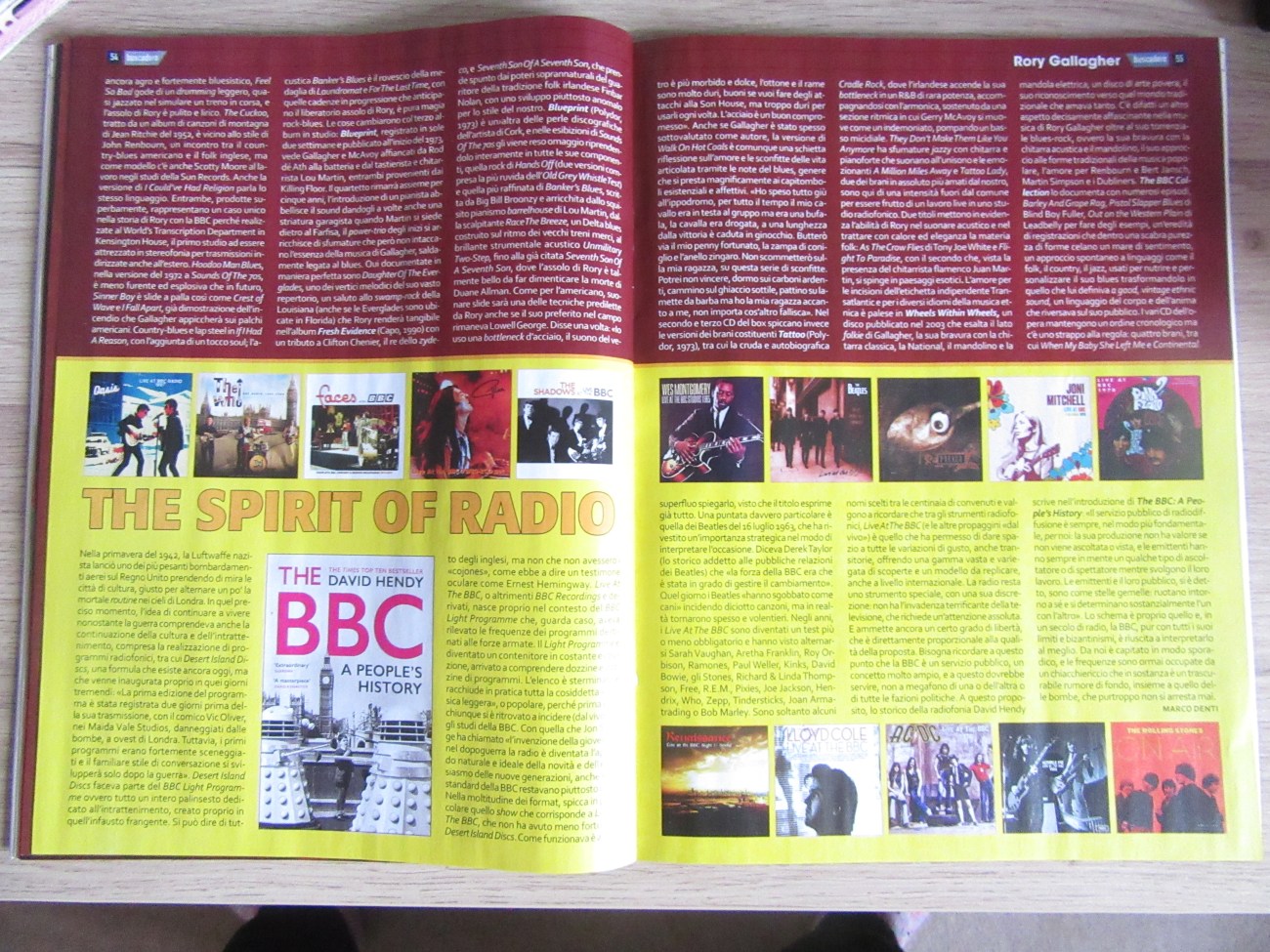
Things shifted with his third studio album Blueprint, recorded in just two weeks and released in early 1973. For this album, Gallagher and McAvoy teamed up with Rod De’Ath on drums and keyboardist/guitarist Lou Martin, both from the band Killing Floor. The quartet remained together for five years. The addition of a pianist gave the sound more depth, occasionally adding a garage-rock flavour when Martin played his Farfisa. Though the power trio from Gallagher’s early years was now enriched with nuances, it did not detract from the essence of his music, which remained firmly rooted in the blues.
Documented perfectly here is ‘Daughter of the Everglades’, one of the melodic peaks of his vast repertoire. This track, a nod to Louisiana swamp rock (despite the Everglades being in Florida) would later be revisited in his Fresh Evidence (Capo, 1990) album with a tribute to Clifton Chenier, the king of zydeco. ‘Seventh Son of a Seventh Son’ is inspired by the supernatural powers of Irish folk healer Finbar Nolan – an unexpected influence for Gallagher’s style.
Blueprint (Polydor, 1973) is another of the Cork artist’s discographic gems, and his performances for Sounds of the 70s offer a perfect tribute to it, including renditions of ‘Hands Off’ (two versions, including the rougher one from Old Grey Whistle Test) and the more refined ‘Banker’s Blues’, written by Big Bill Broonzy and enhanced by Lou Martin’s exquisite barrelhouse piano. Other highlights include the thrilling ‘Race the Breeze’, a Delta blues built around the rhythm of old railway trains, and the brilliant acoustic instrumental ‘Unmilitary Two Step’. ‘Seventh Son of a Seventh Son’ – already mentioned – is another standout, where Rory’s beautiful solo makes listeners forget the tragic death of Duane Allman.
As with the American, playing slide guitar was one of Rory’s signature techniques, though his favourite player in the field remained Lowell George. He once said, “I use a steel bottleneck; the sound of glass is softer and sweeter. Brass and copper are very hard, good if you want to get the attack of Son House but too harsh for regular use.” Though often underappreciated as a songwriter, Gallagher’s version of ‘Walk on Hot Coals’ stands as a clear reflection on love and the struggles of life, conveyed through the raw emotion of blues notes that Gallagher masterfully translated into powerful existential and emotional themes:
“I spent it all down at the race track
All the way my horse led the field
Well, I spent it all down at the race track
All the way my horse led the field
But it was a hoax, the mare was doped,
a length to win she fell down on her knees.
Gonna throw away my lucky penny, rabbit’s foot and gypsy ring
Gonna throw away my lucky penny, rabbit’s foot and gypsy ring
Not gonna gamble on my baby,
on this losing streak I might not win.
Well, I walk on hot coals, sleep on a bed of nails
Walk on thin ice, skate on razor blades
Got my little girl beside me no matter what else fails”
In the second and third discs of the boxset, the versions of songs from Tattoo (Polydor, 1973) stand out, particularly the raw and autobiographical ‘Cradle Rock’, where the Irishman’s bottleneck shines through in a powerful R&B groove, accompanied by harmonica and Gerry McAvoy’s bass adding an almost possessed quality to the rhythm section. ‘They Don’t Make Them Like You Anymore’ has jazzy undertones with guitar and piano playing in unison, while the emotional ‘A Million Miles Away’ and ‘Tattoo’d Lady’ – two of Gallagher’s most beloved songs – are delivered with extraordinary intensity in the live radio studio setting.
Two tracks that highlight Gallagher’s skill on acoustic guitar and his warm and elegant handling of folk material include ‘As the Crow Flies’ by Tony Joe White and ‘Flight to Paradise’. The latter, featuring flamenco guitarist Juan Martin, introduces an exotic flair to the piece. Gallagher’s love for independent labels like Translantic and his fascination with diverse musical traditions are evident in Wheels Within Wheels, an album released in 2003 which showcased his folkie side and his skill on the National, mandolin and electric mandola. This album, a humble recording, reflects his respect for traditional music, the sound of which he cherished deeply.
Other than his skill on acoustic guitar and mandolin, another fascinating aspect of Rory Gallagher’s music was his approach to traditional forms of popular music, inspired by his love for Renbourn and Bert Jansch, Martin Simpson and the Dubliners. The BBC Collection documents this in numerous tracks, from ‘Barley and Grape Rag’ to ‘Pistol Slapper Blues’ by Blind Boy Fuller and ‘Out on the Western Plain’ by Leadbelly, to name but a few examples. These recordings, with their raw purity, convey a sea of emotions, showcasing Gallagher’s spontaneous approach to the language of folk, country and jazz which he used to nourish and personalise his blues, transforming it into what he referred to as a “good vintage ethnic sound” – a language of both body and soul, which he shared with his audience.
While most of the discs follow a chronological order, there is one exception: four tracks from the BBC Radio 2 programme hosted by Paul Jones, recorded in 1986. These include ‘When My Baby Left Me’ and ‘Continental Op’, taken from a time when Gallagher’s band had returned to a trio format with Brendan O’Neill on drums. These tracks are placed on the third disc, which otherwise focuses on recordings from 1974.
The fifth CD of the boxset features Gallagher’s participation in John Peel’s Sunday Concert from 1971, and it is fantastic. It includes a semi-acoustic version of ‘Just the Smile’ and energetic renditions of ‘It Takes Time’ and ‘Laundromat’, all greeted with enthusiastic applause from the audience. In 1973, the Paris Cinema on Regent Street in London was converted into a stereo recording studio for the BBC with a Transcription sound mixer, and it is from here that material appears on the sixth, seventh and eighth CDs.
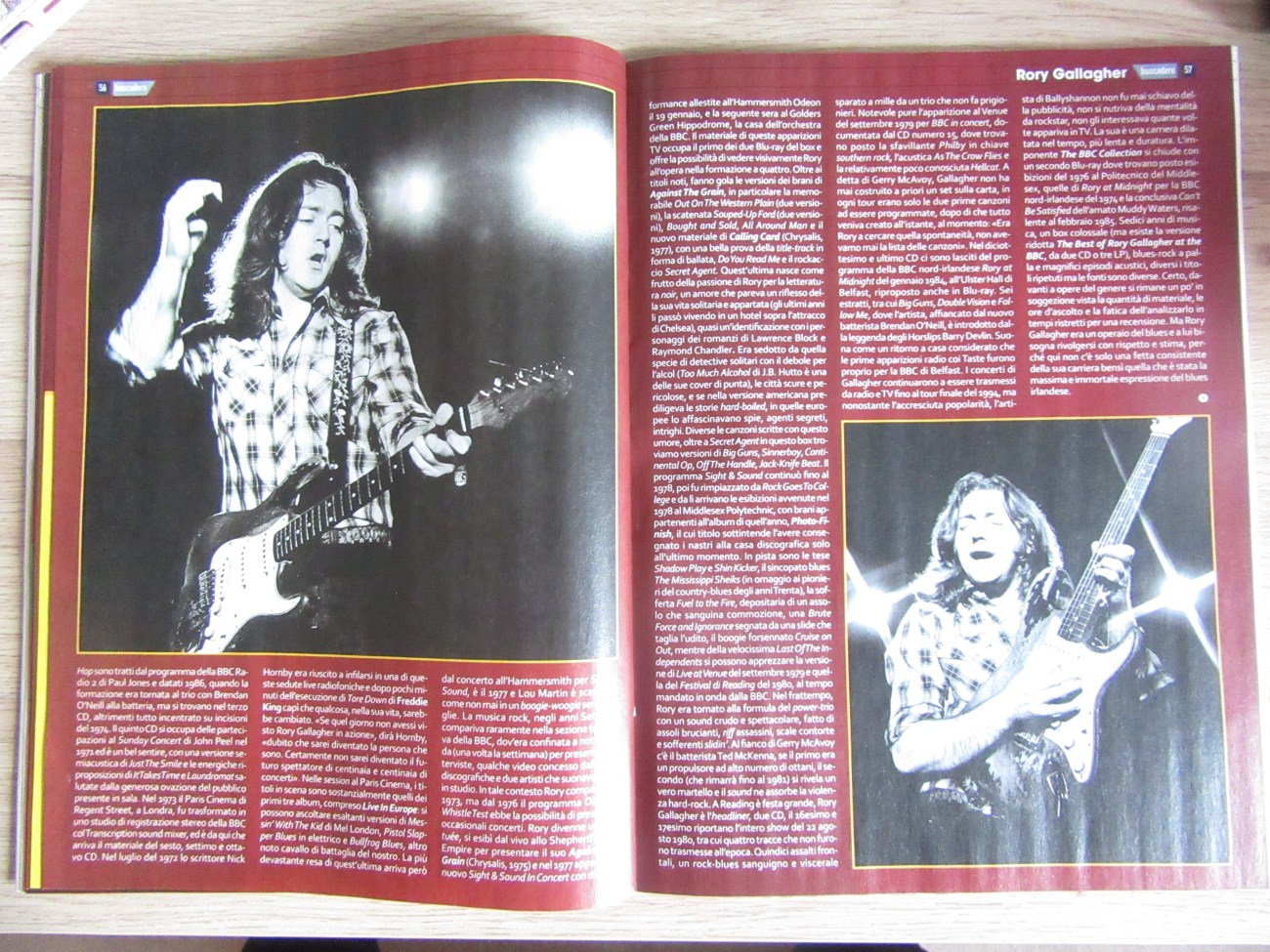
In July 1972, writer Nick Hornby happened to slip into one of these live radio recordings, and after just a few minutes of hearing ‘Tore Down’ by Freddie King, he realised that something profound had shifted in his life. “If that day I hadn’t seen Rory Gallagher in action,” says Hornby, “I doubt I would have become the person I am. Of course, I would not have become the future viewer of hundreds and hundreds of concerts.” The Paris Cinema sessions primarily feature tracks from Rory’s first three albums, including Live in Europe. Here, you can listen to electrifying versions of ‘Messin’ with the Kid’ by Mel London, an electric ‘Pistol Slapper Blues’ and ‘Bullfrog Blues’, another classic that became a staple of Gallagher’s live performances.
The most explosive track, however, comes from the Hammersmith concert for Sight and Sound. It’s 1977 and Lou Martin is unleashed like never before in a boogie woogie performance that is truly unrestrained. In the 1970s, rock music was a rare feature on the BBC TV section, often relegated to late-night programming (once a week) with interviews, a few videos from record companies and occasional live studio performances. In such context, Rory made his first appearance in 1973, but in 1976, the programme Old Grey Whistle Test provided him with a regular platform to present live concerts. He became a frequent guest, performing live at Shepherd’s Bush Empire to promote his album Against the Grain (Chrysalis, 1975). In 1977, he appeared again on the new Sight & Sound in Concert programme, with two performances recorded at Hammersmith Odeon on 19 January and at the Golders Green Hippodrome, home to the BBC orchestra.
The material from these TV appearances fills the first of the two Blu-Rays in the boxset, providing fans with the opportunity to see Rory and his four-piece in action. In addition to the familiar tracks, the performance of songs from Against the Grain are especially captivating. Notable highlights include the memorable ‘Out on the Western Plain’ (two versions), the untamed ‘Souped-Up Ford’ (two versions), ‘Bought and Sold’, ‘All Around Man’ and new material from Calling Card (Chrysalis, 1976) with a beautiful ballad rendition of the title track, as well as ‘Do You Read Me’ and the rock powerhouse ‘Secret Agent’.
‘Secret Agent’ was born from Rory’s passion for noir literature, a love that seemed to mirror his solitary and introspective life (he spent his final years living in a hotel above Chelsea Harbour), a reclusive existence akin to the characters in the novels of Lawrence Block and Raymond Chandler. He was particularly drawn to the solitary, often alcohol-dependent detectives (‘Too Much Alcohol’ by J.B. Hutto was one of his flagship covers) and the dark and dangerous cities of hard-boiled American noir, as well as European tales of spies, secret agents and schemes. This fascination is evident in several of his songs, and in this boxset, you’ll find other tracks reflecting this mood, including ‘Big Guns’, ‘Sinner Boy’, ‘Continental Op’, ‘Off the Handle’ and ‘Jack-Knife Beat’.
The Sight & Sound programme continued until 1978, after which it was replaced by Rock Goes to College. Performances from 1978 at Middlesex Polytechnic are featured, including songs from Photo-Finish, an album released that year and which Rory famously delivered to the record company at the last possible moment. On stage, you’ll hear the intense ‘Shadow Play’ and ‘Shin Kicker’, the syncopated blues of ‘Mississippi Sheiks’ (a tribute to the pioneers of 1930s country blues), the heart-wrenching ‘Fuel to the Fire’, featuring a solo that oozes emotion, ‘Brute Force and Ignorance’, marked by ear-frazzling slide guitar and the raucous boogie of ‘Cruise on Out’. The blistering pace of ‘Last of the Independents’ can be appreciated in versions from Live at the Venue (September 1979) and the Reading Festival in 1980, which was broadcast live on the BBC.
In the meantime, Rory had returned to the power trio formula with a dynamic and blistering sound made up of burning solos, killer riffs, contorted scales and wailing slide. Alongside Gerry McAvoy was drummer Ted McKenna. If McAvoy was a high-octane engine, McKenna (who stayed until 1981) was a true hammer, and together they absorbed the violence of hard rock into their sound. Reading Festival was a great celebration with Rory Gallagher as headliner. Two CDs, the 16th and 17th in the boxset, cover the entire show from 22 August 1980, four tracks of which were not broadcast at the time. The fifteen songs are a raw, sanguine and visceral blues-rock assault shot out at a thousand miles per hour by a trio that holds no prisoners.
Also notable is the appearance at the Venue in September 1979 on the BBC’s In Concert series, documented on CD 15. This performance includes the dazzling ‘Philby’ in a southern rock style, the acoustic ‘As the Crow Flies’ and the relatively unknown ‘Hellcat’. According to Gerry McAvoy, Gallagher never prepared a setlist before a gig. On every tour, only the first two songs were planned; after that, he made it up on the spot according to the mood: “Rory thrived on spontaneity. We never had a setlist.”
In the 18th and final CD, there are highlights from the Northern Irish BBC programme Rory at Midnight from January 1984, recorded at the Belfast Ulster Hall, which is also included in the boxset on Blu-Ray. Six tracks are included, among them ‘Big Guns’, ‘Double Vision’ and ‘Follow Me’, with Gallagher, now joined by Brendan O’Neill, being introduced by Horslips legend Barry Devlin. It feels like a homecoming, considering that Gallagher’s first radio appearances with Taste were also for the BBC in Belfast.
Gallagher’s concerts would continue to be broadcast on radio and TV until his final tour in 1994, but despite his growing popularity, the Ballyshannon artist was never a slave to publicity. He never bought into the rockstar mentality and was never interested in how many times he appeared on TV. His career expanded over time, slowly and steadily.
The powerful BBC Collection closes with a second Blu-Ray, which includes performances from 1978 at the Middlesex Polytechnic, Rory at Midnight for the Northern Irish BBC in 1984 and the conclusive ‘Can’t be Satisfied’ by the beloved Muddy Waters, recorded in February 1985. Sixteen years of music are captured in this colossal boxset (though a reduced version, The Best of Rory Gallagher at the BBC, is available on two CDs or three LPs). It contains hard-hitting blues rock and magnificent acoustic episodes, with repeated titles presented in different sources. Of course, with such a vast body of work, there is a certain challenge in reviewing it in a limited time, given the quantity of material and the hours of listening involved. But Rory Gallagher was a blues worker, and he deserves to be addressed with respect and esteem, as this boxset represents not just a substantial portion of his career but also the pinnacle and immortal expression of Irish blues.

The Spirit of Radio
In the spring of 1942, the Nazi Luftwaffe launched one of the heaviest aerial bombardments on the United Kingdom, targeting cultural cities in an attempt to disrupt the deadly routine of the skies over London. During this precise moment, the idea of continuing to live despite the war also encompassed the continuation of culture and entertainment, including the creation of radio programmes, among which Desert Island Discs was introduced—a format that still exists today, but was inaugurated during those harrowing days.
“The first edition of the programme was recorded two days before its broadcast, with comedian Vic Oliver at Maida Vale Studios, which had been damaged by bombs in the West End of London. However, the early episodes were predominantly dramatic, and the familiar conversational style would only develop after the war.”
Desert Island Discs was part of the BBC Light Programme—a schedule entirely dedicated to entertainment, created in the midst of that unfortunate situation. One could say a lot about the English, but as an eyewitness like Ernest Hemingway put it, they certainly had guts. Live broadcasts at the BBC, or BBC Recordings and their derivatives, were born in the context of the BBC Light Programme, which, as it turned out, revealed a frequency of programmes aimed at the armed forces. The Light Programme evolved into a container that continuously expanded, eventually encompassing dozens of shows. The variety was vast and essentially included all forms of light or popular music, as sooner or later, anyone who mattered in the music world found themselves performing live in the BBC studios.
With what Jon Savage has called “the invention of youth,” in the post-war era, radio became the natural platform and ideal for conveying the news and enthusiasm of new generations, although the BBC’s standards made it more rigid. Among the multitude of formats, shows like Live at the BBC particularly stand out, never experiencing less success than Desert Island Discs. As it worked, it was almost unnecessary to explain the show, given that the title says everything.
A particularly interesting point is that on 16 July 1963, The Beatles made an important strategic move in how they approached the occasion. Derek Taylor, the Beatles’ public relations manager and historian, said that “the strength of the BBC was in being able to manage change.” That day, The Beatles “toiled like dogs,” recording 18 songs. But in reality, they would return often and willingly.
During the years of Live at the BBC, it became a more or less obligatory platform, showcasing artists such as Sarah Vaughan, Aretha Franklin, Roy Orbison, The Ramones, Paul Weller, The Kinks, David Bowie, The Rolling Stones, Richard and Linda Thompson, Free, R.E.M., The Pixies, Joe Jackson, Jimi Hendrix, The Who, Led Zeppelin, Tindersticks, Joan Armatrading and Bob Marley. These are just a few of the notable names among the hundreds of artists who recorded there. Live at the BBC (and other live broadcasts) became an essential instrument in radio, providing space for all varieties of musical tastes, even transient ones. It offered a broad and diverse array of discoveries, creating a model that could be replicated internationally.
Radio remains a unique medium, with its own distinct qualities: it doesn’t have the terrifying intrusiveness of television, which demands your full attention. It still allows for a certain level of freedom, directly proportional to the quality of the content being offered. It’s important to remember that the BBC is a public service, a very broad concept, and it should serve this purpose, not act as a megaphone for any particular political faction. In this regard, radio historian David Hendy writes in his introduction to The BBC: A People’s History: “The public service of radio is always, in the most fundamental way, for us: its production has no value if it is not listened to or seen, and broadcasters always have in mind a certain type of listener or viewer while carrying out their work. Broadcasters and their audience, it is said, are like twin stars: they revolve around each other and determine each other substantially.”
This is the essence of the medium, and in its century-long history, the BBC, despite its limitations and complexities, has managed to interpret it brilliantly. It has happened to us sporadically, and today, the frequencies are occupied by chatter that, in essence, is little more than a negligible background noise—alongside the sound of bombs, which unfortunately never cease.
 REWRITING RORY
Leave a comment