

The Guitarist who United a Troubled Ireland
Rory Gallagher’s ‘Irish Tour’ – the tour that crossed the border into Northern Ireland during the Troubles – turns half a century. The artist was at the peak of his powers, but he was an anti-star.
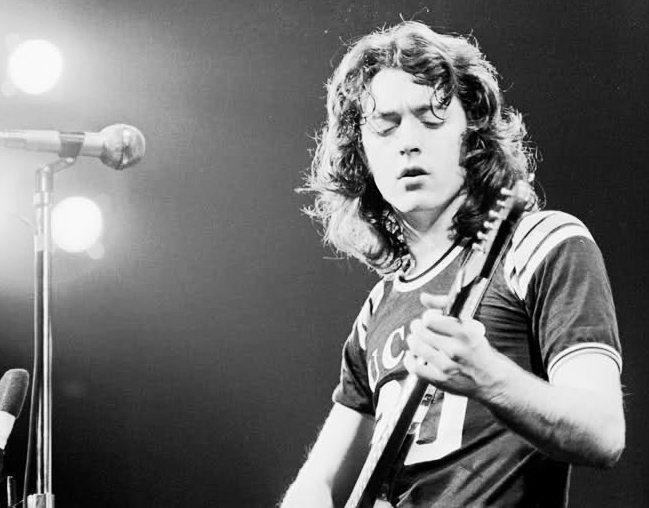
For a chosen few, the guitar becomes an extension not of their hands, but rather of their mind. In the documentary, Irish Tour ‘74, the Irish musician dazzles, even when he’s just tuning his guitar and, inadvertently, produces a gorgeous sound from it. His virtues on the six string rivalled those of Eric Clapton, Jimi Hendrix or Jimmy Page, just a few years older than him; he could have become a member of the Rolling Stones when they were looking for a replacement for Mick Taylor or joined Deep Purple instead of Ritchie Blackmore. But he wanted to do it his own way and was the opposite of what you might expect from a rockstar. He was a simple guy who lived a simple life, who performed more in theatres and small concert halls than in stadiums, who never changed his clothes to go on stage, who never made concessions to agents or record labels, who refused to release singles, who walked rather than took a limo, who never fed newspapers and magazines with gossip and scandals. Irish Tour, his most acclaimed live double album, was released 50 years ago today. The accompanying documentary was later screened in theatres.
Since he was a teenager, Rory Gallagher lived clinging to blues (Muddy Waters) and early rock and roll (Eddie Cochran, Chuck Berry), and was also a jazz fan. At 15 years old, he bought a second-hand and imported Fender Stratocaster that he always carried with him and still played at his final concerts. At 18, he made a name for himself as the frontman of the trio Taste. When he died in 1995 at age 47, from complications after a liver transplant, he hadn’t moved from the same roots.
Taste burst onto the scene in 1966 as a guitar-bass-drum trio, emerging almost at the same time as Cream (with Clapton) and The Jimi Hendrix Experience; in all three cases, torrents of music from the most basic formation possible. Rory hit his first summit when Taste was invited to the legendary Isle of Wight festival in 1970. Hendrix died at 27, Clapton spun various projects irregularly, Page triumphed with Led Zeppelin and Gallagher started a solo career that earnt the respect of his peers and a sect of very loyal followers rather than a massive audience. He played a very energetic blues rock, which could be tinged with distortion (what some call hard blues or heavy blues), but in other songs he transitioned to an acoustic and melancholic folk, with some moments of sonic experimentation akin to progressive rock.

Enthusiasm in Ulster
The documentary directed by Tony Palmer (hard to find on Qello, a bonus service of Prime Video) follows Gallagher in his most inspiring moments on stage during the tour he took of his home island around New Year’s Day in 1974. This alternates with street scenes of the cities he visited, some desolate, and intimate recordings in which the camera discreetly sneaks into the dressing room to show the band (there were four by now: he incorporated keyboards) getting ready or chatting. Everything turns out to be as casual as the artist wanted it to be. There isn’t really an interview, and it’s surprising that there’s not much of the very conflicting political context of that tour.
In the worst years of sectarian violence in Ireland, Rory Gallagher was determined to cross the border again and again with his music. He was born in Ballyshannon, in the Republic but only 9 kilometres from Ulster; as a child, he lived in Derry, on the other side; his family settled definitively in Cork, the south. On New Year’s Day 1972, he was scheduled to perform at the Ulster Hall in Belfast at a time when only local bands played in the city and not very often. They were the worst moments of the Troubles – the name given to the main years of terrorist violence by the IRA and Protestant paramilitary, and by the excesses of British forces.
In Belfast, the guitarist was staying at the Europa Hotel, just 200 metres from Ulster Hall. The establishment boasts the rare honour of being one of the most attacked buildings: 33 explosive artefacts have gone off there. On that New Year’s Eve day, 10 bombs exploded in the Northern Ireland capital: Rory did not contemplate for a minute cancelling the concert, which only enhanced his legend. “I see no reason not to play Belfast. There are kids here and they’re tired of just listening to the records,” he said. There were no explicit political messages in his lyrics, but he became an icon that united Protestants and Catholics. The concert was held in the afternoon because there was a curfew and at 20:00 the bus service ended. Bloody Sunday occurred at the end of this month, with 14 protesters shot dead by British forces in Derry.
Less than two years later, the situation wasn’t much better. Two members of the IRA had died on Christmas Eve, alongside a passerby, when bombs they were preparing exploded in nearby County Down; there were also two recent car bomb explosions in England. The Irish Tour began in the same place in Belfast (a historic building) on 29 December 1973. And in the documentary, we see a fervent crowd screaming non-stop: “Rory, Rory, Rory.” The sectarianism that was bleeding the country and emptying the streets did not exist within the venue. Concerts in Dublin and Cork followed, no less enthusiastic. Rory belonged to everyone.
In March 1975, during the agonies of Francoism, he performed in Madrid at the Monumental Theatre, a performance that greatly impacted a young Rosendo Mercado, who put his stamp on the sound of Leño. The concert was broadcast on TVE. In the 1980s, which were difficult for him because he didn’t fit into the dominant fashions, Gallagher transitioned to hard rock [RR: hmm, not really?], though he couldn’t help but return to the blues frequently. In 1990, knowing he was ill, he released Fresh Evidence, the album in which he was recovering his roots and whose lyrics spoke of pain and grief [RR: the usual whenever this album is mentioned 🙄]. He didn’t release any more albums [RR: no, but he did a TONNE of session work still].
In Ireland, there are many places that remember the great blues rock guitarist. In Temple Bar, the area with the most pubs in Dublin, there is Rory Gallagher Corner, with a guitar on the wall presiding over a square. In his hometown, he has a statue and an annual festival is held in his honour. There’s another memorial with a sculpture in Cork. The Stratocaster bought for £100 in 1963, and used until his final days, is now up for auction at an estimated price of up to £1 million.
One day, Rory was asked what was Irish in his music, given it had clearer American roots, and he replied, “Everyone knows where I’m from. What am I supposed to do to prove it?” It was inappropriate to question his attachment to local music, a man who travelled all over and permeated the folk and country of the United States. He was on his way back. Some chosen for glory prefer to remain authentic.

 REWRITING RORY
Leave a comment