

We pick up Part Three of our article on Rory’s last international tour with a spotlight on the North American leg, which took in 19 cities across the US and Canada throughout March 1991. If you haven’t yet read our previous articles on Japan (Part One) and Australia (Part Two), you can catch up here.
Rory toured North America so many times throughout his career that we, unfortunately, do not have the space to cover every tour here like we did in our Japan and Australia articles. What we have aimed to do instead, however, is to provide our readers with a definitive guide to each date on the 1991 North American tour, using a combination of fan testimonies, bootleg recordings and press reports. As we mentioned in the introduction to Part One, Rory’s 1991 international tour has been widely overlooked in current literature to date. Although there is far more information on North America than the Japanese and Australian parts of the tour, this information tends to centre mainly around two events: Rory’s jam with Slash at The Roxy in Los Angeles and Rory’s final official concert with Gerry and Brendan at the Marquee Club in New York. Everything else before and after these dates tends to pale in comparison. What do we know about Chuys in Tempe, for example? Or the Stone in San Francisco? Club Bene in Sayreville? Or Key West in Detroit? Well, we hope to fill in those blanks here to demonstrate – as we do with all our Rewriting Rory posts – that Rory’s health may have been failing him, but that did not stop him from delivering some of the greatest performances of his career. The fact that nobody has taken the time to previously explore these concerts in any depth or has simply passed them by, assuming that Rory’s physical (and mental) decline resulted in a musical decline is extremely disappointing and something that we hope to begin rectifying with our article.
A Brief Background to Rory and North America
Rory first visited the US in 1969 when Taste were asked to support Blind Faith and Delanay, Bonnie & Friends on their summer tour. The tour was somewhat of a disaster, with Taste given no time for sound checks and no PA system, and Rory uncomfortable with the fact that manager Eddie Kennedy decided to travel on the musicians’ bus, which “create[ed] a business vibe.” Rory also disliked playing daytime gigs in large arenas and hoped to stay on in America to do a tour of smaller clubs instead, but Kennedy did not allow this. According to Dónal, Rory felt that Kennedy had used the trip as a holiday rather than a chance to cultivate agencies, venues and promoters, which added to the friction that led to the eventual break-up of Taste. As a result of his unhappiness, Rory retreated to the back of the tour bus on his own to read rather than socialise with anybody. Nonetheless, the tour had some positives – namely that it enabled Rory to see Muddy Waters perform for the first time in Ungano’s (New York). A rollcall of stars were also in attendance that night, including Buddy Miles, Steve Marriott and Jimi Hendrix. While in Chicago, Rory also visited a “no-go area” of the city to see Hound Dog Taylor.
Once established as a solo artist, Rory was keen to return to the US on his own terms. In October 1971, he arrived for a short tour, sharing the bill with such stars as Little Feat, Buddy Miles, Frank Zappa, Fleetwood Mac, Lee Michaels, Mylon LeFevre and Holy Smoke. Rory subsequently came back to the US almost every year throughout the 1970s, often twice or three times, in fact, and always for extensive three-or four-month periods. Some key highlights during this time including upstaging Aerosmith at the Schaefer Music Festival in Central Park (1974), a funny incident with John Lennon and Jerry Lee Lewis backstage at West Hollywood Club (1974) and a stunning WNEF.FM live broadcast from The Bottom Line (1978). By the end of 1982, Rory had clocked up a whopping twenty-one tours of the US, as Carolyn Fisher of Ireland’s Eye congratulated him on in an interview in January of the following year.
From this date onwards, however, Rory only returned to the US twice more: in 1985 and 1991. While a large part of this was due to the chronic fear of flying that he had developed in the late 1970s, it was also down to some negative experiences he had supporting US “supergroups” who gave him poor sound systems, restricted space on stage and condensed time slots. Ultimately, Rory felt that he wasn’t being treated with respect, which greatly upset him and even led him to pull out of some dates (e.g. Aragon Ballroom, Chicago with Jefferson Starship). Speaking to Fisher, Rory said that he disliked the “high pressure scene” of the US and the way that he was expected to compete with bands on a “circus level” with elaborate stage shows. He also explained how he preferred to build up his reputation there through playing college circuits and club scenes rather than through the release of singles or publicity stunts. However, he did acknowledge that he had “done better in America than is commonly known.”
There was still clear demand for Rory when he returned to the US in 1985 for a two-month tour, this time playing smaller venues (we hope to cover this tour in a later post). And even after a six-year break from touring the country, he was welcomed once again with open arms when he came back in 1991 – something which he seemed rather bemused by when asked in interviews about audience reactions on the tour. Rory had hoped to return to the US again in 1993, but his ill health sadly prevented this. However, on those 19 dates in 1991, Rory made sure to make a lasting impression on North America, sealing his reputation as a first-rate performer and ensuring that – although he never returned to the continent – he most certainly would never be forgotten.
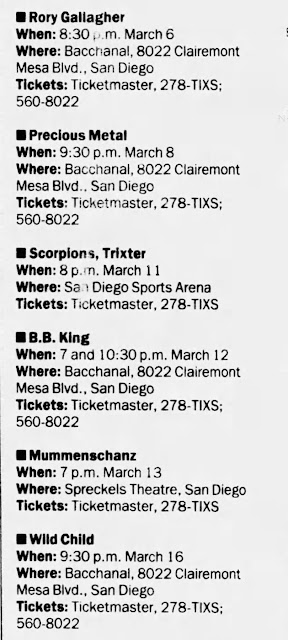
March 6th – San Diego, The Bachanal
For his final tour of America, Rory travelled around Southern California for his first few shows, beginning in San Diego. Rory performed at the nightclub The Bachanal, which despite its small size, attracted many big name musicians, such as Brian Setzer of the Stray Cats, Iggy Pop, Gregg Allman, and Pearl Jam – to name a few. The club closed in 1991, and along with venues such as Iguanas, has since been remembered as one of the major locations that shaped San Diego’s vibrant music scene in the eighties, as demonstrated in this article from the San Diego Union Tribune. Unfortunately, Rory’s full set at The Bachanal is rare to find online. However, we do get a preview from a YouTube upload of “Bad Penny“, which leads into a version of the 1973 song “No Woman, No Cry” by Bob Marley and the Wailers. On this recording alone, we gain a sense of why The Bachanal’s reputation was “the place [that] rocked until the walls sweated,” with the band’s high energy and improvisation on full display here.
For lifelong fan Marc ‘Jake Lee’ Martin, this was his sixth year of seeing Rory Gallagher when he toured America. At fifteen, Marc discovered Rory’s music when browsing his local record shop, buying the album Calling Card purely “based on [the] cover.” Although Marc wasn’t immediately “hooked,” when Rory’s next LP Photo-Finish hit the shelves, the connection was made and “it quickly became my favourite album of all time.” Over the next few decades, Marc saw Rory live in 1976, 1978, 1979, 1982, and 1985. If you would like to read his memories of those gigs, we encourage you to access them by clicking on this link. On Rory’s 1991 USA tour, Marc attended the first four shows (San Diego, Huntington Beach, Redondo Beach, and Los Angeles), as well as Chicago, St. Louis, Boston, and New York. For the San Diego show, the experiences Marc shared with us included meeting Rory and the band after the gig, and that despite Rory’s evident “health issues” (such as carrying his inhaler), “he [had not] lost any of his personality” and “was still friendly and talkative” with Marc.
March 7th – Huntington Beach, Pepper’s Golden Bear
The Golden Bear in the downtown area of Huntington Beach was opened by Harry Bakre in 1929, and originally intended as a fine dining restaurant. Over the years, the restaurant fell into the hands of various owners, all with different outlooks on what the venue should be. From 1963 – 1966, Delbert Kauffman cultivated a folk music atmosphere, featuring the performances of Bob Dylan, Buffalo Springfield, and Les Baxter’s Balladeers (which included a young David Crosby). Following this, the George Nikas years (1966 – 1974) turned the club into a rock-orientated sound, with guests such as Janis Joplin, Neil Young, and Jimmy Reed. The music continued to diversify from 1974 until the club’s closing in 1986, with managers the Babiracki Trio booking acts like Arlo Gutherie, Muddy Waters, and the Ramones. For a brief period in 1991, the club was rebuilt in the same location and re-named Pepper’s Golden Bear, which was the venue for Rory’s final gig at Huntington Beach in 1991.
Rory had visited Huntington Beach only once before on his 1985 US tour, and yet when watching to the bootleg of his show six years later, it was as if the crowd never forgot him, responding enthusiastically after each song, thoroughly enjoying Rory and the band’s blistering performance. A reason for this warm reception could be that Rory’s tour coincided with the I.R.S promotional release of his entire back catalogue on CD (as well as 1990’s Fresh Evidence), ultimately increasing sales and familiarising fans (both old and new) with Rory’s work. This marketing strategy was mentioned in Jim Washburn’s article in the LA Times on March 7th, which featured an interview with Rory prior to his gig at Pepper’s. Despite moments of doubt and frustration that have frequented him recently (“I’ve had a couple of cranky years … where I’ve gotten fed up with certain elements of touring or other parts of the business”), Rory overall expresses a positive outlook to be back on the road, and that in order “to keep your music real” one has to “play for [the] people.” In addition, Washburn reviewed Rory’s Huntington Beach show for a separate article in the LA Times published on March 9, making some interesting observations. On the one hand, Washburn takes note of the many musical high points in the concert, claiming that Rory’s “still got the sound and fury,” and emphasising his guitar prowess (“He has a command of his Stratocaster that only decades can bring. It was alive in his hands as he coaxed wild bends, tricky harmonics, and feedback screams from it”). On the other, Washburn admits that some of the magic, or “the scenery,” was lost “in all the steam of the Strat master’s blistering show.” For much of his career, the general consensus by the critics was that Rory Gallagher was a live musician rather than a studio one, and that his skills were best displayed in a concert setting as opposed to the record. However, Washburn challenges this decade-long reputation, writing of his disappointment that Rory did not include more material from “his new, surprisingly vital Fresh Evidence album,” even daring to claim that Rory’s “strengths are more consistently evident” on his latest record than his show at Huntington Beach. Whichever way we take this lukewarm review, what it does signify is Rory’s growing artistry, particularly in the field of recording, and that is reflected in his profile in the media.
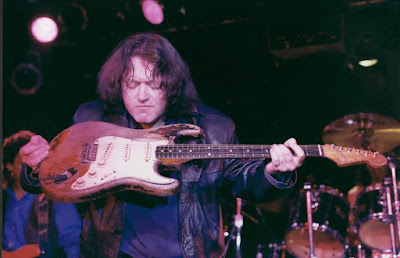
Huntington Beach, 1991.
Photograph by Patrick Kennedy
Alternatively, others were less critical and simply relished in Rory’s return to Southern California. John O’Brien became an “instant fan” when he first listened to Live! In Europe, and saw Rory live sixteen times across his career. In our email exchange, John shared a few highlights from previous gigs, such as the concert in 1974 when Rory shared the stage with John Mayall, to the time the front doors were opened at the Starwood and “Rory ran outside plugged in with a very long guitar cord [and] played “Shadow Play” on the sidewalk in Hollywood.” At the time that Rory played his final gig at Huntington Beach in 1991, the moment was symbolic for a personal reason, mainly because John brought his wife to the show, who “had become a fan of his from listening to my many Rory albums.” Although John was joyous for his musical hero to be back in the US after so long, nowadays the memories are tinged with sadness, because “little did I know it would be his last time.”
March 8th – Redondo Beach, The Strand
What eventually became The Strand in May 1986 had endured a long list of names and functions since its first opening in 1960 as the Plush Horse Inn. Before turning into a nightclub, the building had tried its luck as Annabelle’s Discothèque in 1980, a coffee shop in 1982, to finally a gourmet grocery store from 2000 onwards. 1991 was Rory’s first and only visit to Redondo Beach, and at the present time, we have found no online press reports, images, or bootlegs from the show. Nevertheless, during our six-month research we were able to collect three fan testimonies, starting with Mark, who we reached out to on Twitter. Mark attended Rory’s first 1991 show of the US in San Diego, and was lucky enough to know the manager and grab front row seats. Afterwards, Mark met Rory and the band, and when mentioning that he and his brother were going to the Redondo Beach show as well, Rory added their names to the guest list for free entry. Mark and his brother were invited backstage again at the Redondo Beach gig, remembering that after a great show, the band were “very accommodating and nice.” At this time in the tour, Marc Martin had seen Rory on the previous two nights, and recalls at this particular show the frequent interplay between Rory and Mark Feltham on harmonica, which we imagine would have been at its usual high level of expertise. Our final source comes from a fan entry on the RoryOn site, sent in by Jon. B Wilder. Jon attended the show with a group of friends, sitting at one of the tables near the stage, soaking in the “blistering” and “larger than life” onstage persona of Rory. “I will never forget how quiet, almost solemn, the club became while Rory sang the poignant and haunting “Out on the Western Plain,” Jon writes. When the show was over, Jon approached the stage to shake Rory’s hand. “He looked me directly in the eyes, and gave a wan, little smile.” In half shock, half inebriation, Jon confesses that as he “squeezed” his idol’s hand, he said, “I love you, Rory.” And while he didn’t reply, “[Rory] just gave me a knowing look like, ‘We had a good time together, didn’t we, mate?’ And then he was gone …”

March 9th – Los Angeles, The Roxy
“The line in front of the Roxy waiting to get in ran almost all the way down to the Whiskey, causing many to say that it was the strongest queue in recent memory,” John Sutherland wrote in his review for Metal Hammer. According to every source we consulted (from fan accounts to press clippings), one thing that stood out on the night of March 9, 1991, was how unbelievably packed the Roxy Theatre was for Rory’s show. “I’ve never seen the Roxy that full ever,” long time fan Dave Mayberry recalled, noting the faces of a few well known musicians hidden within the crowd. Despite the clear physical signs that he “wasn’t in good health,” musically Rory showed the opposite, and “somehow he managed to reach back and pull a great performance from the ether,” Dave said. Returning to Sutherland’s review, we discover that outside of the renowned onstage jam with Slash, the press continually report on the high standard of Rory’s musicianship displayed at the gig, and that despite a six-year absence from the US circuit, “his skill as a performer, guitarist, and blues-rock storyteller has not diminished at all.” Bill Holdship for Bay Area Music magazine commended Rory for keeping the power of the blues-rock trio alive and current, reminiscent of Cream and the Jimi Hendrix Experience, “as though they’ve been perfectly preserved in a time warp for the last two decades.” Rory’s return was certainly appreciated by all those listening, and for critics such as Holdship, the chance to hear Rory songs like “Bad Penny” and “Shadow Play” “made this fan once again wonder why [Rory] never became a staple on FM radio.”
Much like the 1975 Rolling Stones session, following his final US tour, journalists would continue to ask Rory about his appearance at the Roxy and the impromptu jam with Slash on “Bullfrog Blues”. “You sometimes get the impression that [Slash] doesn’t care, which is far from the truth,” Rory said in 1993’s Guitar World, “as in the next instance he can let loose a riff that will freeze your blood.” Rory continued his praise of the “very charming” and “timid” guitarist from Guns N Roses, particularly on his “respect to the music and to its origins” in his playing. On many occasions since Rory’s passing, Slash has been asked about the night at the Roxy, appearing in documentaries such as Ghost Blues to recount the event. Meeting Rory left a “great impression” on Slash, and in a 2015 interview with BBC One, Slash admits to the “surprise” he felt when hearing the news Rory had passed away, since “he just seemed so vibrant when I saw him.” Critics positively received the “Bullfrog Blues” jam, Holdship highlighting the “terrific” rendition of Chuck Berry’s “Nadine” and “Little Queenie” towards the end of the set. Nevertheless, according to both the press and fans, the night at the Roxy was most definitely Rory’s night. For Holdship, Rory’s virtuosity “outclassed” the young talent of Slash. For Marc Martin, there was simply “no comparison” between the two guitarists – “Rory was so much better.” And perhaps even Rory could feel in the balmy, packed Roxy that it was his night too, as he left the show “with a big grin that reached everybody in the room,” promising to return “soon.”

March 11th Tempe, March 12th Tucson, March 14th Oakland
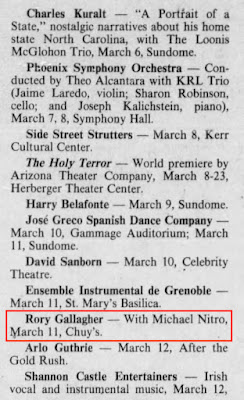
Due to the insufficient amount of information we could uncover about these next three shows in Rory’s 1991 US tour, we have grouped them altogether. Newspaper reports, images, and even fan testimony were scarce to come by, though we managed to dig up two bootlegs. The first is a medley of “Tumblin’ Dice / Bullfrog Blues / Boys Are Back in Town / Be My Guest Tonight” from Rory’s gig at Chuys in Tempe, Arizona. In this brief taste of the show (which unfortunately cuts off midway through Fats Domino’s “Be My Guest Tonight”), we hear Rory’s musicianship at an equal level to previous bootlegs from San Diego and Huntington Beach, indicating that Rory was staying on top form throughout the tour so far. His slide soloing is sharp and explosive on “Bullfrog Blues,” and the crowd continue to show wild admiration. The second bootleg is a full concert at the Omni club in Oakland, California, where again Rory doesn’t let the audience down, starting strong with “Continental Op” and “Moonchild”, to the rocking “Laundromat” as an encore.
March 15th – Santa Cruz, Catalyst Club
Rory continued his travels along the San Francisco Bay Area with his first and only visit to Santa Cruz on March 15, playing the Catalyst Club. The press showed great anticipation for Rory’s performance, as displayed in Tom Long’s highly favourable review of Fresh Evidence in the Santa Cruz Sentinel the night before the gig. “I heard a number of Rory Gallagher albums in the 70s,” Long writes, “and this one [FE] sounds better than any of them.” Long’s comments mirror the sentiments in Jim Washburn’s article for the LA Times, praising Rory for a “consistent” and “[well] thought out” album. Prior to the gig, journalist for Guitar Player magazine, Jas Obrecht, interviewed Rory backstage. With the kind permission of Obrecht, we were allowed to publish the previously unseen transcript of this interview, which you can access here if you did not already when originally posted in June. For those of us who were not there on the night, the two-hour performance has been posted on YouTube, and can be listened to on this link. The bootleg showcases some musical treats, such as the fiery version of “Mr. Pitiful”, which Rory occasionally threw in on the end of “The Loop”.
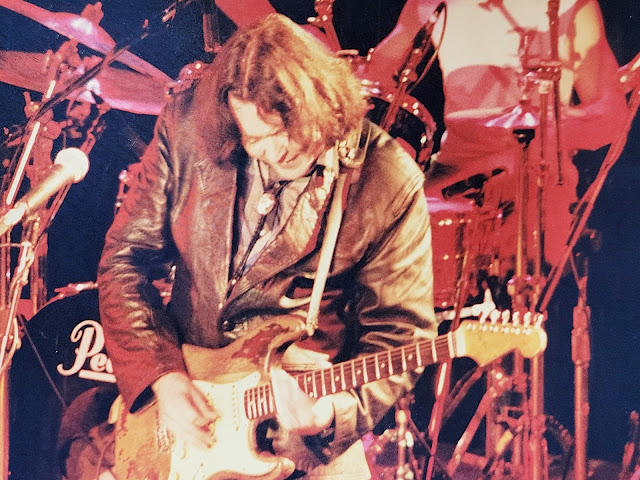
Photograph shared with us by Dawn Moore
March 16th – San Francisco, The Stone
This was Rory’s seventeenth visit to San Francisco, and his second time performing at The Stone since his 1985 US tour. We were unlucky in the search for newspaper reports of the gig, and the only online bootleg is an upload of “Bad Penny”. Nevertheless, back in March we exchanged Facebook messages with Colleen and Carolyn Phillips, a mother and daughter from the San Francisco area. Colleen has been a Rory fan since the early 1970s, often attending Rory concerts with her husband whenever he was doing a local show. Rory’s music was constantly played in the Phillips’ household, and when we asked Carolyn what Rory’s music means to her, she answered: “It’s home, it’s good times, and it’s memories. Rory was my first live concert at nine years old! I can remember sitting right up front against the stage and having my mother shove cotton in my ears!” Like many, Rory formed part of the soundtrack to the post WW2 generation. As evident in Carolyn’s responses to us, Rory’s songs are attached to specific memories for her, whether she was nine years old or thirty years old. In this case, Rory’s music also bonded families. Rory’s appearance at The Stone in 1991 coincided with Colleen’s birthday, and Carolyn was able to organise a special birthday present at the concert for her mother. Carolyn mailed an addressed letter for Rory to The Stone days before the show, which “explained what big fans my parents were of his and how they were regulars at his San Francisco Bay Area gigs. I explained how I wasn’t going to be able to attend, but that my parents were going and that it was my mother’s birthday. I told him her favourite song was “Moonchild” and asked it he could dedicate it to her that night.”
Colleen had this to share about the unexpected birthday shout-out:
[My husband and I] were standing about halfway back in the audience. Rory had just finished his opening song. Then he said, “This next one is for Colleen!” and began tearing into “Moonchild”. My jaw dropped wide open. I looked to my right and some people were holding up their drinks saying, “Here’s to Colleen!”, and the house rocked with the wild sounds of “Moonchild” with people dancing, jumping up and down having a great time! It’s probably the best my best birthday gift ever. I was beyond surprised that something like that actually happened and was grateful nobody knew where I was in the audience. But it also shows the character of Rory Gallagher. A single letter to him from my daughter requesting a song could have simply been tossed aside or into the trash bin, or never even looked at. But it wasn’t and I’ll never forget that night.

Photograph by Brian Brady, used with his permission.
If you would like to read more about Colleen and Carolyn’s story, we encourage you to click on this link for their full interview transcript.
March 17th – San Jose, The Cabaret
Taking place on St Patrick’s Day and knowing what a blast Rory concerts on this date often were (for example, his 1980 gig at the Lyceum in London, where all tickets included a free pint of Guinness at the bar), it’s a real shame that our trail ran fairly cold when it came to collecting information about his show at The Cabaret in San Jose. We couldn’t find any photographs, ticket stubs bootlegs of the concert, and we only managed to track down one fan who was there: Glen Arbor. Nonetheless, Glen offered us a thrilling account of the concert, recalling how The Cabaret was “sold out and filled to the brim with hardcore Rory fans.” As he arrived late to the venue and couldn’t find a seat, he spent the duration “perched on top of the cigarette machine towards the back.” This unusual spot, in fact, gave him “a perfect sightline” and was also in front of the soundboard, enabling a “flawless” mix. Overall, Glen described the evening as “unforgettable” and regretted that this was the last time that he ever got to see Rory live. After 16 years in operation, the Cabaret Club closed in 1997 and has remained virtually untouched since (see photo below).
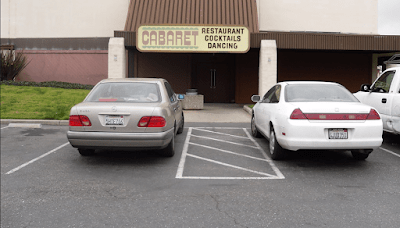
Photograph by Niels Marienlund
March 20th – Minneapolis, Guthrie Theater
One of the first things I (Lauren) did when I became a Rory fan was look up my date of birth on John Ganjamie’s RoryOn website to see if it coincided with a particular concert. When I saw that it indeed did, I was haunted to track down a recording of the concert in question: Minneapolis ‘91. It’s crazy to think that, while I was being born on one side of the Atlantic, Rory was on the other ready to put on the show of his lifetime at the Guthrie Theater. Little did I know as a blissfully unaware newborn that, as I grew up, this man would become the centre of my universe. That, as I was starting my journey on the path of life, this sweet angel’s journey was drawing closer to its (premature) end. That he would never live long enough for me to one day get the chance to meet him, thank him and tell him how much he means to me.

All of these thoughts rushed through my head as I read more about Minneapolis ‘91, so my bar was set very high when I finally managed to obtain a copy of the concert and sat down to watch it a few years ago (sadly, the concert has long since been taken off YouTube for those hoping to find it). Needless to say, it lived up to all my expectations and more. There are so many highlights in this two-hour plus show, from particularly blistering versions of ‘Moonchild’, ‘Don’t Start Me Talkin’’ and ‘Off the Handle’ at one end of the scale to beautifully emotive renditions of ‘A Million Miles Away’, ‘Out on the Western Plain’ and ‘Walkin’ Blues’ at the other. The new material from Fresh Evidence like ‘Walkin’ Wounded’, ‘Ghost Blues’ and ‘Heaven’s Gate’ also goes down extremely well with the crowd. Every time I think I’ve found the definitive version of a Rory song, along comes another one to challenge my belief and that’s certainly the case here with ‘Kid Gloves’. For a long time, it was the Rockpalast ‘90 version that I turned to, but the Minneapolis version is somehow even better; Rory’s vocals are superb and both guitar solos are so fuelled with power and intensity. But my overall favourites are ‘Laundromat’, delivered with all the energy of the 23-year-old Rory was at the time of its original release yet enhanced now with his older, grittier vocals; ‘Goin’ Down to Eli’s’ (which we also mentioned in Part 1), which is so slick and oozing with bluesy soul, accentuated by Mark’s harp playing; and ‘Pistol Slapper Blues’, which I was thrilled to see back in the set and mixed in with Broonzy’s ‘Keep Your Hands Off Her’, showcasing Rory’s expert fingerboard work. Special mentions also go to the two encores that Rory delivered: a killer version of ‘Loanshark Blues’ (the slide work is sublime!) and the final song ‘Used to Be’ (an unexpected surprise that sent the crowd wild).

Photographer unknown
One person who has very fond memories of the Minneapolis gig is Dave Mangin. Dave had “no idea” that Rory was coming to his city until his mum called him at work and said, “That Irish blues guy you really like, Rory Whatshisname, is here tonight at the Guthrie. Can I get you a couple of tickets?” “Hell yeah!” was Dave’s reply, of course. Flash forward to the evening and Dave describes it as the “best concert [he’s] ever seen.” Although it was evident to Dave that “the road was wearing on Rory then,” he “never let up” for the whole two hours and fifteen minutes. Particular standout moments for Dave were the few bars of ‘Tumblin’ Dice’ that Rory threw in during ‘Bullfrog Blues’ (“you could really get why the Stones had him on the list of players to replace Taylor”) and ‘Off the Handle’ where Rory changed around some of the lyrics (“when the cat’s away, the mice play”) and he and Mark made sounds on their respective instruments that Dave has “never heard anyone replicate” and which sent him and his friends “nuts.” Although Dave didn’t meet Rory on this occasion, he had met him in 1979 and recalls him as being “the most gracious man.” Daryl Schwartz was also at the show and describes Rory as still having “magic up his sleeve” and being an “unbelievable musician” despite his ill health.
Prior to the Minneapolis concert, Bruce Bitt of the Star Tribune published an article entitled ‘Blues resurgence gives guitarist Gallagher a boost’. In the article, Bitt adopts the same narrative as many other US journalists, explaining how Rory has been “absent” for years and wondering whether he’ll be able to live up to his previous standards. Rory tells Bitt how “tough” it was for him to still play blues music throughout the 1980s, but with his usual optimism, he expresses hope that “young people want something real now.” Rory also spoke to John Sakamoto of the Toronto Sun following his Minneapolis gig. He repeats his belief about young people being tired of “video” music and looking for the “raw bones and roots of rock again” and states how encouraging it was to see a mixture of ages at his recent concerts. Sakamoto draws a wonderful parallel between Rory and the character in ‘Kid Gloves’ (which we ourselves have spoken about before on Rewriting Rory), noting his unwillingness to “yield to the demands of the music biz.” Rory explains how ‘Kid Gloves’ is “a statement of defiance against the way things are and you can’t put a good man down.” However, he adds with a laugh that if he was really as bitter as the man in the song, he’d “be in trouble.”

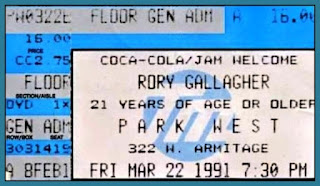
March 22nd – Chicago, Park West
“Perhaps the moral of the story is never ever call an album Jinx,” wrote Chris Heim of the Chicago Tribune in an article published the day before Rory’s concert at Park West in Chicago that once again referenced his long absence from the US. “Now it seems the curse has lifted,” Heim continued, emphasising how Rory is “roaring back with one of the strongest albums of his career” (Fresh Evidence). In the article, Rory talks to Heim about how playing live is “much more natural” for him and that he relishes in the “instant reaction and feedback from the audience.” He also describes how blues “needs a bit of atmosphere […] interplay […] and roughness,” which is only possible with a live audience.
Rory’s cover of Otis Redding’s ‘Mr Pitiful’ – the only song recorded from the Chicago gig that is in circulation – clearly encapsulates all of the above requirements for a strong live performance. Rory threw ‘Mr Pitiful’ into his set from time to time throughout the 1980s (Tegelen 1984, Voelkingen 1987), but this 1991 version is the best one we’ve heard. It is energetic, raw and passionate, and features incredible accompaniment by Mark on the harmonica, as well as encouraging cheers from the audience.
Martin Hayes, the prolific Irish fiddler, was living in Chicago when Rory rolled into town on 22nd March. As a long-term fan, he knew that he had to get tickets. Speaking to Hot Press in the Rory Gallagher 25th Anniversary Special Edition, Martin had the following to say, which again demonstrates Rory’s ability to create the perfect mood in his live performances:
The concert was sold out by the time I found out about it, but since I’d never managed to see [Rory] live, I felt compelled to go and see if I could somehow get in. I did eventually, after much pleading and effort, but I had missed the first twenty minutes in the process of trying to talk my way in. By the time I got into the venue, an incredible atmosphere had built up in the room. Rory was in full command of the evening, it was an amazing display of pure charisma, energy, and passion, with nothing held back. The great blues town of Chicago embraced Rory Gallagher and his music with wild enthusiasm and he was for me, on that night, the conquering Irish hero that my teenage imagination had always envisioned. I remember saying to myself, this is how the stage should always be approached: give everything, hold nothing back and be completely yourself. That occasion showed me the enormous power that one individual with a deep commitment could generate.
Rory’s performance in Chicago also holds special memories for Jeffry S. At the end of the show, Rory reached out to the crowd. Jeffrey immediately pushed his way to the front of the stage to shake his hand. When Rory and Jeff’s hands met, Jeff held on tight and wouldn’t let go, leading Rory to look down at him. “Our eyes met and a dream was fulfilled,” he reflected.
Continuing his ambition to catch Rory as many times as possible on his 1991 US tour, Marc Martin was also at the Chicago gig. He had seen Rory perform in Park West previously in the 1980s when the venue was more upmarket, but by 1991, it was “rundown” and no longer had “tables or waitresses.” Mark’s main memories of Chicago come from the night before when he met Gerry and Brendan by chance in a blues club on Lincoln Avenue. When he asked them where Rory was, they replied, “You don’t wanna know. He really doesn’t go out.” It’s somewhat painful to contrast this image of a reclusive Rory offstage with the “conquering Irish hero” (as Martin Hayes put it) that he was onstage, especially when being in a city so deeply rooted in the blues and brimming with live music. We know that Rory was hurting immensely from Gerry and Brendan’s decision to leave the band, so it is understandable that he wanted to spend time alone when not performing. Rory was not, however, just stewing in his hotel room reading “his beloved detective novels,” as Gerry wrote somewhat sarcastically in Riding Shotgun. Speaking to Jas Obrecht, Rory explained that he was feeling particularly inspired to write on this tour and was also enjoying listening to folk music on his cassette player and playing some jazz and ragtime on his acoustic, all of which he was finding “good for [his] mental health.” So, we like to think that part of Rory’s “reclusiveness” here was to take some well-deserved time for himself and to recharge his batteries before moving on to St Louis for the next show in his jampacked schedule.
March 23rd – St Louis, Westport Playhouse
When speaking to fans about Rory’s concert at the Westport Playhouse in St Louis, most of their memories were of the venue’s revolving stage rather than Rory’s performance per se. Although “there was absolutely nothing amiss” about the concert and it was up to Rory’s usual high standards (as fan Mike Moscardelli told us), many found the stage off-putting. Kirk Koster wrote on Facebook, for example, “Watching Rory and the band go round in circles wasn’t conducive to the show. I always enjoyed Rory being right in your face.” Amy Maloney equally recalls that the 360-degree circular stage was “okay if you liked looking at the back of the band and their amps half the night.”
Rotating stage aside, other fans recall how great it to be in such close proximity to Rory: “You could darn near reach out and touch him” (Dean Gostling); “He came out right next to me and shook my hand” (Nick Nastoff); [he] fucking rocked from the first song till the end” (Gregg Hulsey). Several fans also told us that Rory arrived on stage very late in the evening at this concert. According to Nick Nastoff whose friend worked at the Westport Playhouse, Rory was suffering exhaustion and Dónal “had a hard time” waking him up to play. Nick said that it was very apparent that Rory’s health was “in decline,” yet he still found the strength within him to pull out all the stops and deliver a “great set.” We hear these types of stories time and time again in our research for Rewriting Rory and they really pull on our heart strings. They emphasise Rory’s great respect for his fans and his desire to always do his best for them, even in trying circumstances.
The St Louis show was greatly appreciated by journalist Louise King who wrote a glowing review for the St Louis Post Dispatch. In it, she describes Rory’s ‘comeback’ as “[the] triumphant [return] anyone could have hoped [for]”:
Gallagher was in his element, delivering down-and-dirty blues-based arrangements like there was no tomorrow. His energy was surpassed only by his technique, as he succeeded in eliciting tones from his guitar that consistently amazed the appreciative audience. Standing ovations followed almost every number. And with each ovation, Gallagher seemed to get more adventurous.
She mentions how ‘Ghost Blues’ in particular received the longest ovation and that its “tight, powerful riff nearly mesmerised the capacity crowd.” She concludes by saying how Rory might have kept St Louis waiting a long time, but the response of the Playhouse made it clear that they had forgiven him.
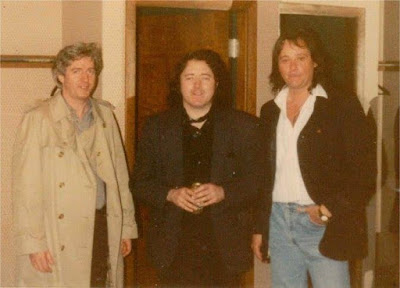
Photograph by Greg “Boom” Bishop
King also conducted a telephone interview with Rory prior to the concert, which was also printed in the same newspaper. Unfortunately, this piece conforms to the typical “rise and fall” narrative that we constantly strike back against with Rewriting Rory. She explains how Rory “spearheaded the Irish rock movement, carved out a reputation as a guitar virtuoso and one of the finest slide players in the world” only to “virtually drop out of sight” after 1982, which she puts down to a “disappointing tour opening for Rush.” Despite these comments which, like so many other newspaper articles, almost try to set Rory up to fail, Rory is positive in his responses, stating how he’s been surprised at the “great reaction” from the crowd so far on the tour and that there’s a “lot more interest” in him than he anticipated, which was “good for the morale.”
A far better interview, published on the same day, comes from George Varga of The Daily Spectrum – a Utah-based newspaper. Varga describes Rory as a “solid performer” who has earnt a place in the “pantheon of rock” and recognises that he has had a huge influence in the music world today and is still just as relevant. Rory explains to Varga how he tries “to be more than just a guitar hero” and that he encourages young people who are fans of Eddie Van Helen to “check out what [he does] and just give [him] a chance.” He goes on to state how he’s “not trying to outsell Presley or the Stones,” but that he thinks there is still a “valid place” for his music. With his typical dry wit, he notes how “somebody in Europe wrote recently that I’m so unfashionable that it’s actually a plus for me!” and that he’s deliberately tried to “stay out of the ‘getting old’ syndrome” and avoid joining “the rank-and-file” of his generation. He tells Varga that his motivation is simply playing, that it’s good for his health to keep touring and that, as Bob Dylan sang, ‘it’s too late to stop now” – all comments that are a little bittersweet when reading in retrospect.

March 24th – Cleveland, The Empire
Tearing Down the Empire couldn’t be a better possible name for the bootleg of Rory’s incredible show at The Empire in Cleveland on 24th March. For a bootleg, the sound is crystal clear and the two hours perfectly capture the supremely high level at which he was playing during this tour. Blood, sweat and tears are poured into every second of this performance, with Rory constantly pushing himself harder and harder with such raw energy and emotion that it’s exhausting just listening to it! It’s something we repeat on Rewriting Rory, but how on earth Rory was able to continue delivering in this way despite being so unwell is utterly remarkable, almost superhuman, and we commend him so much for it.
The recording takes me on the same rollercoaster of emotions, no matter how many times I’ve listened to it. I laugh with ‘Don’t Start Me Talkin’’, I cry with ‘I Wonder Who’, I scream with ‘Ghost Blues’, I boogie with ‘The Loop’, I get shivers down my spine every time the quiet part in the ‘Bad Penny’ solo kicks in, I rock the hell out of my living room to the opening riff of ‘Shin Kicker’ and then I sit back down stunned as the acoustic set begins (this version of ‘Empire State Express’ being the best I’ve ever heard), before being lifted up again to the sounds of ‘Shadow Play’. By the time the barnstorming encore medley of ‘Tumbling Dice’/’Bullfrog Blues’/’The Boys Are Back in Town’/’All Around Man’/’Souped-Up Ford’/’Be My Guest Tonight’ has finished, bringing the show to an end, I feel like I’ve transcended and attained nirvana. It doesn’t matter what might be going on in my life; at that moment in time, everything just seems right and I feel so happy to be alive and be blessed with Rory’s beautiful music. Why Cleveland ‘91 hasn’t had an official release yet beggars belief. While Check Shirt Wizard and Live in San Diego are both great albums, Rory’s 1970s material is very well represented already in his discography. Surely, it’s about time we see the release of some later live performances? And Cleveland ’91 is definitely right at the top of our wishlist!
Given the sheer intensity of Rory’s performance at The Empire, we were disappointed not to be able to track down anybody who was in attendance that night, nor to find any photographs of the concert. We did, however, come across an interview that Rory gave with Judy Black of Cleveland Scene prior to his concert. Like with Jas Obrecht, Rory speaks of how he has been feeling particularly inspired on this tour and has been “writing a bit every day” and “playing a lot more in the hotel rooms.” He also explains how his song-writing “had a boost” several years ago, when he came up with “some new ideas, some new themes and new approaches” and “defined the blues roots a lot more.” These are things that we have argued ourselves throughout our Rewriting Rory articles. Contrary to the notion that some journalists (and fans) have of Rory being stagnant, outdated and not progressing in his later years, he was, in fact, continuously developing, moving beyond that label of “guitar hero”, exploring all sorts of genres and growing into a mature and eloquent songwriter. Rory speaks with optimism to Black about his next album and how he is looking forward to getting into the studio in the summer to start recording. We know from a 2003 interview that Dónal did with Shiv Cariappa that some of that material is out there, at least in lyrical form or on rough tapes (e.g. a tribute to John Lee Hooker called ‘The Detroit Lion’). We can only hope that it gets an official release one day.

March 25th – Detroit, Key West
“[I] cherish the blessing [I] had in having seen Rory play live,” long-term Rory fan and working musician, Marianne Murphy, told us when we spoke to her earlier this year. Marianne had first seen Rory live at the Royal Oak Music Theatre in Michigan in 1976. She came to the gig with a homemade Irish flag on which she’d painted “Rory Go Bragh” within an Irish harp and pushed her way to the front to give it to him. Rory subsequently draped it over his amp for the rest of the show. Marianne saw Rory again on his 1985 tour, this time at Harpos in Detroit where she presented him with a cross stitch picture of his guitar in a frame. When Rory returned to Detroit in 1991, Marianne was sure not to miss the concert, which she described as “fantastic.” After the show, she waited with her husband to meet Rory. Typical of Rory’s kindness, Marianne recalls how, although he was “exhausted,” he was “gracious” and autographed her copy of Defender. When they were driving home and stopped at a red traffic light, her husband noticed Rory in a van alongside looking across at them. Marianne said that she deliberately couldn’t look at him because she felt that she had “taken up enough of his time already.”
On Bibi’s Rory Gallagher Facebook page, Jeffrey Albergo also shared his memories of the Key West show:
The parking lot was full of people that couldn’t get tickets. It was so loud they could hear the whole show. This was my 4th and final time I saw [Rory]. I talked 25 of my friends and co-workers to go, I bought all the tickets the club had on hand. It was a great night!
Unfortunately, there are no bootlegs circulating online of Rory’s performance. However, a number of Detroit press articles prior to the concert do their best to capture what it’s like to experience one of Rory’s live shows. Susan Whitall of the Detroit News, for example, describes Rory as a “wired-up ball of Celtic energy” who is “matchless” as a live performer and who plays with such passion and power that he “leaves the audience as wet as he is.” Gary Graff of the Detroit Free Press, on the other hand, gave Rory an opportunity to discuss how he sees himself as a musician. Rory’s answer is reflective of why we all hold him in such high esteem for his integrity and honesty:
You see, I just believe in what I’m doing. I can see the commercial pitfalls of taking the wrong detours, but I don’t want to be a pop star, number one, and I don’t mind experimenting with music. For myself, I just like the honesty and rawness; you can still be progressive in your lyrics and in the way you use chords and notes. And if you match that with a rootsy sound and mood, you’ve achieved something.
Marianne Murphy certainly believes that Rory achieved more than just something with his music:
Rory’s music makes connections between different genres. It can have some blues, jazz, folk and good old rock and roll. Rory’s music brings people together in a mutual admiration for his talent of which he so generously gave us […] Rory was hugely inspiring for me [as a musician]. I used to play lots of slide blues acoustically. I started listening to the old masters like Robert Johnson, Muddy Waters, Son House, Charley Patton…
Marianne told us that, after her final meeting with Rory in 1991, she was inspired to write a song about him called ‘Hero from the Emerald Isle’. She had hoped to give it to him one day, but instead she passed it on to Paddy Maloney of the Chieftains. The song did, however, end up on the Rory tribute tape They Don’t Make Them Like You, compiled by Rick Oppegaard shortly after Rory’s passing.

Photograph shared with permission from Marianne Murphy
March 26th – Toronto, El Mocambo
Before the show, Rory visited the deejays at the Toronto radio station Q107-FM, discussing a range of topics such as the current Irish music scene, the influence of Lonnie Donegan and skiffle, to his fear of flying that had prevented him from visiting North America in recent years. Throughout his career, Toronto featured in Rory’s touring schedule for a total of twenty times since 1973, and he had played the El Mocambo club on five occasions prior to his final visit. Online bootlegs of the night include the first three numbers (“Continental Op”, “Moonchild” and “I Wonder Who”), as well as “Tattoo’d Lady” and the roaring “Bullfrog Blues” medley (“All Around Man”, “Be My Guest Tonight” and “Tumblin’ Dice”).
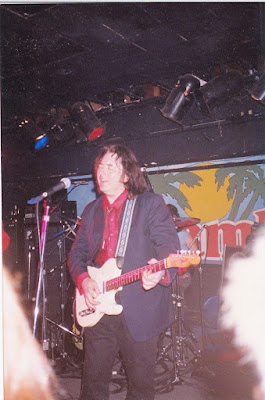
Mocambo, Toronto, 1991.
Photograph by Gerry Crane
March 28th – Sayreville, Club Bene
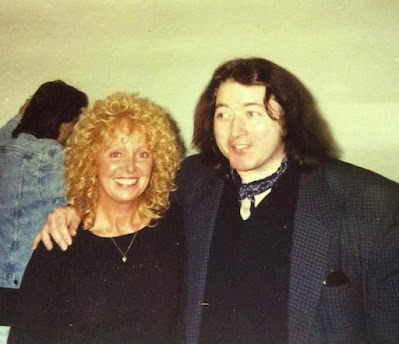
“I don’t actually tour the States to make money and I don’t play music for money as such,” Rory explained to Richard Skelley of the Central New Jersey Home News prior to his gig at Club Bene in Sayreville on 28th March. This is one of many great insights into Rory’s attitude to music that he gave in this interview, which includes other gems about the blues revival (“I didn’t need that to keep my interest in the blues”), his fear of blues becoming too popular (“if blues becomes any more successful than it is right now, I don’t know if it’s going to be considered alternative anymore”), his new record company (“They haven’t exactly been dictating things to me, but we’ll see how it goes!”) and his concerts (“We don’t play with a set list, we mix it up every night”). Indeed, one of the things that kept Rory’s gigs constantly exciting was this element of surprise, of how no one night was ever the same. And Sayreville 1991 is no exception, fan Bruce E. Barrett recalling a particularly interesting memory that he has of the show:
Some guy jumped up on stage during A Million Miles Away and when a stagehand tried to get him off he went into karate mode and the stagehand backed off. The guy was doing karate moves to the guitar of A Million Miles Away and Rory kind of walked the guy off the stage while still playing and nobody got hurt or in a fight. You had to see it to believe it. Wish it had been filmed […] Pretty cool when you think how [Rory] had the power to calm a bad situation down and no one got hurt or thrown out.
We can’t get enough of this story, which is so characteristic of Rory’s attitude to his fans. He was always so accommodating to them – even when they got up on stage and disrupted the show – and always handled any potentially threatening situations in his own gentle and pacifist way, remaining cool, calm and collected and playing on uninterrupted (note, for example, the infamous Athens 1981 gig where he still tried to play, despite tear gas in the air, mass rioting and fires).
Photographer unknown
Robert Gannon was also at the Club Bene show and remembers Rory and the band as being “phenomenal.” He attended with his brother and wife and remembers that she was reluctant at first, having not seen Rory in concert before. After, however, she was suitably blown away and thrilled that Rory didn’t “sing about girls, sex and drugs like most bands.” Although Robert had seen Rory previously on the 1982 Rush tour (and pretty much every time he toured the East Coast from 1979 onwards), he felt that witnessing him in the intimacy of a smaller venue was “even better” and “blew [him] away.” Robert described Rory as a “phenomenal showman” with “incendiary” guitar playing and a “wonderful” rapport with his audience. He is delighted that so many “kids”, such as Jack Austin Despy and Dea Matrona, are keeping Rory’s music “alive and well” today.
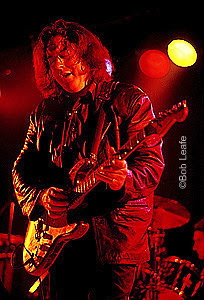
During our preparation for this article, we also managed to track down music photojournalist Bob Leafe who took photographs of Rory at the Club Bene concert. Bob had previously shot Rory in 1978 at the Bottom Line in New York and backstage at the Palladium and described him as “an absolute wild animal on guitar” during his live shows. Although Bob couldn’t remember any specific details of the Sayreville concert or meeting Rory afterwards, he kindly gave us permission to post this fantastic photograph that he took (see below).
Photography by Bob Leafe
March 29th – Boston, Paradise Theater
“The Paradise will be rumbling tonight: in person, Gallagher hits overdrive,” journalist Steve Morse wrote in an article for the Boston Globe, published on the morning of Rory’s gig in Boston. And indeed, rumbling the Paradise was, although, unlike other nights on the US tour, the wheels took a bit longer to get in motion than usual. Speaking to Shiv Cariappa in 1997, Brendan O’Neill recalled the Boston gig being a “nightmare” because there were “a lot of problems on stage.” Apparently, the rostrum was too small for the drumkit, which meant that the cymbals constantly fell off and long-time roadie Tom O’Driscoll had to keep running on stage to put them back on. Brendan felt that this had affected the performance and he hoped that it wasn’t “too obvious” for the audience.
Several people that we spoke to who were in the audience at The Paradise, in fact, did notice that Rory and his band seemed to be having difficulties. However, they also all commented on the remarkable sight they witnessed before them that evening: of Rory undeterredly playing, drawing energy from the crowd and progressively getting better and better. Keen to ensure that his fans didn’t go away disappointed, Rory ended up playing the longest show of the entire tour at just over three hours in length. A constant theme for us on Rewriting Rory is Rory’s “boxer spirit” and how he always persevered and managed to come out on top against all odds. And that’s exactly what he did at The Paradise, channelling his frustrations with the sound into an explosive performance like the true pro that he was.

Courtesy of Michael Pellegrini
As Marc Martin, who we encountered earlier in this article and who was also at The Paradise, told us:
[Rory] was kind of having an off night. Any musician on a tour is gonna have an off night. It happens. But what he did was… it was amazing! He played for three hours. He kept pushing. He kind of got over it, and he started playing songs that I hadn’t heard on the tour. I think he played ‘Souped Up Ford’ and ‘Walking Wounded’, or ‘Slumming Angel’, I think it was.
Mark Morrison – another Rory fan who was at The Paradise on 29th March – also gave us a similar account. He had seen Rory four times previously (first on a double bill with Deep Purple in 1973, then subsequently in 1976, 1982 and 1985) and had “mixed” feelings about the 1991 gig in Boston:
[Rory] looked quite ill and overweight to my eyes that evening and wore a heavy leather coat to try and disguise the fact […] But if there was ever a performer who drew energy from an audience, it was Rory, and the crowd that night was absolutely rabid. As the evening progressed, he seemed to become stronger and more engaged. And towards the end, when he hit the first chords of ‘Used to Be’, the collective roar from the audience damn near blew the roof off the joint. That moment is how I love to remember him.

Photographer unknown
Also in attendance at The Paradise was Michael Pellegrini. He hadn’t seen Rory live previously and remembers being “so thrilled” when he discovered just the day before that Rory was playing locally and immediately bought a ticket. For Michael, the concert was “amazing,” “very high energy” and “pure enjoyment from start to finish.” Being used to big venues, he couldn’t believe how up close and personal he was to Rory in the club. Michael recalled how Rory was “so into the audience and loved running around, even at his middle age.” “He never lost it,” Michael concluded, his four words succinctly encapsulating our fundamental argument with Rewriting Rory. At the end of the concert, Michael yelled Rory’s name as he was walking off stage. Rory turned around just as Michael tossed a CD up onto the stage and asked if he could sign it. Unfortunately, his timing was off; Rory had looked back at the other band members and didn’t see it. He did, however, walk over to Michael’s group and sign his friends’ CDs. Michael was “devastated” that he didn’t get his own signed and had a roadie retrieve it for him once Rory had left the stage.
John Fisher also waited after the show to meet Rory, but to no avail. He ended up giving a self-addressed stamped envelope to a roadie and asking him to pass it on to Rory. Speaking of the concert itself, John was amazed how someone so “sickly looking” could still perform with “a lot of energy” – something that we ourselves have often marvelled at and are in awe of Rory for being able to do. One person who was lucky enough to meet Rory in Boston, however, was Derry Pennywell. Derry’s relationship with Rory goes back a long way – to 1972 in Limerick, in fact. Derry was an underground DJ who decided to call into the Savoy Theatre to watch Rory’s soundcheck. He was approached by Dónal who thought he was Jack Costello of Grannie’s Intentions and asked him to sit in on drums as Rod De’Ath was running late. Derry spent a good half an hour filling in for Rod, describing Rory as “very gracious and kind.” Flash forward almost twenty years and Derry was living in Boston, where he received a call from a friend telling him that Rory was going to play at the Paradise Theater. As he told us:
I immediately got on the horn to my contacts in the radio world (where I worked in for 20 years) to get hooked up for backstage access. Bottom line, no access to that club for that show. That didn’t stop us from making a day of it in Boston and we arrived at the club in time to be third and fourth in line. Doors opened and I saw this young kid rush inside grab one of several Rory posters off the wall, so I snagged one also, rolled it up and then grabbed a spot in front of the Vox amp. Rory did his typical powerful workhorse show and delighted the older fans with some material going back to his early days. I had forgotten what his pure blues/rock felt like. As the venue emptied out, I worked my way to the side stage door manned by two burly bouncers and said I know you have heard every story by backstage wannabes and I explained how I had met Rory and the circumstances and said tell Donal Gallagher that a Jack Costello from Limerick wants to say hi. It being Boston, of course the two lads were ‘Irish’ and that seemed to make it all work out. As I was ushered in through the door, I noticed the young kid that had grabbed the poster first right behind me so I said, ‘He’s with me, is that OK?’ It was. In we went and the young kid approached Rory and I to Donal where I quickly explained the truth of the matter. Much to my amazement, Donal remembered the night their drummer almost missed his first gig with Rory and gladly introduced me to ‘The Gally’. I thought he looked tired and put it down to the show and the tour. He was his quiet, polite usual self and gladly signed both posters. That was the last time I saw or heard of Rory until the shocking and sad news he had passes away all too young. That little boy from Donegal, with minimal outside influence and lessons blazed his own trail through the pages of rock and roll history where he wrote his own story, a story still being read.
“It’s funny how quickly some people forget you,” Rory had mused to Steve Morse of the Boston Globe when talking about his six-year absence from the US. After his performance at the Paradise, Rory certainly made sure that the people of Boston never forgot him again. More than 30 years later and everyone we spoke to still has fond memories of the “unbelievable night” (Ken Bartlett) and “great show” (Brian W. Greene) that Rory put on. As Mark Morrison summarised, “If they took a DNA sample from me, [Rory’s] music would be found there.” I think he speaks for us all when he says that.

Photographer unknown
March 30th – Marquee Club, New York
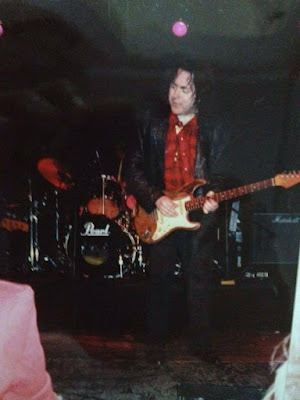
As the proverb goes, all good things must come to an end. And so, on 30th March, Gerry McAvoy and Brendan O’Neill played their last official gig with Rory at the Marquee Club in New York (they would come back as ‘special guests’ for several dates in 1992 while Rory got his new band together). The thirty minutes of surviving footage on YouTube show an extremely tight band at the top of their game and you’d have no idea of the tensions beneath the surface or that Gerry and Brendan were about to go their separate ways. On watching it, we are reminded of the strong resemblance to Taste’s 1970 performance at the Isle of Wight where the “cocktail of venom and exasperation,” as Henry Yates of Louder Sound put it, “brought out the best” in the band and spurred them to a “seven-song thriller that represented their last great live performance.” Although the footage is poor quality – shot from a camcorder in the audience – it is great to have this poignant last concert captured on film for posterity. ‘Continental Op’, ‘Moonchild’, ‘I Wonder Who’, ‘The Loop’, ‘Tattoo’d Lady’ and ‘Off the Handle’ are all delivered with finesse and deep expression, showcasing the strong interplay and ‘telepathy’ between Rory and the other band members. A beautiful moment towards the end of the video shows Rory hugging his Stratocaster to his chest and kissing its neck for several seconds – his faithful companion and constant source of comfort, particularly on what must have been a deeply emotional night for him.
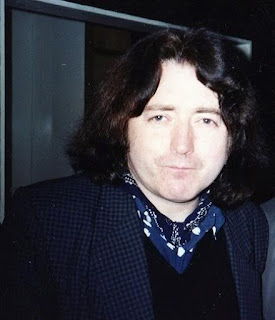
Marc Martin, who we’ve encountered throughout this article, rented a car from Boston to New York for the concert without even booking a hotel room. He told us that he “had a feeling it was going to be the last time [he] would ever see” Rory, so he wanted to make sure that he didn’t miss the show. Marc ended up staying in a sleazy hotel in Skid Row only to find out that the venue had lost his ticket. Thanks to the kindness of Patrick Kennedy, a fellow Rory fan and close friend of the Gallagher family, Marc was able to borrow his Fresh Evidence backstage pass and get into the Marquee Club. For Marc, the New York gig was “the best concert [he] ever saw in [his] life […] the tightest [he] had ever seen the band.” He knew from Gerry and Brendan that the band was breaking up after the concert and found that this seemed to fuel them on to give an unforgettable last performance together. As he continues:
They were unbelievably tight. I’d heard all the concerts on the tour and none of them were bad, but [New York] was incredible. It was like magic. When you hear a band that is really on, when they hit a note at the same time, it was one of those nights. And Rory was lighting it up on guitar. All of a sudden, as I recall, he played ‘Shadow Play’ and he was holding the guitar up, it’s a picture I’ll always remember, and then the lights go off. There’s no encore, it’s over. It was only 45 minutes long, less than an hour. It was so weird. I remember hearing something about that he had to catch a flight back to London the next day, and that’s why they had to cut it early. I probably could have gone backstage, but I didn’t. Part of me just wanted to give him his privacy. And that was the last time I saw him live.
Photograph by Bruno Viana
Although Rory had told the crowd that he could only play a short set because he had an early flight back to London the next day, it was, in fact, due to trouble with the New York Fire and Police Departments as a result of overcrowding in the venue. Word had spread around New York that Rory was going to part company with Gerry and Brendan after the tour, which had increased hype around the concert and led the promoter to capitalise upon this huge demand for tickets. As Dónal told the Irish Examiner, the Marquee Club was “absolutely packed” and both the New York Fire and Police Departments got wind of it and showed up. Dónal spent the duration of the show trying to negotiate between the fire officer who wanted to shut down the venue, the police who were threatening to arrest the promoter and Rory who wanted to continue playing on stage.
I said, ‘Look, if you pull the plug and [Rory] has to go off stage, that’s going to cause even more damage.’ I asked the fire department guy if he could just do two more numbers, and he replied: ‘Ok, he can do two more numbers, as long as one of them is ‘Messin’ With The Kid’! Rory duly obliged, and then finished out his set with ‘Bullfrog Blues’!
Every time we hear this story, we smile at Rory’s unique ability to politely agree with someone and then continue doing things the way he wanted to do them anyway. It’s a pattern that we see throughout his career (see Avril McRory’s funny anecdote, for example, about the recording of Rory’s 1987 concert at the Cork Opera House).
Long-term Rory fan, Vince Rampino, who was also at the New York concert, painted a colourful picture of the atmosphere inside the club for us. He notes the extreme contrast in temperature within and outside the venue (“about 90 degrees, extremely hot” versus “30 degrees, very cold”), the celebrities in attendance (“Kathleen Turner was at the show!”) and the intensity of Rory’s performance (“Rory was a trouper. [He] looked a bit bloated and tired but his playing was still strong”). Although Vince was unable to meet Rory, he recounted fond memories of interactions with him at earlier concerts, such as giving him an empty bottle of Coricidin which he used to play slide in ‘Last of the Independents’ or Rory gulping from his fresh bottle of Heineken.
Christy King is another Rory fan who was at the Marquee Club on 30th March. She had seen Rory live and met him many times when he toured the US and was hoping to meet him once again to tell him that she had recently got married and had a baby. According to Christy, whenever she met Rory backstage, he would tease her by asking why she wasn’t married yet and she would joke back that she was waiting for him. She felt that he “would have got a kick” out of the fact that she had finally settled down and was sorry that she couldn’t let him know. Other fans, such as Patrick Smith, had also been hoping to meet Rory backstage that evening, but were forced to leave the venue swiftly by the Fire and Police Departments. Outside the venue, they were met by hundreds more fans who were unable to get tickets, yet stuck around hoping to catch the sounds of the concert from within.

In Riding Shotgun, Gerry recalls the strange atmosphere when Rory and the band walked off the stage for the final time together:
As we climbed some stairs through a section of the crowd, we were virtually mobbed. Everyone was patting us on the back and trying to shake our hands. I was very aware that this was probably the last time in my life I would ever experience anything quite like this. We got back to the dressing room and we all just sat in silence. Everyone seemed to be feeling the same way, but nobody could find the words to express it. It was a very strange atmosphere. Eventually people started to make small talk but still nothing of any importance was said until Brendan stood up and walked over to Rory. He took Rory’s hand and shook it and said, ‘Good tour, Rory. Well done.’ And then Rory turned to me and shook my hand and said, ‘Well done, Gerry.’ And that was it. No embraces. No tears. Just a huge sense of sadness that overwhelmed the room.
From the Marquee Club, Gerry and Brendan headed to a bar that was owned by an old friend from Belfast, Sammy O’Connor. They asked Rory if he wanted to join them for a few drinks. He said that he probably would, but ended up sending Dónal in his place and going back to his hotel room. It’s saddening to think that this wonderful man, so loved by his fans who risked life and limb just to catch a glimpse of him at the Marquee Club, spent his final evening of the tour alone instead of celebrating his huge success. Who knows what thoughts were going through Rory’s head? Likely sorrow, but perhaps also calculating his next move with his usual tenacity and determination, always planning ahead with that optimism that he never lost, even in the depths of his terrible depression.

Photograph by Bruno Viana
—–
As was often the case in his life, Rory’s 1991 international tour was an event that took place in the face of so many challenges: his crippling fear of flying, his worsening health, the Iraq war which threatened global travel restrictions, the news that Gerry and Brendan were leaving the band. It was only three weeks before the tour that Rory, unable to get a new band together yet, asked Gerry and Brendan to join him. In Riding Shotgun, Gerry wrote that he would have rather “untied the knot completely” and that, although Rory was “amicable” on the tour, there was – understandably – a lot of tension in the air. Just as with Taste’s performance at the Isle of Wight, this growing tension spurred Rory on to ensure that this line-up of the band went out on a high. There was so much at stake and he needed to prove to himself, to his fellow band members and to his Japanese, Australian and American fans that he was still able to pull off world-class performances, to show that nothing had changed, even if, on a surface level, things may have.
Rory was always a formidable performer, but he somehow upped his game on this 1991 tour, which is truly exceptional if we consider that, just the year before, he had been forced to take several months off due to a viral infection and the year before that, he had spent time in a clinic due to extreme exhaustion. Inspired by his return to smaller venues, he played longer sets than he had done in years, throwing in all sorts of tricks and numbers – old and new – and not leaving the stage until he was physically on the point of dropping and his shirt could fill a bucket with sweat when wrung out. “I don’t recognise myself when I’m on stage,” Rory often said, and that’s something we certainly see here on the 1991 international tour. The stage acted as anaesthesia for Rory, enabling him to temporarily numb his physical and mental pain and focus only on the here-and-now, putting on the very best performance for his fans.
All of Rory’s shows across Japan, Australia and North America were sold out, demonstrating the strong demand that still existed for his music. Across our three articles, we’ve encountered so many highlights that represent why we love Rory the person just as much as Rory the musician: from turning shows around (Boston) to pacifying rowdy fans (Sayreville) through remembering and reuniting with old fans in Adelaide and Tokyo. Rory’s constant kindness shines through, whether dispensing friendly advice and words of support to young musicians or simply taking the time to speak to fans, no matter how tired or unwell he was feeling. “Grace” is the word that Martin Carthy often uses to describe Rory and he’s absolutely right. As he wrote in the Order of Service for Rory’s requiem mass, Rory “graced music as he graced humanity. [Grace] is the person who makes life worthwhile by example, who loves his trade and the people who play it and one who tells them so, who makes his peers feel good by his simple presence.”
Gerry and Brendan had their own personal reasons for leaving Rory and we won’t use this public platform to air our own thoughts about this, but what we will say is that their sudden departure occurred at a time in Rory’s life when he was particularly vulnerable and that it was like kicking a man who he was already down. It undoubtedly brought back the trauma of Taste that he never recovered from, and you hear subtle references to this in the improvised lyrics of post-91 live versions of ‘I Wonder Who’. Director of Irish Tour ’74, Tony Palmer, states that Gerry’s departure deeply hurt Rory:
[Rory and Gerry] were bonded together, no question of that. When your family fractures, it can leave you not knowing what to do. I think that left him lonely, and loneliness brings other things along […] He did his best to keep his feet on the ground, but sometimes it gets to you, and it got to him. I think he felt quite depressed about it.
Several years later, Rory was still hurting. When Terry Murphy of the Bridge Club asked him how Gerry was, with tears in his eyes, Rory replied, “Oh they’ve got a new band together. They’re looking after themselves now.”
While we also don’t wish to use this article to pick holes in Riding Shotgun, we do strongly believe that the book is responsible for many of the negative attitudes towards Rory in the final years of his life. Gerry states that Rory’s career “stalled” after he left the band and that Rory took the split “to heart more” because, unlike him, Gerry had a “new career to look forward to.” He says that Rory needed something to “get his career back on track” and that he never capitalised on the success of the 1991 international tour. Too often, we come across comments on social media from fans who assume that 1991 marked the end of Rory’s career and that he never did anything again after Gerry and Brendan left the band. As we’ve shown on Rewriting Rory, Rory may not have recorded another studio album, but he did undertake countless session work and write new material, right up until the end of his life. He also put a new band together in 1992 with David Levy and Richard Newman, touring regularly and continuing to headline major festivals, some of which we feel are the strongest performances of his career (e.g. Temple Bar, Montreux, Inter-Celtic). Perhaps Rory was no longer the globetrotting ‘Vasco de Gama’ of rock, but we like to see him as an Emperor Augustus or Trajan, continuously expanding all across Europe and leaving towns and cities dazzled in his wake by the power of his music. Rory was revitalised by his new band who gave him a boost of fresh energy and ideas, and were an essential part of his later performances, constantly providing him with solid support. So, why on earth have they been cruelly erased from the Rory story to date? That is a matter we will take up in a future article…
For now, we’d like to end with a short quote from Marc Martin when reflecting on Rory’s 1991 international tour:
He didn’t lose it. Health wise, he may have had some issues with that, but he was still a tremendous guitar player. He just struck an emotional chord with me that he still had in ‘91 that he had in ‘77 the first time I saw him. He just was older.
Marc’s words get right to the crux of Rewriting Rory. Whether older, heavier or sicker, it doesn’t matter one bit. Rory was always Rory.
Photograph by Brian Brady
We thank the following people for sharing their memories of Rory with us for our article: Glen Arbor, Dave Mangin, Marc Martin, Daryl Schwartz, Jeffry S., Mike Moscardelli, Kirk Koster, Amy Maloney, Dean Gostling, Nick Nastoff, Gregg Hulsey, Marianne Murphy, Jeffrey Albergo, Bruce E. Barrett, Robert Gannon, Bob Leafe, Mark Morrison, Michael Pellegrini, John Fisher, Derry Pennywell, Ken Bartlett, Brian W. Greene, Vince Rampino, Christy King, Patrick Smith, Colleen Phillips, Carolyn Phillips, Dave Mayberry, Mark Hennessy, Jon B. Wilder and John O’Brien.
Thank you for reading!

 REWRITING RORY
Leave a comment