
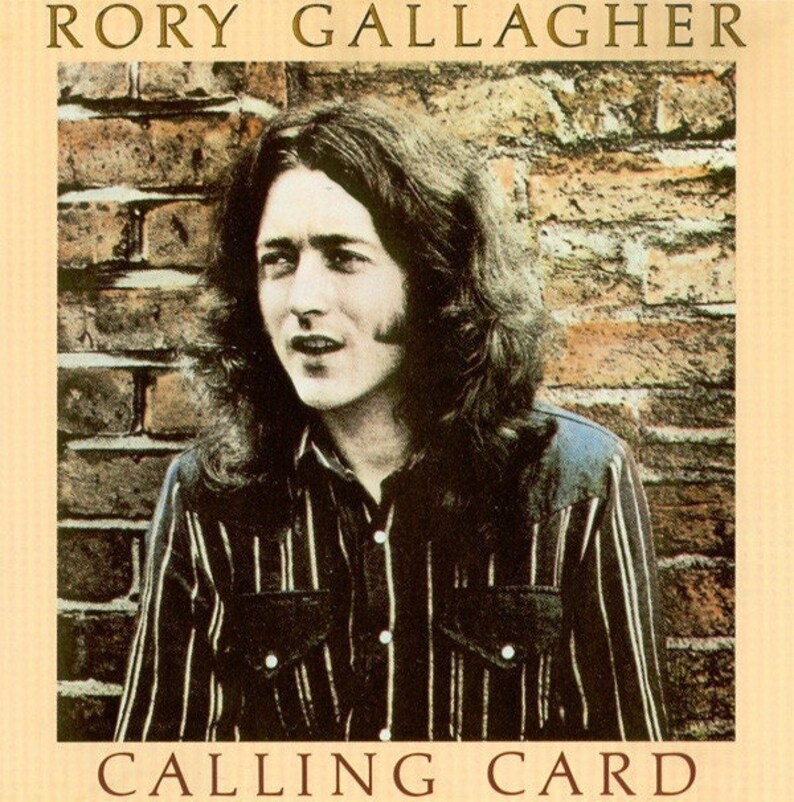
We began our interview with Rory Gallagher fan Marc Martin at how and when he discovered Rory.
MARC MARTIN: I go down to a local record shop, and pick out albums. They were like five dollars back then, and I purchased Calling Card when I was fifteen years old, based on its cover. It was serendipity. I just bought it because of it’s cover. There was only one other album I bought because of it’s cover and that was Tommy Bolin’s Teaser, and in retrospective it turns out that Rory Gallagher and Tommy Bolin became my first and second favourite guitarists. I would listen to Calling Card, but I wasn’t hooked. When Photo-Finish came out, I think in 78’, that album just really made a connection with me. It quickly became my favourite album of all time. I’m a guitarist, I played in a band, I learned all the songs on the album. I would convince my band mates to play some of them, like “Shin Kicker” and “Shadow Play”. Rory Gallagher wasn’t really popular, and I kind of liked being the renegade or the outcast, being influenced by someone that no one knew about. I’m Irish by descent, third generation Irish [and] I live in Chicago.
So for me it was cool to listen to Rory Gallagher, and he really made an emotional connection with me. And then when Top Priority came out, I mean, that album is still my favourite of all time. I listen to it today and I hear things that I hear for the first time, whatever it is, fifty years later, forty years later. Without question, that’s just such a great album. Every song on that is just tremendous. So that was really my connection to Rory Gallagher. I became a true fan, [and was] very influenced by his music, personally and musically. It just made such a connection with me that I can’t really describe it in words.
The interview then turned to Marc’s history of seeing Rory live.
MARC MARTIN: So the first time I saw Rory Gallagher is kind of an interesting story. I was probably sixteen years old, and he was playing at a venue called the Park West in Chicago. Park West was a night club, [and] at the time there was a drinking age [that was] lower back then – this was the seventies. 1976, 1977. And I had to see Rory Gallagher [laughs], there’s no question about it. So I bought large, orange platform shoes that were popular back then. I – off the record – but I got an ID with the correct birthday on it, and there was two shows at the Park West. I think there was a 7 o’clock show and a 10 o’clock show. And I got tickets for both shows. And it was general admission, but the Park West was a very classy place, they had tables [and] waitresses, it was a two beer minimum. The first show I got in, they did not card me. I sat right up front at the table, and it was a fabulous concert. It was back before Ted McKenna was in the band, [but with] Rod De’ath. And I still remember him playing “What In The World” back then. And I went to the 10 c’clock show. The 10 o’clock show I got carded, and I showed my ID and got in. The were tremendous shows.
Then the next time I saw Rory Gallagher was probably in 1978, it was right after Top Priority came out [sic]. I waited in line again, it was at the Park West, and Rory Gallagher pulled up in a tour bus with Gerry and Ted, and he came up and talked to the fans. I had a Top Priority album, and he signed it. He was very cordial and polite. And he was at his peak back then. He really was. He didn’t have any health issues, musically he was soaring, in my opinion. It was a great concert.
Then the next time I saw him I was going to college in Los Angeles during the 79’ tour. He was playing in Los Angeles in a place called the Stardust, and he was playing there right before Christmas. So I stayed late instead of going home so I could see Rory Gallagher. Just to position who he is, a couple nights before I went to see a very popular band at the time called Styx, who I know from Chicago, and it was at the LA Forum, and they were probably one of the top-5 bands of the country at the time. And I had backstage passes, and I went back there and they had the buffets and it was just so pretentious and snotty and uncomfortable, and even the guitarist who I knew since the early 70s playing in high school dances didn’t have time for me. So now I go to the Stardust, I got in for the sound check. I saw him play “Keychain”, which he usually didn’t play live. And then I saw the concert, it was a general admission concert. Then afterwards there was a lounge, or it might have even been a bowling alley there, and anybody could go back there, you didn’t need a backstage pass. I had a beer with Ted McKenna, talked with Rory Gallagher. He was a very gentle human being, very unpretentious. I know you’ve heard that a hundred times. But [he was] very approachable, and would talk to his fans. [He] didn’t have an ego. He was certainly entitled to an ego, but he didn’t have one that he displayed.
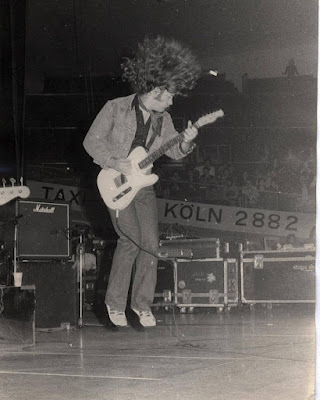
Photograph by Rudi Gerlach
Then he came out with Jinx, and it didn’t have the energy I thought that Photo-Finish and Top Priority had – but I was still a huge fan. Rory Gallagher could do nothing wrong in my eyes. I of course had all his albums, but Jinx was just so different from Photo-Finish and Top Priority. But he still was tremendous, I lost no respect for him. He was touring with Rush, and I was living back in Chicago at the time and I think they were doing three nights at the Rosemount Horizon it was called at the time. And I got tickets for all three nights. And on the second night I’m walking through the venue – I liked Rush but I wasn’t that big of a fan … and I’m walking through the venue, I think leaving, and out walks Rory Gallagher. He’s leaving as I’m leaving. So I strike up a conversation with him, and we had a conversation. He was asking me about going to the Checkerboard Lounge, which was a night club in Chicago where Muddy Waters played and it was still open at the time. He wanted directions there, and to know if it was a rough neighbourhood, gave me backstage passes for the next night. I was with my girlfriend at the time, and he was talking with her. He was outgoing and energetic and friendly. So that was a great experience.
And then he really didn’t come to the States much in the early eighties after that. I saw him again at a place called The Metro in Chicago. Afterwards, there was a bar next door and he was there talking to the fans. I talked to him a bit that time, and I remember he was a little upset because the show didn’t sell out. He wasn’t mean or anything, but he was just a little upset because the show didn’t sell out. So then he didn’t come to the States much, and I still was a huge fan. I got the Defender album when that came out.
Marc’s memories of the 1991 US tour.
MARC MARTIN: So in 91’, again I don’t even know how I found out about it, but I found out he was doing a tour. And at this time I’m a professional, I have some money and I can travel. So I decide I’m going to at least see the first four shows in L.A. He was in Australia, then he flew over to San Diego. They just flew in and almost got right onto the stage. I flew to Los Angeles, and saw those first four shows in California, he basically drove up the coast. So the first show was in San Diego, it was at a night club. I met the band and Rory outside afterwards, and told him I flew in from Chicago and try to see some shows. Rory had some health issues, I remember he had an inhaler. But again he didn’t lose any of his personality, he was still friendly and talkative. I talked to Gerry and Brendan O’Neill at the time. The last show in the coast area was in Los Angeles at the Roxy, and the Roxy was general admission venue. So I’m waiting in line and I meet a gentleman by the name of Patrick Kennedy. Patrick Kennedy said ‘I saw you at the Huntington Beach show’, so we immediately struck up a friendship [and] exchanged numbers. Rory Gallagher pulls up with his brother, he’s not driving, and he pulls up and gets out and talks with the fans in the line. There’s maybe less than twenty of us there, because this is in the mid-afternoon. And then he leaves with his brother, and we wait in line. At the concert there was a lot of Hollywood types there. He ended up having Slash onstage for the encore. Slash played his Les Paul Junior, and they did “Bullfrog Blues”. And Slash? No comparison. And I like Guns N Roses, don’t get me wrong, but there’s no comparison. I don’t know if it was because of the equipment or whatever, but Rory was so much better. And I still have the pictures from the concert. So I have one picture of Rory playing his white Esquire.
So he’s touring the States, that’s back in 91’. Fresh Evidence had came out, and there wasn’t even publicity about it. I didn’t know Fresh Evidence came out. I bought the CD when I was in LA. Of course I saw him in Chicago again, I saw him at the Park West. This time the Park West it was kind of run down, the tables were gone [and] the waitresses were gone. The next night he played in St. Louis, so I was gonna fly down to St. Louis but there were 105 mile winds so I didn’t really wanna fly. So I drove down to St. Louis, and he played on a revolving stage. In Chicago, I think he played on a Friday night as I recall, and the Thursday before – there’s a lot of blues clubs in Chicago – I was at a blues club on Lincoln Avenue, and Gerry and Brendan walked in, believe it or not. So I was there, and I had talked to Gerry and Brendan earlier and they remembered who I was. I was talking to them at the night club, they didn’t play, and I asked them ‘where’s Rory?’ And they just said ‘you don’t wanna know, he really doesn’t go out.’ That was it. They were protective of it.

Photograph by Patrick Kennedy
I had a feeling it was going to be the last time I would see him, so I had to see his last shows. I booked an airline ticket to Boston to see him in Boston. I was a kid from Chicago, and in Chicago we all wear leather jackets, it’s just a style in Chicago. And [Boston] was a college town, and the fans were thinking ‘what are you, a tough guy with the leather jackets on?’ Rory always wore a leather jacket onstage anyways. But he played in a place in Boston, and his sound wasn’t great. He was kind of having an off night. Any musician on a tour is gonna have an off night, it happens. But what he did was – it was amazing – he played for three hours, he kept pushing, he kind of got over it, and he started playing songs that I hadn’t heard on the tour. I think he played “Souped Up Ford” and “Walking Wounded”, or “Slumming Angel” I think it was. The next night was in New York, I rented a car. I didn’t even have a hotel room, so I ended up staying in this hotel on Skid Row where heroin addicts stay. You had to get buzzed up to go in, but I was just going to see the concert. And they lost my ticket. I didn’t even have a ticket. So I called, and they said ‘ok, we’ll have a ticket for you’. Thank God I was able to get in. Patrick Kennedy had a Fresh Evidence backstage pass, and he knew I was going to see other shows, so he gave me his pass to use. Patrick knew Dónal Gallagher and the Gallagher family. I went to New York, and I don’t know if he had an opening band. It was the best concert I ever saw in my life. It was the tightest I had ever seen the band. I knew the band was breaking up afterwards, Gerry and Brendan had told me that. I knew it was gonna be their last concert in the United States, and as I said, I had a feeling in the back of my mind this is gonna be the last time I see him. They were unbelievably tight. I’d heard all the concerts on the tour and none of them were bad, but [New York] was incredible, it was like magic. When you hear a band that is really on, when they hit a note at the same time, it was one of those nights. And Rory was lighting it up on guitar. All of a sudden, as I recall, he played “Shadow Play” and he was holding the guitar up, it’s a picture I’ll always remember, and then the lights go off. There’s no encore, it’s over. It was only 45 minutes long, less than an hour, it was so weird. I remember hearing something about that he had to catch a flight back to London the next day, and that’s why they had to cut it early. I probably could have gone backstage, but I didn’t. Part of me just wanted to give him his privacy. And that was the last time I saw him live.
We’ve been collecting a lot of fan memories from the 91’ tour in particular, and every single memory is unique to every fan that it just shows how great of a performer Rory still was then and always was.
MARC MARTIN: He didn’t lose it, health wise he may have had some issues with that, but he was still a tremendous guitar player. He just struck an emotional chord with me that he still had in 91’ that he had in 77’ the first time I saw him. He just was older. He opened every concert with “Continental Op”, and usually close it with “Bullfrog Blues”. While he would do a lot of the same songs, the setlist was never the same. He would never do the same solo, and he would change up the arrangement. Gerry and Brendan had to be so in tune with what he was doing. You could see Brendan was like laser focused on Rory to pick up the changes, and he could pick it up by body language. He was very good at picking them up and cueing it.
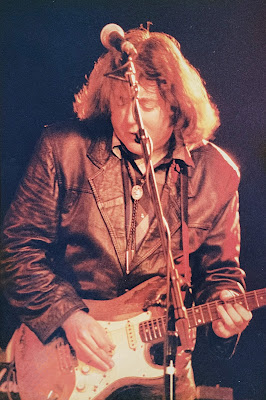
Photographer unknown
Would you say he’s influenced your style of playing as well?
MARC MARTIN: Yeah, if you listen to “Slumming Angel” by Voodoo Trailer Park – it’s on Apple Music and all that, and I posted it on my Twitter handle – and that’s all me on guitar, and so I’m sure you can hear the Rory Gallagher influence with the way I play leads. “Road to Hell” we didn’t realise, [and] part of the reason was there was this software where you could extract the individual tracks from a song, so that one I extracted Brendan’s drums, and so I didn’t wanna release it with him playing the drums. And with that one, people listen to it and go ‘wow, you sound just like Rory Gallagher’ [laughs]. Both the guitar playing and the songwriting, the chord structure; the songwriting’s influenced me tremendously. I wish I could write lyrics as well as Rory did, but the songwriting and the chord structure and arrangement of songs. I’ll listen to a song of Rory’s and ‘ok, this is how he does it, he’ll have four sections and then a verse, then he’ll do a chorus, then he’ll do a bridge’, and I’ll use that as a backdrop for my own songs, to teach me really.
That’s something that Rory doesn’t get enough credit for – he was an amazing lyricist as well. It’s all the focus on his guitar playing, but his lyrics are incredible too.
MARC MARTIN: Oh yeah, such a storyteller, like the subjects he talks about. I really respect that he never wrote about politics, although he was very educated and very up on the politics. According to Dónal, [Rory] would be up on the local politics on every tour, and I believe that. He read a lot, very introverted offstage as you know. His lyrics, how he comes up with these ideas, these stories, it’s amazing. I wish I could do it, but I just don’t have that talent.
Do you think your relationship with Rory’s music has changed throughout the years from when you first heard him on Calling Card when you were younger to now? Or do you think it’s always been the same and you’ve appreciated him at the same level?
MARC MARTIN: I would say I’ve always appreciated him at the same level from Photo-Finish on. I’ve heard, and it’s probably true, that the music you become attached to as an adolescent sticks with you the rest of your life. I know with me I still listen to the same music I listened to when I was in high school. In my opinion the state of music in 2022 is pretty sad. My favourite of course is the lead guitar players, the Rory Gallagher type, and there’s so few of those around. I like blues guys. But as far as a power trio, you don’t see that anymore. Davy Knowles is pretty good, but the state of music now leaves so much to be desired. My affection for Rory Gallagher from Photo-Finish and up until today at sixty years old has been the same. I’ve never lost interest or affection for him.
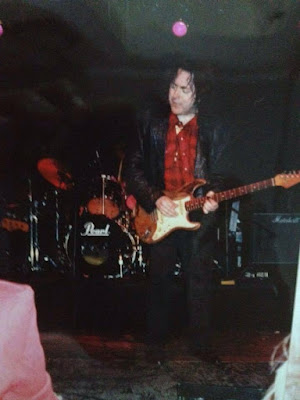
Photographer unknown
What are your lasting impressions of Rory?
MARC MARTIN: It’s kind of a hard question to answer without getting emotional. He’s just been a huge influence. Of course I was very sad when he died, and it’s not all the music. It’s the whole package. It’s really a personal thing because there’s not many people that know Rory Gallagher. Besides the singer in my band and maybe a guitarist here and there, nobody knows who Rory Gallagher is. It’s something that’s been with me since I was fifteen years old. There’s no other musician that’s had that kind of effect on me. I like Stevie Ray Vaughn. I saw Stevie when no one knew who he was at a festival, and got to meet him, saw him play with Buddy Guy, [and I] have tremendous respect for him as a guitar player. But not at that same level as Rory does. I was sad to see that when Stevie Ray Vaughn started to break through and blues was making a comeback, I was really hoping people would latch onto Rory like they did with Stevie. But it didn’t happen. Maybe Rory didn’t want it to happen, I don’t know. I thought back in 79’ when Rory was breaking through with Top Priority, they were playing the album on the radio, and it just … I don’t know. The general population doesn’t appreciate that kind of music, I don’t know why. To me, I’d rather hear someone putting their heart into the music than someone like Eddie Van Halen, who is a technical wizard but I don’t feel the soul. I don’t have any disrespect for Eddie Van Halen or Stevie Vai or Joe Satriani. They’re all great players, and I listen to their music, but for some reason they’re not able to convey that emotion like Rory does. Very few players are. Buddy Guy is probably the only one I can think of, that I’ve seen live, that could do it.
If you would like to read our article about Rory’s 1991 USA tour, please click this link.
 REWRITING RORY
Leave a comment