
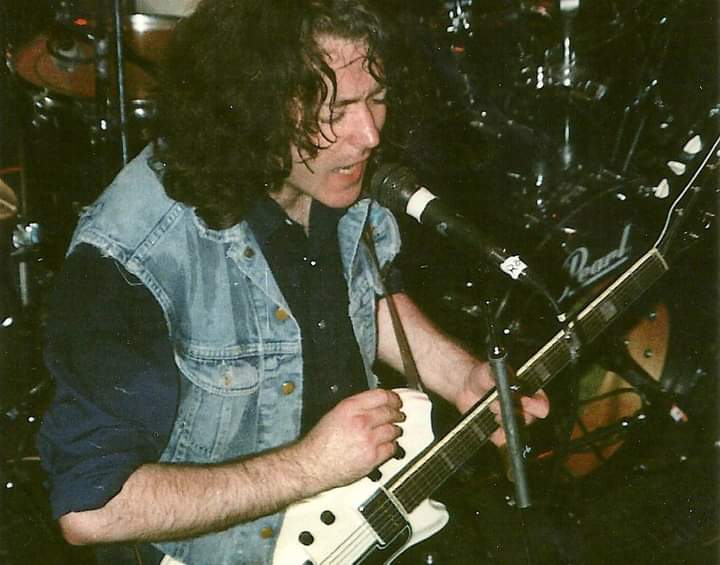
“Blues, whiskey and Irish blood. He alcoholised the blues to later set it on fire and immolate his Stratocaster on the flames of a crunchy and wild sound. The legend of the old Irishman survives intact.
Rory Gallagher gave his guitar its own language, compressing endless feelings into each note. It was a battered old guitar that groaned and howled after being ignited by songs by Lonnie Donegan, Guy Mitchell, Eddie Cochran, Bo Carter, Son House and Chuck Berry. In the same way, when the guitarist sang, a torrent of black soul gushed forth, rough, warm, a torn voice of tribal dialect that communicated directly with the most primitive rural blues. His live performances were interactive storms in which rock and blues exploded like emotional shrapnel. And although it is true that Gallagher’s career always remained in the shadow of his most distinguished colleagues of the instrument and generation, it is fair to recognise that there were very few who could face the instinctive brutality of the Irishman. Too much charisma, too much energy scattered on stage. Rory was a person whose body and soul had a vital need for expression. That is why he never gave in to the pressures of the record industry, he always remained on the sidelines of any prevailing fashion or trend, and his records come to us as honest excesses of rock artifice.
Born in Ballyshannon, County Donegal, Ireland, on 2nd March 1948, they say that at the age of nine he began to strum his first six strings and that at ten he happily mastered songs by Muddy Waters, Robert Johnson and Albert King. Already seasoned at parties and amateur performances, his first professional experience came around 1964, when he was part of the Fontana Show Band and did several tours of Europe with them. The band enjoyed relative success, particularly in Ireland, and with it, Rory was able to infiltrate England. After changing the name to The Impact, the group disappeared around 1965. Immediately afterwards, the guitarist gave life to the original embryo of Taste, with whom he worked throughout 1966-68. Hailing from an anonymous combo dubbed The Axels, bassist Eric Kitteringham and drummer Norman Damery provided serious backing for Gallagher’s sweaty guitar, but never recorded anything. Taste would be consolidated with the arrival of Richard McCracken and John Wilson, bass and drums respectively. Without becoming great instrumentalists in the manner of Baker/Bruce or Redding/Mitchell, these new signings represent the perfect measure for Taste to articulate a power trio formula that was generous in intensity. A group capable of competing with the most inspired of the time.
Of herculean musculature and troglodyte induction, Taste’s music fiercely embraced the blues-rock concept. Especially live, the young and epileptic guitarist displayed his electric pyrotechnics in excessive improvisations that closely followed the hallucinated perception of instrumental freedom imposed by Cream and his outstanding disciples The Jimi Hendrix Experience. Taste recorded two studio albums: Taste (1969) and the essential On The Boards (1970) are two brilliant works, accommodated on sufficiently personal creative bases. Gallagher’s creations convey raw wisdom, tons of feeling, powerful instrumentation. It is obvious that he breathed character. Posthumously, the live shows Live Taste (1971) and Live at the Isle of Wight (1972) appeared, recordings that capture the wild and aggressive organism of the triumvirate. A delight for the spirit.
But when the group enjoyed more popularity and Rory’s guitar was the subject of critical analysis, McCracken and Wilson decided to put an end to the adventure. Rory didn’t think twice. He sought the support of new musicians and the approval of his record company (Polydor, to be exact), and decided to set out on his own as a soloist. From then on, he will sign with his name.
His self-titled debut, dated 1971, will have as key elements, on the one hand, the argument of a mature style – which will not vary too much in the future- and on the other, the collaboration of a bass player (Gerry McAvoy) who will remain his faithful great partner to the end [sic]. For the drums, a dark type of dynamic and succulent punch is hired, Wilgar Campbell. Without a doubt the best of all the drummers he had. The recording surprises for its exquisiteness, its eloquent foundation, its variety: blues and rock, of course, but also touches of jazz, country aromas, acoustic guitars, harmonicas, since then distinctive themes such as Sinner Boy and Laundromat, and the piano collaboration on two of the songs by Vincent Crane from Atomic Rooster.
Rory followed his impulses, had an inquisitive mind, possessed enviable creativity, and never missed an opportunity to expand his expression. He recorded his albums unpretentiously, in terms of time that today are ridiculous. Thus, that same year, 1971, his second solo recording, Deuce, was released, which retains the freshness of its predecessor and is based on the same principles: simplicity and emotion. The production was again carried out by Rory himself, so there is no mannerism whatsoever and the songs flow directly and essentially, unaware of any ornamental interference.
To reflect the unbeatable rapport that the trio oozes, Live in Europe (1972) is edited, a superb collection of songs that offers the opportunity to check to what extent the corpulence unleashed in Taste wins in records and refinement. They are no longer three guys playing poisoned blues with the volume turned up, now things are planned and executed with more delicacy. The rhythmic base is literally overwhelming: Wilgar’s drumsticks fire like lightning, building together with McAvoy’s four strings an energetic support where voice and guitar can culminate their intensity. Atomic versions of Laundromat, In Your Town, the Junior Wells classic Messin´ with the Kid, crawling and monochromatic blues, traditional Irish folk allied with rock´n´roll, country and western… all fused in a stimulating live work that will go down as one of Gallagher’s best albums.
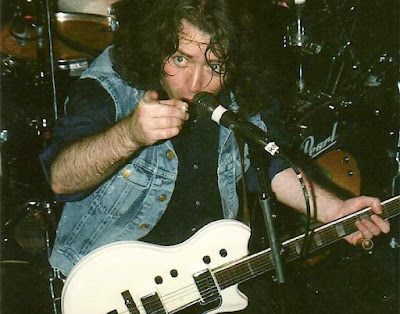
Photographer unknown
That same year, 1972, the position of drummer became vacant and was filled by Rod de’Ath, a man who for many – not for me – far surpasses the glamour of Wilgar Campbell. And they add as a fixed element the keyboardist Lou Martin, who like the drummer comes from the magnificent Killing Floor. With this training, Blueprint (1973) and Tattoo were released, robust works, chiselled with skill and a good hand. In 1974 a corrosive, trephining double LP will be released live that marks the end of the Polydor era: Irish Tour 74. Pure viscera.
With a new contract that ties him to Chrysalis, he releases Against the Grain in 1975. The repertoire includes radiant interpretations of Bo Carter, Leadbelly and Isaac Hayes, as well as a more palpable approach to heavy rock, which gives those distorted riffs a greater field of action. At the suggestion of the record company, Rory handed over production duties on Calling Card (1976) to Roger Glover, bassist for Deep Purple and renowned studio man. The album is recorded at the Musicland studios in Munich and represents his less caked and roaring creation. This domestication guides the sound towards softer and more refined channels. The guitar plucks sound more embedded in the context, treated with greater harmony; the piano takes centre stage, and even his voice calms down, it’s not so hurtful or scratchy. New jazz approaches are revealed, especially in the title track of the LP. The environments are more relaxed, the nuances are outlined with greater caution, resulting in a different album, less wild, with a pronounced intimacy.
The experience must not have been very positive because Rory returns to the original formula: dispenses with the piano and signs someone who recovers Campbell’s adrenaline. That person is Ted McKenna, ex Alex Harvey Band. The power trio concept regains prominence and the next three albums will be devastating hard-rock onslaughts. Photo-Finish (1978) is a tremendous burst of force, amphetamine boogie erected on a heavy sound that strikes with its purity and emotion. This ballsy album is followed by Top Priority (1979), the last great album [sic] from the furious Irishman, a sticky, electrocuting rock blaze that incinerates the soul. As a final touch, Stage Struck (1980), a live show documenting the enormous power of the trio…
…Alcohol, an inseparable companion, ended up taking him away in 1995 [sic]. Since then, no one has filled the gap of that guy who refused to join the Rolling Stones, who always maintained an unshakable faith in his music. His legacy was recently dusted off in some new remastered editions and with additional themes, even publishing resounding sessions for the BBC dated in 1978.
These lines are worth a belated tribute to a musician who never gave up. To your health, mate.

 REWRITING RORY
Leave a comment