
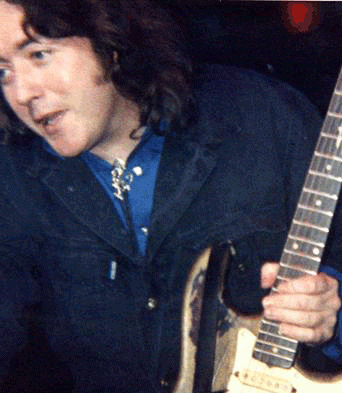
The year or the current weather season didn’t matter. He always wore jeans, and more often than not a plaid shirt or a worn plain T-shirt. The hair, always long, was inescapably reminiscent of the images of the seventies, the ones that many of us knew when we began to be interested in rock and its derivatives. For most, his image was associated with that of a time and a certain way of listening to and understanding music. His guitar, old, dilapidated, almost wrinkled from use, was his vehicle of expression, his lover, his friend, his indefatigable companion.
Rory Gallagher was shy, apolitical, highly educated, a drinker, anarchic in his work, a movie lover and, like a good Irishman, deeply religious. And above all, he was sincere. To realise this, it was enough to listen to any of his records and hear him play the guitar with that sparkling and jovial clarity that was always his hallmark………….
………….Tired of playing other people’s songs for the public to dance and be entertained, Rory left The Impact and decided to form his own group, an almost legendary trio called Taste …….
……..Forging a style that was somehow a precursor to the hard rock of the 70’s until the disintegration of the band in 1971. After the break-up of Taste, Gallagher would embark on a long solo career……………………. Rory’s golden age began.
On his own. yes, because this was always the way Gallagher approached his career and his music. Already on his first albums (Rory Gallagher, Deuce, Live in Europe, Blueprint, Tattoo), Rory had it very clear: concise and functional rhythm section, sparse or simply non-existent production, absolute leading role of the guitar and, above all, a lot of rock, a lot of blues, some country and traditional music, and tons of delivery and simplicity. This was his trademark, a blind faith in what he was doing, a brutal sincerity and a complete lack of artifice and unnecessary sophistication in music as raw and visceral as Gallagher’s own personality.
All this was even more appreciable if possible in his concerts. Beyond his record productions, Rory Gallagher was always a musician who gave the best of himself on stage, a place where his temperament, calm and quiet by nature, was transformed into a torrent of vitality and electrifying energy.
Precisely, the end of this first solo stage culminates with the release of a brutal live album, Irish Tour ´74, in which Rory clearly demonstrates what he is capable of doing with his old ’62 Stratocaster in his hands . Then a little rest. Six albums in three years (to which must be added his collaborations on albums by Mike Vernon, Muddy Waters, Jerry Lee Lewis and his idol Lonnie Donegan) constituted an inhuman rhythm that even a rough Irish drinker [sic] like Rory had to rethink. And so he did.
Against the Grain (1975) was a transitional album in Gallagher’s career, more rigorous and intimate than its predecessors. Earlier, he had even allowed himself to turn down an offer from the Rolling Stones to fill the vacant spot left by Mick Taylor to continue his old but timeless vibe. That’s when, well advised by Chrysalis, his new record company, Rory decides to put himself in the hands of a reputable producer (Roger Glover, ex-bass player of Deep Purple) and stop self-producing (it’s a way of speaking, since his records were normally recorded in four or five days and with hardly any remixes)……………………
……………A pity, really. For many, an old blues and rock musician has left, an obscure and half-forgotten name belonging to the seventies; for others, a great guitarist has abandoned us, one of the best exponents of white blues rock of all time. We are not worthy.
 REWRITING RORY
Leave a comment