

* This article was originally posted on http://www.rorygallagher.es. When we translated it, we decided to include the comments of Nacho – who runs the website – because he makes some very good criticisms of the quite frankly nasty piece of “journalism”.
NACHO’S COMMENTS BEFORE YOU START READING THIS ARTICLE:
This article reflects the sad history of Spain, where the true professionals are displaced by the intrusion of bunglers. The truly prepared remain under the orders of four ignorant recommended people, where there are thousands of unemployed journalists and a bloke who doesn’t know what to write about has a job as a commentator in any newspaper.
Joaquín del Río, a poor wretch, who did not realise how lucky he was to be able to interview a legend and, apparently, having never heard of him in his sad life, dared to publish this La Hoja del Lunes. Let us all feel sorry for those who are given nuts and don’t know how to crack them. Hello Joaquín, you are the epitome of the old saying “all fools are lucky!”
ROCK IS A HYPERPOWERFUL MEDIA
The singer, however, bored many fans and all strangers with his music.
He’s halfway between being a down-and-out hippy big shot and a classic heavy drinker of Irish beer. He voted a firm no in the recent referendum on divorce in his country. He carries behind him twenty years of experience that becomes an insurmountable handicap when trying to communicate with an audience much younger than him. In the absence of another alternative, the image of a corpse in an incipient state of artistic decomposition parades around the world’s stages.
His few unconditional fans, however, remain convinced that he is one of the best guitarists in the world. He’s Rory Gallagher.
Unfortunately, Rory Gallagher is such a gentle man that it is very hard to rule him out completely. With the hurt feelings of someone who has been on the verge of hitting the big time without success, he strongly defends any allusion that his music is outdated.
RG: Rock has changed a lot since I started out twenty years ago now. Videos, attention to image, aesthetics and advertising have become more important than music. Most of the new bands haven’t been able to do more than a couple of two-minute songs and they’re not interested in music for its own sake, but as a business. There is no longer any improvisation, there is no feeling in what is done. There is no room left for the free spirit, there is more and more channeling, more marketing, more image. In many cases, the video is thought up before the song and we systematically see images of stories that don’t exist in the original song.
JDR: However, you were one of the first to use cinema as a means of promotion in the early seventies. Is it possible that the medium has evolved turning against those who have not done the same?
RG: No. It’s true that I always liked the idea of using cinema, but I think that image can’t be allowed to end with the music. Cinema and video can be media at the service of groups, but a musician should not be asked to become an instrument of the videomaker. A clear case of what I am saying is Follow Follow Sputnik.They do not control their products.
JDR: Yes, but that is the characteristic of Sigue Sigue Sputnik and they also make a show of it.
RG: Well, everyone is free to become what they want, but I don’t like it. I prefer to listen to music from years ago, when music was music. I’m talking about Jimi Hendrix or Bob Dylan, for example.
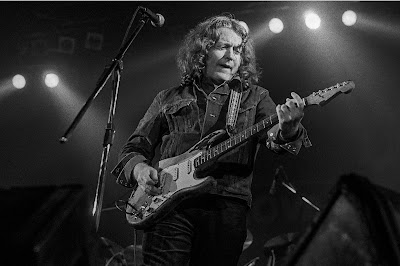
Photo by Ferran Sendra
JDR: Do you really think that Hendrix or Dylan were simply musicians and that their success had nothing to do with their image and their participation in the hippy movement?
RG: I think the term ‘hippy movement’ is too vague. I myself have been included within that term and I have never been a hippy. In my case, it was never more than a label that helped me get known. I participated in several big festivals, but I did it as a musician, never as an ideologue. Hendrix was a hippy, but he would have succeeded with or without a ‘movement’ because he was really good. Image is fine to me, but assuming that you are a musician beforehand.
JDR: In the early days of rock’n’roll, this style of music had a huge social impact. What do you think rock has to say in 1986?
RG: I think it can offer intelligent texts, like those of Elvis Costello, and even political options, like those of The Clash. Rock’n’roll is a hyperpowerful means of communication that can do anything. Anyway, I’m not interested in what I can do with my songs. I’m only interested in music itself as a means of expression.
JDR- You keep insisting that you just want to make music, but I guess it’s not just for the sake of it. What do you want to communicate with your songs?
RG: That depends on many things. Sometimes I want to create new atmospheres and look at myself in the mirror of my songs. I like to see myself in my texts and check that I am still the same.
JDR: When you select the songs for a concert, does whether it is London or Gijón influence your choice of one type of song or another?
RG: Very little. I can sense a different atmosphere before starting, but then you really forget who you’re performing for. When you’ve already done two songs, you only think about communicating with your audience, regardless of whether you’re in a big city or not. On the other hand, when you do a tour full of performances in different countries, there comes a time when you don’t know exactly where you are anymore. Anyway, in this case I was concerned to find out that we were going to play in a bullring and that the people of Gijon have a strong regional feeling. That interested me a lot because I have the same problem being Irish.
JDR: Is it difficult for an Irishman to access the British market?
RG: At the beginning a lot. You can’t get anything important until you decide to go to London and work from there. At that point you’ve solved half the problem, you’re still Irish, but at least you’ve uprooted yourself. When you have earnt a position is when you can afford to remember your roots, but not before.
JDR: Finally, Rory, you said a long time ago that you wish you were born black because your music is based on blues. Do you still have that same unrealisable desire?
RG: Yes… Well, no… I really don’t know what to say. It’s too complex a subject to talk about after playing rock’n’roll for two hours.
Rory Gallagher, it is true, spared not a single second in his performance in Gijón. He was on stage for two and a half hours, which represents almost twice the amount of time of a normal concert. The sad thing is that the result of his effort did nothing more than turn the cliché around into “boring, if long, twice as boring.”
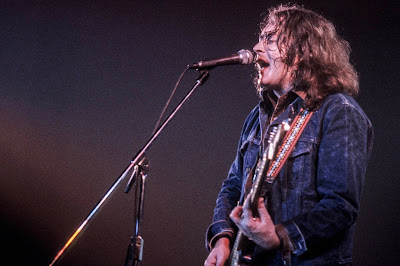
Photo by Ferran Sendra
NACHO’S COMMENTS AFTER YOU’VE READ THIS:
JDR: Insurmountable handicap when trying to communicate with an audience much younger than him
N: What a ridiculous comment! Now it turns out that if the Rolling Stones, BB King or Rosendo himself are not the age of those who attend their concerts, they cannot communicate anything to them, nor can any of the spectators enjoy the show. Rock’n’roll has no age, brother, or rather, fifty or sixty!
JDR: The singer, however, bored many fans and all strangers with his music.
N: Oh, what a beautiful sentence! It’s a shame you didn’t enjoy the party that the other 2,999 people enjoyed. I am quite surprised that there was any “strangers” inside the bullfighting arena. I don’t think there was anyone who paid to see the Stukas, the opening act, who at that time played at almost all the parties that took place in Asturias and that, any other night, you could enjoy them without paying a penny . Um… maybe you’re right, being summer and seeing revelry, it’s possible that some foreigner sneaked into the concert thinking that a bullfight was going to take place. Ask your colleagues from the newspaper El Comercio, I think they got quite bored. You just have to read what they published the next morning (you have it in Reportajes).
JDR- Unfortunately, Rory Gallagher is such a gentle man that it is very hard to rule him out completely.
N- Ugh, luckily!
JDR- In the absence of another alternative, the image of his corpse in an incipient state of artistic decomposition walks around the world’s stages.
N- Goodness me, another excellent sentence! What a vocabulary this man has, although I doubt very much that he has registered the copyright. Mate, you must be the only smart person living in this world of idiots who pay money to be bored at a concert, the only one in this world full of freak promoters who hire a corpse to make a buck on the boring show they know the aforementioned assholes are going to get bored at, and the only one who realised that it was stupid to send an excellent correspondent like you to fill page sixteen with such an event, considering that there are more interesting things in this shitty world to write about. How can you bear it? Joaquin del Rio, please:
Get on the Sputnik and disappear!
 REWRITING RORY
Leave a comment