

When preparing this year’s schedule for Rewriting Rory, we admit that we were stuck on what to post this month. We felt a lot more at ease deciding on a topic to celebrate Rory’s birthday in March, but what could possibly be respectful, or indeed right, to celebrate on such an awful date – a date we wish we didn’t have to mark on our calendar at all. For some, the start of June can be filled with blue skies and sunshine as summer rolls in, but for us Rory Gallagher fans, those warm and sunny days feel clouded over. Today brings about a mixture of emotions: love and loss, joy and sadness, admiration and reflection. Since we all carry heavy hearts for Rory on this occasion, we tried to keep this month’s theme light and (to an extent) fun, by researching and writing about some of our favourite television appearances and interviews of Rory throughout the last decade of his life.
Our curiosity knows no bounds when it comes to Rory, and for today’s post, the information could be scarce, and often times our path of curiosity led to a barren end, while other times we found gold. We are now able to share previously unknown details regarding two of Rory’s television appearances, one of them a performance with musician Götz Alsmann in 1987, and the other an interview on the short-lived youth program Borderline in 1988. While some days are more joyous, others can be depressive; on the one hand, Rory will always be with us, but on the other, we can never shake his hand with gratitude or confess to him our happiness his music has brought us. When even the music becomes too painful to listen to, simply because it is a reminder that he is gone, we find our constant source of joy to be running this blog. What began as a casual suggestion has developed into a force. On a personal level, we now have a means to which we can officially thank Rory, but on a more serious note, we feel our words contribute to the bigger picture of cementing Rory’s legacy in the twenty-first century. Everything we do is for you, Rory.
We now end with a simple and gracious wish, and hope you as the readers find joy in this month’s Rewriting Rory post.
Interview with Andy Kershaw, Whistle Test, 26th February 1985
We kick off this exploration of some of our favourite later Rory TV appearances with this wonderful clip from the classic British music show Whistle Test (formerly called Old Grey Whistle Test). This clip was filmed four days after Rory returned from his history-making tour behind the Iron Curtain, which took in Yugoslavia and Hungary (read more here). After a brief pause back home in Ireland, Rory then travelled to the US to embark on a six-week tour, followed by several summer festival dates back in Europe – a hectic schedule that lays rest to those ridiculous ‘hiatus’ claims that are still often made about the years between Jinx and Defender.
Launched on BBC2 in 1971, Old Grey Whistle Test set itself out from the very beginning to be an ‘alternative show’ to Top of the Pops, focusing on albums rather than chart music. It also distinguished itself from Top of the Pops by having bands perform live in the studio rather than lip-sync. Although initially hosted by Richard Williams (the features editor of Melody Maker), the show is forever associated with DJ ‘Whispering’ Bob Harris who took over as presenter in 1972. Perhaps almost as famous as Bob is the show’s theme song ‘Stone Fox Chase’ by Area Code 615 (replacing Santana’s ‘Jingo’, also in 1972), which coincidentally was the song that inspired Mark Feltham to learn the harmonica. After various changes of presenters following Bob’s departure in 1978 (Annie Nightingale, Mark Ellen, David Hepworth and Richard Skinner), the show moved to a live mid-evening slot in 1983 and was relaunched with new title credits, theme tune and the abbreviated title Whistle Test. One year later, up-and-coming DJ Andy Kershaw got his big broadcasting break when he joined the series.
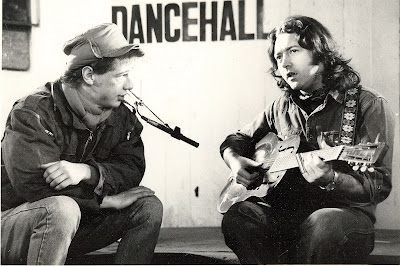
In the episode of Whistle Test in which Rory features, Andy is dispatched to Dingwall’s Dancehall in Camden Lock (a club that boasted the longest bar in London at the time, as well as near-pub price drinks and New York-style burgers) to “find out if there is some kind of future for the blues in 1985.” Andy begins his segment by talking to ‘Ice Man’ Albert Collins, as well as a number of independent record producers that specialise in blues music, such as Bruce Iglaur (Alligator Records) and Dave Foster (Hot Shot Records). Interspersed with these interviews are video clips of some of the stars of the 1980s blues scene, including Robert Cray and Stevie Ray Vaughan.
Photograph by BBC
Here, Andy paints a rather positive view of the blues, despite the many challenges it faces in a world now dominated by MTV and synthesisers. The people he speaks to note that sales of blues records are, in fact, increasing amongst both collectors and casual punters, attributing this to the fact that “musical standards have slipped” and people are looking back to the roots in search of “something more emotional rather than mechanical.” Particular shoutouts are given to the Fabulous Thunderbirds, Anson and the Rockets and Johnny Winter, all credited with injecting new life into the Texas blues.
The segment then ends with Mr. Blues himself, sitting with his beloved National in his arms – practically an extension of himself. As Andy takes a seat next to Rory, he describes it as a “bit of an emotional moment,” explaining that his first gig was Rory at the Free Trade Hall in Manchester when he was roughly 12 years old (either 1971 or 1972) and that this experience marked his gateway to the blues. Andy begins by asking Rory how he first got interested in the blues. In the story we’ve all come to know so well now, Rory mentions discovering the music of Leadbelly and Big Bill Broonzy through Lonnie Donegan and Chris Barber, before later moving on to Chuck Berry, Jimmy Reid and, ultimately, Muddy Waters – his all-time hero. Andy then asks Rory whether there is any evidence to suggest that young people are rediscovering the blues. In his characteristically optimistic manner, Rory states that “you get little peaks now and then” and that once “all this hi-tech synthesiser carry-on” starts to cool down, there might be room for it again. He also notes that blues fans are always there, but the problem is the “radio people” who do not programme blues music as they think it is no longer “fashionable.” As usual, Rory gives intelligent, thoughtful answers and it is a real pleasure to listen to his insights.
The interview part now over, Andy points at Rory’s National and asks him to “give us a demonstration of what you can do on one of these things.” Rory looks straight at the camera, laughs and cheekily asks, “Who’s your friend?” the joke marking his relief at finally being able to stop talking and play the guitar (a common feature of many Rory interviews – see, for example, “what’s the limerick?” in Rocksteady 1990). “I’ll do a little bit of a number,” he says modestly, before breaking into a beautiful version of “I Can’t Be Satisfied”. Right from the opening sweeps of slide and powerful vocals, Rory captivates the viewer, immediately creating an intimate and cosy atmosphere. We have personally never seen another artist with the ability to make such an impression in such a short space of time. When the recording cuts off halfway through passing to another scene of Andy leaving Dingwall’s Dancehall, we are left crying out for more.
Interview with Frankie Miller, Das Beste aus dem Rockpalast, 4th July 1986
Even if you don’t speak German, Rockpalast is a word familiar to many music fans, especially those of Rory. The concept of Rockpalast was developed by Peter Rüchel and Christian Wagner in 1974. Together, they proposed a series of live concerts, especially for German television and radio, featuring performances by internationally known bands and musicians. Viewers were encouraged to watch the concerts on TV, yet tune into the radio to listen to the music in stereo. The first Rockpalast shows took place in the WDR studios in Cologne in front of a small audience. But as their popularity grew, Peter and Christian decided to move them out into clubs and venues across Germany. 23rd July 1977 marked the launch of this new format, with an all-night concert scheduled at the Grugahalle in Essen and, for the first time, broadcast live all across Europe. For many, Rockpalast was more than just a music show; it became “the philosophy of a generation” (Mig Music).
From 1977 to 1986, a total of seventeen Rockpalast all-night concerts were broadcast live from the Grugahalle. There were also a number of open-air summer concerts, such as those on the Loreley (1981-1985). After twelve successful years, it was decided that 1986 would be the last Rockpalast. Over that period, Rory had appeared at Rockpalast a record-breaking four times: Cologne 1976, Essen 1977, Wiesbaden 1979 (as part of the Mai Festspiele) and Loreley 1982. All four performances are highly memorable and showcase what a fabulous live entertainer Rory was. We also can’t mention Rory at Rockpalast without giving a nod to his later performance in 1990 when the show was revived as Rocklife – a concert for which we have a particular soft spot.
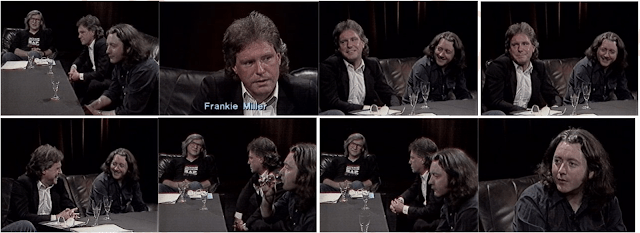
To mark the end of this first era in the history of Rockpalast, Peter Rüchel hosted a “Best of Rockpalast” programme on WDR in July 1986, featuring clips from its twelve-year run and interviewing guest stars. Naturally, given Rory’s strong association with the show, Peter invited him to take part. Rory was already in Germany at this time to play at the Out in the Green Festival in Dinkelsbühl and St Goarshausen, so he willingly accepted. Accompanying Rory was Scottish singer-songwriter Frankie Miller, another regular Rockpalast performer who took time out of his German tour to appear on the show.

Taken from Volker Grupe’s website http://www.rory.de
Rain and I talk to one another about this Rory interview at least two or three times a week, but when I sat down to write about it for this post, I struggled for days to articulate my thoughts simply because it means so much to me. I’ve followed Frankie’s music for many years, having first discovered him through his friendship with Thin Lizzy and his guest appearance on their 1974 Nightlife album. So, when I first watched Rory’s 1979 Rockpalast concert, I was thrilled beyond belief to see Frankie join him on stage and run through three incredible jams together (my favourites in Rory’s career): “Round and Round”, “Walkin’ the Dog” and “Roll Over Beethoven”. The instant connection between the two of them is so evident. Rory’s skilful licks perfectly complement Frankie’s gravelly vocals, while the huge smile on both of their faces throughout the 20-minute set is a sheer delight to watch. Keen to seek out more Rory and Frankie collaborations, I then came across their soundtrack for the 1981 film A Sense of Freedom and was blown away by the sensitivity of the music. And finally, I encountered this interview, offering a chance to see the two of them interacting offstage, which was so special.
There’s just something about watching this clip that brings me so much comfort and joy. I felt these emotions the first time I ever watched it and I continue to feel them several years later every time I tune in. Firstly, there’s Peter and the very evident affection that he has for Rory. He speaks to him with such warmth and has such passion for his music, which is truly heart-warming to see. Then, of course, there is Rory himself: his soft-spoken voice, his intelligent responses, his characteristic humility… even down to the way that he anxiously plays with his hands throughout as he listens to Peter. And when Frankie joins the pair, he injects a real sense of humour and cheekiness into the interview, leading Rory to break out in laughter several times. Anyway, enough outpourings from me! Let’s dig into the interview content!
Peter introduces the segment in German, providing a little background on Rory’s Rockpalast appearances. Rory – having a relatively good understanding of German – listens intently to Peter’s words and nods along. Peter then switches to English to ask Rory whether 1986 is “still a time for live music.” Rory states that the “video boom” and the rise in groups who “make records with two synthesisers” rather than go on tour is putting “heavy pressure” on bands who like to play in clubs and theatres. However, he is optimistic that the atmosphere has started to change in the last six months thanks to bands like the Pogues and the Long Ryders. Ultimately, he concludes that there will always be people who want to see “real sweat, real hands, real players.” What we particularly love about Rory’s answer is that he is very much describing himself yet in such a modest way that he draws no attention to himself whatsoever.
Next, Peter points out to Rory that he has always stayed true to the blues and wonders whether he thinks the blues still has an audience. Echoing some of the discussion in February 1985’s Whistle Test, Rory says that he believes it does and cites the success of Robert Cray, Fabulous Thunderbirds, George Thorogood and Johnny Winter as proof. He also mentions the forthcoming European tour of Junior Wells and Buddy Guy. “Blues is a folk music, and it will always live in some form,” he says sagely, “It will creep its way into rock & roll or jazz, so I’m not worried about that. But I would be sad if some of the younger people dismissed it as an ancient form of music.”
After a pause to show a clip of “Secret Agent” from Rockpalast 1977, Peter resumes the interview, asking Rory about his new record and what it will be like. Rory explains about the various delays that have occurred over the last few years, but is hopeful that it will be released in August (eventually released in July 1987 as Defender). He explains, with a laugh, that the majority of the tracks are “bluesy,” but that some of the songs have a different edge. “You try to keep your original sound and then try and get some new things on top of that,” he explains, “It’s tough. Quite hard without being over the top.”
Taken from Volker Grupe’s website http://www.rory.de
As Rory’s portion of the interview wraps up, he is joined on the sofa by Frankie who immediately gets the studio laughing. When asked by Peter if he has any memories of his 1976 Rockpalast gig, Frankie shakes his head and responds how “it’s unbelievable to see what one person would wear” in reference to his bell bottoms and yellow jacket. Peter giggles out loud, while Rory adopts a naughty schoolboy smile. Frankie is then asked which Rockpalast he enjoyed the most and he says categorically that it was “the one with Rory” in Wiesbaden, describing it as a “fantastic night.” In an earlier 1982 interview with Alan Bangs, Rory spoke more about the “great atmosphere” of that night, explaining how he and Frankie went back to the hotel after the gig and played until dawn, then got out acoustic guitars and continued to play as they had breakfast. Peter concludes the interview by asking Frankie about his band, who he describes as “really cooking” and states that they are having a great time on the road together.
“Nadine” and Interview, Rock-Pop in Concert, 6th July 1986
Rock-Pop in Concert was a German music show that ran from 1978 to 1987 on ZDF and featured a series of live concert recordings by well-known international pop and rock stars. The show was a spin-off of the popular 1970s series Rock Pop, which aimed to give a platform to German rock groups, as well as international up-and-coming bands. Rock Pop was presented by Christian Simon and ran roughly ten times a year on Saturdays, while Rock-Pop in Concert ran less frequently, largely covering major summer festivals. In July 1986, Rock-Pop in Concert turned its attention to the Out in the Green Festival, which was taking place over two days in the towns of Dinkelsbühl and St Goarshausen. The 1986 festival featured such acts as Jethro Tull, Magnum, Nazareth, Status Quo and, of course, Rory who headlined on both days.
This 45-minute episode of Rock-Pop in Concert offered highlights of the festival for viewers, dedicating a brief four-minute slot to Rory. The clip begins with the camera swooping down from an elevated viewpoint, capturing the multitudes of people in attendance at the festival. The opening riff to ‘Edged in Blue’ plays as the camera pans out, creating an atmospheric scene. The camera then shifts to Rory walking from his caravan towards the stage, his Strat clutched in his left hand and a paper cup in his right. The voiceover in German states how “a whole generation wished they played guitar as well as Rory did,” before going on to say how he has been absent from Germany for the past four years and questioning whether he can “still manage to live up to expectations.” By now, Rory has reached the edge of the stage, his brother Dónal waiting in the wings. He runs out saluting the crowd.
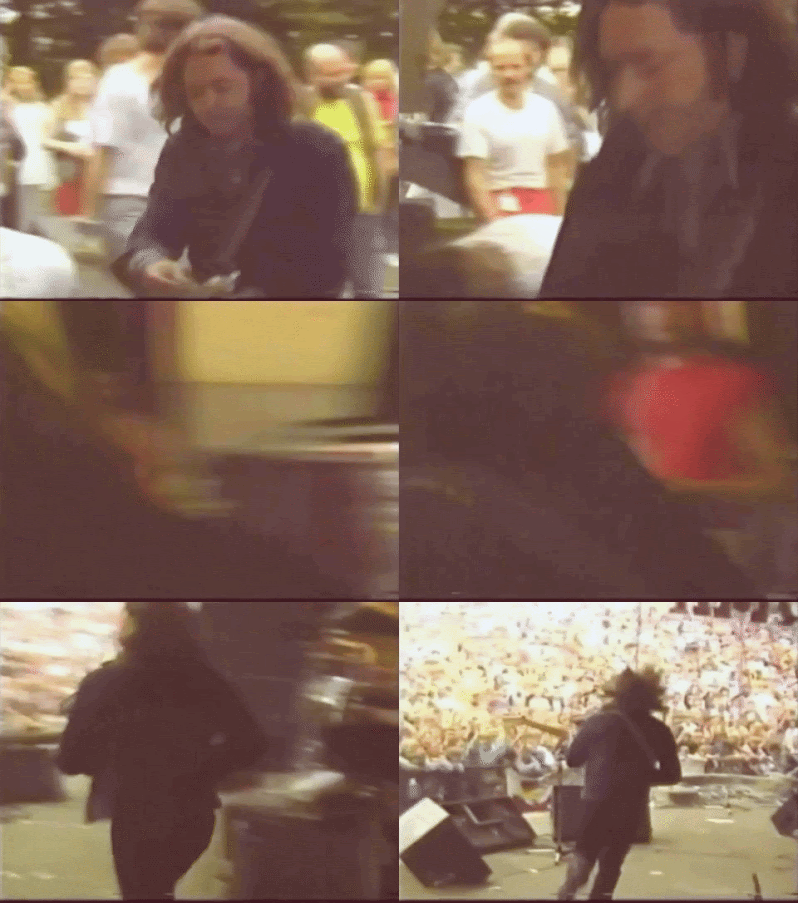
The clip then transitions into a barnstorming version of Chuck Berry’s “Nadine” (the fourth song of the set), leaving no doubt that he certainly can still live up to expectations! Rory performed “Nadine” so many times throughout his career and in so many different ways, but this is one of the standout versions (along with Vienna 1987), Mark Feltham adding a whole new dimension with his expert harp-playing. As the camera moves across the crowd, we see people sitting in trees to catch a better view of the stage, as well as large ‘Welcome back, Rory’ banners, indicating just how well-loved he is in Germany. Frustratingly, the clip cuts just before Rory’s guitar solo and picks up at the end of the show with Rory and the band exiting the stage and heading to their caravans. On seeing a group of fans waiting for him, Rory – despite being exhausted and covered in sweat – doubles back to speak to them and sign some autographs. This is such a beautiful moment captured on film and a true testimony to how kind-hearted Rory always was to his fans.
In the next scene, Rock-Pop in Concert takes to the audience, asking several members what they thought of Rory’s performance. One man says how he has seen bands with more members, such as BAP, yet Rory with just three others (Gerry, Brendan and Mark) can “get people to burst.” Then, a young woman says how she has never seen Rory live before, but he was “fabulous, a real artist.” In fact, she is so shocked that she is unable to speak coherently, babbling “what he does with that guitar… this guitar, that guitar, this style, that style…” Even without understanding German, the huge grin on her face says it all, demonstrating Rory’s supreme ability to make people happy with his music and gain a generation of new fans. Finally, the presenters catch up with Rory himself. This is another favourite scene of ours as Dónal, always concerned for his brother’s wellbeing, puts his hand on Rory’s back and tries to get him to keep moving, but Rory ignores him and continues speaking to the interviewer. Usually so critical of his own performances, Rory states that he was “very satisfied” today and that there was a “good atmosphere and a good feeling” at the festival.
“Loanshark Blues”, WWF Club, 9th November 1987
Following the release of Defender in July 1987, Rory’s schedule began to fill with promotional events and interviews, which he juggled alongside festival dates and a European tour. The tour took him to Germany in November, starting in Hamburg on 15th November and finishing in Kiel exactly one month later. Somehow, the week before, he also found time to cram in a visit to the WDR studios in Cologne to make an appearance on WWF Club.
Broadcast weekly on Friday evenings from 1980 to 1990, WWF Club was an entertainment show that featured music, sketches, interviews, pantomime and trivia. It was presented by Jürgen von der Lippe (replaced by Jürgen Triebel in 1985), Marijke Armado, Frank Laufenberg and a robot doll called Bruno. The show quickly became famous for its anarchic humour and relaxed feel, earning it the nickname the “Warm Sausage Fan Club.” Such was the show’s popularity that it broadcast Carnival and Christmas specials each year and, in 2020, to mark its 40th anniversary, all four presenters were reunited and interviewed on the popular talk show Kölner Treff.
WWF Club was known for playing practical jokes on its guest musicians, such as by making scenery collapse on stage during their performances or the presenters popping up unexpectedly in the background. We’ve often wondered if Rory was aware of this before agreeing to appear on the show(!), but luckily, the presenters were on their best behaviour on 9th November and let Rory perform “Loanshark Blues” undisturbed.
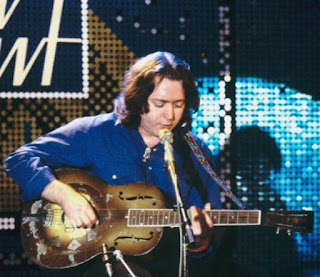
Photographer unknown
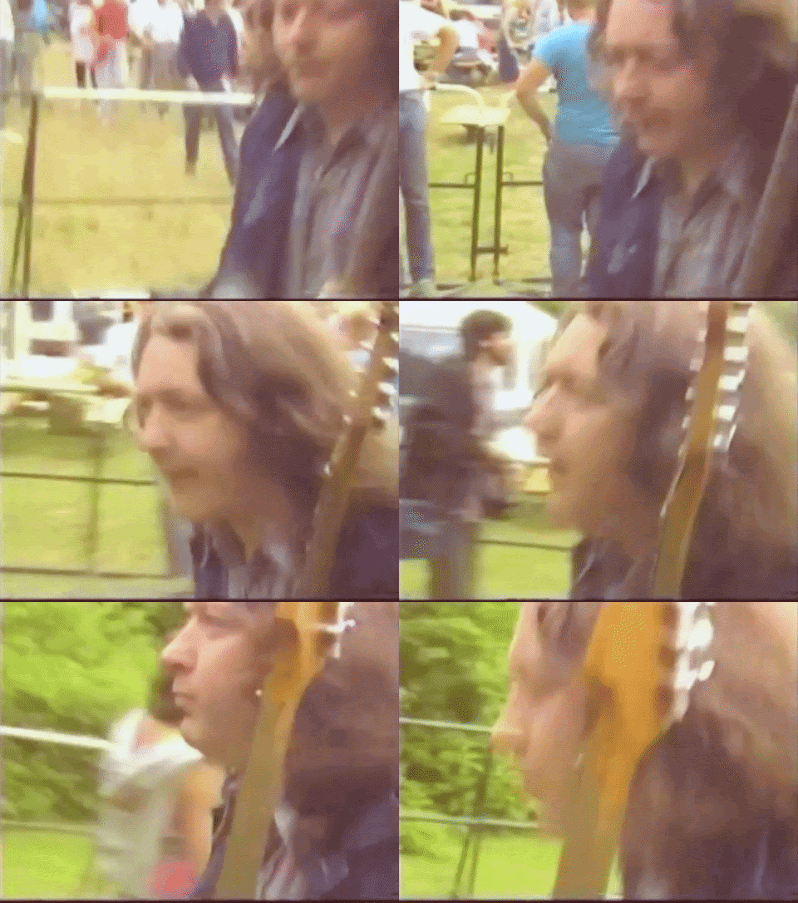
There are three versions of Rory’s “Loanshark Blues” performance circulating online. Two are shot from slightly different camera angles (the ScottishTeeVee channel has both, although the best quality version of the second camera angle can be found on the official Rory Gallagher channel), while the third also features a short introduction and interview with Rory at the end. Regardless of the version you watch, what is immediately apparent in all three is the lively club atmosphere of the WDR studio. The studio is packed to the rafters with men and women sitting at tables, drinking, chatting and generally having a good time. In fact, it calls to mind the wonderful Dutch programme De Filter Furore that Rory appeared on in 1976, giving a highly memorable performance of ‘If the River Was Whiskey’ (in addition to “Bankers Blues” and “Garbage Man”).
In keeping with the easygoing mood of WWF Club, the clip begins with Frank Laufenberg standing behind a bar. He states what a fantastic live performer Rory has been since the days of Taste and promotes the new Defender album, as well as the two-month tour of Germany that Rory is about to embark on. Then, he hands over to Rory who is on a small stage within touching distance of the crowd, adding to the intimacy of the setting.
Rory, suffering from increasing stage fright at this time, shows a touch of nerves at the beginning of his performance. His hands shake as he takes several warm-up strokes on his National, before closing his eyes and getting completely ‘in the zone’. Now, all traces of nerves gone, he kicks into the iconic opening riff of “Loanshark Blues”, gaining in confidence as he starts to sing.
Rory once described “Loanshark Blues” as the best song he has ever written, and it is easy to understand why. This stripped-down acoustic version really accentuates the song’s excellent lyrics and Rory’s very underrated ability to create a whole story and capture a mood with his words. The tale of a man who is down on his luck and makes the mistake of borrowing money from a loanshark is like a lost Dashiell Hammett or Raymond Chandler novel – the hard-boiled crime authors who Rory so dearly loved. Rory’s vocals are also especially powerful here, while his slide solo is absolutely magical, putting it on a par with the exceptional electric version that he performed at Cork 1987 (another favourite of ours!). The song comes to an end all too soon and Rory breaks out into a little smile as the audience clap contentedly. It is truly the mark of a genius – as Rory surely was – to deliver such a memorable performance in just under three minutes.
Rory is then joined on stage by Jürgen Triebel who is a little overenthusiastic in his praise, throwing his arm around Rory’s shoulders and shaking him. Rory is noticeably uncomfortable, yet remains his usual polite self. Jürgen asks him what kind of guitar he is playing, and Rory patiently explains to him – as he did so many times over the years – that it’s a “very old guitar, 1932, a National, made of metal” and knocks it with his fist. Jürgen then thanks him and hands over to Frank, bringing the short interview to a close.
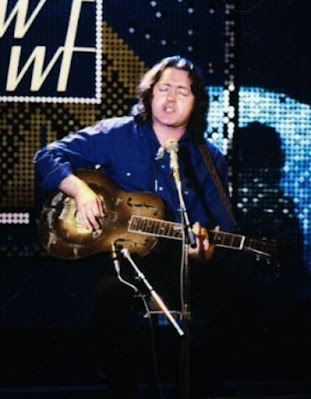
Photographer unknown
“Don’t Start Me Talkin”, Tele Illustrierte, 13th November 1987
The day after Rory’s appearance on WWF Club and before starting his German tour on 15th November, he crossed the border into the Netherlands, playing a warm-up gig in Utrecht. This was followed by another concert in Deinze (Belgium) and then back into the Netherlands again to play Geleen. Never one to slow down, Rory immediately travelled back to Germany the day after, stopping at Studio 3 in Mainz to appear on the ZDF show Tele Illustrierte.
Tele Illustrierte was a magazine show that ran from 1982 to 1991 on weekday evenings. It broadcast at 17:10pm, following the Heute news programme and was roughly 35-40 minutes in length. It was one of the first and few programmes allowed to broadcast live from the German Democratic Republic. The show was a follow-up to Drehscheibe, a programme that had run from 1964 to 1982 on ZDF and featured a combination of news, entertainment, reports, interviews, studio guests and music. TI, as it became affectionately nicknamed,was designed by ex-Heute editors Alexander Niemetz and Bernhard Töpper who decided to bring back popular presenters who were previously involved with Drehscheibe, such as Ulrich Craemer, Peter Nemec and Helge Philipp.
Being a live show, Tele Illustrierte had a deliberately loose format that could be adapted to incorporate breaking news and capture spontaneous reactions from the studio audience. Nonetheless, it still had five features that were integral parts of its daily programme – The Current Topic, The Good Advice, From the Countries, In Conversation and Sports Daily – and fit with its dual aim to both inform and entertain. The Good Advice section, where members of the public were given tips on everything from cars and cooking to medicine and travel, was particularly popular amongst viewers. Every show ended with music, featuring German and international artists across a broad spectrum of genres. This is, of course, the section on which Rory appeared in November 1987.
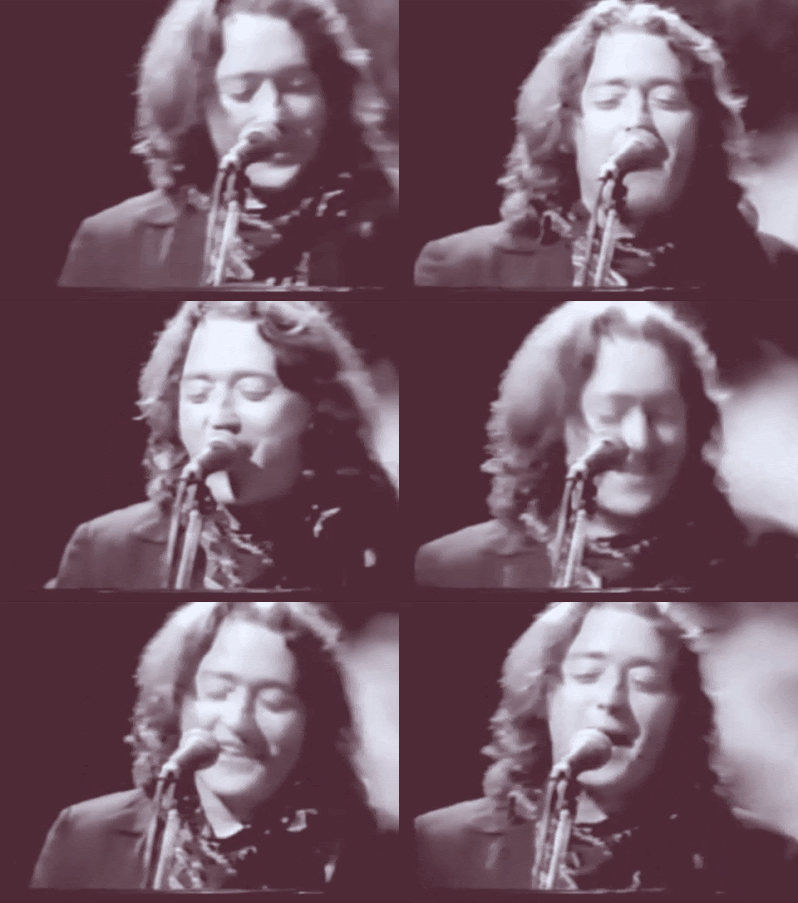
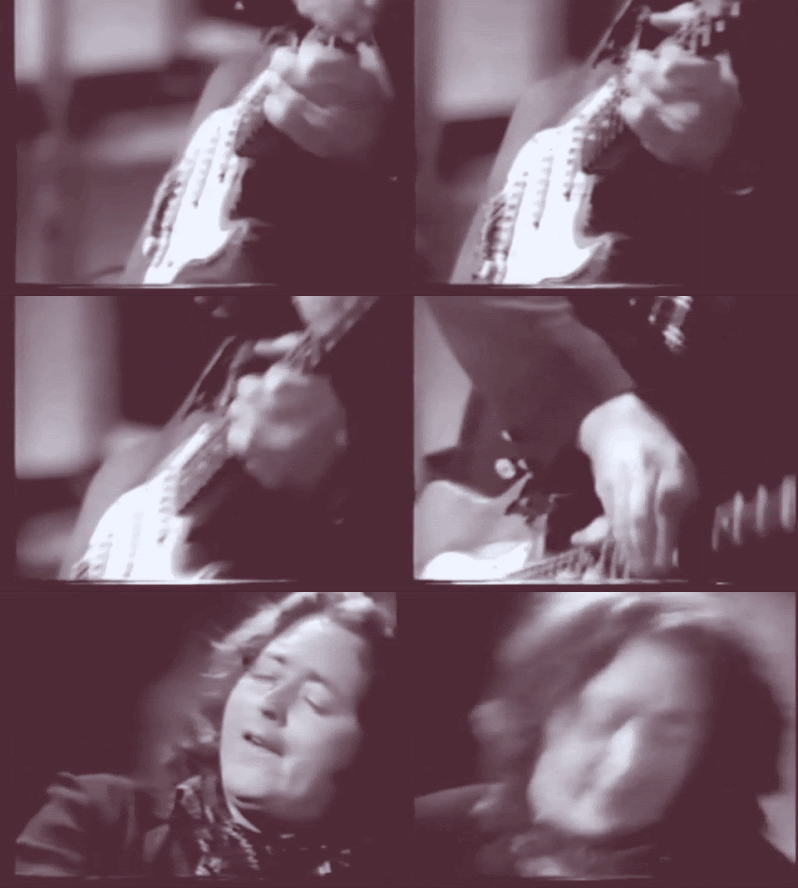
Unfortunately, the only footage of the clip currently available online is in black and white, although the show was originally broadcast in colour and there are colour stills of Rory’s performance on the fantastic RoryOn website. However, even in monochrome, Rory shines through with all the colours of the rainbow, giving an absolutely splendid performance of Sonny Boy Williamson’s “Don’t Start Me Talkin”. The clip begins with a brief presentation from Helge Philipp who provides a short biography of Rory and explains that he is about to start a one-month tour of Germany. Then, it is over to Rory, who waves shyly to the audience before his usual transformation into confident blues virtuoso as he breaks into the song’s distinctive opening riff.
It is always a pleasure to hear Rory perform “Don’t Start Me Talkin” and the song is a particular highlight of his later performances for us (Cork 87, Ohne Filter, Rockpalast 90, to name but a few). It’s one of those fine examples of a cover being better than the original, with its perfect combination of Rory’s gritty vocals, his beautiful soloing and Mark’s harp-playing. But there are two things we especially love about this Tele Illustrierte performance. First, how even playing a four-minute abridged version of the song, Rory is able to give the performance of a lifetime, putting his heart and soul into every word he sings and every note he plays. And second, the look of sheer joy on his face throughout, which is so infectious for the viewer. Whether it’s the little hip wiggle he gives in the chorus, the expressiveness of his eyes (on “out on the streets”), his smile and laughter during Mark’s solo, his gestures (on “honked his horn” and “get my hair sot”), his string-pulling… they all combine to bring the song to life in a truly magical way. It’s, without doubt, one of the finest examples of music as a tonic, a pick-me-up, an invigorator! You just can’t help but tap your feet and grin like a Cheshire Cat as you watch.
“I Can’t Be Satisfied”, Roxy, 18th November 1987
When we think of Rory and banjos, there are likely two clips that come straight to mind for most: his impromptu banjo performance on a boat on Lake Geneva as part of the 1977 Montreux Jazz Festival or his fantastic ten-minute jam with virtuoso Béla Fleck seventeen years later at the same festival. But what fewer people may be aware of is the third clip in this, if you will, Holy Trinity of banjo performances, and that’s the one with accomplished German musician Götz Alsmann that took place in November 1987.
In fact, this two-minute clip of Rory and Götz playing together has long intrigued us. The footage shows the two of them in, what appears to be, a diner. Rory, dressed in black, is standing in front of a series of fruit machines with his beloved National in hand, while Götz, in a contrasting white jacket, is seated alongside with his banjo. The scene now set, the two break into the Muddy Waters’ classic “I Can’t Be Satisfied”. As usual, Rory’s slide playing is sublime, while Götz gives the song a whole new edge with his expert string plucking, the two of them almost working in a call and response manner.
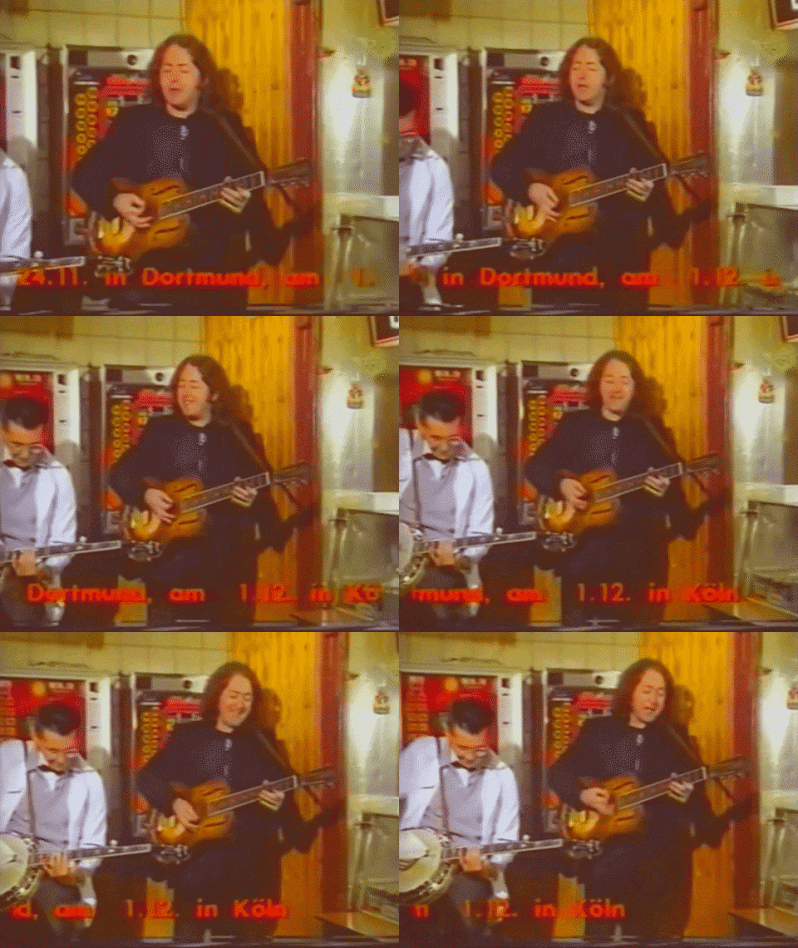
As Rory starts to sing, Götz kicks in with a high-pitched twang of the banjo, leading Rory to look across at him and giggle. In fact, Rory has a boyish smile on his face for the whole performance, clearly thriving on Götz’s accompaniment. The song progresses and Rory makes his way across the diner with Götz in tow. They move past the counter, the sound of Rory’s laughter resonating as they step outside. Then, Götz breaks into a delightful version of “La Vie En Rose” (Edith Piaf’s signature song), with Rory playing the accompanying rhythm. At this point, the camera does a circular sweep catching the two of them from a low angle that captures a huge smile on both of their faces. And then, just like that, the credits roll and the clip is over.
Digging a little further, we learnt that this performance was recorded for the magazine show Roxy, which appeared on German TV channel WDR from 1986 to 1990 and was presented by Götz. Roxy was aimed at young adults and featured a number of reports on different subjects each week, including music. We were lucky enough to catch up with Götz last month and get the chance to ask him more about this curious performance.
Given the musical chemistry between Rory and Götz, we were surprised to hear that the performance was, in fact, very spur-of-the-moment and that they had only met the night before, although Götz told us that he had known of Rory’s music since the days of Taste. So, who was the genius who suggested that the two men come together? Why, none other than the legendary Peter Rüchel, who we discussed earlier in relation to Rockpalast. As Götz explained:
While preparing a new episode of my WDR-Show ‘Roxy’, “the magazine for the young adult,” which ran from 1986 to 1990 filmed in Cologne, I had an evening’s appointment with the head of WDR Youth Television, Peter Rüchel, who was also responsible for the world famous ‘Rockpalast’ shows at the same station. We met in a hotel bar and, preparing a concert recording for WDR, Rory was there, too, celebrating and drinking with us. Rory and I had never met before. When Peter learned that we were shooting our program the next day in the outskirts of town at a fast food stand and also learning that I had my banjo with me, he suggested to Rory and myself to “do something together.” And sure enough, the next morning Rory and Peter showed up at the site, we fooled around a little bit, chose the song and off we went. As far as I remember, we did it in two takes. To add a little ‘La Vie En Rose’ at the end of the song was Rory’s idea.
Götz recalled that the restaurant (in inverted commas!) was “just about the dirtiest food stall” he had ever encountered, “an extremely dirty and seedy place” where he “wouldn’t even have bought a coke.” He told us that Rory was equally “appalled by the surroundings” and had hoped to order some breakfast, but “wouldn’t touch anything” once he had checked out the place. According to Götz, the whole recording took just thirty minutes, including rehearsal and soundcheck. Rory then left immediately, off to a series of other WDR appointments. When asked of his lasting memories of Rory from the day of the recording, Götz described him as somebody “very friendly and even shy.” Although Götz does not follow rock music himself, he has fond memories of the performance and says he feels “honoured” to have met Rory and played with him on this occasion. He also told us he was “amazed” just how many people have asked him about this “special TV moment” over the years. We are so grateful to him for finally shedding light on this curiosity in Rory’s musical history for us.

“I Can’t Be Satisfied”, Aktuelle Stunde, 19th November 1987
The day after his spontaneous performance with Götz Alsmann on Roxy, Rory travelled to Düsseldorf, where he was playing a concert that evening at Philipshalle. While at rehearsals during the afternoon, Rory was joined by the crew from the infotainment magazine Aktuelle Stunde, who filmed a backstage interview with him and a short performance.
Founded by Claus Hinrich Casdorff in 1982 (and still running today), Aktuelle Stunde was broadcast daily on WDR television from 19:00 to 20:00 and focused on current events that concerned the inhabitants of North Rhine-Westphalia, as well as consumer information. Itaimed to offer an informal, less dry version of the news for viewers, with its relaxed format and its presenters in casual dress. Until 2019, the Aktuelle Stunde studios were based in Düsseldorf so, with the major news of Rory being in town, it was only logical to feature him on that evening’s show.
The clip begins with the show’s two presenters (possibly Klaus Klenke and Bettina Tietjen) briefly introducing Rory, before handing over to a pre-recorded clip of Rory and the band at Philipshalle playing “I Ain’t No Saint” from the new Defender album (a performance in which Rory, as usual, gives his absolute all, even though it is just a rehearsal). Unfortunately, the wonderful performance is drowned out by a voiceover in German, which explains how Rory still remains true to the blues, despite the changing music scene of the 1980s.
The camera then cuts to backstage, where Rory takes a brief break from rehearsals to conduct an interview with Aktuelle Stunde. The setting of the interview is a personal favourite of ours, Rory sitting casually on a large instrument case and holding a cup of beer. The interviewer opens by stating that some people have criticised Rory for playing the same music for 22 years. Rory looks momentarily upset at the comment (a comment that he heard so often and so unfairly throughout his career), before giving a fantastic response that perfectly encapsulates his musical ethos and just why we love him so much:
I don’t think that stands up really. If you have a very strong style of your own… I know it’s 1987, but you can’t just easily change your material. My style is a gift from God. If I changed my style every six months, I’d end up like Frankenstein. It’s easy to be critical and to say, ‘he always sounds the same.’ Maybe 1% of that is true, but 99% is work. New ideas, new material, with respect for the roots of my music.
As the interview fades out, the clip returns to rehearsals, showing a small section of “The Loop”, which would go on to form part of 1990’s Fresh Evidence. Again, the performance is more like a showstopper than a rehearsal, Rory and the band firing on all cylinders. Then, it is back to the interview again, where Rory is asked whether he has plans to make a video to support Defender. He explains how he has considered doing a video, but “not with all the cliches: the swimming pool, the Rolls Royce, the parties.” After a brief pause, he goes on to state how 90% of videos are “excessive” and “not clever,” and that most of the music that goes with them is “flimsy.” We love Rory’s candidness here; he somehow always manages to get the perfect balance of being polite yet not afraid to speak his mind.
After the interview, Rory is joined by Mark for a spectacular rendition of ‘I Can’t Be Satisfied’. There is a lovely few seconds before they start when they don’t realise that they are being filmed and we see the affection between them both as they laugh and joke with one another. Rory then breaks into the opening riff of this Muddy Waters’ classic and Mark follows shortly behind, providing beautiful accompaniment. As we well know, Rory never performed the same version of a song twice and it’s part of what makes his performances so exciting and engaging to watch. It is truly incredible how much this version of ‘I Can’t Be Satisfied’ varies from the one he played just the day before with Götz Alsmann, given a whole new spin by the addition of Mark. We’ve made no secret of our huge love for the Maestro of the Harp (see December’s blog post for more) and he truly excels here, delivering a beautiful solo following Rory’s prompt of “alright” halfway through the song. The two of them have such an incredible dynamic and work off each other so perfectly. The camera angles work wonderfully here at capturing the mood, whether by zooming in on Rory’s hands on the fretboard, his black boots tapping against the box or Mark’s expressive ‘wahs’ on the harmonica. Sadly, the clip cuts off early as the presenters interrupt to say goodbye and Aktuelle Stunde comes to an end. As usual, we are left wanting to hear more.
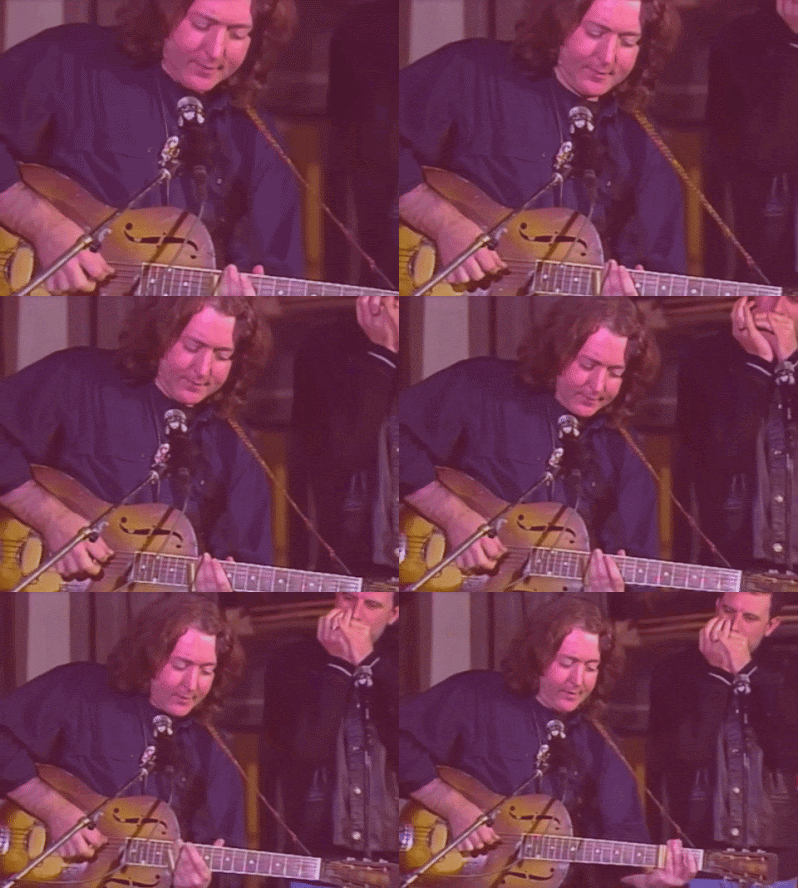
1988 RTÉ Evening Extra spot with Mark Feltham, February 1988
In 1988, Rory gigged extensively while promoting the Defender album. This included a tour around Ireland, which he had not done since 1984. During this time, he guested on many radio and television stations, such as an interview with Dave Fanning (which we covered in last month’s post), as well as a performance of “Walkin’ Blues” with Mark Feltham on RTÉ’s Evening Extra program. Evening Extra was a short-lived, thirty-minute segment that focused on a range of social and cultural topics, from health, to cooking and Irish politics. During the programme’s two-year run (1986-1988), many hosts and reporters were featured, including Bibi Baskin, Aonghus McAnally, Siobhan Cleary and Shay Healy.
Healy was often assigned the music-orientated portions of Evening Extra (for example, his interview with Philomena Lynott on the one-year anniversary of her son, Phil Lynott’s, passing), and so it was only fitting that he introduce Rory and Mark during their guest appearance. Unfortunately, the majority of the interview is excluded in the YouTube video, and we only have access to the final sentence of Rory’s answer to, what we presume, was Healy asking him about his feelings on being back home in Ireland (“… now and then, you always miss it when you’re away”). Healy adds that it is always a pleasure to see him return to Ireland (“we look forward to every time you come back here”), before turning the stage over to Rory and Mark.
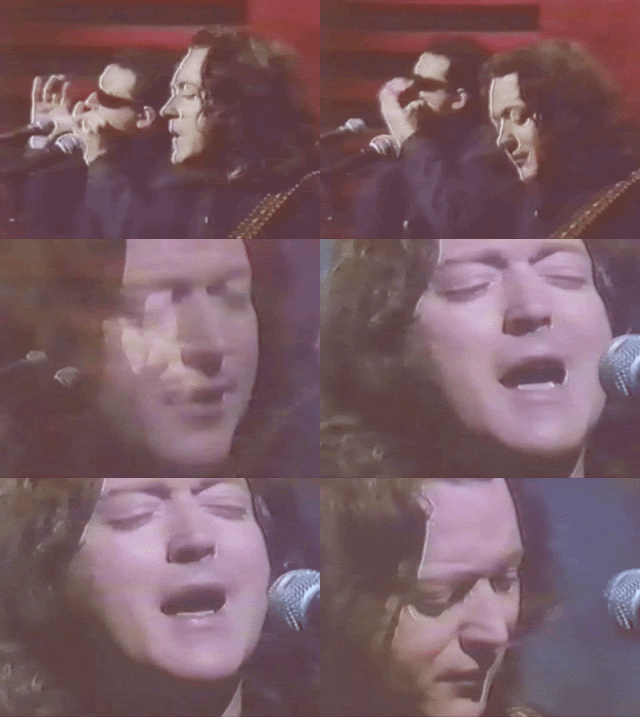
This version of ‘Walkin’ Blues’ is quite sombre and sedated, with Rory talking his way through the lyrics rather than singing them. Nevertheless, towards the end of the song, he incorporates hauntingly beautiful vibrato to his vocals, especially on the line “you know I had the mean, old walkin’ blues.” When the tune is over, the camera pans over to Healy watching from afar, and he explains that the sweat on Rory’s brow was not only from “the blues,” but also “a really bad flu,” which accounts for his croaky – yet still poignant – voice. Although the date of this video is listed as 6th February, we hypothesise this to be incorrect, and suspect it was at a later point in the tour. To begin with, Evening Extra was filmed and broadcast from Monday to Friday, and 6th February happened to fall on a Saturday in 1988. Next, as previously stated, Rory was unwell here (most likely from mental and bodily exhaustion of the tour), and during his other television appearance earlier that month (The Late Late Showon 12th February), he shows no sign of illness. Finally, to wrap up the segment, Healy mentions Rory’s upcoming concert in Galway “on Friday” (26th February), and thus, we estimate that Rory’s appearance on Evening Extra occurred between February 22nd to the 24th.
Above all, what we can take away from this performance is Rory’s commitment to music and people. Despite feeling under the weather, Rory followed through with his commitment by appearing on television on the one hand, and on the other, not disappointing the audience by giving a mediocre rendition.
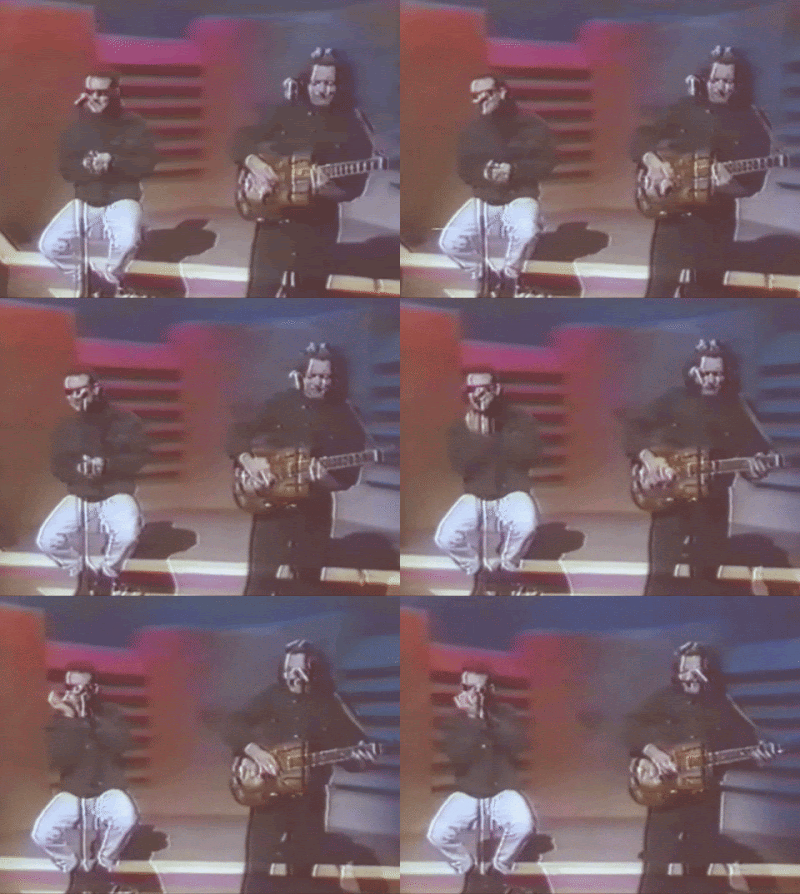
The Late Late Show, 12th February 1988
The Late Late Show is as legendary in Ireland as Ronnie Drew’s voice, and is the second longest running late night chat show in history. The program began in the summer of 1962, with Dublin-born Gay Byrne (affectionately known as ‘Gaybo’) selected as host, particularly after his work with Britain’s Granada Television (he famously interviewed The Beatles for the first time on TV for People and Places). In 1999, Gay retired from The Late Late Show, and was replaced by Pat Kenny (1999-2009), followed by Ryan Tubridy (2009-). Days away from his first of four concerts at Dublin’s Olympia Theatre during his 1988 tour, Rory featured on The Late Late Showon 12th February. This is most likely Rory’s first and only appearance on the program, and on this occasion he performs a captivating rendition of ‘Out on the Western Plain’, as well as being interviewed by Gay.
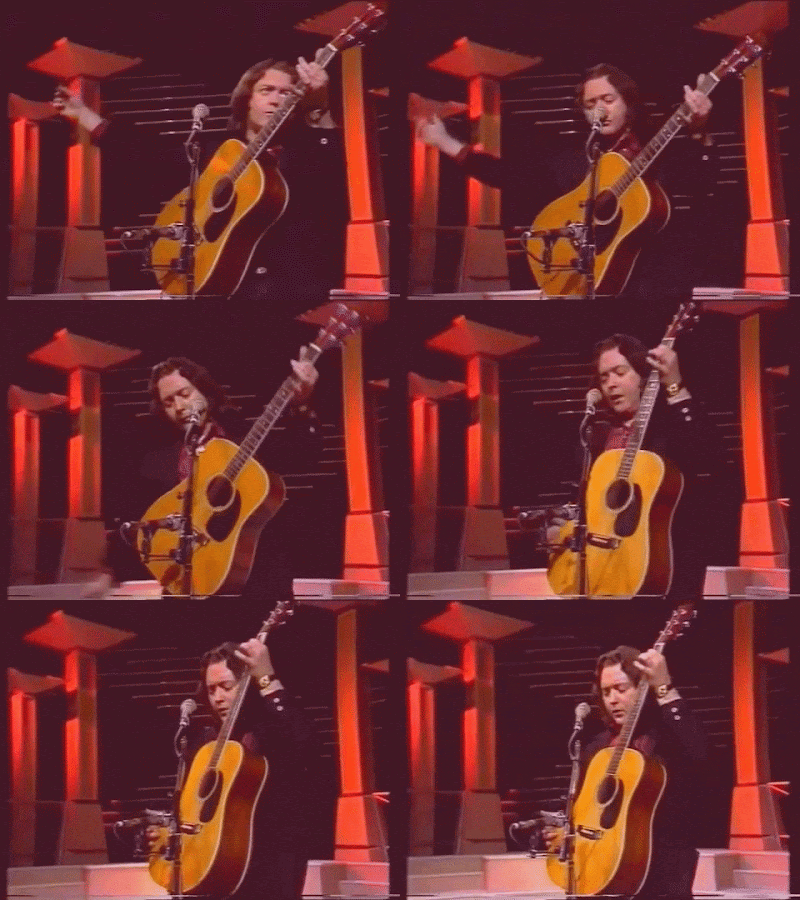
There are many lighthearted and funny moments within the clip, and similar to other Rory interviews, we often find ourselves favouring certain quotes and referring to them in our conversations. After announcing the list of dates for Rory’s current tour, Gay’s line of questioning begins at Rory’s childhood and musical upbringing. A highlight includes Rory’s response to the mention of being born at the (ironically named) Rock Hospital in Ballyshannon (“I believe the hospital is still there as far as I know, but they didn’t put the plaque up yet [laughs]”). As we covered in our guideline to Rory’s achievements published back in March, Rory was honoured with a plaque at Ballyshannon’s Rock Hospital in 2000. Other milestones in his life are covered including growing up in Cork, introduction to the guitar at the age of nine, and his early gravitation towards American country blues and rock n roll.
I kind of knew from seeing Elvis Presley, and hearing Big Bill Broonzy and Leadbelly on the TV and the radio that that’s where I was aiming at […] I was more interested in American roots music than Irish traditional or opera, which you might hear at home or something. I had this sort of great love of Leadbelly and these travelling musicians […] People like Chuck Berry and Lonnie Donegan didn’t hurt either, or Buddy Holly, Eddie Cochran. At that stage just to see someone playing a guitar and singing was enough to switch me on, you know? I wasn’t too snobby about it.
Gay makes a point of the contrast to Rory’s usual energetic performance style (“a lively guy and operates very well”), versus his “downplaying” on The Late Late Showdueto the lack of equipment and space. To demonstrate this, a portion of ‘Messin’ With the Kid’ from Rory’s televised gig at the Cork Opera House in 1987 is shown, which was directed by a member of the production team at The Late Late Show, Anita Notaro. As the clip plays, you can faintly hear in the background Gay’s occasional comments, before fading back to the interview and Rory laughing, most likely feeling bashful from having to watch himself. Gay mentions the “extraordinary” way that “the old riffs” from rhythm and blues have continued to stand up throughout history, which Rory agrees with.
The strange thing is that you can spend, as we did, maybe ten years trying to be very clever sometimes and update the riffs and try and use the roots base and be European clever with it. But it’s a no-win situation. You end up just to be able to play T. Bone Walker riffs or whatever with your own original stamp is really what I found lately that, you know, I’ve got twenty five more years of this to try and [laughs] learn.
In 1988, there had been many musical changes, including the way Rory approached the blues. “I’ve moved back towards the real origins of the music,” he says, “simplifying, cutting down, and just trimming it down a lot.” Gay emphasises yet another change, which is the way Ireland now appreciates rhythm and blues. He describes Rory’s performance at the Cork Opera House as “heartening” and “extraordinary” because “twenty years ago” there would have never been that kind of “adulation” for an Irishman playing that sort of music in his hometown. Rory adds this insight to the conversation:
I think the sad fact that in Ireland that quite often the whole blues and R&B side of things is overlooked because lately a lot of the groups, good groups at that in Ireland and in Western Europe, they’re all very white orientated, you know what I mean? … I think for awhile a lot of youngsters thought that if a man sat down with a twelve string guitar and a chair that he was like the black equivalent of Séamus Ennis or something, if that doesn’t sound daft. But I think lately now and again, I’d like to think people are beginning to reappraise these great original blues players, because that’s the source.
Gay then returns to Rory’s energy levels displayed at the Cork Opera House show, and the difference between his “laidback” demeanour offstage and his onstage presence (i.e. the ‘Dr. Jekyll and Mr. Hyde’ complex that is often associated with Rory). Jokingly, Rory replies, “that’s my son, he does all that for me,” meanwhile he sticks to the acoustic numbers. This leads the conversation onto a more sombre undertone, especially when Rory mentions how “less together” he is when off the road, verses how “fit” he becomes when touring. His brief, though poignant, comments allude to the restlessness and depression that occurred throughout Rory’s life, and exacerbated on breaks between tours. Gay moves on to Rory’s dislike for the business side of the music industry, and while Rory vaguely refers to the Taste split (“for a couple of years I kind of didn’t keep an eye on certain people in the early days,”), he ends – as always his way – on a positive note: “But in general I just like to play, and play every night.” In retrospect, the interview ends with a touch of sadness, particularly on today’s anniversary. Gay asks if in twenty years time, when Rory is sixty-two, if he will still be playing. “Chuck Berry just turned sixty-two,” Rory explains, “and if I can be anything like he is at that age, I’ll be more than happy.”
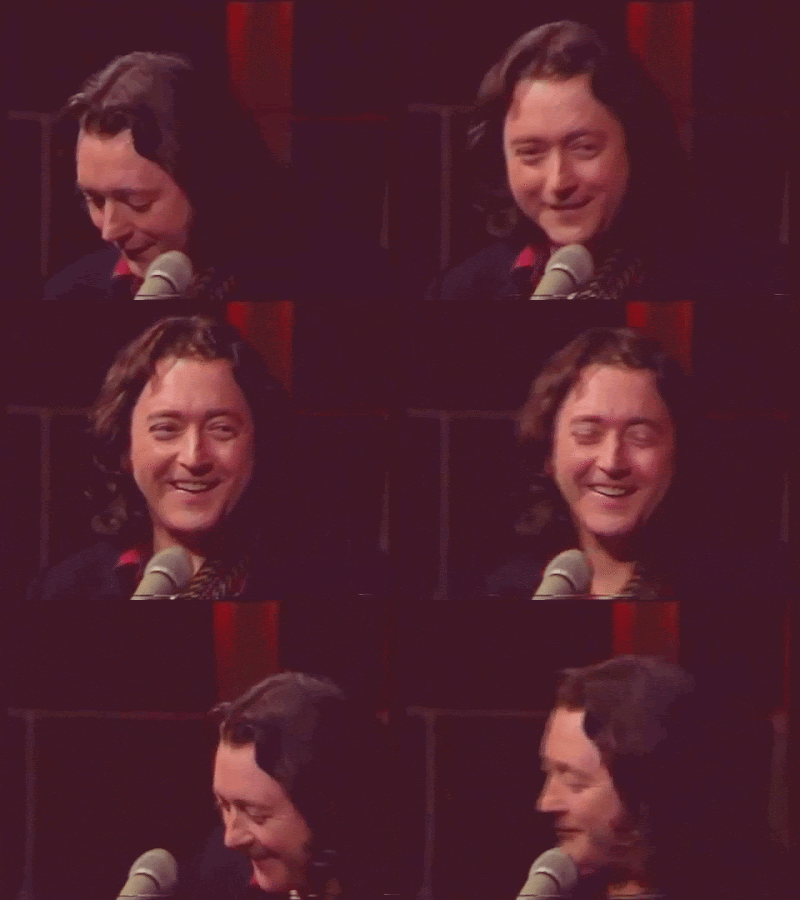
1988 Borderline interview, March 1988
The third television appearance Rory completed on his 1988 tour of Ireland was for the RTÉ program Borderline. The show began in 1986 and featured youth orientated topics, ranging from “music, fashion, film, and entertainment,” as well as featured a live phone-in, music performances, and a participating studio audience. In the two-year run of the show, Aonghus McAnally, Rónán Johnston, Eithne Hand, Majella Nolan, and Maria Doyle hostedBorderline.
The specific date of Rory’s interview on Borderline is unclear. RTÉ’s photographic archive on their website lists the interview as occurring at Studio 1 between the 1st and 29th of February, and included in the special edition of Borderline on March 1st, which aired on the same night as the Stag/Hot Press Awards at Dublin’s The Waterfront Nightclub. As reported in the Evening Herald, the awards ceremony was shown during the Borderline episode, and we surmise this clip of Rory to be at the Stag/Hot Press Awards as a kind of promo for the show. We can only presume then that Rory’s interview with Rónán Johnston and Maria Doyle was either filmed on an alternate date, or perhaps on the awards night itself, and Rory might have had a change of clothes. In recent years, this episode of Borderline was uploaded to the RTÉ website as part of an anniversary of the TV station. However, to our knowledge, the episode is no longer available online.
Moving onto the interview now, Rónán’s introduction mentions Rory’s recent win at the Stag/Hot Press awards, and claims him to be “the total and utter king of rhythm and blues.” We’ve always found Rory’s gesture of standing up to the small crowd’s applause to be very gentlemanly and sweet. The questions begin with Rory’s recent release of Defender and what has kept him busy since his last visit of Ireland in 1984, including tours of America and behind the Iron Curtain. On the topic of touring, Maria highlights Rory’s longevity on the road (“about 25 years?” she asks, to which Rory jokingly begins to count and answer with a smile, “more or less,”), as well as wondering if he is ever “tired” of the relentless schedule.
It’s more challenging now than it is when I started off, in a funny kind of way […] I think every now and then you think you’ve just achieved what you aimed to go for in the start, but um, the longer you do it the more you find you don’t really understand the whole thing, the more you need to challenge yourself. It’s not just good enough to do a good concert tour, or make one or two good albums … you really have to keep pushing yourself further and further.
Rónán makes a remark about the contrast of Rory’s popularity and his “low key” nature, to which he answers quite assuredly that “you can’t go for the brass ring all the time, [but rather] you gotta keep your source of independence […] I like to keep 1% of myself to myself, you know?” Towards the end of the interview, two questions from the audience are taken: the first is about the cost of maintaining the 1961 Fender Stratocaster (“35 pounds, sometimes 50 pounds. It depends … but the poor guitar’s nearly finished. Super glue is holding it together”), while the second question relates to Rory’s influences (“I would say my main influences were Chuck Berry, Muddy Waters, Woodie Guthrie, Leadbelly, but the list for me keeps on going”). Maria turns attention onto the current blues scene today, and if a younger generation are picking up on the same artists from the 1930s-1950s that Rory loves and admires:
I hope so. I think there’s a touch of that because if you’re using electronic drum machines all the time, it’s fighting against the natural heartbeat, you know? And I think the people – with all due respect to ‘visual music’, we call it – I think even very young people still get a kick out of seeing a guy sitting on a chair playing natural music with his hands.
Although Rory emphasises the need for recognition of particular artists, such as New York guitarist John Hammond, as with a lot of his answers, he ends on a positive note, and that with the success of Robert Cray and Stevie Ray Vaughn, “I think it’s looking healthy at the moment on the blues horizon.”
Through emailing the musician Shea Fitzgerald, who incidentally co-wrote the theme tune to Borderline with Rónán, we were fortunate enough to get in contact with Rónán to ask about this interview. Here were Rónán’s immediate recollections about his first encounter with Rory:
It’s a funny one, because as a 20-year-old musician, meeting Rory was intimidating (for me anyway, I think Maria was cool with it!!)
What really struck me was how incredibly shy Rory was. I chatted to him before and after the show and it was much like the interview itself, really quick stilted, I’m guessing mostly my fault!! He had a guitar with him and the thing that struck me most was the minute he had it strapped on he was relaxed again. The guitar did the talking for him
Rónán informed us that following his career in television, he changed pathways and for the past seven years has worked as a licensed psychotherapist. Rónán shared a few poignant details he has in retrospect about the interview, “I can see even as a 38 year old man … [Rory] was already in the grip of the demons that got him in the end.” We were struck in particular by Rónán’s final comment, which echoes sentiments that we have often spoken and written about in regards to Rory’s final years and life-long struggle with mental health (refer to our first post in November, 2021).
This sensitive gentle guy with immense talent had obviously learnt to medicate in a particular way and I’ve often wondered in the intervening years if he’d had the right help would he have survived?
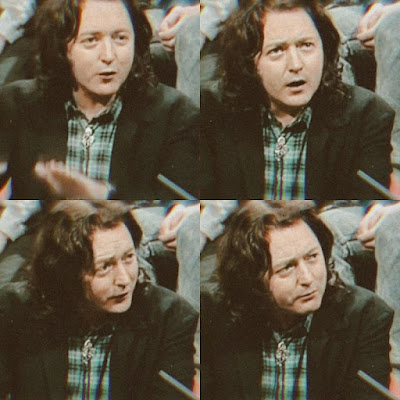
1990 Ohne Filter Interview, 30th March 1990
Ohne Filter (“Without Filter”) was a German television show that ran from 1984 to 2001, and across those years featured live music performances from over three hundred acts, such as Chris Rea, Gary Moore, Little River Band, and Tony Joe White. The show was known for its motto ‘pure music’, and captured quality shows at the SWF studios in Baden-Baden, which were then broadcast internationally. On 30th March 1990, Rory appeared on the program for the first and only time, and while his hour set is one we would absolutely love to discuss and analyse in a future post, today we instead focus on his interview with Felix Parbs prior to the performance. Felix was one of many people we tried to source contact details for in preparation of this post, but unfortunately we were never able to find this information, nor much about his career following Ohne Filter.
From 1981 to 1985, Felix co-hosted with Andreas Ernst the WDR youth-orientated talk show ‘Kaffee oder Tee?’ (Coffee or Tea?). We discovered an early advert for the program, which prided itself on their “provocative questions” and “explosive topics of conversation”, including the special guest Harald Naegeli, a graffiti artist known by his nickname ‘Sprayer of Zürich’. In addition, Felix was a presenter for Radio Luxembourg, and part of the guitar ensemble, Duo Presto, with Peter ‘Hank’ Frede. Although we are unsure how many albums the pair released together, we found an advertisement from a 1990 issue of Music and Media for their 1989 self-titled release (most likely a debut). Currently, there are three tracks available online: “Das Ohr Lügt Nicht” (The Ear Does Not Lie), “Aber Nu” (But Now), and “Muggenflokati“. The guitar work is intricate with minimalist production, and very entertaining. The album features original compositions, albeit the one cover of Doc and Merle Watson’s “Black Mountain Rag”. Sitting back and listening, we wondered if Rory was aware of Felix’s musical background, and indeed if their love of guitar came up in conversation off camera …

For the moment, however, we are limited to only what is on camera, and turning to the interview now, the first question Felix asks of Rory is about his 1961 Fender Stratocaster, which is in his arms for the entire clip. In our February post, we likened this affectionate hold of his Stratocaster as a “security blanket” for Rory, helping calm his nerves. Felix mentions that Rory has just travelled from London where he has been recording and mixing his “new” album (Fresh Evidence), and Rory briefly details between a shaky voice and sigh of relief what has been a gruelling process for him: “We hoped to have the album out earlier, but it took a little bit more time. We’re doing a new cut, but it’s finished now so at long last, it’s been very hard.”
The mood turns upbeat (and remains so for the rest of the interview) as Rory recalls the “special memory” of working with his hero Muddy Waters in 1972 (“the man was so kind”, “he knew quite a lot,” “the attitude was spectacular”). Felix reveals the recent news that blues musician Willie Dixon had telephoned Rory earlier that day to propose a studio session with his band, as well as with Eric Clapton and Keith Richards. “We’ll see what happens,” Rory says, “It looks good.” Unfortunately, due to unknown reasons, this session never occurred. For his final answer, Rory shares the story about an AC30 amp of his going up in flames at a show in New York, his excitement intensifying the huskiness of his voice, which we always find endearing. “And the audience was [applauding], they thought this was The Who, you know?” Rory says, and he and Felix smile, “But of course it was only disaster for me [laughs], but I got through it.” Felix then wishes Rory luck with the show, and confirms that, “it’s going to be a very rocky, but bluesy night, right?” Rory shyly nods, adding: “We try to cover the rainbow, different spectrums of the sound. But let’s see how it goes, yeah? I hope it goes well.”
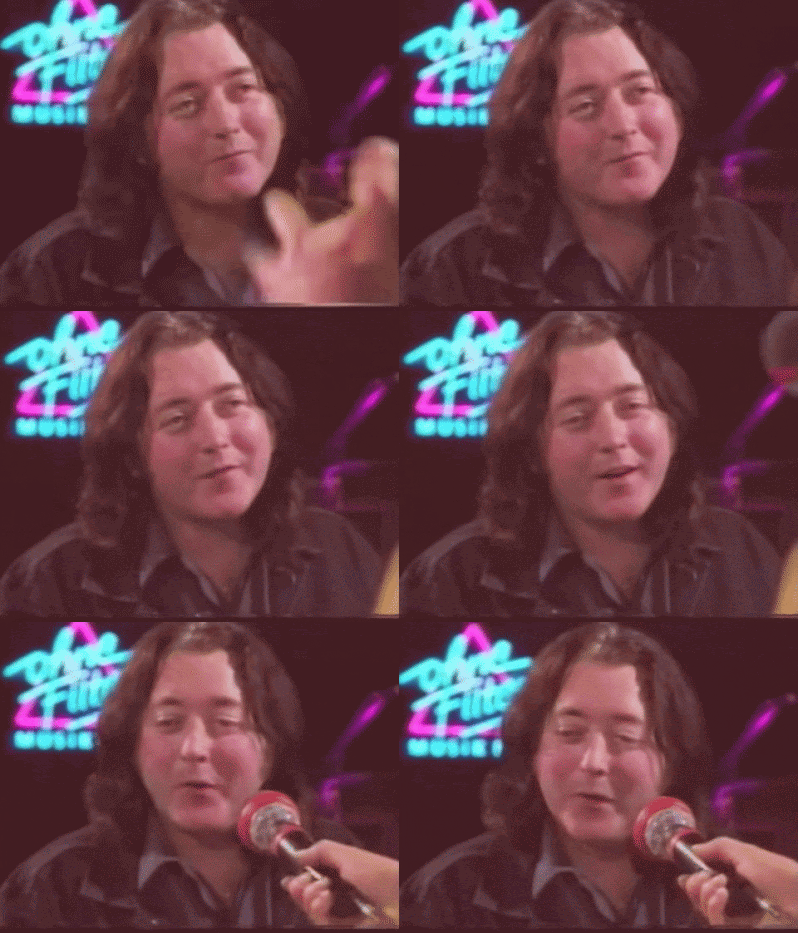
ARTÉ interview, August 1994
There is very little known about this interview. While some sources associate the interview with Rory’s performance at the Inter-Celtic Festival in Lorient, it is more likely in connection with the Montreux Jazz Festival, which Rory appeared at in early July. As a result, the location of the interview is either in Montreux, or possibly in the UK in his room at the Conrad Hotel by Chelsea Harbour. So far, only one version of the interview has surfaced online, and includes a partial answer: “My writing is getting better. My playing is getting better. I’m much more happy today as a musician. I’m not happy as a person, but I’m happy as a musician.” Physically, Rory seems quite tired, even lethargic. He then plays a very tender version (“à la Celtic”) of “Out on the Western Plain” on his 1990s Charvel 625C acoustic, which is abruptly cut off in the middle of Rory’s solo.
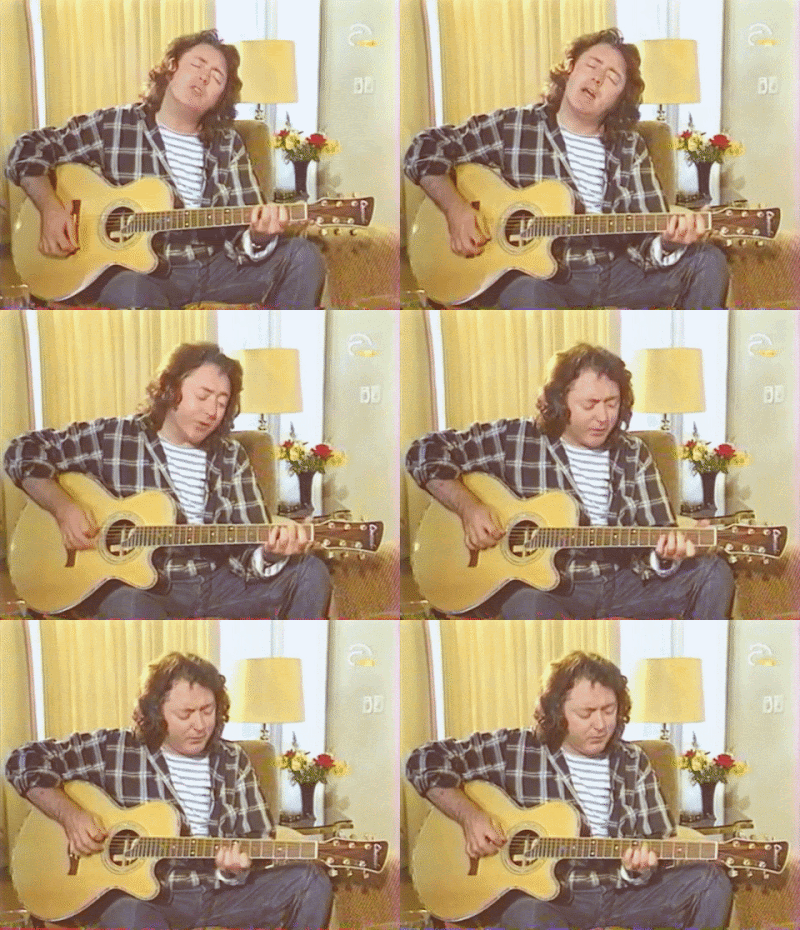
Rock N The North Interview, 1994
Sometime in the early part of 1994, Rory was interviewed for the six-part documentary series Rock N The North, which showcased the music scene of Northern Ireland. Terri Hooley, often referred to as the ‘Godfather of Irish punk’, created the series for Ulster Television. Rory featured in the second episode, which traced the blues and beat movement in Belfast in the sixties. The first half of the episode highlights the importance of the Maritime Club, a music venue that advanced the blues scene in Ireland, and was also notable for the debut of Van Morrison and Them. A few ex-members of Them appear in the episode, including Morrison himself, original keyboardist Eric Wrixon, and guitarist Billy Harrison. Although the blues offered the younger generation of the sixties a voice of expression, rebellion, and distinctiveness, on the other hand, Ireland was a different musical landscape to Britain and America, and becoming a successful band was difficult. “Don’t forget, it wasn’t an open door then for Irish bands,” Rory remarks early on in the program, “[and] to be taken seriously as a rhythm and blues band or something like that was quite a challenge.”
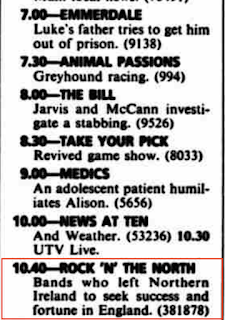
The North, from the Irish
Independent (Aug 23, 1994)
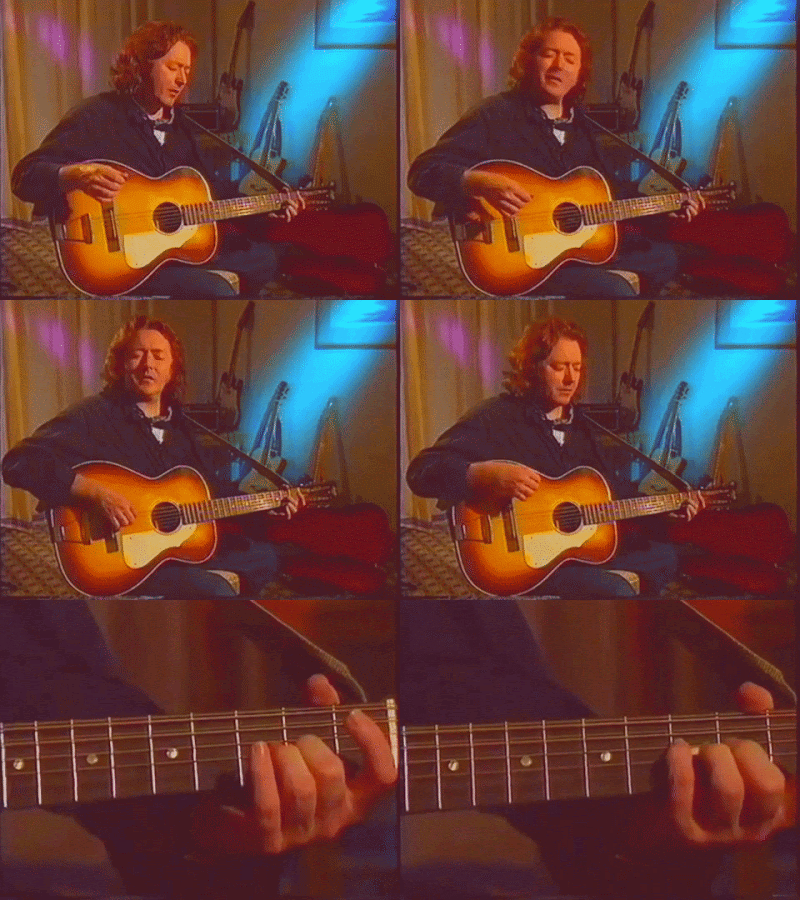
One of the reasons why American blues was relatable and appealing to the Irish is that they share similar musical characteristics. Ex-guitarist of Thin Lizzy, Eric Bell, highlights two ways that the blues and Irish folk music “intertwine”: firstly, the scales and techniques in both traditions are alike, and secondly, the “lilt” that the Irish often have is present in blues. Rory builds upon this idea from Bell through demonstration, using his Stella 12 string acoustic to interpret the 1946 Arthur Crudup song ‘That’s All Right, Mama’. Rory utilises the ‘Celtic tuning’ (DADGAD), popularised by singer-songwriter Davey Graham. Of course, we usually hear Rory apply this tuning for “Out On The Western Plain”, but on this occasion, we are presented with more of a short tutorial rather than a performance, as he adds comments here and there (for example, the shape of chords, “that’s almost a Celtic G,” to “the African influence”). Rory improvises most of the words, the sorrowful lyrics reading more like poetry than a song.
That’s all right, mama, that’s all right with you,
That’s all right, mama, that’s all right with you.
Treat me low and lonesome, any way you do.
Treat me like a baby, treat me low and mean.
Treat me like a baby, treat me low and mean.
I’ll go walkin’ down Main Street, you gotta watch that scene.
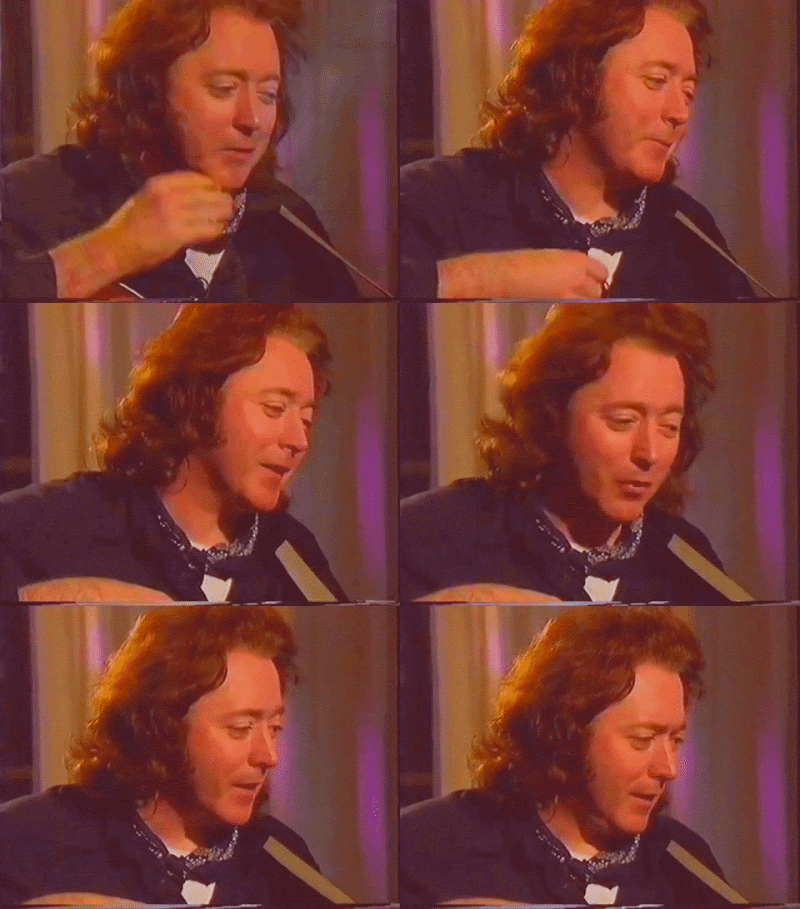
The latter half of the episode is dedicated to Taste. Rory fondly reflects on his stay in Belfast during the early career of Taste, his memories still “ultra clear” for him, before concluding, “I miss those days, to be honest with you.” In addition, comments from John Wilson (drummer of the Mark II era of Taste) are included within the segment, as well as the songs ‘Leaving Blues’ and ‘Dual Carriageway Pain’ from the band’s 1969 debut album. Similarly to Them, poor business and personal differences contributed to the (arguably premature) split of Taste, and in what would be one of Rory’s final public statements about the band, the trauma of such a loss is still evident decades later, as shown in his body language, from the pauses between words, to his faraway look.
Oh, it’s like why does any band split up? There’s no clever answer to that. It’s just that things came to a crisis point unfortunately, I’m still … we’ve … the whole thing’s been reviewed now and we’re all sort of in contact again. It’s just communications breakdown, right? And it was a shame because it was a great band, and it shouldn’t have been allowed to happen is the way I would put it.
The program goes on to highlight popular Irish acts that didn’t venture across to England, but instead found success on home soil, such as David McWilliams. However, as the sixties drew to a close, popular music in Ireland was set to drastically change following the start of the Troubles, with the scene staying stagnant for most of the seventies. “The bands might have disappeared,” the narrator states, “but the blues and beat era was to be remembered fondly for igniting the spirit of a generation.” The episode ends with a performance by Eric Wrixon and the Belfast Blues Band covering “Baby, Please Don’t Go”.
Portions of Terri Hooley’s interview with Rory that had been previously unseen in the Rock N The North series were subsequently used for the 1995 documentary, Gallagher’s Blues. A scene that was not included was Rory talking about his influences, such as Lonnie Donegan, Leadbelly and Woodie Guthrie (“that was really my territory”). He recalls hearing Muddy Waters on the American Forces radio station as a pivotal moment, “it just changed my life.” Moreover, Rory responds with a balanced answer when reflecting on his time in The Fontana Showband / The Impact, and that although “from the start it wasn’t my thing,” he can see retrospectively the benefits, “it gave me the opportunity to learn chords and play with brass sections.” To conclude the documentary, Rory’s version of “That’s All Right, Mama” is shown, as well as talk of his future ambitions.
I’d like to keep on touring. I’d like to learn more. I’d like two great albums in the charts, not for my sake but for the people that have supported me over the years and fans, if I may use that expression. That’s uh … to do well for other people, really, hopefully.
The above quote is one of our personal favourites from Rory, demonstrating his profoundly kind, humble, and bashful qualities, particularly during this intensely low period in his life. The circumstances surrounding this interview were documented in Rory Gallagher: The Man Behind The Guitar by Julian Vignoles, as well as the essay by Colin Harper for the book Irish Folk, Trad, and Blues: A Secret History. According to cameraman Brian Reddin, when he and Terri Hooley arrived in London, they received a phone call from Dónal Gallagher informing them that Rory would be cancelling the interview. However, many hours later, Dónal had persuaded his brother to go through with the interview, and rang Hooley back to update him on the change of plans. Rory felt uncomfortable with the original location of a scheduled studio, and so the interview was conducted in his hotel room on Chelsea Harbour. “[Rory] was anxious about the interview,” Reddin recalls for Vignoles, “anxious about everything. He didn’t want to play anything.” Nevertheless, Hooley noticed an immediate change in Rory’s demeanour when asking him the reason as to why the blues appealed to the Irish, “that set him off, and he talked for it seemed like hours.” In the 1995 obituary by Colin Harper from Record Collector magazine, Hooley mentions how “important” it was to feature Rory in Rock N The North, “I always thought he was a very shy and wonderful guy – definitely a big hero of mine.”
When Rory came into both of our lives, it was like being hit by a bolt of lightning. He seemed to arrive straight out of the blue at a time when we needed him the most and instantly made everything seem right when we were feeling so low. It is funny just how quickly his music engrained itself into our souls and how we felt such a deep connection with him from the get-go – a connection that is truly impossible to put into words and which we have never felt with any other musician.
Our love for Rory is a love that somehow grows each day and transcends far beyond his music. We have learnt so much from him as a person, from his kindness and humility, his gentleness and grace, his generosity and compassion, his purity and goodness. He is our role model, our idol, our muse, our guardian angel. Truly one of the finest human beings you’re ever likely to come across.
It feels strange to say this about someone we never met, especially someone who passed away when I (Lauren) was just four years old and Rain wasn’t even born yet, but we truly miss Rory. We miss him so much some days that our eyes fill with tears and our chests literally ache with sadness that he is no longer here and that he never fulfilled his dream of continuing to play into old age like his hero Muddy Waters. We carry these feelings around with us constantly and they often come up in our daily conversations with one another, but every 14th June, they are accentuated, leaving us with heightened sensations of numbness, emptiness, sorrow…
Rory is so much a part of our everyday lives in all that we do – listening to his music, watching his concerts, sharing photos, talking about him, researching for our blog and Instagram accounts, even quoting him to one another – that he feels very much alive. In fact, we often forget that he is no longer here. So, whenever June 14th comes around and we see the posts on social media to mark his passing, it’s like receiving a blow around the head. Suddenly, we remember shit, he’s gone.
Rory was taken from us far too soon under extremely tragic circumstances. We wish more than anything that he was still here, spreading joy to us all with his music and that sweet smile of his (have you ever seen another musician who was so happy to perform?). But at least, we can be thankful for the incredible legacy he has left behind. Any time we want to, we can just start up a record or turn on a video to hear/see him, immerse ourselves in his incredible talent, soak up his energy, passion and creativity … Rory will always live because his music is timeless, immortal. And as long as his name is on our lips, he will never be forgotten.
So, let’s have our own Requiem for Rory today. However you choose to remember him – whether by lighting a candle, saying a prayer, raising a pint of Guinness or simply blaring his music loud and proud – let’s take a moment to honour this truly special, one-of-a-kind man who has brought happiness to and enriched the lives of so many. Let’s also spare a thought for Dónal and the rest of the Gallagher family on this difficult day and hope that the memories of Rory that they carry in their minds and hearts bring them some comfort.
We thought that it was fitting to end this post with the final lines of Seán Ó Riada’s “Ag Criost an Siol”. Ó Riada’s mass setting was Rory’s favourite, and this song was performed by a choir at Rory’s memorial service at Brompton Oratory, where he regularly attended mass (it was, in fact, the first time that an Irish language song was performed there):
Ó bhás go críoch, ní críoch ach athfhás
(From death to end, not end but rebirth)
i bParthas na ngrás go rabhaimid
(in blessed Paradise may we be)
These lines summarise how we see Rory. He is reborn every time we listen to his music, look at photographs of him, talk about him with one another… In each of these actions, we keep him alive. And yes, in blessed paradise we most certainly are whenever we hear his soulful blues and see his angelic face.
We love you, sweet Rory. Thank you for everything.
Until we meet again.
L&R
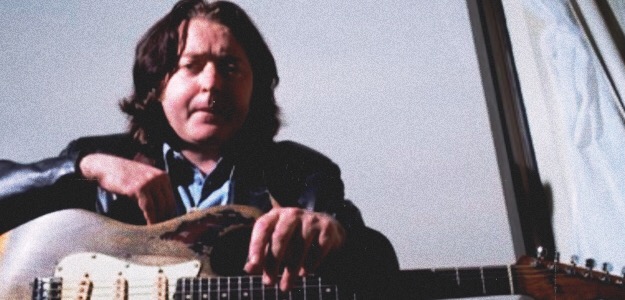
Photograph by Louis Vincent
We send our heartfelt thanks to Ulrich Kopmann, Götz Altsmann, Shea Fitzgerald, and Rónán Johnston for speaking to us in preparation for this post and sharing their insights into interviewing Rory.
Thank you for reading!


 REWRITING RORY
Leave a comment