
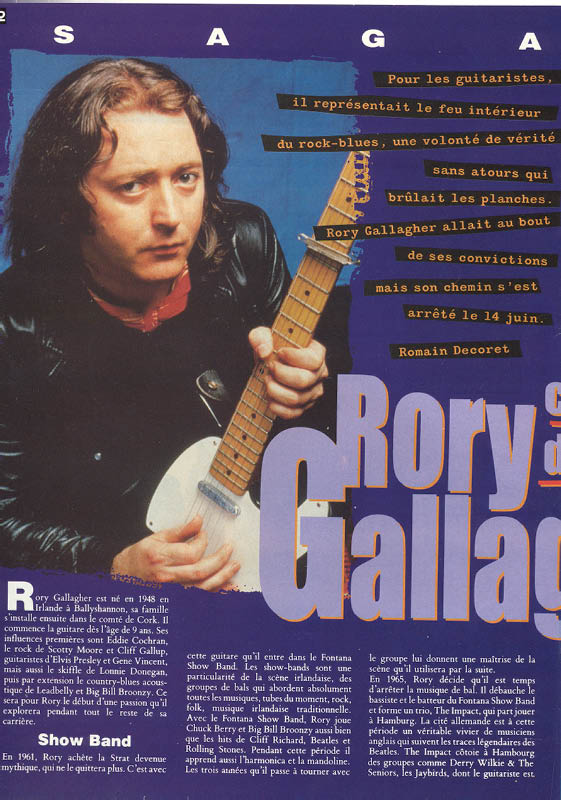
RORY GALLAGHER – A SHOT OF BLUES
For guitarists, he represented the inner fire of rock-blues. A man without any trappings who was passionate and honest and set the stage alight. Rory Gallagher was still pursuing these beliefs, but his journey ended on 14th June.
Rory Gallagher was born in 1948 in Ireland in Ballyshannon. His family then moved to County Cork. He started to play guitar at 9 years of age. His first influences were Eddie Cochran, the rock of Scotty Moore and Cliff Gallup (Elvis Presley’s guitarists) and Gene Vincent, but also the skiffle of Lonnie Donegan, then by extension the acoustic country blues of Leadbelly and Big Bill Broonzy. For Rory, this would be the start of a passion that he would explore for the rest of his career.
Show Band
In 1961, Rory bought the now-legendary Strat, which never left his side again. It is with this guitar that he joined the Fontana Show Band. Showbands were a particularity of the Irish music scene, dance groups that played absolutely all types of music: chart hits, rock, folk, traditional Irish music. With the Fontana Show Band, Rory played Chuck Berry and Big Bill Broonzy, along with the hits of Cliff Richard, the Beatles and the Rolling Stones. During this period, he also learnt the harmonica and the mandolin. The three years that he spent touring with the group gave him a mastery of the stage that he would use from then on.
In 1965, Rory decided that it was time to stop playing dance music. He poached the bassist and drummer from the Fontana Show Band and formed a trio, The Impact, who went on to play in Hamburg. In this period, the German city was a real breeding ground for English musicians following in the footsteps of the legendary Beatles. In Hamburg, the Impact rubbed shoulders with groups like Derry Wilkie & the Seniors, the Jaybirds (whose guitarist was Alvin Lee) and the Burnettes who had a certain Noel Redding in their line-up. Their schedule was exhausting: five sets per evening as a minimum. The audience demanded the musicians to “put on a show” and they gave 100%.
Taste
After returning to Ireland, Rory continued to tour for a while, then he met John Wilson, the previous drummer with Van Morrison’s Them, and bassist Richard McCracken. A new trio is formed in 1967, Taste. Their manager Tony Colton gets them to sign with Polydor and the first album is recorded. Rory works wonders on his Strat whose varnish is already just a memory, eroded by sweat, beer and, without doubt, some applications of white spirit. This first album is the prototype for the following albums: original hard rock songs with explosive changes in rhythm (Blister on the Moon, Born on the Wrong Side of Time) and long blues in which Rory is able to express his epic Irish sensitivity which goes well with the blast of country blues (Sinner Boy – Gallagher’s own composition –, Sugar Mama, a cover of Gamblin’ Blues by Lil Son Jackson and a superb version of I’m Movin’ On with a breathtaking acoustic solo). Without a doubt, Taste leaves their mark on Cream, but more so the rock than the jazz elements of their music. The group tours in England and they become favourites at the Marquee and other clubs in London.
A second studio album follows in 1969 with hits like What’s Going On and Railway and Gun. In 1970, after participating in the Isle of Wight Festival with Jimi Hendrix and the Doors, Taste split up. John Wilson, the drummer wants to make progressive music and, with Richard, they start a new group – Stud – which doesn’t last very long. In the 1980s, it is John Wilson by the way who does the samplings of the infamous Jive Bunny. Taste brings out two live albums post-split: Live at the Isle of Wight and Live Taste. Rory Gallagher decides to pursue the adventure of his own solo career.
Black & White Album
He then gets a new rhythm section with Wilgar Campbell on drums and a solid Irish bassist who would stay with him until the end [sic], Gerry McAvoy, sometimes nicknamed Rod De Ath [sic]. The first solo album Rory Gallagher comes out in 1971 with a black and white cover and very colourful music. Incandescent riffs (Laundromat), rock with melodic chords (Can’t Believe It’s True) and uncompromising blues (Sinner Boy, rerecorded for the album). The same year, Deuce is released – another studio success. From now on, Rory tours nonstop all over Europe where he is hugely successful. Germany, Holland and France discover this Irishman whose popularity owes everything to the sincerity with which he performs on stage. Hence, Live in Europe in 1972, followed by the fabulous Irish Tour ’74, which was filmed by Tony Palmer. Rory orients his repertoire towards Blind Boy Fuller (Pistol Slapper Blues), folk ballads (Goin’ to my Hometown, which he plays on the mandolin), while also cultivating hard rock – he was part of the first wave (Tattoo’d Lady). In England, he plays a hugely successful show at Reading Festival.

Irish Loner
At the same time, Rory Gallagher teamed up in the studio with Jerry Lee Lewis for the album The Session, recorded in London in 1972. He also played with Muddy Waters on the album The London Sessions. He was also part of the contingent of guitarists called by the Stones to Munich in 1975 for the Black and Blue sessions with the aim of finding a replacement for Mick Taylor. But Rory fans knew from the start that a Keith Richards/Rory Gallagher long-term association was in the realm of impossibility, given the dominating character of Keith and Rory’s milder Irish temperament. Also in that year, Rory changed labels and moved to Chrysalis with a superb album Against the Grain.
The Irish soul of Rory Gallagher and his true love of the stage and the audience helped him to finish the 1970s with a succession of excellent studio albums and European tours before a loyal crowd. Calling Card, Photo Finish, Top Priority and Stage Struck reflect Rory’s style well and his faithful Strat loses even more paint at every show. Strangely, this is the moment when the blues has a rebirth in Texas with Stevie Ray Vaughan, Roomful of Blues and the Fabulous Thunderbirds, but Gallagher starts to space out his tours and albums. His divorce [sic], more or less chronicled in Jinx (82), plunges him into a dangerous beer/alcohol/junk food cycle [sic] that is difficult to bear.
Ghost Blues
Yet in this period, Rory is often in the USA. He has a cousin in Boston and travels to the south, meeting Clifton Chenier to whom he would later dedicate the song King of Zydeco. It is now his brother who manages him [sic]. He plays in US clubs and universities, but he lacks solid support in American showbiz. He then records Defender, a blues album with the drummer Brendan O’Neill, Gerry McAvoy and the harmonica player Mark Feltham. Then in 1990, he brings out his final album Fresh Evidence, a superb comeback with premonitory songs like Ghost Blues and Walkin’ Wounded, but also a fabulous version of Empire State Express by Son House, played on the mandola (a baritone mandolin) and a sharp instrumental with the harmonica player Mark Feltham called The Loop. This will be the musical testament of Rory Gallagher, despite another album that was almost ready. Rory came to France in 1993 to play at the Bataclan where his Marshall blew out the leads of the sound system and the lights. The last Parisian concert took place last year at the Olympia, filled to the brim, and the crowd exploded during Ghost Blues. And then this terrible news: Rory Gallagher died on 14th June 1995 following a liver transplant. And who is going to make that battered Strat sing from now on? So long, Rory.
 REWRITING RORY
Leave a comment