
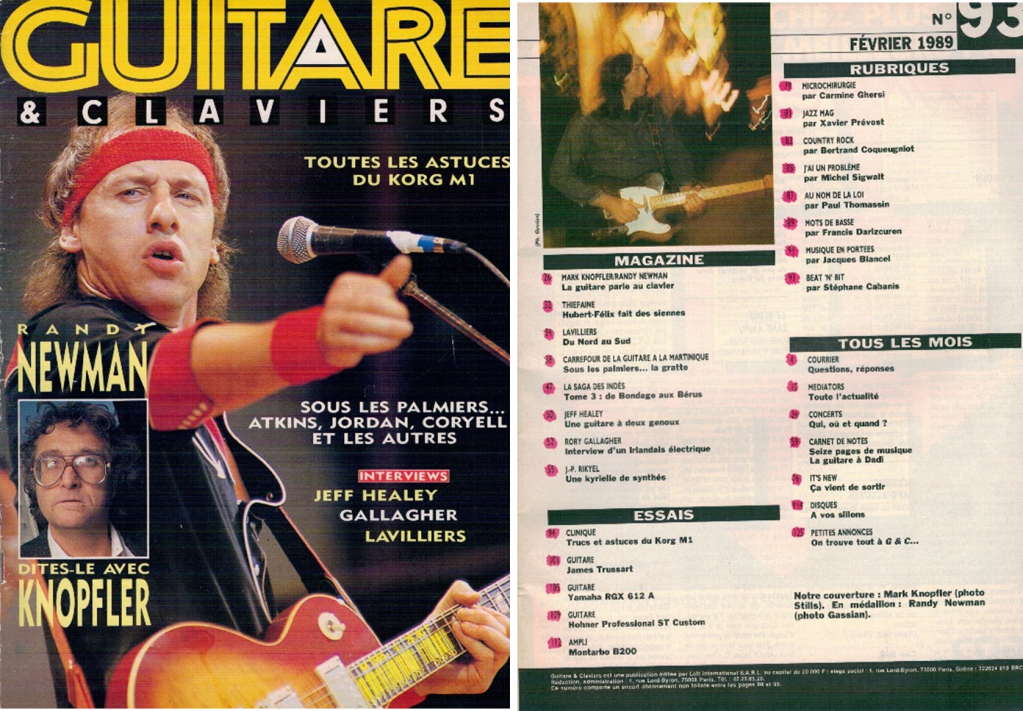
ON THE ROAD AGAIN
The Irishman who knows so well how to electrify the blues, the man with the battered Strat – Rory Gallagher! – hasn’t disappeared from the scene, we reassure you! He doesn’t bring out new records too often, but he continues to tour. Our London correspondent caught up with him quickly between two dates.
Rory Gallagher is one of those eternally rootless people who states that he only lives in London because he has to work there. But he doesn’t want to die there because he misses the soul and sensitivity of his compatriots. His heart belongs to Donegal in Ireland where he was born. A very humble character, a man of taste, passionate about cinema and culture, he has pursued his career away from trends, developing a very particular style between blues, rock and Irish folk – a genre that can be recognised from the first measure. He is one of the last big-hearted bandits/rebels who has chosen a Strat to preach the blues in the four corners of the world. You can easily understand how an Irishman can have the blues in his skin. Get colonised for 700 years and see how you feel!
.jpg)
So, always on the road?
Yes, England, Scotland and Wales, after, a short while in Ireland; spring in Europe and at the start of summer, we’ll be in Japan, Australia and New Zealand.
You tour a lot?
Less than before: just eight months a year approximately. I did 25 tours in 10 years in the United States. I don’t recommend that to anyone! I have got a lot of pleasure from experiencing all that, but it’s different not. I can no longer live from hotel to hotel and three suitcases, and flying makes me claustrophobic. I want to live a long time, not retire at 40 years old. I am a small fish compared to, say, Muddy Waters or John Lee Hooker, but I aspire to their way of living: it’s fantastic to be 60 years old and always playing. In Ireland, age doesn’t matter. Music is so much a part of our life that we don’t think about image, TV etc. We just play. That’s very close to the mentality of the blues.
.jpg)
What countries do you like the most?
I don’t have a preference, it depends. I am a human being, I like big provincial towns without the provincial inferiority complex. I like the idea of decentralisation. I’ve been to Japan three times, their welcome is legendary and their culture… I like their attitude towards cinema… but, talking of cinema, France is number one for me.
You like French cinema?
Oh yes, yes! Melville, Godard, Lelouch, Truggaut… above all, I like the 1960s thrillers. Lino Ventura was my favourite hero. I see a relationship with rhythm and blues in the police genre. On my album Defender, a lot of the lyrics are about simple people who must work for the mafia. Initially, they are not gangsters, but it’s “Loanshark Blues”, they live in a type of 1980s Metropolis. The image that Europeans have of the blues is very idyllic. The reality, when you go to Detroit, Chicago, New Orleans, is very different. It’s very hard. It’s the ghetto.
Where is the blues in 1989?
The Americans like to think that there is a blues revival, but if that’s true, it is not in America! It seems that people must die to have a chance at being heard on the radio. The Europeans are much more receptive… they knew Robert Cray, Stevie Ray Vaughan or even, now, Jeff Healey long before the Americans. The young people who are interested in the blues currently, unfortunately, stop at white musicians and don’t learn about Skip James, Blind Lemon Jefferson, Son House, Leadbelly etc. because their records are a bit outmoded and aren’t played on the radio. However, I prefer the productions from that period: more direct, more emotional. When I’m 60 years old, I would like to do production, not for the money but to recover a natural energy and sound: simple four-track studio, old types of microphones and effects. I don’t think that sound has really evolved in the 32 track and digital studios. The first Chess records were done on two track, Buddy Holly, Cochran…
And doing production now doesn’t interest you?
A few things have been suggested to me, but my work schedule is too hectic. And people at record companies are too obtuse, they become suspicious if you don’t use the “jet set” recording techniques. I remember sleepless nights working tirelessly to find interesting sounds and effects. Young musicians are lazy and too easily let technicians take over. Saying that, there is a lot of good music now. I really like the Clash, their mentality and their ideas, but they were rarely produced correctly. The production is a problem: if you don’t please everyone (press officer, label representative, producer etc.) you end up like me in a situation where, one day you speak to the record company and the day after, it’s all over. There’s a cold war for years.
.jpg)
Do you always have six guitars on tour?
Yes, it’s my only bourgeois side. Guitars that I’ve accumulated over the years. I use them all more or less. I have different open tunings, different chords. I am not a collector. In the States, you can buy a guitar for the price of two drinks in a French bar. It’s very useful in the studio: when the Fender and Gibson sound too upmarket, a three-dollar guitar sometimes does the trick!
What open tunings do you use?
Acoustic, the same as Bert Jansch: Dadgad. Very country and western. Otherwise, open A, E, G. Nothing uncatholic, except at home to compose.
You don’t use the vibrato much…
In the studio, the last time… but I find that it is a bit too common and the vibrato on my Strat broke inside about 10 years ago.
How is your 61 Strat?
Refretted, new mechanics, the pick ups are second generation, the original ended up falling off! Normal factory micros, I blocked a dial and put a five-position switch.
What pedals? Amps?
I have an octave effect box, a compression pedal, a tube screamer and a flanger. On the amp, a small delay for a very light repetition and a graphic equaliser. The amp, it is either a Marshall combo or a Vox AC30, joined to a Marshall JMP head and three Marshall speakers with each four twelve-inch speakers. I forgot the noise reduction just before the amp. I don’t like racks: in the studio, I prefer to use my effects directly in recording. If the sound is good at the start, it can only be better on arrival.
Have you seen Jeff Healey?
No, but I know him. His technique is very strange. The only people to have done that before are Roger Miller and Thumbs Carlisle in a more country style. But I find his material a bit weak: perhaps with more experience and other songs… The most impressive is the attack like when you listen to Mike Bloomfield for the first time. I really like the Americans: Jeff, Stevie Ray, they all play the Strat genre, a style created by BB King or Albert Lee, but you should also listen to someone like John Hammond. He doesn’t really play lead guitar, rather flat chords, like John Lee Hooker meets Robert Lockwood. Only doing solos quickly becomes boring. I try to work in that sense: more rhythmically, double chords and, above all, feeling… so when you do a solo, it truly takes off. I improvise a lot on stage. Apart from some songs like ‘Kickback City’ which is a sort of hymn, the chorus is a bit arranged; I also replay the first two parts every evening, but then I improvise. In the blues, I try to play like the big band brass instruments. The strict pentatonic scale quickly becomes boring. I also like rockabilly/Buddy Holly on two chords. But above all, I try to have a Gallagher style!
A very varied style that everyone can appreciate in concert for two hours of uncompromising rock, touching the hard and jazz, a bit of Hispanic too. An electric party with the band: Gerry McAvoy (bass), Brendan O’Neill (drums) and Mark Feltham (harmonica). Then, alone with the acoustic guitar, which allows you to listen to his lyrics, which have the merit of being original and exposer in rebel hymns or country ballads all his libertarian soul.
“When I was a cowboy and the bullets were whizzing around me…”
 REWRITING RORY
Leave a comment