

Click on this link if you missed Part 1 of our post this month covering Dave Fanning’s early memories of Rory and their first meetings.
Today, we continue exploring the topic, taking you through Dave’s late 80s and early 90s encounters with Rory, as well as the work he has done since Rory’s passing in 1995 to keep his legacy alive. Throughout the article, we include fragments from our recent interview with Dave, which offers new perspectives and reflections of Rory’s contribution to the music industry and history.
16th February 1988, The Dave Fanning Show
While the Rocksteady clip might be the prime way to our hearts, this 1988 interview with Rory and Dave is most certainly the runner up. This interview captures the best of Rory’s character, both as an artist and person, with many of his memorable answers often quoted back to each other in our day-to-day conversations.
We left Part 1 with Dave and Rory’s meet at the 1986 festival Self-Aid, which, coincidentally, was the final time Rory would be in Dublin until his 1988 tour of Ireland while promoting the Defender album. Dave starts the conversation with this topic, describing the Self-Aid experience as “a bit of an odd one”, which Rory immediately agrees with. Rory recounts the hustle and bustle of his short set (“I was off the stage before I had cooled down”), comparing it to the regular “package tours” African-American artists endured in the fifties and sixties, offering a sympathetic view, “that must have been nerve-wracking.” Despite the time constraint and unpreparedness, Rory concludes with a positive outlook: “As long as a bit of [my performance] was good, you know?” Similarly, when Dave briefly mentions Rory’s televised appearance at Cork Opera House in 1987, we as the listener (and fan) are delighted to hear Rory speak proudly about one of the most, quite frankly, stunning live performances of his career. Although “the cameras did constrict us a wee bit,” Rory was generally pleased with the atmosphere, the lighting, and “as televised things go, I think it was a success.”
Moving on, Dave gets Rory to open up a little more by asking him about the recent release of Defender and explain the five-year gap between albums. Rory narrows it down to three reasons: firstly, the abandoned effort titled Torch, which was re-worked into an entirely new project (i.e. Defender); secondly, contractual setbacks, eventually leading to the establishment of his label Capo; and finally, between these creative and business obstacles, he was – as always – touring. “I just don’t know where the five years went,” Rory stated, “its just as silly as that.” He admits this process was “depressing” because his output, up until that point, had been “fairly punctual”, and due to the delay, people were beginning to wonder, “is he dead? Or is he retired? Is he fed up?” An aspect we love about Dave’s interviews is that, being a fan, it is clear he has done his research and always references past Rory quotes from magazines or articles. On this occasion, Dave asks Rory to further explain his opinion that Defender is “different from anything [he has] done before.”
I think there’s a unity, and I think there’s sort of a theme running through it […] I can’t say I’m entirely satisfied, I mean, I’m not walking round saying that. But I think it’s got a mood, and it means what it says. I feel that it’s convincing, which doesn’t mean it’s Sgt. Peppers or anything else. Also I was fighting against what was the current theme and attitudes in a lot of production and a lot of music. I made the album for my own headstone, not for great success or anything. That’s genuine; I made the album for my own enjoyment.
The eighties was certainly a different musical market compared to the decade previously, and Dave dedicates a large portion of the interview to how Rory has settled into this change, beginning with a new audience. “We’re getting a real mixture,” Rory asserts, “we’ve got everything from fans from the beginning right through to young teenagers, in all forms, from suits to leather jackets and back again.” Rory confirms that he would never “draw a line at certain waves of audiences,” and when Dave asks how he would feel if fans of a modern band, listing U2 as an example, were to attend his gigs, Rory replies that he “wouldn’t be adverse to U2 fans or the Waterboys [fans], whoever.” Despite a recent period of career instability, Rory nevertheless appears undeterred with his long-term musical goals, expressing the desire to “aim high” and “elevate [myself] into that realm where those guys [Muddy Waters and Chuck Berry] are at,” instead of being remembered as simply a “good ol’, reliable” blues imitator. Interestingly, Rory’s legacy was brought up in our Zoom chat with Dave, and he shared this insight, which poignantly reflects the fulfilment of Rory’s career ambitions:
I just hope they [the public, the fans] see he was a great songwriter as opposed to just a guy who brought the blues into some more decades from the old blues guys, which was great that he did that, but I just thought he was more than what a lot of people sometimes think he is.
Halfway through the interview, Dave turns the floor over to Rory and asks for a song, joking to him that the news segment will be coming up shortly and “so don’t make it a twenty minute track.” Rory makes a quip back, “thirty eight minutes”, before giving a short introduction to his song choice: John Lee Hooker’s “Want Ad Blues”, which appeared on his 1961 album The Folk Lore of John Lee Hooker. Similar to television, a live performance on radio from a band or artist can be limiting due to the obvious time factor, and therefore be a poor representation of their musical range. However, Rory’s version of “Want Ad Blues” epitomises his great entertainment abilities in that he is able to conjure up a mood, indeed a presence, in less than five minutes and without an extended warm-up. Rory’s approach is confident (becoming more so as the minutes roll by), evident from his addition of a slide introduction and solos, to then his mature, rumbling vocals (particularly on the mid – late verses). Rory didn’t perform this track too often, and being a cover, a casual fan might not be too familiar with it. However, he keeps the listener (whether old, new, or the in-between) engaged by the assortment of rhythms: brisk down-strokes on the National, to bold and passionate sweeps of his slide, and finally the occasional cease of guitar altogether to allow the tap of his boot to build the beat’s momentum.
Earlier in the interview, Rory spoke about the preconceptions of being a “white European” playing African-American roots music, and that “everyone’s ready to stick a dart in you or a knife in you if you don’t pull it off.” He surmises ways to overcome this (“relate to the lyrics, feel at home with the song, and almost totally adopt it”), and from our analysis above, we can deduce that Rory successfully applied his own blues, meaning, and flavour to “Want Ad Blues”.
Overall, this conversation between Dave and Rory in 1988 is filled with many memorable moments and quotes. These moments are across the emotional spectrum, from the very playful, such as Rory’s take on the many sexual escapades detailed in Chuck Berry’s 1988 autobiography (“I tell you, he’ll never get into the Holy City, that’s for sure”), or his brazen proclamation that the new music from Fleetwood Mac is “Cinzano music”. Rory was unafraid to share his musical opinions, and Dave always gave him the space to unburden them. On the other hand, some moments are more reflective and sombre, for instance, Rory’s musing on the commerciality of his 1979 song “Philby” (“even though I’m sort of anti-single and all that, it really would not have hurt my conscience too much because I was proud of the song and the production and the whole thing”). And lastly, one of our personal favourites, Rory’s inspiring integrity and loyalty to his artistry and the blues tradition:
I’d like people to say ‘he plays the toughest rock around, but he does it with the minimalist of frills’. And I wanna play tough blues as well […] you get to a certain point in your life where you’ve got to beat these European blues stigmas, which was connected to, say, Fleetwood Mac and Blue Horizon, Chicken Shack, and all that. They did their thing, but they all stopped at a certain point, and while writing my own material and trying to play modern music, I – at the expense of being unpopular – dig deeper and deeper … it’s just a great hobby for me.
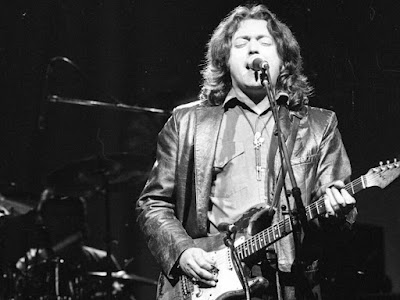
Photograph courtesy of Independent News and Media
12th April 1989, The Dave Fanning Show
Our next interview with Dave and Rory is from a year later via a phone conversation for 2FM Radio. Unfortunately, no audio of this meeting exists on a public platform, though it was taped and transcribed by a fan that caught the interview halfway through. This was later included in a February edition of Deuce Quarterly in 1989.
What we love about this interaction is that, while short, we gain some great insights from Rory about his musical direction for the next year or so. To begin with, Dave asks about his recent gig as a headlining act for Irish Rock Week, held at the Mean Fiddler club. Rory provides a very optimistic reflection, commenting on the band’s presentation (“they were really cooking”, “on form”), as well as his own (“I was really coasting with them”). If you are interested in knowing more about Rory’s appearance at the 1989 Irish Rock Week, we will be dedicating a blog post to this show in December.
Defender was a popular topic of conversation in their 1988 chat, and despite nineteen months since its release, the album again creeps into this interview. Dave remarks on the success of Defender, as indicated by Rory’s inclusion on a guitarist’s poll for Sounds magazine in 1988. “Yes, it was my most successful [album], and it did bring me back into the Reader’s Poll,” Rory says, before admitting, “it’s bad luck for me to comment, but it is a morale boost for me when you see your name in with guys like Prince.”
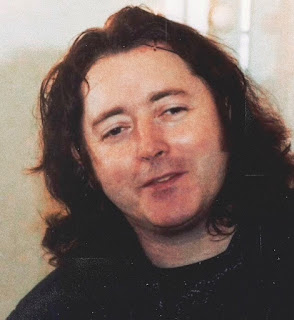
in Ghent, 1989. Photograph by
Gino Buysrogge
As the interview winds to a close, Dave enquires about future plans. Though Rory has concerts lined up (“on the Continent … behind the Iron Curtain, [a festival] if one exists in Estonia at Talon … some dates in Ireland and some festivals [in London]”), what really excites him the most is preparing and recording material for the next album. “Not as [a] son of Defender,” Rory clarifies, “but very much an independent project.” He expresses great determination (“I think we can go on better on the new one”), plus ideas on the sound (“we are going to use a lot of primitive equipment!”). As we know, this future album would become 1990’s Fresh Evidence, one of Rory’s most sophisticated recording efforts, which generated even greater critical laud than Defender.

22nd May 1990, Rocksteady
In 1990, RTÉ producer Avril MacRory moved to the UK’s Channel 4 network and started a music programme called Rocksteady. And who more perfect to host it than Dave? Rocksteady was broadcast out of Channel 4 studios in Charlotte Street, London and weaved together live music broadcasts from venues across the UK and Ireland with pre-recorded interviews. On 22nd May 1990, Rory appeared on the show, reviewing the charts with Dave from a cosy pub in Camden Lock, London.

Photograph by Bertrand Alary
The clip begins with Dave asking Rory what he thinks of The Pretenders. Rory replies that he is “quite a fan” and is looking forward to the new album because it features Billy Bremner who is “one of [his] favourite guitar players.” Next, the topic turns to Gary Moore and his new Still Got the Blues album. What strikes us the most here is how positive and complimentary Rory is to Gary, especially considering that he was feeling rather upset at the time about blues becoming a new trend that many people capitalised upon when he had done “the dirty work” for years “without the least bit of support”(as stated in an interview with French Guitar World). Here, Rory praises Gary’s talent for playing the blues and including Albert Collins and Albert King on his record and expresses hope that Gary does more work in the blues field and digs deeper into the country blues. “There’s room for both of us, I think,” he says diffidently.
Dave then inquires as to whether Rory follows the charts. In his characteristically polite manner, Rory replies, “50 or 60% of that material just wouldn’t get across to me.” He describes the charts as “very shifty,” but ends on a positive note: “I’m always keeping an eye out on my favourites.” Dave concludes the interview by asking Rory what he has been up to and, almost self-effacingly, Rory replies softly, “Well, I’ve got this album called Fresh Evidence…” describing it as a “southern album” influenced by Slim Harpo, Scrapper Blackwell and Son House.
Finally, Dave asks Rory to “see us out with a piece of music.” Relieved that the interview part is over (as Dave himself told us, “Rory just wanted to play music. He didn’t really wanna do a lot of talking about it”), Rory can’t resist a joke: “What was the limerick? Okay, you threw this at me!” He then proceeds to play a beautiful version of Muddy Waters’ “I Can’t Be Satisfied”, the camera panning down to capture a great shot of Rory’s foot tapping in time with the music and up again to his fingers moving expertly on the fretboard. The video is over all too soon, almost cutting off abruptly.
Prior to our interview with Dave, we had shared the three minutes of Rocksteady footage with him via email. He had never seen it before and enjoyed finally watching it after all these years. When we caught up with him in person, he confirmed what we had read in his 2015 article: that he had, in fact, spent the entire day with Rory. And what’s more, he told us that more footage should be out there of them walking around Camden Lock (we are currently in talks with the British Library’s Sound Archive to track this down, so watch this space!). Dave reflected on what it was like to spend a whole day with Rory and how different it was to simply hang out with him rather than conduct an interview:
And in fact, in that interview in 1990 from Camden Lock or somewhere I think it was, I spent the day with him and all that… like, I really enjoyed being with him for the day and it was nice, but he wasn’t really being interviewed. He was just hanging around with me, and it’s so much easier to be with Rory when he’s not being interviewed. And we did that thing of having to walk through the crowd, like Camden Lock is full of people wandering around, and we have those radio mikes on so there’s a camera way over there, and nobody knew we were being filmed. We were just two guys talking. That was fine.
We then asked Dave whether Rocksteady was the last time that he and Rory met. After pausing to think the question over, Dave answered that he believes it was. Just a few months before Rory passed, Dave caught up with Dónal at the Fleadh in London and was surprised at what he had to tell him:
I bumped into Dónal and I was talking to him and asked ‘how’s Rory?’ And he said, ‘Ah, not too good,’ and that was the first time I heard that Rory was actually sick, and possibly in the face that Dónal was making, there seemed like the word ‘terminal’ was coming through. But I didn’t know what he was talking about. I had no idea about this.
We then moved onto the topic of Rory’s passing and whether Dave could remember where he was when he heard the news:
Yeah, I can. I was not in this house, but I was in a house about a mile away from where I live. And, yeah, I was really quite shocked, even though I had had an inkling from meeting Dónal. I had no idea when I met Dónal at all that Rory was sick, and, as I say, that it looked from Dónal that ‘prepare for the worst’ kind of thing, which even at the time I didn’t quite take in […] I remember my friend who I would go to Rory concerts with was literally going on holidays that day, he was leaving the country, and we had a talk about it for a good while. But, yeah, I do remember when Rory died. It was terrible, completely terrible.
When asked of his overall lasting impressions of Rory, Dave recalled him as somebody who was “such a nice, quiet guy […] really introverted […] very gentle and almost frail […] very, very, very shy.” As Dave spoke more in depth about these impressions, his words really pulled on our heart strings:
Dónal would say ‘nobody knew Rory Gallagher as well as Dónal did,’ and Dónal would say ‘I didn’t know Rory Gallagher at all.’ In other words, nobody knew Rory Gallagher. It’s kind of sad, I mean it really was. I mean, Rory didn’t leave a wife, or kids, guitars, a house, a car, a dog. He left nothing. He didn’t really have anything. […] He just wanted to be on tour […] Rory was a sad man. He wasn’t a happy person, I don’t think really. And if Dónal says that he never really knew him, I can tell you nobody really knew him

Photograph by Bertrand Alary
1995: “Even my mother knew who Rory Gallagher was”
In the days following Rory’s passing, Dave was involved in a number of tribute efforts. He was quoted in the Irish Independent on June 16, 1995, calling Rory “the first real Irish rock star.” The article features information about Rory’s funeral in Cork, plus praises from many in the musical world, from promoter Jim Aitken, to Gary Moore, and Brush Shiels from Skid Row. On June 17th, Dave would host the special broadcast ‘Tribute to Rory Gallagher’ for the RTÉ station. Although the full program is unavailable on the Internet, the RTÉ archive have posted a snippet on their website, which includes an introduction from Dave. He talks about his first exposure to Rory’s music through his group Taste, as well as the impact of the Isle of Wight festival. “Rory became a good friend of 2FM,” Dave recounts, “and I met him and interviewed him many times over the last fifteen years […] in a nutshell, he was one of the nicest guys I ever met.” The program was split into two sections, with the second half dedicated to Rory’s performance at the Cork Opera House in 1987. The short clip finishes with Rory’s 1988 appearance on the Late Late Show, playing Leadbelly’s “Out On The Western Plain” and speaking to presenter Gay Byrne.
As part of the December 1995 tribute issue of Hot Press magazine, statements were gathered from those in the music industry who worked with or were inspired by Rory. Dave’s contributions to the article echo his familiar fondness of Rory as not only a musician, but also a person (“incredibly well-mannered and polite”, “[I] idolise the man”, “very nice guy”). He even mentions the fact that his mother was aware of Rory Gallagher after hearing the news of his passing, highlighting Rory’s scope across all generations of the Irish public.


Flying the Flag for Rory
In the almost 27 years that have passed since Rory’s untimely death, Dave has continued to fly the flag for him, regularly organising tribute radio shows, contributing to newspaper articles and documentaries, and appearing at Rory-related events and unveilings. While there are far too many to cover here, we wanted to discuss a selection of our favourites, peppered along the way with first-hand insights from Dave.
In 2010, Dave did a wonderful radio tribute show to mark Rory’s 15th anniversary. In between playing a selection of Rory songs, he was joined on the telephone by Dónal and blues guitarist Bernie Marsden. Dónal discusses the statue of Rory in Ballyshannon (due to be unveiled at the time) and Rory auditioning to join the Rolling Stones, while Bernie talks about his latest album Bernie Plays Rory and what a huge influence Rory was to him (“once we saw this man play the guitar, we thought, ‘oh, we’d better think again here!”). Dave once again reflects here on Rory being “one of the quietest, most gentle people [he] had ever met in [his] entire life.” Bernie agrees, stating that:
The way that somebody could be so powerful, so dominating on the stage, having a good time and making sure other people had a good time and then to be so quiet and gentle off the stage. This was a huge influence on me as well as the guitar playing.

Photographer unknown
Dave also extracts poignant reflections from Dónal too, who explains how “Rory couldn’t function if he wasn’t on the road” and went into hospital for two weeks in 1989 for rest from nervous exhaustion. Bernie also shares a private thought: “a lot of us were going home to a girlfriend or family […] none of us ever realised Rory was going home just waiting for the next gig.” Finally, Donal mentions Bernie’s forthcoming appearance at the Ballyshannon Festival and the fact that both David Levy and Richard Newman (of Rory’s final band) are playing with him. “Those guys were really fantastic with Rory,” he concludes.
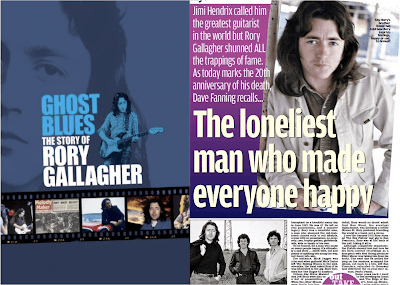
In the same year, Dave also participated in the Ghost Blues documentary, discussing the Irish showband movement and how Rory was part of this scene before joining Taste, as well as his broader impact on Irish music. He also later developed and produced his own ‘Story of Irish Rock’ series for RTÉ, with episode one dedicated to Rory (along with Van Morrison and Phil Lynott) and how he was an early pioneer of Irish music. Dave expressed similar thoughts when talking to us, stating that:
There is a triumvirate of Irish rock: there’s Phil Lynott with Thin Lizzy, there’s Van Morrison and there’s Rory […] and Rory was really important to anybody who’s anybody in Irish music, because he was the first […] no matter what happened with Rory, he came back for a gig every Christmas.
Whenever Rory is mentioned in the Irish press, Dave’s name still is not far behind. In a 2004 article in the Irish Independent to mark Rory’s 9th anniversary, Dave described Rory as “his number one hero, a total inspiration and one of the nicest people [he] ever met,” while in a 2017 interview with VIP Magazine, he called Rory “always one of the nicest guys” and a “real gentle soul.” In his own piece for the Irish Daily Mail in 2015, he also reiterated these sentiments: “it’s not just that he wasn’t boastful, raucous or egocentric. He really was one of the quietest, most shy guys I’ve ever met […] a beautiful man.”
Dave was present at the unveiling of Rory Gallagher corner in Dublin in 2006 (on the invite of Dónal), as well as the launch of a Rory Gallagher commemorative coin in the residence of the President of Ireland in 2018. Dave told us he had passed by Rory Gallagher Corner just a few days before our interview and joked of his amazement that nobody has tried to “throw a rope up and pull down [the guitar sculpture].” He also shared a funny story about meeting Dónal at the 2018 event and pointing out Julian Vignoles to him who had just finished writing a new book about Rory (Rory Gallagher: The Man Behind the Guitar). Dónal responded negatively about the book and Dave, planning to launch the book later that month, blurted out, “Oh geez, what have I done!?”
Still hosting the Dave Fanning Show on 2FM and involved in a range of other exciting music projects, Dave shows no signs of slowing down any time soon. In 2008, B.P. Fannon wrote, “without Dave Fanning on the radio, music in Ireland would have had a poorer face.” We are of the belief that Rory’s legacy would also have a poorer face without Dave and we very much look forward to his future involvement in this area.
Since our conversation with Dave, there have been many times his words and stories have resurfaced in our minds throughout the day. Without question, meeting Dave Fanning was one of the highlights of our life (even if it was just through a computer screen). Across the hour, we delved into various topics, one of them being Dave’s opinion on other Irish music stars: Phil Lynott (“a very genuine, nice guy”), Van Morrison (“a bollocks”), and Bono (“really genuine”). He shared with us a great memory about Phil Lynott’s arrival to the renowned Slane Festival in County Meath, which since its beginning in 1981, has generated crowds of up to 70,000 – 80,000 (“[but] it gets about 100,000 to be honest,” Dave tells us). Thin Lizzy headlined the first Slane Festival, and Dave recalls:
We were there sitting down, and this helicopter comes in, and I had known that Led Zeppelin had a plane with the four symbols on it, but this helicopter comes in and out steps this rock god, I mean ‘wow, we have arrived. Ireland is on the map. Look, we’ve got one’. Phil Lynott. And he just looked fantastic. He just looked like everything, with his bass guitar and the lights shining off it
In addition, we talked about rock institutions and the Rock N Roll Hall of Fame in Cleveland. Dave had spent four days in Cleveland a few years ago as part of a U2 event at the Hall of Fame, and while he thought the museum was “great” and “fantastic” to look at, on the other hand, “I don’t really want my music to be in a museum. It doesn’t really matter to me.” Of course, with this discussion of legacy, we naturally turned to the topic of Rory and his legacy, as we briefly alluded to earlier in our article. In terms of how Rory’s music – or music generally – is remembered in the public sphere, Dave had this important lesson for us, and that our love of music should not be based on how, or even if, an artist is widely acclaimed and remembered, but how we relate to the music, both now and in the future.
Yeah, um, like ‘legacy’ and ‘credit’ those things I don’t think Rory gave two hoots about that. That’s not the way I look at it, but just was his music any good and was he any good at what he did and all the rest of it? I thought he was great, that’s all I care about.
I’ve moved on to other music […] But Rory’s [music] has stayed with me, and I love when that happens. Like around that time, John Lennon released his kind of first solo album, John Lennon / Plastic Ono Band [1969], and it sounds as good today as it did then, but, I mean, that’s not necessarily the way I judge anything. I just like the music. I happen to like Rory’s music now too, and that’s enough. End of story.
On a final note, we use the opportunity here to officially thank Dave for taking the time out of his schedule to contribute to our two-part article, and we will forever treasure his friendly, knowledgeable, and humorous manner with us. As today is the anniversary of the 1990 Rocksteady interview, which in many ways was the genesis of this post, we encourage everyone to go and have a watch of the video on YouTube. By the end of the day, we’re sure the number of views will have increased by another hundred – and if not from our readers, then I’m sure by Lauren and I …


 REWRITING RORY
Leave a comment