

“Who’s gonna kiss and hug you when all your so called friends have packed up, sold your home, sold your car, stole your soul—but they can’t get this guitar.”
“I Wonder Who”, Montreux 1985.
Without Excalibur, is King Arthur still King?
Without his Pelion ash spear, is Achilles still the greatest warrior amongst the Greeks?
And without his sunburst, 1961 Fender Stratocaster, is Rory Gallagher still Rory Gallagher?
Mythology is largely entwined within rock and blues tradition. For example, the integration of the Faustian bargain into the story of Delta blues legend, Robert Johnson. An object plays an important role in ancient mythology, and this role of an object—or, in this case, an instrument—can be argued to be as important in music. This mythologising of the instrument is epitomised in the relationship between Rory Gallagher and his 1961 Fender Stratocaster.
There is an odd feeling that, from its conception, this Fender Stratocaster was destined to be—or rather find—Rory.
For a 1991 interview with Young Guitar magazine, Rory claimed that his iconic Stratocaster was “the first Fender guitar in Ireland” and was sold to him due to an order error by the original owner. As Rory explains: “he [Jim Conlon of Irish group, the Royal Showband] wanted a red one, and they sent him the sunburst one instead. When the red one came in ’61, he sold [the sunburst Stratocaster] and I got it in the shop.” This first encounter between instrument and player has become Irish musical folklore, as seen through author Jean-Noël Coghe’s romantic descriptions in the 2002 book, Rory Gallagher: A Biography: “Rory hesitated before lifting it off its stand … everything around him faded into the background until he was alone with his guitar, Rory the kid and his mythical Fender Stratocaster ’61.”
In contrast, Dónal Gallagher reflected in a 2004 article the (humorous) circumstances of how the purchase truly occurred at Crowley’s Music Shop in Cork:
Being the younger brother, Rory had instructed me as to how I should behave in the event that he would go into the store and ask the owner, Michael [Crowley], for a better look at the instrument. My sibling informed me that possibly he may want to hold the guitar and see how it felt to hold a Stratocaster. Basically, I was to keep my gob shut and nod in agreement if called upon to do so.
“Michael had the figures worked out in minutes, so much per week over a period of thirty six months. ‘I’ll take it,’ Rory said, shaking Michael’s hand. ‘Your mother is OK with this, is she? The hire purchase agreement is in her name,” the store keeper asked. ‘Yes, of course she is. Isn’t she?’ Rory smiled wryly for me to confirm his statement. Speechlessly I nodded; Lord God, we’ll end up in prison for three years at this rate, I thought.
“Rory and I ran out the door with the Stratocaster in its beautiful tweed case. Nearing home, I was sent ahead to make sure the path to our shared bedroom was clear of adults. I wasn’t allowed to touch the guitar and had to give my word of honour to Rory, who would give the matter consideration and might let me hold it at some point, provided that I stick to my promise.
The prized Stratocaster was to be kept underneath Dónal’s bed, and if found, he was to use the excuse that “[it] was being minded for one of the fellows in the Fontana [Showband].” However, it did not take long before the guitar was eventually discovered and questioned.
‘Where did this come from?’ I heard our mother ask as I neared the bedroom. Rory, unable to lie to her, said ‘Ask Dónal.’ I began a retreat down the stairs. ‘Come back here,’ mother ordered. Forgetting my lines, I began to blurt out something far-fetched. Interrupting, Rory came clean … justifying the purchase on the basis that with a Stratocaster he could play both rhythm and lead simultaneously, and his band could then dispense with its rhythm player and that way Rory would be paid more and thus pay off the loan quite easily. Mammy, knowing her son’s talent, allowed him to keep the guitar.
In 1967, Rory’s Stratocaster was stolen from the back of a van after a performance with his first group, Taste. In the medieval mythology of King Arthur, Excalibur would not let anybody but Arthur—the “rightwise king born,” as English novelist, Thomas Malory, wrote—pull itself from the stone, as if the object knew its owner. Similarly, in the case of Rory, although stolen, like a faithful companion, the guitar returned home a week later (found by police behind a garden wall), as if the instrument could simply not be without its rightful owner. Dónal has equated the event to being “like someone we knew had been kidnapped,” and that not only was Rory very depressed over the (temporary) loss, but “as family, [we would] take on the depression as well.”
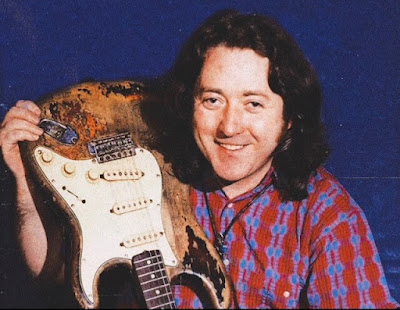
June edition 1987.
Photographer unknown.
Rory’s Stratocaster is known for having a worn-out, battered appearance, which has been interpreted by some as an accompaniment to his rustic, hard-working onstage persona. The sunburst finish was severely faded from the wooden body, which, according to Dónal, was partly due to the musician’s rare blood type, causing his sweat to act “literally like paint stripper.”
Whilst watching Rory’s live concert, Irish Tour ’74, on the weekend, my friend posed an important question about the worn Stratocaster: “Why does he not just buy another one?”
“Because,” I quickly answered, “it was special.”
And this “special” quality is the point of today’s blog post: we know what the Stratocaster means to us the fans, but what did the Stratocaster mean to Rory?
“He could talk about it all night,” writes Marcus Connaughton in his biography, Rory Gallagher: His Life and Times (2012).We have all heard the stories of inseparability between Rory and the Stratocaster, from sleeping next to the guitar in his bed, to protecting it when a fight broke out at a gig during the Fontana days. At times during interviews, Rory eludes to the notion that the Stratocaster is not only an instrument to him, but instead a companion. However, also within Rory’s words, there is the sense that this guitar is more than a piece of wood, more than a separate entity, but in fact an integral part of himself. “It’s my life,” Rory affectionately stated in conversation with Ray Minhinnett for Curves, Contours, and Body Horns: The Story of the Fender Stratocaster, “It’s almost like knowing its weak spots are strong spots. I don’t like to get sentimental about these things, but when you spend 30 years of your life with the same instrument, it’s like a walking memory bank of your life there in your arms.”
Rory was known to be a quiet man, and it is our assumption that the guitar was the only comfortable source for him to express his tangled, complex emotions within. Nevertheless, for every great relationship, there is tragedy as well. It hurts to think that during the final months of Rory’s life, his “best friend” and “lucky charm” was out of arms reach as he lay in a hospital bed, recovering from a liver transplant. Twenty-seven years following Rory’s passing and his beloved Stratocaster is now “orphaned.” Nevertheless, we take the opportunity here to celebrate one of the greatest partnerships in blues history. In doing so, we have accumulated a short list of six highlights between man and guitar, man and lover, man and himself.

“Shadow Play” Montreux Jazz Festival (July 18, 1979)
Although our blog focuses on the period 1985-1995 of Rory’s career, it would be ridiculous not to include this performance from 1979 on our list. The introductory passage of Julian Vignoles’ biography, Rory Gallagher: The Man Behind the Guitar (2018), perfectly captures the scene Rory sculpts for his audience:
With the guitar at fever pitch and feeding back, he whips it off and places it on the ground. He begins a kind of primitive ritual as the instrument howls and the band keeps playing. Gallagher is paying homage to his guitar. He skips across the stage, gestures to the crowd, animatedly pointing back at the stricken instrument, appearing to accuse it of something, perhaps of dominating his life?
Out in the Green, Loreley, Germany (July 6, 1986)
This is just a tiny clip of Rory walking with the Stratocaster in his hand from his caravan to the stage. Yet, in the brief 20 seconds of footage, we see the love and affection he has for his guitar, just how inseparable the two of them are. As he reaches the stage edge, he raises the Stratocaster up and starts his enthusiastic run out, saluting the crowd along the way. In many ways, the clip recalls Macroom ’78 when Rory turned up at the festival site in Dónal’s car, Stratocaster in hand already, and headed directly out on stage.
Interview for Ohne Filter, Baden-Baden, Germany (March 30, 1990)
This piece of footage is a dear favourite, and for many reasons. An endearing feature—and the most important to this post—is the loving and devotional way Rory holds the guitar, even when he is not playing it. Rory’s Stratocaster often seemed to act as a security blanket for him in interviews, helping him calm his nerves and feel more secure, and we see that clearly here.


Interview for Young Guitar Magazine, Japan (Feb 20, 1991)
One of our favourite interviews with Rory, where he provides some fantastic insights into his music, instruments and performances. Fast forward to the 20-minute mark to hear Rory speak about the joy of purchasing his Stratocaster from Crowley’s Music Store and the work he’s had done to it over the years. He also provides a beautiful response to the question, “why do you stick with the Strat?” explaining how much it means to him, how it “has a peculiar sound of its own” and how he vowed to never let go of it again after it came back to him after being stolen.
Temple Bar Blues Festival, Dublin, Ireland (August 15, 1992)
Even in this small clip of the show that is available, Rory’s love for his Stratocaster shines through in spades. He holds it affectionately towards his chest as he introduces ‘Tattoo’d Lady’ with the words “I love playing it” and then he later plants a loving kiss on its neck. This was a difficult time for Rory and his bond with his beloved guitar seems to intensify, offering him a form of comfort when he felt lost and alone.
Excerpts from StratMasters documentary, (2007)
The inclusion of Rory in this documentary is wonderfully appropriate. Rory shares with us what the Stratocaster means to him, his thoughts on what other guitarists bring to the Stratocaster sound, and (very humbly) talks about his own technique. We get glimpses of the trust between him and his instrument, from the range of styles (country, blues, and even funk) that Rory showcases for us, to his compulsion to sneak in a riff between the pauses of his answers. Rory’s instinctual touch around the fretboard is almost frightening.
Finally, we wanted to end by mentioning a lovely clip of Rory’s nephew Daniel from 2019, where he talks about the Stratocaster. Here, he mentions how Rory’s eyes would light up and he would immediately transform into “a child” whenever he was asked about the guitar in interviews. As Daniel so beautifully put it, for Rory’s whole life, the Stratocaster remained “his favourite thing in the world.” The greatest love story ever told? For us, it certainly is.


 REWRITING RORY
Leave a comment